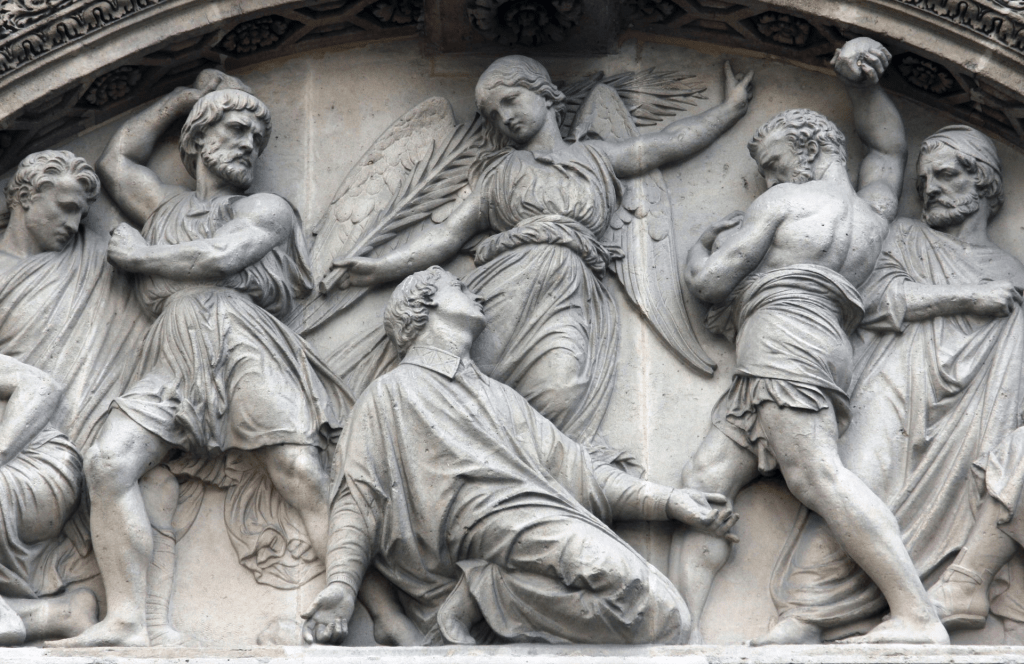
Put To Death (Acts 7:55-60)

The Martyrdom of Stephen, by sculptor Gabriel-Jules Thomas (1824-1905)

But Stephen, full of the Holy Spirit, looked up to heaven and saw the glory of God, and Jesus standing at the right hand of God. “Look,” he said, “I see heaven open and the Son of Man standing at the right hand of God.”

At this they covered their ears and, yelling at the top of their voices, they all rushed at him, dragged him out of the city and began to stone him. Meanwhile, the witnesses laid their coats at the feet of a young man named Saul.

While they were stoning him, Stephen prayed, “Lord Jesus, receive my spirit.” Then he fell on his knees and cried out, “Lord, do not hold this sin against them.” When he had said this, he fell asleep. (New International Version)

Although I am a trained in biblical exegesis and hermeneutics (interpreting Scripture) I believe that most insights come from making simple observations about the text. So, I want to point out: Stephen was not martyred by the Romans, a religiously pagan group, nor Gentile people; he was martyred by those of his own ethnicity, by “God’s people.”

The religious authorities were more than just unhappy with Stephen. The Sanhedrin (the Jewish ruling council) were incensed with him, so mad that they were grinding their teeth at him. The council sincerely believed Stephen was a blasphemer of God, that what he was saying was so subversive and religiously radical, they could stone him to death with a clear conscience, as if this act were upholding God’s honor and God’s Law.

The result was not only the death of a humble man; it also sparked an intense persecution against the church which caused a new Christian diaspora (Acts 8:1-3). Many believers in Jesus found themselves as Christian refugees trying to eke out a living and worshiping Christ in foreign places.

I wish I could say the greatest opposition I’ve ever experienced as a Christian came from non-Christians who simply misunderstood and misinterpreted me. However, my most hurtful wounds have come from the hands of church folk, believing they were acting on God’s behalf by exacting an emotional martyrdom upon me with the stones of gossip, slander, backbiting, blame-shifting, and outright lying (and a few threats of violence).

Whenever I encounter persons who no longer attend church and have no intention of ever returning to any local congregation, I get it. I understand. Yet, although the church is sometimes like a woman of disrepute, I still love her, and will do whatever I can to edify her and not repay evil with evil.

Stoning a believer, either actually with physical rocks or virtually with verbal stones, is akin to persecuting Jesus himself. That’s because Christ so closely identifies with his people that it is as if he is a head, and his followers are a body – joined together in a vital union.

So, when Christ’s Body is subjected to what I call, “hermeneutical hubris,” in which one group of people insists there is only one way to interpret Scripture, and then uses their authority and structures of power to force compliance on another group, the result is persecution.

And that is precisely why Christians can abuse other Christians.

Rather than discerning that all Christians belong to God, one narrow-minded and small-hearted group excludes all other groups who disagree with them as blaspheming the name of Christ.

For example, insisting that a literal interpretation in the only means of understanding the Bible’s authority is to ignore and abuse the actual and real authority which exists with the Bible. I am in no way encouraging an “anything goes” type of approach to Holy Scripture that lets it say whatever you want it to say. 

What I am saying is that the biblical writers themselves employed different methods of interpretation, as well as the early church fathers (which is one reason I hold to the interpretive guides of the ancient Christian creeds, i.e. The Apostles’ Creed and Nicene Creed).

Far too often, churches stick to a particular interpretation because they believe they are keeping biblical fidelity. This is many times born of a fear that Christendom will be lost, and society will sink into an abyss of egregious sin. The irony is that many churches are sinking into forms of abusive and ungracious behavior by fighting battles that Scripture does not call them to fight.

The binary thinking of “I’m right and you’re wrong” is not an approach you’ll find in God’s Holy Word.

Even if the Sanhedrin in Stephen’s day intended on upholding the holiness of their God and the rightness of their cause, the impact it had on the church was martyrdom, death, and diaspora.

Unfortunately, throughout Christian history, the tables have too often turned with Christians persecuting Jews. I myself would like to avoid being the persecutor. If I kill anything, may it be putting to death my own sin – because that is what the Bible calls me to do.

Dear brothers and sisters, you have no obligation to do what your sinful nature urges you to do. For if you live by its dictates, you will die. But if through the power of the Spirit you put to death the deeds of your sinful nature, you will live.

The Apostle Paul (Romans 8:12-13, NLT)

Since, then, you have been raised with Christ, set your hearts on things above, where Christ is, seated at the right hand of God. Set your minds on things above, not on earthly things. For you died, and your life is now hidden with Christ in God. When Christ, who is your life, appears, then you also will appear with him in glory.

Put to death, therefore, whatever belongs to your earthly nature: sexual immorality, impurity, lust, evil desires and greed, which is idolatry. Because of these, the wrath of God is coming.You used to walk in these ways, in the life you once lived. But now you must also rid yourselves of all such things as these: anger, rage, malice, slander, and filthy language from your lips. 

Do not lie to each other, since you have taken off your old self with its practices and have put on the new self, which is being renewed in knowledge in the image of its Creator. Here there is no Gentile or Jew, circumcised or uncircumcised, barbarian, Scythian, slave or free, but Christ is all, and is in all.

Therefore, as God’s chosen people, holy and dearly loved, clothe yourselves with compassion, kindness, humility, gentleness and patience. Bear with each other and forgive one another if any of you has a grievance against someone. Forgive as the Lord forgave you. And over all these virtues put on love, which binds them all together in perfect unity.

Let the peace of Christ rule in your hearts, since as members of one body you were called to peace. And be thankful. Let the message of Christ dwell among you richly as you teach and admonish one another with all wisdom through psalms, hymns, and songs from the Spirit, singing to God with gratitude in your hearts. And whatever you do, whether in word or deed, do it all in the name of the Lord Jesus, giving thanks to God the Father through him. (Colossians 3:1-17, NIV)

Gracious God, as your Son humbled himself on this earth, so may your church walk continually in such humility that believers everywhere work together in unity for the sake of gospel of grace as a blessing to the world in the power of your Holy Spirit. Amen.

Handling Opposition (John 8:48-59)

Christ and Pharisee, by Russian artist Ivan Filichev, 1993

The Jews answered him, “Aren’t we right in saying that you are a Samaritan and demon-possessed?”

“I am not possessed by a demon,” said Jesus, “but I honor my Father and you dishonor me. I am not seeking glory for myself; but there is one who seeks it, and he is the judge. Very truly I tell you, whoever obeys my word will never see death.”

At this they exclaimed, “Now we know that you are demon-possessed! Abraham died and so did the prophets, yet you say that whoever obeys your word will never taste death. Are you greater than our father Abraham? He died, and so did the prophets. Who do you think you are?”

Jesus replied, “If I glorify myself, my glory means nothing. My Father, whom you claim as your God, is the one who glorifies me. Though you do not know him, I know him. If I said I did not, I would be a liar like you, but I do know him and obey his word. Your father Abraham rejoiced at the thought of seeing my day; he saw it and was glad.”

“You are not yet fifty years old,” they said to him, “and you have seen Abraham!”

“Very truly I tell you,” Jesus answered, “before Abraham was born, I am!” At this, they picked up stones to stone him, but Jesus hid himself, slipping away from the temple grounds. (New International Version)

I am a recovering perfectionist. There was a time in my life when I believed that I could attain perfection in all things. And, what’s more, I thought that if I could be perfect in everything I said and did, I would never face any opposition.

It took me awhile to realize that Jesus, the perfect Son of God, handled life on this earth as well as anybody ever did or could, and yet he still faced continual opposition. Then, at the end of his life, Jesus was ridiculed, tortured, and killed by people who should have known better.

The religious leaders, at the time of Christ, leveled on Jesus their worst accusations by calling him a Samaritan and demon possessed. But Jesus handled it. He wasn’t surprised by it. Nothing they said threw him off.

Christ Accused by the Pharisees, by Duccio di Buoninsegna, 1308

There is a way to deal with opposition. There’s a path to dealing effectively with the meanness of others. And there’s a way to face the trouble, as well as your Anfechtung (spiritual oppression and depression) about what’s happening.

The road ahead, however, may be counter-intuitive to how you think. And the way forward might be so far off your radar that you may dismiss what I’m about to say to you. Maybe you’ll even call me a Samaritan.

But before I get to that, I’ll say this: Opposition, even oppression, is endemic to the human condition. Everyone, at times, suffers this way; none of us are immune to affliction, nor can we insulate ourselves from pain. If you are not currently suffering in some way, it means you are either coming off a time of hardship, or are about to enter a new period of distress.

Holiness and godliness don’t keep suffering at bay. Just ask Jesus. In fact, the Lord Jesus himself promised that following him involves a sort of oppression that those who are not Christians will never face. (John 16:33) 

Christ’s disciple, Peter, came to understand the reality that since Jesus experienced opposition, so will his followers. (1 Peter 4:12).

The Lord’s brother, James, understood that everyone faces difficulty; and he wisely discerned that opposition is a teacher, from which we learn maturity, perseverance, and patience. (James 1:2). 

Jesus’ greatest follower, Paul, continually dealt with opposition from others, more than any follower of Jesus in history. And he insisted that anyone who belongs to Christ will have trouble;  and that suffering enables us to persevere and be in solidarity with Jesus. (2 Timothy 3:12; Romans 5:3-5; Philippians 1:29)

Yes, in this world you will have trouble. But take heart. Jesus has overcome the world. (John 16:33)

Now, back to the topic of handling opposition from others. Here’s the truth:

Dealing with opposition, oppression, and suffering comes through Christ, and not from us. And the practice of overcoming trouble doesn’t come from fighting against it, but by sitting with it and learning from it.

Stated differently: Jesus has overcome the world through his death, resurrection, and ascension. On the cross, he absorbed all the sin and suffering of everyone. This means that your suffering, no matter it’s source, will be subdued whenever you invite it to take a seat with you and have a conversation with it.

Said yet another way: Quit fighting against your suffering. Stop kicking and screaming long enough to look your feelings square in the face and learn from them.

The opposition is trying to tell us something. But if we keep taking the stance of a pugilist, trying to punch it away, it will just keep moving forward and never topple. 

Oppression isn’t something you beat; it’s something you learn from. Jesus already did the beating and the winning.

And we’ll only learn from suffering and overcome it when we embrace it. Therefore, the counter-intuitive, counter-cultural practice is: Submit to suffering. When we do that, like Jesus, we simply slip away from the oppressors. They no longer have any power over us.

Don’t hear what I’m not saying. I’m not an advocate for sanitizing your troubles or trauma with a positive spin. Evil is evil, bad is bad, and no amount of saying otherwise will change the leopard’s spots. 

And yet, only through submitting to the process of what opposition teaches us, can we hope to break its power over us.

Let’s liken our opposition to encountering a bear in the wilderness. The National Park Service gives us this advice if facing a bear while out hiking: “Once a bear has noticed you and is paying attention to you, these strategies can help prevent the situation from escalating:”

  • Identify yourself by talking calmly so the bear knows you are a human and not a prey animal. Remain still; stand your ground but slowly wave your arms. Help the bear recognize you as a human. It may come closer or stand on its hind legs to get a better look or smell. A standing bear is usually curious, not threatening.
  • Stay calm and remember that most bears do not want to attack you; they usually just want to be left alone. Bears may bluff their way out of an encounter by charging and then turning away at the last second. Bears may also react defensively by woofing, yawning, salivating, growling, snapping their jaws, and laying their ears back. Continue to talk to the bear in low tones; this will help you stay calmer, and it won’t be threatening to the bear. A scream or sudden movement may trigger an attack. Never imitate bear sounds or make a high-pitched squeal.
  • Hike and travel in groups. Groups of people are usually noisier and smellier than a single person. Therefore, bears often become aware of groups of people at greater distances, and because of their cumulative size, groups are also intimidating to bears.
  • If the bear is stationary, move away slowly and sideways; this allows you to keep an eye on the bear and avoid tripping. Moving sideways is also non-threatening to bears. Do not run, but if the bear follows, stop and hold your ground. Bears can run as fast as a racehorse both uphill and down. Like dogs, they will chase fleeing animals. Do not climb a tree. Both grizzlies and black bears can climb trees.

Fighting against someone’s oppression is about as useful as taking on a bear. Both bears and oppressors can be dangerous. We don’t blame bears if they act like bears. Likewise, let’s not be surprised when opposition arises.

I suggest we treat opposition as if we are facing a bear in the wilderness of trouble:

  • Calmly identify yourself. Doing the big freak-out is only going to encourage suffering to do damage. Oppression will pass, but you must be patient and calm. 
  • Talk in low tones to the opposition.
  • Remember who you are; you belong to God. 
  • Handle oppression as if it is curious about you. 
  • Walk with others. You’re not John Wayne. Community is necessary, not optional.
  • Keep your eye on opposition. Don’t ignore it, or pretend it isn’t there. Don’t run. Face it and keep it in front of you.

Jesus was calm, honest, and forthright. He was, therefore, able to speak and handle himself with wisdom in the face of opposition and trouble. Christ knew who he was, who the opposition was, and what his purpose was; and we can know those same things, as well.

Grant us patience, O Lord, to follow the road you have taken. Let our confidence not rest in our own understanding but in your guiding hand; let our desires not be for our own comfort, but for the joy of your kingdom; for your cross is our hope and our joy now and unto the day of eternity. Amen.

Resist the World, the Flesh, and the Devil (Acts 6:8-15)

St. Stephen Before the Sanhedrin, by Mariotti di Nardo (1394–1424)

Now Stephen, a man full of God’s grace and power, performed great wonders and signs among the people. Opposition arose, however, from members of the Synagogue of the Freedmen (as it was called)—Jews of Cyrene and Alexandria as well as the provinces of Cilicia and Asia—who began to argue with Stephen. But they could not stand up against the wisdom the Spirit gave him as he spoke.

Then they secretly persuaded some men to say, “We have heard Stephen speak blasphemous words against Moses and against God.”

So they stirred up the people and the elders and the teachers of the law. They seized Stephen and brought him before the Sanhedrin. They produced false witnesses, who testified, “This fellow never stops speaking against this holy place and against the law. For we have heard him say that this Jesus of Nazareth will destroy this place and change the customs Moses handed down to us.”

All who were sitting in the Sanhedrin looked intently at Stephen, and they saw that his face was like the face of an angel. (New International Version)

Stephen was a squeaky clean guy – ethical, upright, above board, honest, spiritual – and a profoundly wise and devoted follower of Jesus. Because of his integrity, Stephen was acutely attuned to systemic evil in all its insidious institutional forms; alert and wise to the sinful nature of humanity; and aware of the devil’s evil intentions and machinations in the world.

And because Stephen had a well-developed Christian spirituality, it put him on the radar of the world, the flesh, and the devil – and ended up getting him killed as the first Christian martyr.

The big three enemies of every Christian are: 

  1. a sinful world system (1 John 2:15-16)
  2. the inherent sinful nature (Ephesians 4:22)
  3. the devil, who seeks to exploit the world and the sinful nature to tempt and move us into rebellion against God (1 Peter 5:8-9) 

However, the good news of Christianity is that Jesus Christ has obtained deliverance and freedom for people from each of those enemies. For this deliverance and freedom to be a practical reality in daily experience, each believer in Jesus must know and practice the truth.

In the original Fall of humanity, there was a passive response to the temptation of the serpent, along with an acceptance of doubt concerning God’s Word. There was also an acceptance of insinuations concerning God’s goodness and wisdom, and a deliberate choice to follow the suggestions of Satan and disobey God. 

The seriousness of that Fall into disobedience cannot be overemphasized. The Fall introduced the dimensions of sin, lust, depravity, slavery, ignorance, death and every form of evil into the human race. People became alienated from God and enslaved to the devil. 

The final effects of this sinful bondage will not be completely severed until the final judgment. The hold of the devil is so profound that it took the death and resurrection of Jesus Christ to break that hold and make it possible for humanity to be redeemed.

The descriptive titles given to Satan indicate his activity and what he is up to: 

  • Tempter (Matthew 4:3)
  • Deceiver (Revelation 12:9)
  • Accuser (Revelation 12:10)
  • Adversary (1 Peter 5:8)
  • Murderer and Liar (John 8:44)
  • The god of this world (Ephesians 2:2) 

Holy Scripture indicates that people can be significantly influenced – both personally and corporately – by Satan through: 

  • giving the devil a foothold (Ephesians 4:27)
  • lying (Acts 5:3)
  • physical and spiritual attacks (Job 1-2; 2 Corinthians 12:7)
  • deception (Revelation 12:9-10; 2 Corinthians 11:3)
  • temptation (1 Corinthians 7:5; 1 Thessalonians 3:5)
  • pride (1 Timothy 3:6)
  • corruption (2 Corinthians 11:3)
  • accusations (Revelation 12:10)
  • hypocrisy (Acts 5:1-11) 

People ignore the activity of Satan at their peril.

Just like the religious leaders trying to keep Stephen’s mouth shut, Satan’s purpose and aim is to keep each and every person from spiritual progress and maturity, and from the daily experience of living in faith, hope, and love. 

Unfortunately, the evidence of Satan’s success is all around us, even in the church. Whenever well-meaning Christians experience difficulty in prayer, in reading Scripture, in living for Christ, in overcoming sins, and in maintaining right fellowship with other believers, then this is a reminder of the subtle and powerful effect evil has upon us. 

It is imperative that we know and understand the provision we possess in overcoming the evil one.

Basic knowledge for combating the devil is this:

  • The crucifixion and resurrection the Lord Jesus Christ defeated Satan (Colossians 2:15) 
  • Jesus has destroyed the power of death and delivered those held in bondage (Hebrews 2:14-15) 
  • Christ came to this earth so that he might destroy the works of the devil (1 John 3:8) 
  • Through Christ’s ascension, Jesus is now seated in triumph over Satan (Ephesians 1:19-21; 2:5-6)

In order for this incredible access to become reality, there must be a complete and honest confession which repents and renounces past and present sins. 

If we confess our sins, he is faithful and just and will forgive us our sins and purify us from all unrighteousness.

1 John 1:9, NIV

There must be a complete and honest obedience to God in faith, hope, and love by standing with the truth (Ephesians 6:10-18); and there also needs to be an aggressive resistance of the work of Satan through constant vigilance by being rooted and established in truth. (1 Peter 5:8-9)

If you feel guilty, but don’t know what you’ve done or why you feel this way, then be aggressive about rejecting it. 

If you accuse yourself (“If you were really a Christian you would not be thinking a thought like that…”) then be pugnacious about refusing it. 

If your thoughts, emotions, and desires threaten to get out of hand – then take charge of them and bring them into subjection to Jesus – because you have the authority of Christ’s death, resurrection, and ascension behind you to reject and refuse all error and every satanic whisper.

Know the enemy’s lies and deceptions. Be hawkish about dealing with false guilt and unwarranted shame according to the truth of the gospel. 

Do not attempt to always do this alone; you are not an army of one. Seek the help and assistance of others who will, along with you, pray and practice the truth.

This is the sort of wisdom Stephen teaches us. So, let us learn from him and submit ourselves to the truth we know.

Almighty God, in you are hidden all the treasures of wisdom and knowledge. Open our eyes that we may see the wonders of your Word; and give us grace that we may clearly understand and freely choose the way of your wisdom; through Christ our Lord. Amen.

I Am the Gate (John 10:1-10)

“Very truly I tell you Pharisees, anyone who does not enter the sheep pen by the gate, but climbs in by some other way, is a thief and a robber. The one who enters by the gate is the shepherd of the sheep. The gatekeeper opens the gate for him, and the sheep listen to his voice. He calls his own sheep by name and leads them out. When he has brought out all his own, he goes on ahead of them, and his sheep follow him because they know his voice. But they will never follow a stranger; in fact, they will run away from him because they do not recognize a stranger’s voice.” Jesus used this figure of speech, but the Pharisees did not understand what he was telling them.

Therefore Jesus said again, “Very truly I tell you, I am the gate for the sheep. All who have come before me are thieves and robbers, but the sheep have not listened to them.I am the gate; whoever enters through me will be saved. They will come in and go out, and find pasture. The thief comes only to steal and kill and destroy; I have come that they may have life, and have it to the full. (New International Version)

In an idyllic world, we would never have to contend with thieves and interlopers within the flock of God. But, as you well know, we live in a less than perfect world. The spiritual robber-baron is the one who poses as a religious figure, yet is really around to fleece the sheep.

Obviously, anyone who has to jump the fence, instead of entering through the gate, has something nefarious up their dastardly sleeve. In fact, these interlopers feel they have a right to get in, by any means, because of their inflated sense of self-importance.

Jesus, of course, is using metaphor and figure of speech to communicate something important: The thieves are robbing God’s honor for themselves and bringing harm to God’s people. By trying to take away the way, the truth, and the life, the religious leaders were spiritual burglars attempting to be both gate and gatekeeper.

In short, the religious leaders believed they were more important than Jesus; and they tried to keep Christ and the people from connecting with each other.

And that is the insidious form of all religious quackery – to keep people separated from what can help them the most so that the charlatan can soak up all the attention, authority, and accolades.

But a faithful and true shepherd enters through the gate with confidence and care. Such a person has no other agenda and no other concern than Jesus and what Christ has said, has done, and will do.

The pastoral ministers amongst us help lead the flock through the gate so that they might enjoy safety, security, and succulence. The shepherd calls people by name, and doesn’t generically yell at nameless folk, to bring them alongside the Good Shepherd.

Thus, we are to have a faithful concentration and commitment to Christ; a voice which is discernibly oriented toward pointing people’s attention to Christ; and a teaching and leadership which moves into the world in order to bring Christian speech and action that blesses the world.

One of the problems many persons experience is that they listen to strange voices, instead of the familiar voice of their trusted pastor and the voice of Scripture, reason, and history. They follow a pet preacher’s or person’s interpretation of everything without reservation, rather than seeking to hear the voice of God in everything which is said.

Big churches, large ministries, and eloquent people are not necessarily the vocal chords of God. We must be discerning and wise. Not everyone who says, “Lord, Lord,” will enter the kingdom of heaven. It’s only the person and the faith community which does the will of God that’s able to get in.

Wolves in sheep’s clothing exist. So, we must beware.

Idioms, figures of speech, and metaphors get lost on some folk. That’s what happened for Christ’s original hearers. A lot of head-scratching was happening because they couldn’t figure out what in the world Jesus was talking about. “They” are the people who interpret all of life through personal agendas and selfish means. Their self-absorption prevented them from seeing the person right in front of them, who he really was, and what he was actually saying to them.

I Am the Gate of the Sheepfold, by Kathrin Burleson

So, Jesus plainly told them that he himself is the gate of the sheep. “I am” the gate. Deliverance, reconciliation, freedom, and protection all come together in Christ to provide a good life, a life of abundance that is worth living. We have peace with God through the Lord Jesus.

In today’s Gospel lesson, we learn from Jesus the following:

  • The key to being a good shepherd is being faithful to Jesus Christ
  • The concerns of a good shepherd are to attract, bring in, protect, free, feed, and lead God’s people into a good life through Jesus Christ
  • The way for a good shepherd is to love the sheep, care for them, and be with them through thick and thin, as Christ does
  • The preoccupations of those who ignore entering through the gate, which is Jesus, are to gain for themselves what rightly belongs to God: glory, honor, praise, power, authority, accolades, and devotion.

Everything hinges on Jesus as the gate of life. In centering ourselves completely around Christ, and by giving up the false self of keeping up appearances to others, we find our true self, connected to God in which all our needs are fully met and satisfied.

Merciful Father, you gave your Son Jesus Christ to be the Good Shepherd. In his love for us, he laid down his life and rose again. Keep us always under his protection, and give us grace to follow in his steps, in the strength and enablement of the Holy Spirit. Amen.