Faith, Hope, and Love (Acts 27:13-38)

When a gentle south wind began to blow, they saw their opportunity; so they weighed anchor and sailed along the shore of Crete. Before very long, a wind of hurricane force, called the Northeaster, swept down from the island. The ship was caught by the storm and could not head into the wind; so we gave way to it and were driven along. 

As we passed to the lee of a small island called Cauda, we were hardly able to make the lifeboat secure, so the men hoisted it aboard. Then they passed ropes under the ship itself to hold it together. Because they were afraid they would run aground on the sandbars of Syrtis, they lowered the sea anchor and let the ship be driven along. 

We took such a violent battering from the storm that the next day they began to throw the cargo overboard. On the third day, they threw the ship’s tackle overboard with their own hands. When neither sun nor stars appeared for many days and the storm continued raging, we finally gave up all hope of being saved.

After they had gone a long time without food, Paul stood up before them and said: “Men, you should have taken my advice not to sail from Crete; then you would have spared yourselves this damage and loss. But now I urge you to keep up your courage, because not one of you will be lost; only the ship will be destroyed. Last night an angel of the God to whom I belong and whom I serve stood beside me and said, ‘Do not be afraid, Paul. You must stand trial before Caesar; and God has graciously given you the lives of all who sail with you.’ So keep up your courage, men, for I have faith in God that it will happen just as he told me. Nevertheless, we must run aground on some island.”

On the fourteenth night we were still being driven across the Adriatic Sea, when about midnight the sailors sensed they were approaching land. They took soundings and found that the water was a hundred and twenty feet deep. A short time later they took soundings again and found it was ninety feet deep. 

Fearing that we would be dashed against the rocks, they dropped four anchors from the stern and prayed for daylight. In an attempt to escape from the ship, the sailors let the lifeboat down into the sea, pretending they were going to lower some anchors from the bow. Then Paul said to the centurion and the soldiers, “Unless these men stay with the ship, you cannot be saved.” So the soldiers cut the ropes that held the lifeboat and let it drift away.

Just before dawn Paul urged them all to eat. “For the last fourteen days,” he said, “you have been in constant suspense and have gone without food—you haven’t eaten anything. Now I urge you to take some food. You need it to survive. Not one of you will lose a single hair from his head.” After he said this, he took some bread and gave thanks to God in front of them all. Then he broke it and began to eat. They were all encouraged and ate some food themselves. Altogether there were 276 of us on board. When they had eaten as much as they wanted, they lightened the ship by throwing the grain into the sea. (New International Version)

An engraving of the Roman prison ship, by Henry Adlard (1799-1893)

Keeping your courage in the face of an intense stressor is more than challenging. Yet, the Apostle Paul did it. Not only that, but he also had the wherewithal to help keep up the spirits of the people around him – even though he was on a prison ship in the middle of storm.

How did Paul do it? How did he remain encouraged himself, while also encouraging others? What’s the answer? Three words which are essential to the Christian life: faith, hope, and love.

Every believer knows from experience how difficult it is to practice these in daily life, especially the crucible of multiple stressors. One reason it’s so doggone hard, even when we want to please the Lord, is due to the confusion between our inner feelings and our outer actions. Yet once we understand the incongruence, and how to evaluate our inner experience, then it’s a whole lot easier to make daily decisions of faith, hope, and love.

In the beginning God created humans in the divine image. Humanity’s relationship to God was central to daily life (Genesis 1:26; 2:16-25). And God created people with the capacity to interact with the divine through our ability to think and reason. (Ephesians 4:24; Colossians 3:10)

Before there were broken relationships between Creator and creature, our original ancestors had complete self-control, along with unity and harmony between one another and God. (Genesis 1:31; 2:7, 16-25). 

It’s vital for us to recognize the distinction between human being and human doing; there’s a difference in who we are and what we do. (Romans 1:21-32; 6:16-22; 1 Corinthians 9:27; Ephesians 4:21-32)

And if we fail to grasp this distinction, we’re going to have some big stress in living as Christians.

In Adam and Eve’s disobedience toward God, humanity took on its own authority, and started making decisions independent of God. In other words, the source of authority switched, and we began relying upon ourselves.

The problem with this is that our brokenness has left us in disparate parts, badly in need of integration. The fall of humanity compromised our integrity, and so, we have a messed up sense of what to do, how to feel, and how and what to think.

This is why rational people do irrational things, and why fear, stress, and anxiety rule so much of our lives. Many a church pastor, not understanding this dynamic, is forever frustrated and flabbergasted that parishioners do not simply take what has been taught them, and go do it. (If it were that simple there would be no place for the Holy Spirit!)

There’s more. In our fallen state, we lost control of our capacity to function well – and are now vulnerable to manipulation from others, and from Satan. (Ephesians 2:2-3; Galatians 5:16-21)

As a result, our inner conscience has become confused. We are not always certain of right and wrong, or what needs to happen whenever we’re distressed. We end up misunderstanding what life is really supposed to be about. We’re disconnected from our original source of faith, hope, and love.

However, the good news of Christianity is that through the redeeming work of Jesus, and a new birth, the bondage of shame and disconnection is reinstated. God once again becomes central to daily life. The Lord’s gracious authority is restored.

In this renewed relationship, we can again receive truth through the Holy Spirit and the Holy Scriptures. Our daily practical experience of this relationship brings freedom, joy, assurance, peace, and self-control. Yet, even though one is redeemed by Jesus Christ and believes in him, it is still possible to regress into conflict, doubt, fear, anxiety, frustration, disappointment, and confusion. (Romans 7:14-25; 1 Corinthians 3:1-4)

We must, therefore, make daily decisions of faith, hope, and love based in our identity as God’s image-bearers:

  • Recognize you have the ability to function in faith, hope, and love as God’s beloved child.(2 Corinthians 7:1; Romans 8:14-17)
  • Understand the difference between your being and doing. Evil thoughts and emotions do not make you evil. What you do with your feelings and thoughts is what’s vital. (See how Jesus handled this in Matthew 4:1-11).
  • Know that you can take charge of your thoughts, feelings, and actions. (Galatians 5:22-23)
  • Know also that you can reject whatever is harmful and out of sync with your basic identity. (Ephesians 4:22; Colossians 3:5-9; Titus 2:11-12)
  • Respond to God and God’s Word by daily obedience. Learn to think and act on the basis of truth. (Acts 27:25)
  • Discern that practicing the truth will result in freedom, and a re-patterning of thinking and functioning. (John 8:32; Titus 2:11-14; Philippians 2:12-16)

Supportive communities help one another live into shared values and commitments. Faith, hope, and love exists and grows in the context of community.

Paul had faith by believing what he heard; hope by looking ahead to the end of God’s promise; and love by reaching out to his fellow prisoners and the ship’s crew. Whereas stress moved to distress for most on the ship, Paul found strength, within that same stress, by practicing faith, hope, and love.

Almighty God, give us true faith, and make that faith grow in us day by day. Also give us hope and love, so that we may serve our neighbors according to your will; through your Son, Jesus Christ our Lord, who lives and reigns with you and the Holy Spirit, one God, now and forever. Amen.

Change and Stress (Acts 27:1-12)

When it was decided that we would sail for Italy, Paul and some other prisoners were handed over to a centurion named Julius, who belonged to the Imperial Regiment. We boarded a ship from Adramyttium about to sail for ports along the coast of the province of Asia, and we put out to sea. Aristarchus, a Macedonian from Thessalonica, was with us.

The next day we landed at Sidon; and Julius, in kindness to Paul, allowed him to go to his friends so they might provide for his needs. From there we put out to sea again and passed to the lee of Cyprus because the winds were against us. When we had sailed across the open sea off the coast of Cilicia and Pamphylia, we landed at Myra in Lycia. There the centurion found an Alexandrian ship sailing for Italy and put us on board. We made slow headway for many days and had difficulty arriving off Cnidus. When the wind did not allow us to hold our course, we sailed to the lee of Crete, opposite Salmone. We moved along the coast with difficulty and came to a place called Fair Havens, near the town of Lasea.

Much time had been lost, and sailing had already become dangerous because by now it was after the Day of Atonement. So Paul warned them, “Men, I can see that our voyage is going to be disastrous and bring great loss to ship and cargo, and to our own lives also.” But the centurion, instead of listening to what Paul said, followed the advice of the pilot and of the owner of the ship. Since the harbor was unsuitable to winter in, the majority decided that we should sail on, hoping to reach Phoenix and winter there. This was a harbor in Crete, facing both southwest and northwest. (New International Version)

Change is an emotionally charged word. For some, change is longed for. Those with adverse circumstances and difficult situations may look for change, and even for a miracle to turn their life around. Others want nothing to do with change; they’ve had a bad experience with it. Their fortunes were good, until something changed. And now they’re stressed out.

The majority of us have some sort of love/hate relationship with change – which is why there are people who look askance on Christianity and raise their eyebrow in skepticism toward Christians or religious folk in general. At the heart of Christianity is change, and change can be quite threatening toward a lot of people.

The Apostle Paul perhaps knew about change better than any Christian in history. He went from resisting change with violence, to embracing change so wholeheartedly that he became a victim of other’s violence. We meet him in today’s New Testament lesson as a prisoner being shipped from Palestine to Rome.

Paul’s message, at its core, is the good news of transformation because of Christ’ crucifixion and resurrection. It’s a message of radical and joyous change, of new life. And it’s also a scandalous message which impacts the surrounding culture.

Wherever the gospel of Jesus Christ went, people responded, and it influenced society to a significant degree. Throughout the Acts of the Apostles, political authorities, religious leaders, and cultural elites felt powerful shifts in their societies. Yes, a few became Christians themselves, but most resisted the change, and in some cases, in their irritated stress response, retaliated against believers.

The message of Christianity doesn’t yield to political forces that attempt to domesticate God; and that reality put many believers in the crosshairs of those forces.

Paul’s ability to keep up his witness to Christ, even while held prisoner under powerful Roman authority, comes from a theology that God is above all earthly rule and can make a way where there seems to be no way. In other words, no matter whether human institutions, empires, and structures either acquiesce or oppose the gospel makes no difference; God is able to bend any system and authority for divine purposes.

And this is precisely why the Apostle Paul appears calm, non-anxious, and able to encourage others in the center of a storm in which everyone might lose their lives. Put simply: Paul trusted God.

Yes, we have unwanted circumstances. Yet, if we are able to entrust ourselves to a good God (which may sound trite and easy, yet is anything but that) then we find that we’re also able to have a radical acceptance of the situation we’re presently in.

Faith and trust help us to accept difficult changes and respond to stress with resilience because faith is attentive to the following:

  • Knowing change is coming. Throughout the New Testament we are told that adversity and suffering are an integral part of the Christian life. Paul wasn’t caught by surprise with a storm. In his life, he expected the difficulties to come.

You have seen me experience physical abuse and ordeals in places such as Antioch, Iconium, and Lystra. I put up with all sorts of abuse, and the Lord rescued me from it all! In fact, anyone who wants to live a holy life in Christ Jesus will be harassed. (2 Timothy 3:11-12, CEB)

  • Paying attention to the feelings of self and others. Emotions are not a necessary evil. They play a very important role in helping us come to grips with what’s happening. Paul acknowledged the emotions of everyone on the ship, as well as his own. And this became the pathway to both acceptance and encouragement.

There’s a season for everything
    and a time for every matter under the heavens

a time for crying and a time for laughing,
    a time for mourning and a time for dancing. (Ecclesiastes 3:1, 4, CEB)

  • Becoming resilient. The ability to adapt, to find ways of surviving and thriving, is buoyed by a robust faith which can see with spiritual eyes and make decisions of faith, hope, and love.

“When I was born into this world,
    I was naked and had nothing.
When I die and leave this world,
    I will be naked and have nothing.
The Lord gives,
    and the Lord takes away.
Praise the name of the Lord!” (Job 1:21, ERV)

Stress and change can be hard and overwhelming. Yet, at the same time, it can be an opportunity to put faith into practice and be a blessing to the world.

Assist us, Lord, in living hopefully into the future. In the face of change, help us to set unnecessary fears aside and to recognize our potential for creative response. Help us to develop a reasonable optimism and to guard against our own defensiveness. Be with us as we remember and celebrate former times, and keep us from unreasonable yearning for them, which takes us from the work you have set before us in our time. All this we ask in the name of your Son, our Savior, Jesus Christ. Amen.

Put To Death (Acts 7:55-60)

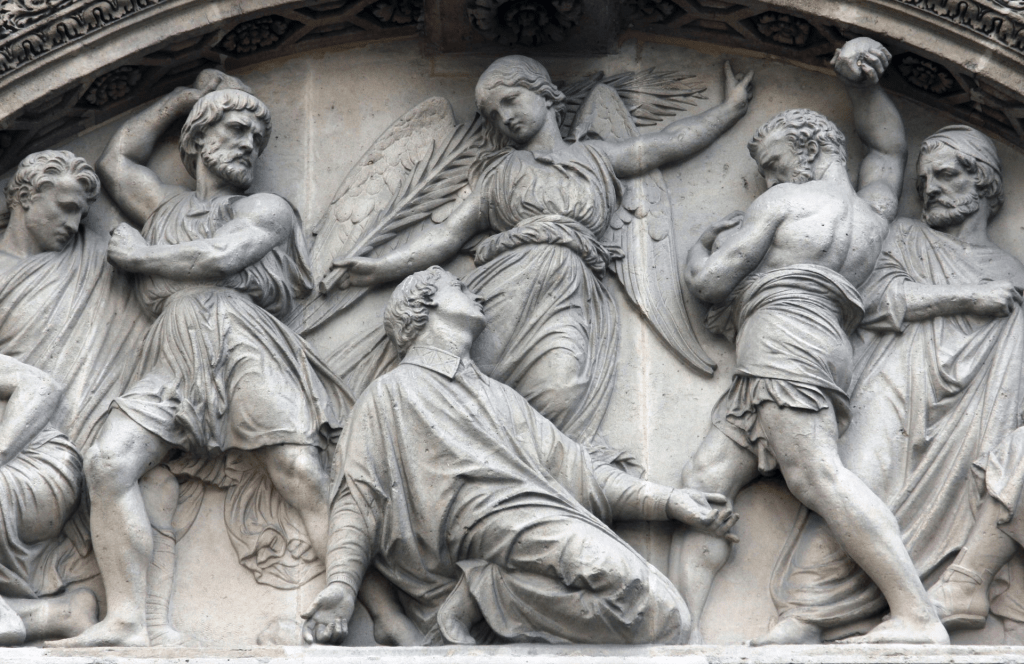
The Martyrdom of Stephen, by sculptor Gabriel-Jules Thomas (1824-1905)

But Stephen, full of the Holy Spirit, looked up to heaven and saw the glory of God, and Jesus standing at the right hand of God. “Look,” he said, “I see heaven open and the Son of Man standing at the right hand of God.”

At this they covered their ears and, yelling at the top of their voices, they all rushed at him, dragged him out of the city and began to stone him. Meanwhile, the witnesses laid their coats at the feet of a young man named Saul.

While they were stoning him, Stephen prayed, “Lord Jesus, receive my spirit.” Then he fell on his knees and cried out, “Lord, do not hold this sin against them.” When he had said this, he fell asleep. (New International Version)

Although I am a trained in biblical exegesis and hermeneutics (interpreting Scripture) I believe that most insights come from making simple observations about the text. So, I want to point out: Stephen was not martyred by the Romans, a religiously pagan group, nor Gentile people; he was martyred by those of his own ethnicity, by “God’s people.”

The religious authorities were more than just unhappy with Stephen. The Sanhedrin (the Jewish ruling council) were incensed with him, so mad that they were grinding their teeth at him. The council sincerely believed Stephen was a blasphemer of God, that what he was saying was so subversive and religiously radical, they could stone him to death with a clear conscience, as if this act were upholding God’s honor and God’s Law.

The result was not only the death of a humble man; it also sparked an intense persecution against the church which caused a new Christian diaspora (Acts 8:1-3). Many believers in Jesus found themselves as Christian refugees trying to eke out a living and worshiping Christ in foreign places.

I wish I could say the greatest opposition I’ve ever experienced as a Christian came from non-Christians who simply misunderstood and misinterpreted me. However, my most hurtful wounds have come from the hands of church folk, believing they were acting on God’s behalf by exacting an emotional martyrdom upon me with the stones of gossip, slander, backbiting, blame-shifting, and outright lying (and a few threats of violence).

Whenever I encounter persons who no longer attend church and have no intention of ever returning to any local congregation, I get it. I understand. Yet, although the church is sometimes like a woman of disrepute, I still love her, and will do whatever I can to edify her and not repay evil with evil.

Stoning a believer, either actually with physical rocks or virtually with verbal stones, is akin to persecuting Jesus himself. That’s because Christ so closely identifies with his people that it is as if he is a head, and his followers are a body – joined together in a vital union.

So, when Christ’s Body is subjected to what I call, “hermeneutical hubris,” in which one group of people insists there is only one way to interpret Scripture, and then uses their authority and structures of power to force compliance on another group, the result is persecution.

And that is precisely why Christians can abuse other Christians.

Rather than discerning that all Christians belong to God, one narrow-minded and small-hearted group excludes all other groups who disagree with them as blaspheming the name of Christ.

For example, insisting that a literal interpretation in the only means of understanding the Bible’s authority is to ignore and abuse the actual and real authority which exists with the Bible. I am in no way encouraging an “anything goes” type of approach to Holy Scripture that lets it say whatever you want it to say. 

What I am saying is that the biblical writers themselves employed different methods of interpretation, as well as the early church fathers (which is one reason I hold to the interpretive guides of the ancient Christian creeds, i.e. The Apostles’ Creed and Nicene Creed).

Far too often, churches stick to a particular interpretation because they believe they are keeping biblical fidelity. This is many times born of a fear that Christendom will be lost, and society will sink into an abyss of egregious sin. The irony is that many churches are sinking into forms of abusive and ungracious behavior by fighting battles that Scripture does not call them to fight.

The binary thinking of “I’m right and you’re wrong” is not an approach you’ll find in God’s Holy Word.

Even if the Sanhedrin in Stephen’s day intended on upholding the holiness of their God and the rightness of their cause, the impact it had on the church was martyrdom, death, and diaspora.

Unfortunately, throughout Christian history, the tables have too often turned with Christians persecuting Jews. I myself would like to avoid being the persecutor. If I kill anything, may it be putting to death my own sin – because that is what the Bible calls me to do.

Dear brothers and sisters, you have no obligation to do what your sinful nature urges you to do. For if you live by its dictates, you will die. But if through the power of the Spirit you put to death the deeds of your sinful nature, you will live.

The Apostle Paul (Romans 8:12-13, NLT)

Since, then, you have been raised with Christ, set your hearts on things above, where Christ is, seated at the right hand of God. Set your minds on things above, not on earthly things. For you died, and your life is now hidden with Christ in God. When Christ, who is your life, appears, then you also will appear with him in glory.

Put to death, therefore, whatever belongs to your earthly nature: sexual immorality, impurity, lust, evil desires and greed, which is idolatry. Because of these, the wrath of God is coming.You used to walk in these ways, in the life you once lived. But now you must also rid yourselves of all such things as these: anger, rage, malice, slander, and filthy language from your lips. 

Do not lie to each other, since you have taken off your old self with its practices and have put on the new self, which is being renewed in knowledge in the image of its Creator. Here there is no Gentile or Jew, circumcised or uncircumcised, barbarian, Scythian, slave or free, but Christ is all, and is in all.

Therefore, as God’s chosen people, holy and dearly loved, clothe yourselves with compassion, kindness, humility, gentleness and patience. Bear with each other and forgive one another if any of you has a grievance against someone. Forgive as the Lord forgave you. And over all these virtues put on love, which binds them all together in perfect unity.

Let the peace of Christ rule in your hearts, since as members of one body you were called to peace. And be thankful. Let the message of Christ dwell among you richly as you teach and admonish one another with all wisdom through psalms, hymns, and songs from the Spirit, singing to God with gratitude in your hearts. And whatever you do, whether in word or deed, do it all in the name of the Lord Jesus, giving thanks to God the Father through him. (Colossians 3:1-17, NIV)

Gracious God, as your Son humbled himself on this earth, so may your church walk continually in such humility that believers everywhere work together in unity for the sake of gospel of grace as a blessing to the world in the power of your Holy Spirit. Amen.

Handling Opposition (John 8:48-59)

Christ and Pharisee, by Russian artist Ivan Filichev, 1993

The Jews answered him, “Aren’t we right in saying that you are a Samaritan and demon-possessed?”

“I am not possessed by a demon,” said Jesus, “but I honor my Father and you dishonor me. I am not seeking glory for myself; but there is one who seeks it, and he is the judge. Very truly I tell you, whoever obeys my word will never see death.”

At this they exclaimed, “Now we know that you are demon-possessed! Abraham died and so did the prophets, yet you say that whoever obeys your word will never taste death. Are you greater than our father Abraham? He died, and so did the prophets. Who do you think you are?”

Jesus replied, “If I glorify myself, my glory means nothing. My Father, whom you claim as your God, is the one who glorifies me. Though you do not know him, I know him. If I said I did not, I would be a liar like you, but I do know him and obey his word. Your father Abraham rejoiced at the thought of seeing my day; he saw it and was glad.”

“You are not yet fifty years old,” they said to him, “and you have seen Abraham!”

“Very truly I tell you,” Jesus answered, “before Abraham was born, I am!” At this, they picked up stones to stone him, but Jesus hid himself, slipping away from the temple grounds. (New International Version)

I am a recovering perfectionist. There was a time in my life when I believed that I could attain perfection in all things. And, what’s more, I thought that if I could be perfect in everything I said and did, I would never face any opposition.

It took me awhile to realize that Jesus, the perfect Son of God, handled life on this earth as well as anybody ever did or could, and yet he still faced continual opposition. Then, at the end of his life, Jesus was ridiculed, tortured, and killed by people who should have known better.

The religious leaders, at the time of Christ, leveled on Jesus their worst accusations by calling him a Samaritan and demon possessed. But Jesus handled it. He wasn’t surprised by it. Nothing they said threw him off.

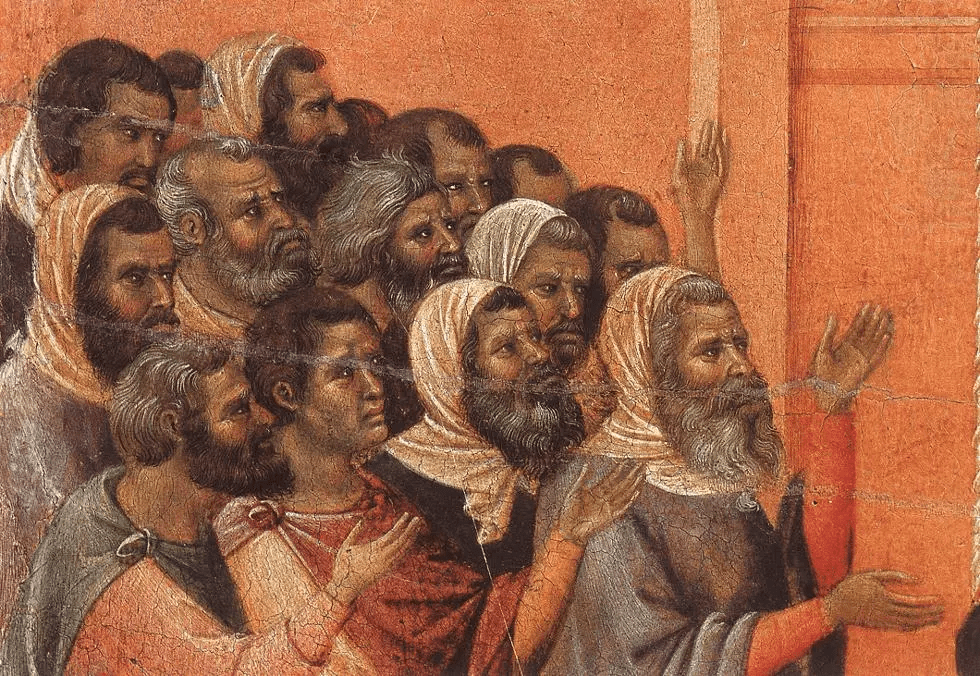
Christ Accused by the Pharisees, by Duccio di Buoninsegna, 1308

There is a way to deal with opposition. There’s a path to dealing effectively with the meanness of others. And there’s a way to face the trouble, as well as your Anfechtung (spiritual oppression and depression) about what’s happening.

The road ahead, however, may be counter-intuitive to how you think. And the way forward might be so far off your radar that you may dismiss what I’m about to say to you. Maybe you’ll even call me a Samaritan.

But before I get to that, I’ll say this: Opposition, even oppression, is endemic to the human condition. Everyone, at times, suffers this way; none of us are immune to affliction, nor can we insulate ourselves from pain. If you are not currently suffering in some way, it means you are either coming off a time of hardship, or are about to enter a new period of distress.

Holiness and godliness don’t keep suffering at bay. Just ask Jesus. In fact, the Lord Jesus himself promised that following him involves a sort of oppression that those who are not Christians will never face. (John 16:33) 

Christ’s disciple, Peter, came to understand the reality that since Jesus experienced opposition, so will his followers. (1 Peter 4:12).

The Lord’s brother, James, understood that everyone faces difficulty; and he wisely discerned that opposition is a teacher, from which we learn maturity, perseverance, and patience. (James 1:2). 

Jesus’ greatest follower, Paul, continually dealt with opposition from others, more than any follower of Jesus in history. And he insisted that anyone who belongs to Christ will have trouble;  and that suffering enables us to persevere and be in solidarity with Jesus. (2 Timothy 3:12; Romans 5:3-5; Philippians 1:29)

Yes, in this world you will have trouble. But take heart. Jesus has overcome the world. (John 16:33)

Now, back to the topic of handling opposition from others. Here’s the truth:

Dealing with opposition, oppression, and suffering comes through Christ, and not from us. And the practice of overcoming trouble doesn’t come from fighting against it, but by sitting with it and learning from it.

Stated differently: Jesus has overcome the world through his death, resurrection, and ascension. On the cross, he absorbed all the sin and suffering of everyone. This means that your suffering, no matter it’s source, will be subdued whenever you invite it to take a seat with you and have a conversation with it.

Said yet another way: Quit fighting against your suffering. Stop kicking and screaming long enough to look your feelings square in the face and learn from them.

The opposition is trying to tell us something. But if we keep taking the stance of a pugilist, trying to punch it away, it will just keep moving forward and never topple. 

Oppression isn’t something you beat; it’s something you learn from. Jesus already did the beating and the winning.

And we’ll only learn from suffering and overcome it when we embrace it. Therefore, the counter-intuitive, counter-cultural practice is: Submit to suffering. When we do that, like Jesus, we simply slip away from the oppressors. They no longer have any power over us.

Don’t hear what I’m not saying. I’m not an advocate for sanitizing your troubles or trauma with a positive spin. Evil is evil, bad is bad, and no amount of saying otherwise will change the leopard’s spots. 

And yet, only through submitting to the process of what opposition teaches us, can we hope to break its power over us.

Let’s liken our opposition to encountering a bear in the wilderness. The National Park Service gives us this advice if facing a bear while out hiking: “Once a bear has noticed you and is paying attention to you, these strategies can help prevent the situation from escalating:”

  • Identify yourself by talking calmly so the bear knows you are a human and not a prey animal. Remain still; stand your ground but slowly wave your arms. Help the bear recognize you as a human. It may come closer or stand on its hind legs to get a better look or smell. A standing bear is usually curious, not threatening.
  • Stay calm and remember that most bears do not want to attack you; they usually just want to be left alone. Bears may bluff their way out of an encounter by charging and then turning away at the last second. Bears may also react defensively by woofing, yawning, salivating, growling, snapping their jaws, and laying their ears back. Continue to talk to the bear in low tones; this will help you stay calmer, and it won’t be threatening to the bear. A scream or sudden movement may trigger an attack. Never imitate bear sounds or make a high-pitched squeal.
  • Hike and travel in groups. Groups of people are usually noisier and smellier than a single person. Therefore, bears often become aware of groups of people at greater distances, and because of their cumulative size, groups are also intimidating to bears.
  • If the bear is stationary, move away slowly and sideways; this allows you to keep an eye on the bear and avoid tripping. Moving sideways is also non-threatening to bears. Do not run, but if the bear follows, stop and hold your ground. Bears can run as fast as a racehorse both uphill and down. Like dogs, they will chase fleeing animals. Do not climb a tree. Both grizzlies and black bears can climb trees.

Fighting against someone’s oppression is about as useful as taking on a bear. Both bears and oppressors can be dangerous. We don’t blame bears if they act like bears. Likewise, let’s not be surprised when opposition arises.

I suggest we treat opposition as if we are facing a bear in the wilderness of trouble:

  • Calmly identify yourself. Doing the big freak-out is only going to encourage suffering to do damage. Oppression will pass, but you must be patient and calm. 
  • Talk in low tones to the opposition.
  • Remember who you are; you belong to God. 
  • Handle oppression as if it is curious about you. 
  • Walk with others. You’re not John Wayne. Community is necessary, not optional.
  • Keep your eye on opposition. Don’t ignore it, or pretend it isn’t there. Don’t run. Face it and keep it in front of you.

Jesus was calm, honest, and forthright. He was, therefore, able to speak and handle himself with wisdom in the face of opposition and trouble. Christ knew who he was, who the opposition was, and what his purpose was; and we can know those same things, as well.

Grant us patience, O Lord, to follow the road you have taken. Let our confidence not rest in our own understanding but in your guiding hand; let our desires not be for our own comfort, but for the joy of your kingdom; for your cross is our hope and our joy now and unto the day of eternity. Amen.