The Example of John the Baptist (Matthew 14:1-12)

John the Baptist preaching, by George Maurice Cloud (1909-1973)

At that time Herod the ruler heard the news about Jesus. He said to his servants, “This is John the Baptist. He’s been raised from the dead. This is why these miraculous powers are at work through him.” Herod had arrested John, bound him, and put him in prison because of Herodias, the wife of Herod’s brother Philip.

That’s because John told Herod, “It’s against the law for you to marry her.”

Although Herod wanted to kill him, he feared the crowd because they thought John was a prophet. But at Herod’s birthday party Herodias’ daughter danced in front of the guests and thrilled Herod. Then he swore to give her anything she asked.

At her mother’s urging, the girl said, “Give me the head of John the Baptist here on a plate.” Although the king was upset, because of his solemn pledge and his guests he commanded that they give it to her. Then he had John beheaded in prison. They brought his head on a plate and gave it to the young woman, and she brought it to her mother. But John’s disciples came and took his body and buried it. Then they went and told Jesus what had happened. (Common English Bible)

John the Baptist’s murder is not only an ancient story; it’s also a story about our contemporary world – a world of power, sex, and intrigue. Times may change, but people across the ages do not. Humanity is fundamentally the same in every century. And the world is still the world, no matter the historical time. 

The contrast between King Herod and John the Baptist supply us with two types of people who exist throughout every age of humankind, offering us the choice of which way we will go with our lives. The story illustrates for us the reality of living in a fallen world as a devout person.

The Herod in today’s Gospel lesson was a son of Herod the Great, the one who killed all the male babies when Jesus was born in order to try and get rid of any rival king (Matthew 2:1-18). King Herod is displayed in the narrative as a tragic and pathetic figure who is ruled by his own lusts. He seems too proud and wimpy to admit he made a rash promise. He killed a man just to save face with his guests at a party.

This a Jerry Springer worthy family drama: The Herod family was rich, proud, and downright violent. They tended to marry within their own clan to hold their power and possessions for themselves. Herodias married her uncle Herod Philip; Salome was their daughter.

Later, Salome married Philip the tetrarch, half-brother to Herod Philip. Through marriage, Salome became both aunt and sister-in-law to her mother. Then the Herod in our story married Herodias, who had been married to Herod’s half-brother, Herod Philip. Having fallen in love with Herod Antipas, Herodias divorced Herod Philip to marry Herod Antipas.

Sheesh, nothing quite like complicated family drama.
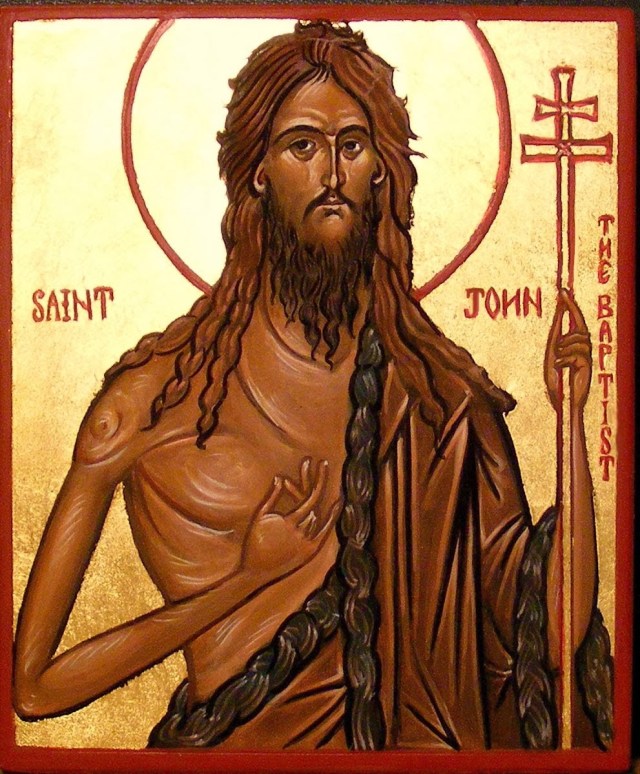
Orthodox icon of John the Baptist

Into this violation of Old Testament marriage laws (the Herod’s were Jewish) came John who made no bones about the fact this was not right (Leviticus 18:16, 20:21). Herodias nursed a grudge against John for speaking out against her and Herod’s choices.

Hell, hath no fury like a woman’s scorn, and when Herodias found an opportunity to get rid of John, she coached her daughter into asking for John the Baptist’s head on a platter. Herod, too insecure to take back his ridiculous promise and look like a fool, consented to the execution of John.

In contrast to all this tragic theater is John the Baptist. John was a messenger of God and a preacher of repentance. As one who was preparing the way for Jesus, his message was simple and to the point: Repent, for the kingdom of God is near.

John got into trouble and lost his life because he spoke truth to power by meddling in the life of King Herod and his family. The Herod’s were the political establishment of the day, and John did not temper his words when dealing with them.

There is a refreshing integrity about John. He was always the same, no matter where he was, and no matter who the people were around him. In contrast to Herod, John was bold, courageous, confident, unafraid, and secure enough in his relationship with God to engage in ministry without thought to the consequences. 

John was unconcerned for what others might think of him, if he proclaimed truth in the public square, and it ended up costing him his life.

John the Baptist Rebuking Herod, by Giovanni Fattori (1825-1908)

The story of John the Baptist’s death speaks about the hostility of this world. And it prefigured and foreshadowed the death of Jesus:

  • Like John, Jesus was executed by the civil authorities.
  • Herod, like Pilate after him, hesitated to execute and was swayed by the crowd.
  • Herodias, like the chief priests toward Jesus, finally got her way through scheming and manipulation.
  • John’s disciples came and took his body and buried it, just like Joseph of Arimathea and Nicodemus did for Jesus.

These stories, on the surface, appear to be only gloom and doom. Yet, there is a message of hope and joy. The absurd is working out itself in deliverance from sin, death, and hell. Through death, Jesus conquered death. We now have no fear of death; its sting has been taken away. Without fear of death, we have no reason to fear life with its troubles and tribulations.

The fork in the road is between the way of John or Herod. It’s a values-based decision. If worth is derived from what we do, what we have, and/or other’s opinion of us, we will likely identify more with Herod and his choices. If there is a preoccupation with hoarding power and control, this is the path of Herod. 

Conversely, if the ultimate value is in knowing Christ crucified and the power of his resurrection, then we identify with John as our spiritual ancestor. If security and worth is derived from being in Christ, then there is boldness to speak truth to power and give grace to the powerless.

Herod saw no further than his immediate needs and safety; he failed to discern his own heart. Because of his spiritual blindness, Herod did not look away from himself and look to God. Faith in Jesus comes when persons look away from themselves and look to Christ who holds the power to free all from spiritual bondage.

Consider the example of John the Baptist. He consistently sought to do the will of God as best as he understood it. Together with all God’s people past and present, we declare that God is with us, the kingdom of God is near, and the love of Christ brings faith and hope.

Almighty God, through your providence John the Baptist was wonderfully born and was sent to prepare the way of your Son, our Savior, by the preaching of repentance. Lead us to repent according to his preaching and, after his example, constantly to speak the truth, boldly to rebuke vice, and patiently to suffer for truth’s sake; through Jesus Christ your Son, our Lord, who is alive and reigns with you, in the unity of the Holy Spirit, one God, now and forever. Amen.

On the Importance of Hospitality (3 John 9-12)

A mosaic of the Apostle John, at the Monastery of St. John the Theologian, in Patmos, Greece

I have written something to the church, but Diotrephes, who likes to put himself first, does not welcome us. So if I come, I will call attention to what he is doing in spreading false charges against us. And not content with those charges, he refuses to welcome the brothers and sisters and even prevents those who want to do so and expels them from the church.

Beloved, do not imitate what is evil, but imitate what is good. Whoever does good is from God; whoever does evil has not seen God. Everyone has testified favorably about Demetrius, and so has the truth itself. We also testify for him, and you know that our testimony is true. (New Revised Standard Version)

I believe in an egalitarian world. Ideally, humanity is meant to live in equity with one another. Humility, meekness, and gentleness are to be the inner dispositions of a person’s life.

These virtues work themselves out in being concerned for the common good of all, laboring toward just and righteous ways of living for everyone and sharing our lives, as well as our resources, with each other. Viewing one another as equals inevitably leads to gracious hospitality.

However, in a world of power disparities, and privileged inequities, are attitudes of seeking attention, a perceived need to always win and be first, and tight-fisted control of authority and money. The common good of all persons is scaled back to be the concern for the common good of some. There is a failure to regard the weak, poor, and vulnerable as legitimate members of the community.

The Apostle John wrote his short succinct letter in a concern that the church may be following a leader who was taking them down a bad path – a road leading to injustice where power and privilege remain with a few, and perhaps even one. John’s plainspoken exhortation was to judge rightly between what is good and bad, and then imitate the good while forsaking the bad.

Hospitality is the true litmus test between the good and the bad.

An openness to the stranger, the immigrant, the migrant, the alien, the foreigner, the newcomer, and the outsider characterizes authentic fellowship.

Being closed to such persons and having a xenophobic bent to others who are different is the mark of unwelcoming and inhospitable people.

Hospitality serves others, whereas being inhospitable cajoles others to serve our needs.

Jesus, the Lord of all, did not come to this earth for people to serve him. Christ came to serve others, and to give his life to save many people (Matthew 20:28; Mark 10:45; John 13:1-17). We are to imitate the loving service and radical hospitality of the Lord Jesus. He is our example. We are to imitate Christ.

We must have both orthodoxy (right belief) and orthopraxy (right practice). Both go together like a hand in a glove. Good actions are the result of good and proper beliefs. The following are some thoughts about this nexus between belief and practice:

  • Hospitality (literally “love of the stranger”) is a way of life fundamental to orthodox Christianity, based in the person and work of Jesus
  • God is hospitable and loves the outsider, welcoming them into the dance of the Trinity, and provides for them; our human hospitality is to reflect this divine welcome
  • Hospitality means extending to another a kindness typically reserved for family or friends
  • The teaching of the New Testament emphasizes the practice of hospitality (Luke 14:12-14; Matthew 25:31-46)
  • The consistent witness of church history is to lift up and hold Christian hospitality.

“Whatever person you meet who needs your aid, you have no reason to refuse to help them.”

John Calvin

This was no mere theoretical advice for Calvin, whose ministry center of Geneva, Switzerland swelled with French Huguenot refugees fleeing persecution. Calvin, always the theologian, grounded his understanding of hospitality in the divine:

“We should not regard what a person is and what they deserve but we should go higher – that it is God who has placed us in the world for such a purpose that we be united and joined together. God has impressed the divine image in us and has given us a common nature, which should incite us to provide one for the other.”

John Calvin
  • Hospitality is a practice which integrates both respect and care. St. John Chrysostom warned his congregation to show “excessive joy” when offering hospitality to avoid shaming the recipient of care.
  • Biblical hospitality does not need to know all the details of someone’s life before extending care. If Christ forgave and healed those who injured him, how could we neglect even a starving murderer? 
  • True hospitality involves a face-to-face relationship of encouragement and respect – not just a distant giving of alms. Hospitable persons pay attention to others and share life with them.
  • The great twin concerns of hospitality are universalizing the neighbor and personalizing the stranger. One reason why many of the rich have little sympathy for the poor is because they seldom visit them. Hospitality depends on us recognizing our commonalities with strangers rather than our differences.
  • This is how we evaluate our hospitality: Did we see Christ in them? Did they see Christ in me?

Hospitable God:

Give us eyes to see the deepest needs of people.

Give us hearts full of love for our neighbors as well as for the strangers we meet.

Help us understand what it means to love others as we love ourselves.

Teach us to care in a way that strengthens those who are sick.

Fill us with generosity so we feed the hungry, clothe the naked, and give drink to the thirsty.

Let us be a healing balm to those who are weak and lonely and weary by offering our kindness to them.

May we remember to listen, smile, and offer a helping hand each time the opportunity presents itself. And may we conspire to create opportunities to do so.

Give us hearts of courage to risk loving our enemy.

Inspire us to go out of our way to include outsiders.

Help us to be welcoming and include all whom you send our way.

Let us be God’s hospitality in the world. Amen.

God, the Jilted Lover (James 4:4-10)

You’re cheating on God. If all you want is your own way, flirting with the world every chance you get, you end up enemies of God and his way. And do you suppose God doesn’t care? The proverb has it that “he’s a fiercely jealous lover.” And what he gives in love is far better than anything else you’ll find. It’s common knowledge that “God goes against the willful proud; God gives grace to the willing humble.”

So let God work his will in you. Yell a loud no to the Devil and watch him make himself scarce. Say a quiet yes to God and he’ll be there in no time. Quit dabbling in sin. Purify your inner life. Quit playing the field. Hit bottom, and cry your eyes out. The fun and games are over. Get serious, really serious. Get down on your knees before the Master; it’s the only way you’ll get on your feet. (The Message)

Quite apparent is the fact that the Apostle James was not trying to win friends in the world. However, he was trying to influence the people within the churches in his care. Specifically, he was confronting the proud and arrogant.

So, please understand, up front, that James was going after the haughty persons because it takes a hammer to break a hard heart. And so, his approach ought only to be emulated in the unique context of handling persons stuck in their own destructive hubris. Nevertheless, there is much instruction in these verses to help us all.

Throughout Holy Scripture, we find a marriage metaphor, likening the relationship of God to the people, much like a lover. God’s covenant relationship is at the heart of understanding the whole of Scripture. Whenever people stray from divine promises, God is offended and hurt. 

Yes, God feels pain. God is an emotional Being, which is why we have emotions as God’s image-bearers. One way to view the Bible is that it is a book about God, the jilted lover. The Lord set affection and love upon people, yet many people have spurned their Lover’s advance. And this situation pains God. 

When Adam and Eve, decided to find satisfaction outside of God, the Lord was hurt. After them, when people had children and raised them, they did so largely apart from the God who loved them:

The Lord saw that the human beings on the earth were very wicked and that everything they thought about was evil. He was sorry he had made human beings on the earth, and his heart was filled with pain. (Genesis 6:5-6, NCV)

Yet, God was gracious. The Lord took a group of Noah’s descendants, Abraham’s family, and set a covenant of affection on them. God hoped to restore the world to right relationship through the Israelites. However, they too, came to set their affections on others. So, nearly half of the Old Testament is devoted to communicating the Lord’s hurt and disappointment. 

Like a jilted lover, God longed for Israel to remain faithful. For example, the prophet Hosea had an unfaithful wife, Gomer, and their relationship mirrored the relationship between God and Israel. Just as Hosea did not give up on his wife, even though she was brazenly unfaithful, so God looked at Israel as a spouse and could not bear to give her up.

Israel spurned their lover’s grace and kindness and actively sought other lovers, causing God anger and agony. God recounted the history of unfaithfulness:

“At every crossroad you built your platform and degraded your beauty by spreading your legs to all comers. And so, you encouraged even more promiscuity. You prostituted yourself with the Egyptians, your neighbors with the large sexual organs, and as you added to your seductions, you provoked me to anger…. 

Still not satisfied, you prostituted yourself to the Assyrians, but they were not enough for you either. So, you prostituted yourself with the Babylonians, the land of traders, but again you were not satisfied. How sick was your heart that you could do all these things, the deeds of a hardened prostitute?…

You are like an adulterous wife: you take in strangers instead of your husband. Ordinary prostitutes are given gifts, but you gave your gifts to all your lovers. From every direction you even bribed them to come to you for your sexual favors. As a prostitute, you were more perverse than other women. No one approached you for sexual favors, but you yourself gave gifts instead of receiving them.” (Ezekiel 16:25-34, CEB)

Despite Israel’s unfaithfulness, God extended grace to the beloved spouse:

“I am taking you back!
I rejected you for a while,
but with love and tenderness
    I will embrace you again.
For a while, I turned away
    in furious anger.
Now I will have mercy
    and love you forever!
I, your protector and Lord,
    make this promise.” (Isaiah 54:6-8, CEV)

The Old Testament ends with God still longing for return:

The Lord proclaims: “I care passionately about Zion; I burn with passion for her.” (Zechariah 8:2, CEB)

All of this theological awareness was in the heart of the Apostle James when he wrote his letter to the hard-hearted. He knew they were flirting with the world. He wanted them to stop and return to the God who longed to show them grace, if only they would humble themselves.

God yearns, passionately, for us to find our needs met, and enjoyment found, in the loving divine embrace. Spiritual adultery hurts God deeply, like it would any jilted lover. God awaits with loving patience to show grace and compassion to wayward people. 

Only the stance and attitude of humility can receive grace. Sinful pride prevents people from receiving God’s good gift. So, James rattled-off ten quick staccato commands to remain connected in a love relationship with God. They are resolutions to live by. 

Submit to God

Humble folk willingly place themselves under God’s authority because they are convinced God has their best interests at mind. One temptation when facing adversity is to entertain the belief that no one is going to look out for you except yourself. So, to avoid getting hurt too badly, we might become cynical, arrogant, and callous – self-protective strategies designed to keep the hurt away. This only creates hardness of heart. The alternative is faithful submission to God – knowing that God’s Spirit will protect and living with the conviction that nothing can separate us from the love of God in Christ.

Resist the devil

Satan is a bully. The way to deal with bullies is to stand up to them. We face down the temptation by submitting to God and resisting the devil. Don’t be deceived into flipping it around by listening to Satan and avoiding submission to God.

Come near to God

Like a loving parent, the Lord longingly looks out the window waiting for prodigals to return. Coming to God is the first thing we ought to do. When my daughter was young her bike was stolen. So, we sat down together in the backyard and came to God in prayer. I barely finished praying when a police cruiser pulled up in the alley behind our house. The policeman rolled down his window and said, “Hey, are you missing a bike?”  We hopped in and he took us to where someone had ditched the bike. It was a tremendous lesson that when we come to God, God comes to us. I realize life does not always work that way, yet we can be assured that God listens, hears, and will respond.

Wash your hands

We cannot approach God with blood on our hands, but must come squarely facing our sin and disobedience.  We must deal with the wrong we have done without sweeping it under the rug. God wants us to admit our sin, receive grace, and deal with matters of restitution and reconciliation, without trying to save face when found out in a concern for “optics.”

Purify your heart

Whereas the previous resolution is mostly external, this one addresses the inner person, the heart. Not only do our actions need to be cleaned up through washing our hands, but our attitudes must also be purged of pollution. Our hearts cannot handle two masters; we are to be single-minded without mixed motives.

“The man who tries to walk two roads will split his pants.”

African proverb

The next four resolutions describe important emotional responses to sin:

“The Crying Giant,” Wilmington, Delaware

Grieve

Trying to move on without grieving and lamenting is called denial. Grief is not only an event; it is a process which takes time. Grieving is biblical. Sharing our stories with each other, giving testimony to God’s grace, and expressing ourselves is important. A loving God knows there cannot be healing apart from grief and lament.

Mourn

Blessed are those who mourn with an emotional response to the devastation of sin. Mourning sees sin in all its foulness and degradation. People who do not mourn become hard-hearted and need deep spiritual transformation. Jesus offers the remedy: By his wounds we are healed.

Wail

We are to more than cry – we need to wail.  Whereas mourning might be more personal, wailing has a much more public dimension to it. I believe the great tragedy in many modern churches is an inordinate focus on victory and triumphalism. The result: Far too many Christians cry alone. No one should ever have to cry by themselves. We must weep with those who weep. If there ever was an appropriate place for crying, it should be amongst fellow brothers and sisters in Christ.

Change

We cannot turn the clock back to some bygone idyllic era. We are to grasp the type of change which occurs in living for Jesus Christ and above sin – with no casual cavalier attitudes toward sin. I once had a conversation with a young woman about heaven and hell. When we began the discussion, she expressed a desire to be wherever the better party was going on. By the time we finished our conversation she was grieving and crying. I never knew what became of her. But once she got just a glimpse of the gravity of sin, it undid her.

Be humble

Humility sums up all these resolutions. The paradox is that through grieving, mourning, and wailing we become joyful and satisfied; through suffering there is glory; becoming last is to become first; entering the narrow gate leads to the broad open space of God’s eternal life.

Gracious God, our sins are too heavy to carry, too real to hide, and too deep to undo. Forgive what our lips tremble to name, what our hearts can no longer bear, and what has become for us a consuming fire of judgment. Set us free from a past that we cannot change; open to us a future in which we can be changed; and grant us grace to grow more and more in your likeness and image, through Jesus Christ, the light of the world. Amen

A New Outlook on Life (2 Corinthians 5:17-22)

Therefore, if anyone is in Christ, the new creation has come: The old has gone, the new is here! All this is from God, who reconciled us to himself through Christ and gave us the ministry of reconciliation: that God was reconciling the world to himself in Christ, not counting people’s sins against them. And he has committed to us the message of reconciliation. We are therefore Christ’s ambassadors, as though God were making his appeal through us. We implore you on Christ’s behalf: Be reconciled to God. God made him who had no sin to be sin for us, so that in him we might become the righteousness of God. (New International Version)

Everyone sees things (and people) only in part. We all have our own unique perspective and take on life. And we interpret life from that particular angle.

God has brought us new life, and with it, a new outlook on life, made possible by the person and work of Jesus Christ.

The Apostle Paul gained a new orientation on his life because he encountered God’s love through Jesus Christ. And his experience of love caused Paul to live for Christ and not for himself. He gained a new perspective.

Conversion to Christ and following Jesus brings a new outlook on life that enables us to live a good and beautiful existence on this earth for the sake of the church and the world.

God brings a new outlook to us in three major ways. The way we look at ourselves, others, and God:

  • No longer do we need to compulsively demean ourselves, nor think of ourselves as better than we really are. Instead, encountering a new life in Christ, we see that we are truly loved by God and worthy of giving and receiving love. See what great love the Father has lavished on us, that we should be called children of God! And that is what we are!… This is how we know what love is: Jesus Christ laid down his life for us. (1 John 3:1, 16, NIV)
  • No longer do we view others as tools to take advantage of; and neither do we look merely at one’s outward appearance. Instead, experiencing new life helps us to see other people as spiritual persons, important to God and needing divine love, just like us. This is love: not that we loved God, but that he loved us and sent his Son as an atoning sacrifice for our sins. Dear friends, since God so loved us, we also ought to love one another. No one has ever seen God; but if we love one another, God lives in us and his love is made complete in us. (1 John 4:10-12, NIV)
  • No longer do we view Christ as merely a good teacher or a moral man. Instead, our new life gives us the lenses of seeing Jesus as Savior and Lord. This is how we know that we live in him and he in us: He has given us of his Spirit. And we have seen and testify that the Father has sent his Son to be the Savior of the world. If anyone acknowledges that Jesus is the Son of God, God lives in them and they in God. And so we know and rely on the love God has for us. God is love. Whoever lives in love lives in God, and God in them. This is how love is made complete among us so that we will have confidence on the day of judgment: In this world we are like Jesus. There is no fear in love. But perfect love drives out fear because fear has to do with punishment. The one who fears is not made perfect in love. (1 John 4:13-18, NIV)

With new life comes a new perspective that results in a new way of life. I was once walking with my late mother-in-law through an art museum. We came upon a piece of art that didn’t necessarily speak to me; and I really didn’t understand it. But my mother-in-law happened to know the artist who painted the picture. And she told me about the person, why she painted it, and what she was trying to convey with her art. This information completely changed the way I saw the painting.

As we progressively get to know God, it really ought to transform how we view the Lord and look at Holy Scripture. And when we discover God in Christ, we see a caring Lord who went out of the way to become one of us, become the pioneer of our salvation, and bring about redemption and reconciliation through an ignominious death on a cross.

God has deliberately sought us and brought us back into the divine dance through Christ – which is why we celebrate. And the highest form of celebration is imitation, that is, becoming ambassadors representing who Jesus is by being just like him.

We imitate Christ through our relationships. Whenever we act with humility, mourn over the world’s sin, deal with others according to grace and gentleness, seek right relationships and keep everything above board, are pure, merciful, and peacemaking in all our dealings, and love and pray for our enemies – then we are encountering God, imitating Christ, and living a new life from a new vantagepoint.

Because Christians have been reconciled to God through Jesus, it transforms how we see people and our desires in our relationships with them; and it changes our stance and perspective on the God who initiated and brought salvation and reconciliation to us. I want to:

  • Grow in a relationship with God through worship, prayer, and scripture reading
  • Grow in relationships with other Christians in fellowship, service, and love
  • Grow in relationships with my neighbors and everyone I encounter, to be an ambassador for Jesus, as if God were working through me to accomplish the compassionate loving of the world and demonstrating how to live a blessed and peaceful life.

In finding our true spiritual home, we find life. There’s nothing quite like being able to live a peaceful existence because of God’s reconciling work in Christ on our behalf.

Lord God, bring us together as one, reconciled with you and reconciled with each other. You made us in your likeness, and you gave us your Son, Jesus Christ. Enable us to know you and one another in the spirit of grace and love. Amen.