The Parable of the Tenants (Matthew 21:33-46)

Illustration of the parable of the vineyard workers, in the Codex Aureus of Echternach, c.1040 C.E.

“Listen to another parable: There was a landowner who planted a vineyard. He put a wall around it, dug a winepress in it and built a watchtower. Then he rented the vineyard to some farmers and moved to another place. When the harvest time approached, he sent his servants to the tenants to collect his fruit.

“The tenants seized his servants; they beat one, killed another, and stoned a third.Then he sent other servants to them, more than the first time, and the tenants treated them the same way. Last of all, he sent his son to them. ‘They will respect my son,’ he said.

“But when the tenants saw the son, they said to each other, ‘This is the heir. Come, let’s kill him and take his inheritance.’ So they took him and threw him out of the vineyard and killed him.

“Therefore, when the owner of the vineyard comes, what will he do to those tenants?”

“He will bring those wretches to a wretched end,” they replied, “and he will rent the vineyard to other tenants, who will give him his share of the crop at harvest time.”

Jesus said to them, “Have you never read in the Scriptures:

“‘The stone the builders rejected
    has become the cornerstone;
the Lord has done this,
    and it is marvelous in our eyes’?

“Therefore I tell you that the kingdom of God will be taken away from you and given to a people who will produce its fruit. Anyone who falls on this stone will be broken to pieces; anyone on whom it falls will be crushed.”

When the chief priests and the Pharisees heard Jesus’ parables, they knew he was talking about them. They looked for a way to arrest him, but they were afraid of the crowd because the people held that he was a prophet. (New International Version)

I once saw a guide dog gently pressing on his blind owner to go a certain way. But the man didn’t go that way. The dog kept pressing until the blind man kicked his dog. And then, the guy walked smack into a parked car on the street.

We can sometimes think too much of ourselves; and tend to believe that what we say and do and think are right – until we walk into a parked car, looking like a fool.  We need, of course, to listen to God. Yet, because we cannot see God, it’s too easy to treat the Lord as if he were an absentee landowner.

Today’s parable is about who will inherit the kingdom of God. The religious establishment of Christ’s day were not characterized by Christ’s Beatitudes. They thought they were okay. But they were really like a blind man kicking the guide dog, believing their way was right.

There are five truths illustrated in this parable that we need to grasp. The point of the parable is that Christ is looking for people who do God’s will and produce righteous fruit. Before we get into those truths, let’s get the cast of characters straight:

  • the landowner is God
  • the vineyard is Israel, God’s people
  • the tenants that the landowner put in charge are the religious leaders
  • the servants are the Old Testament prophets of God
  • the Son is Jesus

God is patient and longsuffering

God is like the guide dog who gently and lovingly keeps nudging, trying to get the person’s attention. In the parable, God’s people are likened to a vineyard. Jesus drew much of his teaching from the prophet Isaiah.

In Isaiah chapter 5, Israel is likened to a vineyard that God carefully takes care of, looking for fruit, but not getting any. For Jesus to tell the parable about a vineyard, gained the attention of people who knew the Scriptures.

Like Isaiah, Jesus pictured God as having a persistent, patient love for people, even when the tenants rebel and try and throw God out. The landowner, God, has:

  • planted
  • put in a wall
  • dug a winepress
  • built a watchtower
  • rented it out
  • sent the servants 

All these verbs describe a God who put a lot of time and energy into the vineyard. Even today, God still fusses over the vineyard and is looking for people to produce fruit in keeping with a genuine sense of righteousness. 

Humanity, especially the religious insiders, are sinful

In contrast to God’s love and care, is humanity’s persistent rebellion. The picture is of people who are hell-bent on rejecting the love of God. God’s patient love is met each time with a heightened hardness of heart on the part of the tenants. Jesus wanted the crowd to feel the situation of the landowner who goes beyond normal conventions in continuing to send servants; and the tenants’ violence in response.

God feels the weight of human sinfulness. Because the landowner is absent and we cannot see him, we may forget or not realize that God feels the full range of emotions. Each person who goes their own way and refuses God’s love; does not respond to God’s efforts to see fruit produced; and any system that is imposed contrary to God’s good order and care, all grieves God. Jesus later expressed his own grief and longing:

“Jerusalem, Jerusalem, you who kill the prophets and stone those sent to you, how often I have longed to gather your children together, as a hen gathers her chicks under her wings, and you were not willing.” (Matthew 23:37, NIV)

The Son was sent as the final act

Any “normal” landowner would throw the tenants out after the first sending of servants that didn’t go well. Yet God the landowner knew what he was doing. Jesus actually summarized the plot line of the Old Testament, and of our lives, as well. The history of salvation moves like this through Scripture:

  • God loves people
  • people keep rebelling against that love
  • God keeps pursuing peoiple
  • then, God does the unthinkable by becoming one of us 

Jesus, stepped into this messy, bloody and violent world, full of hatred and hardness of heart. Then, the Son was killed and thrown outside.

God’s judgment is awful

Jesus drew his listeners into the story, and invited a response to what the landowner would do after all of the overtures to the tenants. The listeners responded that “he will bring those wretches to a wretched end.” And in a sense Jesus says, “You are them.” 

Jesus invited them to remember and realize the Scripture by looking at it as the Son who was killed. He let the crowd know that rejection of the Son results in the Son becoming the most prominent person. Jesus wanted them to look at their bibles and see Christ. He was rejected by his own – which will result in a pulverizing judgment, like a stone falling on a person.

God replaces the whole crew

God is transferring the kingdom of God from the proud and hard-hearted religious insiders to the repentant, soft-hearted outsiders. The self-righteous people failed to accept Jesus because of their insistence on being right; the spiritual beggars accept Jesus and God’s love and are the true subjects of the kingdom. The supposedly spiritual people who had all the religious traditions failed to see what those traditions really point to. 

We don’t own the kingdom; God does. God calls the shots, and has every right to expect people to produce the fruit of mercy, purity, and peacemaking in keeping with a humble heart that desires genuine righteousness.
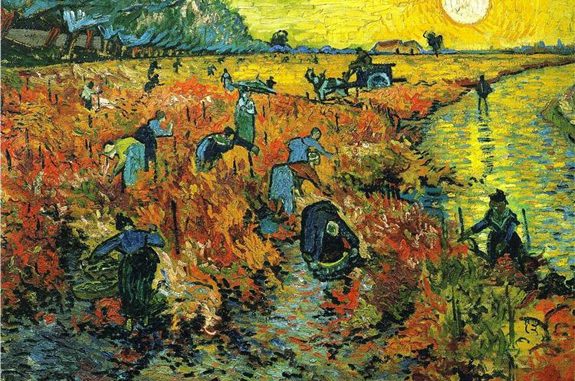
The Red Vineyard by Vincent Van Gogh, 1888

Maybe this parable seems a bit distant from us. To help us hear the story of Jesus as his original hearers heard it, I now restate the parable in a contemporary form:

Listen to another story about who is really a Christian. There was a landlord who built an upscale apartment building. The landlord spared no expense in creating apartments that were comfortable and homey. Everything he designed and built was with the care of someone who thought about what people would need and like most about a place to live. He included a host of amenities to his apartments because he really wanted the people to have as much joy living there as he did designing and building them. 

The owner put a gate around the complex so that the apartment community would be safe and secure. He hired a security firm to keep watch over the apartment complex. Then, when every detail was in place, the landlord rented out his apartments. But he didn’t just rent them out; he wanted to see the joy on the faces of the renters when he made a contract with them that included an entire year’s free rent. After that first year, when it came time for the first rent to be due, the landlord did not receive a single rent check. He was puzzled about this, so he decided to send some of his employees to collect the rent in person.

While the renters were in one of the large common lounges enjoying being together, they saw the landlord’s employees coming from a distance. So, they hatched a devious plan. Over their year of living in the beautiful apartments, they began to think they were especially special, and not like other people who lived in places that weren’t as nice as where they lived.  They gained such a twisted idea of their own importance that they believed they didn’t need to pay rent; and no one was going to tell them what to do. After all, they deserved to live where they did. They have a right to it. They don’t need to answer to anyone, including this supposed landlord who they have never seen in this last year, anyway.

Then the renters took the landlord’s employees and beat one, killed another, and took a baseball bat to a third. They took the bodies and threw them in the dumpster behind the building. Then the landlord, not wanting to evict his renters even after such a terrible experience, sent some other employees, more than the first time. But the renters had no guilt about what they had done, and did the very same thing to the second group of employees.  Even after this, the landlord was reluctant to let the law take over and decided to send his own son to collect the rent so that the renters could keep living in his apartments.

But when the renters saw the son, they said to each other. “Look! The guy sent his son. If we kill him, then we can forget about the old man and claim the whole apartment complex for ourselves.” 

After telling this story, Jesus asked all the church people listening, “When the owner of the apartment complex comes, what do you think he will do to those renters?” The crowd was into the story and replied, “He’s going to judge those ungrateful murderers, and replace the whole bunch of them with all new renters.” 

Jesus then said to them, “Have you never read in your bibles that the son who was rejected and killed has become the most important person of all? The Scriptures are all about the Son.”

“So, I am telling you that even though you have been in the Church all your life, it isn’t yours. I’m going to replace the whole lot of you with people who are humble and sensitive to sin; people who know they don’t deserve the nicest place to live in the world. If you persist in ignoring the Son, all you have to look forward to is God’s judgment.”

When all the important church people heard Jesus’ stories, they knew he was talking about them. And, even though they saw themselves in the story, they still wanted to do their own thing. They didn’t change one bit. Instead, they decided to be sneaky and try and do away with Jesus in their lives without getting in trouble. 

The kingdom of God and Christ’s Church is not an entitlement. And it does not inoculate us from God’s judgment. We must produce fruit in keeping with repentance. God is gently nudging us, like a guide dog. Will we respond in humility and turn where the Lord wants us to turn?

Who Is Jesus? (John 7:40-52)

The Light of the World, by William Holman Hunt, c.1853

On hearing his words, some of the people said, “Surely this man is the Prophet.”

Others said, “He is the Messiah.”

Still others asked, “How can the Messiah come from Galilee? Does not Scripture say that the Messiah will come from David’s descendants and from Bethlehem, the town where David lived?” Thus the people were divided because of Jesus. Some wanted to seize him, but no one laid a hand on him.

Finally the temple guards went back to the chief priests and the Pharisees, who asked them, “Why didn’t you bring him in?”

“No one ever spoke the way this man does,” the guards replied.

“You mean he has deceived you also?” the Pharisees retorted. “Have any of the rulers or of the Pharisees believed in him? No! But this mob that knows nothing of the law—there is a curse on them.”

Nicodemus, who had gone to Jesus earlier and who was one of their own number, asked, “Does our law condemn a man without first hearing him to find out what he has been doing?”

They replied, “Are you from Galilee, too? Look into it, and you will find that a prophet does not come out of Galilee.” (New International Version)

Orthodox Christian icon of Jesus Christ

There was a lot of buzz in Christ’s day of who Jesus really was. Prophet? Messiah? And, if Jesus really is a big deal, would he really come from Hicksville Nazareth? What about his credentials? His class? His pedigree?

Opinions on Jesus haven’t really changed all that much from the ancient world. They are still just as diverse now as when he was on this earth.

Unlike today, ancient people could not simply “Google” Jesus and find out where he was born and grew up. And they had no access to doing background checks in a matter of minutes to find out all kinds of things about him. Had the religious authorities bothered to do their homework and investigated Jesus, they would have found that, indeed, he was born of the Davidic line and in Bethlehem.

The short of it is that a chunk of the people simply assumed they knew Jesus wasn’t of proper Messiah credentials. They assumed and did not investigate because they did not want to know. No one can be faulted for ignorance. However, purposeful ignorance is perhaps the greatest of all sins, betraying a deep egoism of pride and prejudice.

In their hubris, the religious leaders sent the temple guards to bring Jesus in. Yet, in a clear demonstration of heavenly authority, the guards actually listened to Jesus and saw for themselves who he really is. Their simple confession testifies to Christ’s credibility. If one would but just see and listen for themselves, and engage in a genuine investigation, they could walk away finding truth.

6th-Century Byzantine mosaic of Jesus

Opponents of Jesus for the past two thousand years assume that Christians have been duped into taking the opiate of the people. Many think that followers of Christ were manipulated by religious hacks trying to gain power over others. But that’s a curious opinion, considering Jesus continually did just the opposite of that and was a champion for the poor, the powerless, and the marginalized persons of society.

When professional people with recognized degrees and competence do not believe you, nor take your own experience and learning seriously, what do you do?

Well, you could listen to them, or you could listen to your own gut telling you that you’re being gaslighted by a bunch of highly intelligent simpletons who are unfamiliar – are ignorant – of the faith you are familiar with.

What’s more, there are always smart and experienced people in the room who know better. Nicodemus was such a person. He was a serious scholar, and chose to speak up about these things. Authorities and credentials matter, yet of first importance is to know how to go about any sort of inquiry – rather than just passing over an objective investigation and assuming you know better.

Ethiopian artist depiction of Jesus teaching

For decades, I have (graciously) challenged others who do not believe in Jesus to actually read the Gospel accounts and at least engage in some minimal investigation – rather than giving opinions based on limited knowledge and secondary sources.

After all, as Nicodemus pointed out so long ago, shouldn’t we first give Jesus a fair hearing before we start dismissing him as nothing more than a religious figure that a bunch of people follow?

And I must also point out that this applies to us Christians, as well. Rather than waving aside Buddha or Muhammad or any other religious figure as false, don’t you owe their followers the basic respect of hearing them out before you dismiss them as fake, or in some cases, worse than that?

If you accuse another point of view, which is different than your own, as wrong or not real, without first hearing the accused and gathering objective evidence, then we really have no business getting uppity when another person accuses or dismisses our own faith.

Sadly, the colleagues of Nicodemus chose not to answer him but to instead engage in the age old practice of ad hominem argumentation by attacking the person, thereby deflecting having to give an answer.

People attack other people out of fear. And, in this case, it seems to me the religious leaders were downright afraid of investigating Jesus and giving him an honest hearing. Because if they did, they just might have their world turned upside-down; and they wanted the status quo to be maintained, at all costs, even if it meant ignoring the truth.

Jesus Washing the Feet of His Disciple, by Japanese artist Sadao Watanabe (1913-1996)

You don’t have to take my word on any of these things about Christ or Christianity. Read the Gospel of John for yourself – in one sitting if possible. Ingest the words. Drink in the experiences. Then, come and have a conversation with me.

Jesus, Lamb of God, have mercy on us.

Jesus, Bearer of our sins, have mercy on us.

Jesus, Redeemer of the world, give us your peace.

Jesus, Light of the world, shine in our hearts.

Jesus, Hope of all, be our companion on our way.

Jesus, Great Physician, heal our broken lives.

Jesus, Beloved Son of God, kindle within us the fire of your love. Amen.

The Parable of the Vineyard Workers (Matthew 20:1-16)

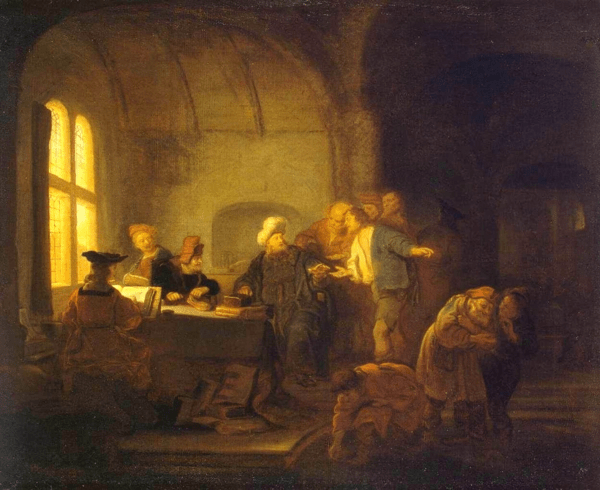
The Workers in the Vineyard, by Rembrandt, 1637

“For the kingdom of heaven is like a landowner who went out early in the morning to hire workers for his vineyard. He agreed to pay them a denarius for the day and sent them into his vineyard.

“About nine in the morning he went out and saw others standing in the marketplace doing nothing. He told them, ‘You also go and work in my vineyard, and I will pay you whatever is right.’So they went.

“He went out again about noon and about three in the afternoon and did the same thing. About five in the afternoon he went out and found still others standing around. He asked them, ‘Why have you been standing here all day long doing nothing?’

“‘Because no one has hired us,’ they answered.

“He said to them, ‘You also go and work in my vineyard.’

“When evening came, the owner of the vineyard said to his foreman, ‘Call the workers and pay them their wages, beginning with the last ones hired and going on to the first.’

“The workers who were hired about five in the afternoon came and each received a denarius. So when those came who were hired first, they expected to receive more. But each one of them also received a denarius.When they received it, they began to grumble against the landowner. ‘These who were hired last worked only one hour,’ they said, ‘and you have made them equal to us who have borne the burden of the work and the heat of the day.’

“But he answered one of them, ‘I am not being unfair to you, friend. Didn’t you agree to work for a denarius? Take your pay and go. I want to give the one who was hired last the same as I gave you. Don’t I have the right to do what I want with my own money? Or are you envious because I am generous?’

“So the last will be first, and the first will be last.” (New International Version)

Fairness

We humans have an innate sense of right and wrong, justice and injustice. We want life to be fair. It disturbs us when there is favoritism, discrimination, and preferential treatment. When things seem off, and others seem more privileged, envy can easily creep in and settle in our bones.

The envy can go even deeper. For example, is it fair that any child should struggle with health issues like cancer, epilepsy, and mental disorders? Is it fair to have healthcare disparities? Is it fair to have a spouse taken from you before their time? Is it fair to lose your job through no fault of your own? Is it ever fair to be treated like a second-class citizen?

Pat answers to people’s genuine struggles will not do, such as “You just need to work hard and hope for the best;” “We have to take what is given us and accept these things;” “Think of all those starving children in India;” or the more crass, “Suck it up buttercup; life was never meant to be a rose garden.”  Those statements are simply unhelpful.      

At the heart of envy is the belief that others are getting something that I deserve. “It isn’t fair!” we cry. Yet, God does not always operate according to our standards of fairness. God’s very nature is to be generous and full of grace. The parable which Jesus told about the vineyard workers is a story not of unfairness, but a story of generosity and grace. It’s all in how you look at it.

A normal workday in the ancient world was ten hours, not counting breaks. The workday began at 6:00am. A denarius was a typical day’s wage for laborers. The landowner went out at the third hour, 9:00am; the sixth hour, noon, etc. He kept returning to hire more workers even up to the last hour of the workday. Laborers were always paid at the end of the day.

In this parable, the last workers were paid first, which prompted the first workers hired to think they would be getting more, even though they had been promised a denarius. So, they grumbled about not getting more. They thought the landowner was not being fair.

Parable of the Workers in the Vineyard, by Johann Christian Brand, 1769

Complaining

Grumbling. Complaining. Murmuring. It is the bane of our existence. Decades ago, when gas station attendants still filled tanks for customers, I was working at a station and had a lady go berserk on me for not checking her oil and cleaning her windshield, because I did it for the car in front of her. Even though there was a sign right in front of her that said checking oil and cleaning windshields is only done upon request, the lady thought she was getting gypped. 

In truth, the landowner did not cheat nor defraud the workers in any way. He paid the agreed upon wage, just like he promised. Should he want to pay everyone the same even though the amount of work was different was his own business.

The problem was not with the owner, it was with the worker’s envy of the owner’s generosity toward the others. God distributes gifts because God is gracious, not because we have earned anything. Our standard of fairness is not the rule of the kingdom of God – grace is.

Grace

Deep down many believe we control our destiny, and that we save ourselves by what we do. We discern that if we serve God all our lives, in the end, God will reward us. We believe that our pious activities, our acts of service and our work for the Lord, will bring us salvation, or, at least a leg up in the kingdom of God over others who have not worked as hard or as long as we have. After all, we do the right thing.

So, what about those who have not figured out Christianity… those who do not have the correct or proper beliefs… or those who have not straightened out their lives? According to a worldview of human fairness, they are out of luck. They should be in church. They should work harder, faster, and better. Then, they could get their lives in order. If they would only understand fairness, we reason, then all would be well.

But there is a problem, because the parable of the workers told by Jesus seems to be saying that is not how it works at all.  Jesus seems to be saying that grace and grace alone saves, that God’s amazingly naïve and irresponsible grace is available to anyone and everybody. And that troubles the workers to no end. 

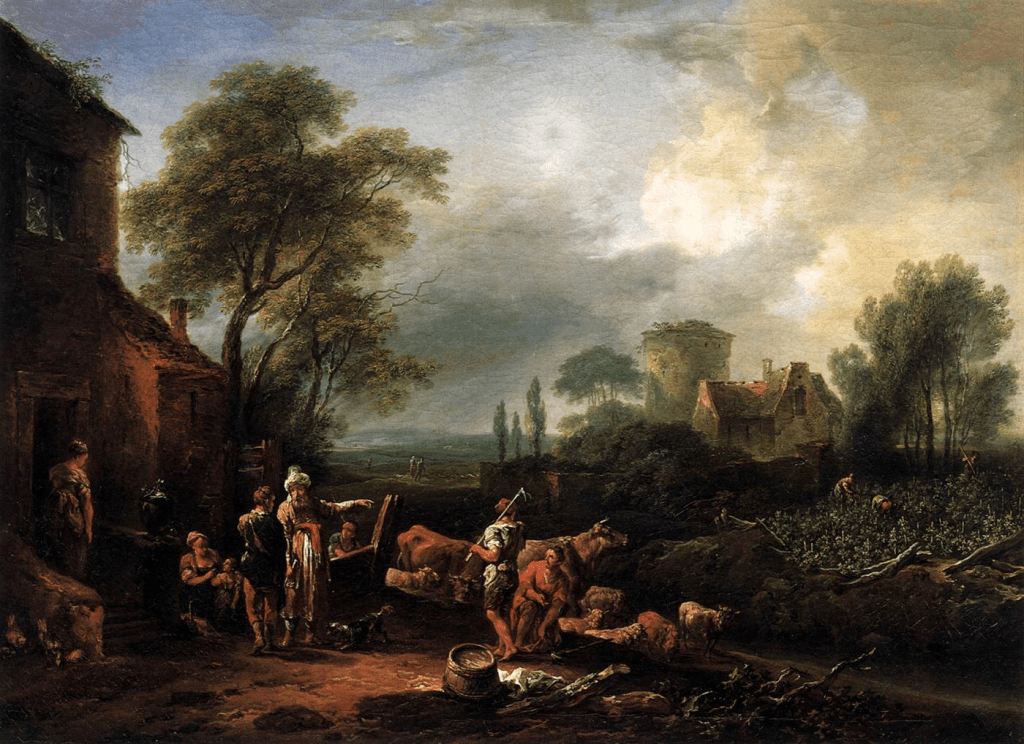
Parable of the Workers in the Vineyard, by Solomon Koninck, c.1648

What’s in it for me?

Whenever we run headlong into God’s unfair grace and see that God’s way of doing things is so far removed from our way, there is bound to be grumbling. After all, if God is going to run a vineyard like the one in the gospel lesson and give everybody the same pay regardless of their actual work hours, then what’s the use of getting up early in the morning to work? 

What is the good of sitting in church, listening to sermons from a crazy preacher who is no better than us, if these outsiders, these Johnny-and Jane-come-lately’s can waltz in at the last minute and receive the same treatment as the rest of us? For many church folks who diligently serve, it’s not fair to pay so much attention to outsiders and build ministry around people who aren’t even here, who don’t yet know Jesus.

The conclusion and point of the parable: The last will be first, and the first will be last. In Luke’s prodigal story, the elder brother grumbles and gripes: “All these years I’ve been slaving for you and never disobeyed your orders.  But when this son of yours who has squandered your property with prostitutes comes home, you kill the fatted calf!”  It is the firstborn son that complains. (Luke 15:11-32)

In both the parable of the prodigal son and the parable in today’s lesson, “good” people are the ones who fail to see the heart of the Father and of the landowner. The “firsts” got off track because, over time, they forgot the kingdom hinges on grace, not effort, on not simply doing the right things over a long period of time.

Who’s in control?

God controls the flow of mercy, not us. 

We might be surprised in heaven with those already sitting at God’s banquet table, and equally surprised with who is not there. Resentment can move us away from the table of mercy God is preparing. The problem comes whenever we think we are above other people.  We might be sinners, but we are not as bad as some other people are!  We commit ordinary sins, not mass murder!

Here is the unvarnished truth: God does not owe you nor I a thing, and God cares about all kinds of people, not just us and people who think and live like we do. Our hearts need to be big enough to center ministry around other people who are different than us.

If our hearts are small, we easily get jealous when God pays attention to prodigals and profligates. Grace becomes too repugnant a doctrine for us.

The gospel of Jesus Christ is about grace. Life is not all about being decent or even moral; and it is certainly not about our own goodness. The gospel is about being steeped in and surrounded by the grace of God in Christ, so that we, in turn, can show others grace. Grace is the way God deals with us beyond what we deserve or feel we have earned. 

Grace is unfair; we get what we do not deserve. 

May we allow God’s grace to so permeate our hearts and lives so that we will give it to others as freely as we have received.

Praise be to you, almighty and everlasting Father of our Lord Jesus Christ. In Christ, you have given us every spiritual blessing in heaven – you chose us before the world was made, and in love, to be your holy people. It pleased you to make us your own children through Jesus Christ. 

So we praise you because of your wonderful grace, given to us freely, in Christ, the one you love. We have forgiveness of sins because of this lavishly rich grace. Amen.

A Spiritual Check-Up (2 Corinthians 13:5-10)

Examine yourselves to see if your faith is genuine. Test yourselves. Surely you know that Jesus Christ is among you; if not, you have failed the test of genuine faith. As you test yourselves, I hope you will recognize that we have not failed the test of apostolic authority.

We pray to God that you will not do what is wrong by refusing our correction. I hope we won’t need to demonstrate our authority when we arrive. Do the right thing before we come—even if that makes it look like we have failed to demonstrate our authority. For we cannot oppose the truth, but must always stand for the truth. We are glad to seem weak if it helps show that you are actually strong. We pray that you will become mature.

I am writing this to you before I come, hoping that I won’t need to deal severely with you when I do come. For I want to use the authority the Lord has given me to strengthen you, not to tear you down. (New Living Translation)

God is concerned about our spiritual health and vitality. And so, it’s important that we have regular spiritual check-ups and tests to evaluate the vitality of our faith. If we are spiritually sick or debilitated, the Lord seeks to restore us back to health.

In the Gospels, whenever Jesus miraculously healed a person, it was for far more than taking away a disease or correcting a disability. The Lord sought to make them well in order to restore a person’s life by including them in the community. For example:

  • Leprosy put a person on the outside, both literally and relationally. Ceasing to be a leper meant that a person now had no obstacles to full participation in communal life.
  • Blindness reduced a person to being a beggar in order to survive. Having sight restored meant that the person can now work with others, make a living, and contribute to the needs of others.
  • Incarceration was (and still is) a complete removal of a person from society. Being in prison severs many human connections. Release from jail opens the way to reconnection and an opportunity to have a different way of being with others.
  • Poverty encumbers a person and weighs them down so heavily that it limits their ability to function socially and relationally. Without poverty, a person is able to establish healthy patterns of giving and receiving within the community.

Those who are physically whole, mentally sharp, emotionally satisfied, and spiritually redeemed are free of obstacles and impediments to communal life.

So, it is a travesty whenever the people who enjoy full inclusion in the community, turn around and separate themselves, keeping relational distance from certain persons, and do not participate in the common good of all. They makes themselves sick and weaken their faith because of their lifestyle.

The type of spiritual examination of faith the Apostle Paul was talking about was not to obsess over whether one is a true believer, or not. He was referring to the person who claims faith yet maintains separation from others. In other words, to exclude others is the kind of behavior that unbelievers do, not Christians.

Yet, there are many sections of Christianity and entire Protestant denominations who pride themselves on such separation. They believe they’re being holy and keeping themselves from impurity. However, far too many of them are really putting a sanctified spin on their own sinful predilections to avoid people they don’t like.

Paul has no tolerance for calling exclusion of others “holiness” and naming the maintenance of an insider/outsider status as “sanctification.” The Apostle knew this was all poppycock and wanted nothing to do with it.

Christ didn’t die on a cruel cross, take away the obstacles to faith, open the way to know God, and create peace through his blood for a pack of so-called “Christians” to then erect imaginary concrete border walls to keep others out of Christian community and fellowship.

In God’s upside-down kingdom, the privileged insiders are really the outsiders; and the underprivileged outsiders are actually the insiders.

The privileged believers are just as sick as the leper, the blind, the poor, and the prisoner; and just as much in need of restoration. The path to their inclusion is solidarity with the entire community of the redeemed – rather than picking and choosing who is in and who is out.

All this, of course, is another way of stating that Christianity is as beset with cliques as anywhere else – with individual believers, local churches, and particular traditions following their pet theologians and pastors and not associating with others who follow a different set of folks.

The ancient Corinthian church was a train wreck of opposing groups and cliques. The Apostle Paul had had enough of it and called the people to do some serious self-examination. And he was careful not to degrade or discourage them but to try and encourage the church to tap into the Christ which dwells within them.

Spiritual health and restoration, for Paul, meant specific behaviors which intentionally include people. To be inclusive means we actively work toward grafting people into community, as well as discourage behaviors that create division, and thus, spiritual illness. Here are three ways of including others:

  • Practice hospitality. The word hospitality literally means, “love of stranger.” A hospitable believer goes out of their way to invite another into their life, to give them the gift of relationship and fellowship.

Take care of God’s needy people and welcome strangers into your home. (Romans 12:13, CEV)

Above all, show sincere love to each other, because love brings about the forgiveness of many sins. Open your homes to each other without complaining. And serve each other according to the gift each person has received, as good managers of God’s diverse gifts. (1 Peter 4:8-10, CEB)

  • Nip bitterness in the bud. In an ideal world, everyone holds hands and sings kumbaya together. We live, however, in a fallen world. Harmony, unity, and peace take copious amounts of energy. Like an attentive gardener, we must do the work of identifying weeds and uprooting them, so they don’t take over the garden.

Make every effort to live in peace with everyone and to be holy; without holiness no one will see the Lord. See to it that no one falls short of the grace of God and that no bitter root grows up to cause trouble and defile many. (Hebrews 12:14-15, NIV)

  • Seek to encourage others, and learn how to do it. Encouragement is both a gift and a skill to be developed. To encourage another is to come alongside and help someone with both affirming words and willing hands. It’s what Jesus did (and does) for us.

Christ died for us so that, whether we are dead or alive when he returns, we can live with him forever. So, encourage each other and build each other up, just as you are already doing. (1 Thessalonians 5:10-11, NLT)

Hospitality, harmony, and help are all forms of love. And love is to be the guiding principle and practice of church and community. Love is always the prescription for a healthy spiritual life and a restored community of faith. It prevents truth decay.

Lord, make me an instrument of your peace:
where there is hatred, let me sow love;
where there is injury, pardon;
where there is doubt, faith;
where there is despair, hope;
where there is darkness, light;
where there is sadness, joy.

O divine Master, grant that I may not so much seek
to be consoled as to console,
to be understood as to understand,
to be loved as to love.
For it is in giving that we receive,
it is in pardoning that we are pardoned,
and it is in dying that we are born to eternal life.
Amen.