Clap and Shout! (Psalm 47)

Clap your hands, all you people!
    Shout joyfully to God with a joyous shout!
Because the Lord Most High is awesome,
    he is the great king of the whole world.
He subdues the nations under us,
    subdues all people beneath our feet.
He chooses our inheritance for us:
    the heights of Jacob, which he loves.

God has gone up with a joyous shout—
    the Lord with the blast of the ram’s horn.
Sing praises to God! Sing praises!
    Sing praises to our king! Sing praises
    because God is king of the whole world!
    Sing praises with a song of instruction!

God is king over the nations.
    God sits on his holy throne.
The leaders of all people are gathered
    with the people of Abraham’s God
    because the earth’s guardians belong to God;
        God is exalted beyond all. (Common English Bible)

God is King, the Supreme Sovereign over all creation and the entire universe.

In the Christian tradition specifically, Jesus is King. Christ is the One who gives shape, form, and substance to the reign of God over the earth. This is what the Lord’s ascension to heaven communicates – that Jesus sits at the right hand of God the Father, exercising a benevolent rule as the rightful monarch over all creation.

This redemptive reality of the Lord’s good reign is a cause for praise. And this is what today’s psalm is all about. We, as the subjects of God’s kingdom, are called to praise the Lord.

The psalm tells us exactly how to praise the Lord because of God’s powerful and compassionate authority: Clap your hands and shout!

For worshipers who believe acknowledgment of God is most appropriate with silence and contemplation, even a cursory reading of the psalms will inform them differently. Although it seems to me most worship experiences need more familiarity with silence, I also passionately believe they could use a whole lot more enthusiasm with clapping and shouting.

Depending upon where you fit in the spectrum of Christianity’s tradition of worship, high church or low church, very liturgical, or not, it behooves all churches to incorporate the full range of human expression to God – including both silence and shout, hands clasped reverently in prayer as well as exuberantly clapping in praise.

It’s biblical to applaud God! And it’s healthy, too – both spiritually and physically.

Whenever we fail to pause in our feelings of happiness and enjoy the moment, it’s more than a missed opportunity. Unacknowledged and unexpressed joy trains us to depress our feelings, eventually leading to depression itself. Yet, whenever we pause to outwardly demonstrate gratitude through the exuberance of shouting and clapping, it benefits everyone – God, others, and self.

Physically clapping and shouting helps keep the heart and lungs healthy, even playing a curative role with pulmonary problems. It gives relief to joint pain, gout, headaches, insomnia, and digestion. Shouting and clapping even sharpens the intellect and increases the brain’s ability. And, of course, applause is a social phenomenon which binds folks together in community.

For the psalmist, applause to the Lord is the appropriate response to God’s power and victory in the world. Since the Divine presence is everywhere – and that presence is merciful, just, and kind – we ought to take the time to acknowledge and celebrate a loving God watching over us with tender care and concern.

No matter the circumstance, God is with us. That reality alone is enough cause for exuberance and celebration. Even though evil still resides in this old fallen world, God is King, and still sits on the throne. The pastor and hymnwriter, Maltbie Davenport Babcock (1858-1901), had it right:

This is my Father’s world:
O let me ne’er forget
That though the wrong seems oft so strong,
God is the Ruler yet.
This is my Father’s world:
Why should my heart be sad?
The Lord is King: let the heavens ring!
God reigns; let earth be glad! 

It isn’t the attempt to rouse human and personal confidence which enables us to face the foulness and degradation of this world. Rather, it’s the spiritual awareness of God’s presence and power which resides around us and within us. This is the basis of our confidence, and the ground of our peace. It’s the reason for the believer’s joy, even amidst awful circumstances.

Our connection with one another as worshipers is the common acknowledgment of God’s rule and reign over all creation. And our link as followers of Jesus is the collective conviction that Christ is King, we are his subjects, and all things belong to God, including us.

Whenever we connect with this basic theology, spontaneous and joyous praise is the result. So, if we lack the joy of the Lord in our lives, the place to go is to use today’s psalm. Read it several times over, out loud. Shout the psalm! Clap while shouting the psalm! Sing the psalm aloud! Praise the risen and ascended Lord!

Just try and be morose after doing that!

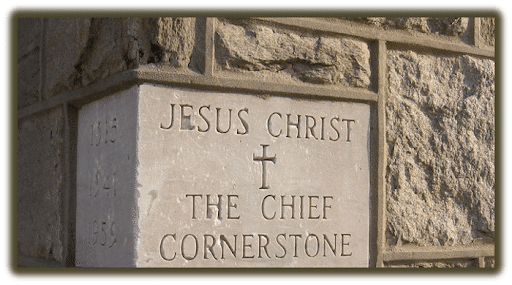
Jesus Is the Cornerstone (Psalm 118:1-2, 14-24)

Give thanks to the Lord, for he is good;
    his love endures forever.

Let Israel say:
    “His love endures forever….”

The Lord is my strength and my defense;
    he has become my salvation.

Shouts of joy and victory
    resound in the tents of the righteous:
“The Lord’s right hand has done mighty things!
    The Lord’s right hand is lifted high;
    the Lord’s right hand has done mighty things!”
I will not die but live,
    and will proclaim what the Lord has done.
The Lord has chastened me severely,
    but he has not given me over to death.
Open for me the gates of the righteous;
    I will enter and give thanks to the Lord.
This is the gate of the Lord
    through which the righteous may enter.
I will give you thanks, for you answered me;
    you have become my salvation.

The stone the builders rejected
    has become the cornerstone;
the Lord has done this,
    and it is marvelous in our eyes.
The Lord has done it this very day;
    let us rejoice today and be glad. (New International Version)

Jesus The Cornerstone, by Gloria Ssali, 2016

Indeed, today we rejoice with gladness and celebrate that Christ is risen! Christians have a firm foundation of faith that gives us strength and stability.

Everyone’s life is constructed on some sort of foundational support. If we consider a building, it’s foundation has four cornerstones. For us as people, those stones consist of the body, the mind, the emotions, and the spirit. Each of these stones is holding up the one building of our life, and so therefore, they each need our attention in order to be well maintained.

Physical

Jesus is the

Mental Spiritual

Cornerstone

Emotional

We can neither treat them as if they are different sizes (which then would never hold up the building of our life) nor as of different importance.

For example, if we get a crack in the physical stone of our life, it is insufficient to examine the mental stone and try to repair the crack through positive thinking or mindfulness. Or, if our emotional stone is damaged, it won’t get fixed by focusing on the spirit stone by only praying.

These days, a lot of people have had bad, even traumatic, religious experiences, and so they’ve jettisoned the spirit cornerstone altogether. And as their building begins to collapse, they wonder why this is all happening.

The spirit cornerstone is Jesus. We need him. We need his whole entire life – not just parts of it. Christ is not a tool that we can use and then store in the garage for next time; he’s the whole garage, and the entire hardware store. We can no more set him aside than we can set aside our lungs or our heart.

So, why do so many resist facing the cracked and damaged stones? Why resist, or even reject, Jesus? Why do so many Christians want the victory of this Resurrection Day without the hard suffering of Good Friday?

Because we are still coming to grips with what it takes to live into the victory of the Cross – yes, the Cross. There’s no new life without a death. If we want a miracle, we need to die – die to our expectations, dreams, desires, and anything we believe we need, other than Jesus.

The builders rejected the stone because it was too hard. But the reality is that you cannot build on a foundation of marshmallows. Love isn’t actually soft, but hard; it’s permanent, like solid marble; it’s not going anywhere. We need that firm base of love to construct a soul that’s worth living.

Christ’s earthly life had incredible times of miraculous healings, provisions of food and necessities, and relational connections. But that’s only part of it. There was also hardship, adversity, rejection, mockery, torture, abuse, and death. When the Apostle Paul considered it all, he said:

But whatever were gains to me I now consider loss for the sake of Christ. 

What is more, I consider everything a loss because of the surpassing worth of knowing Christ Jesus my Lord, for whose sake I have lost all things.

I consider them garbage, that I may gain Christ and be found in him, not having a righteousness of my own that comes from the law, but that which is through faith in Christ—the righteousness that comes from God on the basis of faith. 

I want to know Christ—yes, to know the power of his resurrection and participation in his sufferings, becoming like him in his death, and so, somehow, attaining to the resurrection from the dead. (Philippians 3:7-11, NIV)

Both suffering and resurrection go together for a spiritually sound life, free of cracks and damage. A new life is fresh, hopeful, and full of promise – and it’s downright hard; there is nothing easy about it. We don’t get to pick and choose which parts of Jesus we want – we must take him wholesale just as he is, the entire thing.

It’s from the person and work of Jesus Christ as our cornerstone – both his cross and resurrection – that a new building is being built into a spiritual house which is the place of hospitality for the entire world.

As you come to him, the living Stone—rejected by humans but chosen by God and precious to him—you also, like living stones, are being built into a spiritual house to be a holy priesthood, offering spiritual sacrifices acceptable to God through Jesus Christ. For in Scripture it says:

“See, I lay a stone in Zion,
    a chosen and precious cornerstone,
and the one who trusts in him
    will never be put to shame.”

Now to you who believe, this stone is precious. But to those who do not believe,

“The stone the builders rejected
    has become the cornerstone,”

and,

“A stone that causes people to stumble
    and a rock that makes them fall.”

They stumble because they disobey the message—which is also what they were destined for.

But you are a chosen people, a royal priesthood, a holy nation, God’s special possession, that you may declare the praises of him who called you out of darkness into his wonderful light. Once you were not a people, but now you are the people of God; once you had not received mercy, but now you have received mercy. (1 Peter 2:4-10, NIV)

Jesus is our cornerstone, the center of life and worship. Our priority as believers, is allowing God to build us into a community of faith that worships Jesus with lives dedicated to knowing him and making him known.

Christian worship is the expression of a relationship in which God the Father reveals himself and his love in Christ, and by his Holy Spirit gives grace, to which we respond in faith, gratitude, obedience, and love to one another and the world. 

People, at their core, exist for worship. Firmly built on Christ the cornerstone, worship becomes less about gaining truth, and more about letting truth gain us and capture us. The more we pay attention to the presence of Jesus Christ through song, prayer, Scripture, and sacrament, the more we will experience the centrality and power of God. Jesus becomes very precious to us when we align ourselves to him as the cornerstone of our faith and worship.

I urge you, brothers and sisters, in view of God’s mercy, to offer your bodies as a living sacrifice, holy and pleasing to God—this is your true and proper worship (Romans 12:1, NIV)

Jesus, as the cornerstone upon which all is supported, means that acceptable worship can happen anywhere. Everywhere can become a sanctuary and a sacred space – home, neighborhood, and marketplace – as well as church. In all these locations, Christian discipleship will prove itself.

Several years ago, a man named Matt had an aunt who had struggled for years to make ends meet. When her health started to decline, she was forced to sell her fifty acres of property to pay for health care. As an act of kindness, Matt traveled to Massachusetts and bought the land from his aunt for the appraised value of $50,000. While exploring the land to see about building a house, he discovered outcroppings of stone ledges.

Matt contracted a geologist, who surveyed the land and informed him the stone was actually Goshen stone, a type of mica used for sidewalks, patios, and landscapes. At the time, it sold for $100 a ton – and Matt had about 24 million tons on the land. The appraised value on the surface was $50,000, but experts estimated that the land was worth up to $2 billion.

Jesus is the precious cornerstone. He is much too valuable to be left in on a piece of property undiscovered. And he’s also much too needed to merely remain in a church building. He’s the cornerstone who has the resurrection power to be the foundation for all the world. So, let’s let him.

Almighty God, who through your only Son Jesus Christ overcame death and opened to us the gate of everlasting life: Grant that we, who celebrate with joy the day of the Lord’s resurrection, may be raised from the death of sin by your life-giving Spirit; through Jesus Christ our Lord, who lives and reigns with you and the Holy Spirit, one God, now and forever. Amen.

Worship That Is Fit For a King (Colossians 1:11-20)

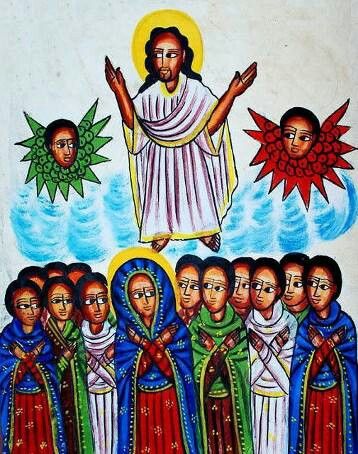
17th century Ethiopian Orthodox depiction of the glorified Christ

[May you be] strengthened with all power according to his glorious might so that you may have great endurance and patience, and giving joyful thanks to the Father, who has qualified you to share in the inheritance of his holy people in the kingdom of light. For he has rescued us from the dominion of darkness and brought us into the kingdom of the Son he loves, in whom we have redemption, the forgiveness of sins.

The Son is the image of the invisible God, the firstborn over all creation. For in him all things were created: things in heaven and on earth, visible and invisible, whether thrones or powers or rulers or authorities; all things have been created through him and for him. He is before all things, and in him all things hold together. 

And he is the head of the body, the church; he is the beginning and the firstborn from among the dead, so that in everything he might have the supremacy. For God was pleased to have all his fullness dwell in him, and through him to reconcile to himself all things, whether things on earth or things in heaven, by making peace through his blood, shed on the cross. (New International Version)

Today is Christ the King Sunday. It is intended to help us see the cosmic reality that Jesus reigns over all creation as the only rightful Sovereign of the universe. This particular Sunday always comes just before Advent so that we remember to anticipate both a baby and a king.

Christ as Lord of all exposes three problems humanity faces:

  1. Building our own petty kingdoms and setting ourselves up as masters over our own small worlds.  People who have been hurt (all of us) often attempt to seize power for themselves in order to avoid ever being hurt again, or in the belief that wielding power could have prevented others from being hurt. The classic villains of movies and literature are ones who seek to destroy the current establishment so that they can rebuild it in their own idea of how the world should operate. The destruction is motivated by protecting loved ones from pain. The irony is that a lot of hurt is inflicted on the protagonists in order to alleviate the antagonist’s pain.
  2. Bowing to other kings besides King Jesus. When distressed, we might rely on alternative authorities to address our hard circumstances – expecting another to give us what only Jesus can. Instead of running to Christ, there is a fleeing to politicians or pundits or pastors. And we rely on them to cope with whatever is going on in our lives.
  3. Lacking awareness of the power we have as subjects of King Jesus. Christians possess authority in Jesus Christ. As believers in Jesus, we reign with him and can exercise authority over every dominion that exists, especially the dominion of darkness.

Jesus is King. Neither you, nor I, are. 

A simple statement; yet, not easily engrafted into daily life. 

Part of the original sin of Adam and Even was rebellion – to break the bonds of loving authority God provided for them. Westerners, especially, tend to have an anti-authoritarian strain which runs rather deep in us.

When my middle daughter was a child and grappling with the implications of faith in Christ, she blurted out an honest cry that we can likely resonate with: “I just don’t want another person in my life telling me what to do!” 

Indeed, Jesus is King; we are not.

Christ the King Sunday reminds us of the pre-eminence and lordship of Jesus Christ: 

  • All things were created through Jesus and for him. 
  • Everything in all creation is held together by Jesus. 
  • Christ is the head of the church. 
  • In Jesus Christ, complete divinity exists and reigns. 
  • Jesus made peace through the cross because he had the authority and the qualifications to do so. 
  • Broken relationships and proper lines of authority are now restored and redeemed in Christ.
Ethiopian Orthodox depiction of the glorified Christ

We can also likely relate to, at times, indulging in the illusion (and delusion!) of being in control and independently dictating the course of our lives. Yet, mercifully, Jesus is the great sovereign King, and this is a good thing – because in Christ we find authority to redeem and reconcile. 

Because Christ is King, we really ought to submit to him. In fact, we need to pay some attention to how our bodies are to submit to his lordship.

When the body moves to animating physical actions of submission, this helps the heart to follow. Whole person worship involves engaging the mind, spirit, emotions, and, yes, the body. To neglect the body in worship is to truncate the ability to connect with God in Christ.

A typical metaphor for the Church is the “Body of Christ.” We can live into that phrase through an embodied spirituality of submission. Our individual bodies are temples of the Holy Spirit, important for expressing worship. (1 Corinthians 3:16)

God created us with literal physical bodies. And Jesus has a literal physical body. Bodies are important for whole person worship. This means the physical postures we take in worshiping King Jesus are significant. We need to pay attention to them.  

A healthy practice for Christians is to kneel in the presence of the Lord. I realize some Christian traditions do it as a part of their worship, and some do not. Some like it, some don’t. Yet, bowing, even prostrating oneself (if you are physically able!) can be a powerful symbol of the heart’s desire and disposition to submit to the lordship and authority of Jesus Christ. 

Crawling out of bed in the morning getting on your knees and beginning the day with submission to live into the will of God; and also ending the day in the same manner, is a practical way of remembering who Jesus is and who we are.

I believe all Christians need to feel free in adopting a physical posture of worship which helps them connect with God in Christ. For some, that will be sitting in a comfortable position in contemplation. Others will want to stand, raise their hands, even dance in praise.

It also behooves us to let our bodies respond to whatever is happening with us spiritually. Exuberant praise needs the expression of hand clapping and toe tapping. Confession of sin needs a bit of bowing, kneeling, even prostrating. For prayer, hands open and palms facing up to receive blessing from God is a good bodily position of worship.

You get the idea. Just remember we need to strive for congruence in our worship, that is, what is happening with our outward bodily movements needs to match what is occurring inward with our spirits. And when the two are in sync, meaningful worship can happen – worship of submission fit for a king.

Sovereign God, in your mercy you have sent your Son, the Lord Jesus, who has brought reconciliation to a once broken relationship. I bow before you in obedience, submission, and worship. Let me live a cross-shaped life through enjoying the peace you have given me in Christ in both body and soul. Amen.

Luke 19:45-48 – Jesus Cleans House

A bronze panel of Jesus chasing the merchants from the Temple by Lorenzo Ghiberti (1378-1455)

When Jesus entered the temple courts, he began to drive out those who were selling. “It is written,” he said to them, “‘My house will be a house of prayer’; but you have made it ‘a den of robbers.’”

Every day he was teaching at the temple. But the chief priests, the teachers of the law and the leaders among the people were trying to kill him. Yet they could not find any way to do it, because all the people hung on his words. (New International Version)

Jesus seems a bit like an actor in an old western movie. He’s the sheriff who drifts into town, sizes up the situation, shoots up the bad guys, defends the women and children, and cleans up the town. 

It’s a side to Jesus that might surprise some.

Jesus is no simple one-dimensional person, as if he’s always calm and picking dandelions. Christ is fully human and fully God – a complex person full of both human and divine anger. Today’s Gospel lesson reminds us that Jesus defies stereotyping, and that we need to see a fuller profile of who he is, and what he is up to.

Jesus is not only the merciful servant who graciously heals at the temple; but he is also a mighty judge who is intolerant of unjust systems and cleans house. 

Because Jesus is superior to everything, he is not some Being that we can domesticate for our own personal use. He did not come to this earth as some sort of spiritual vitamin supplement, or to be on call 24/7 in order to bail us out when we need it, or help us get ahead in life.

Instead, zeal for his Father’s house consumes Jesus. (John 2:13-17)

Jesus driving the merchants out of the Temple by Raymond Balze (1818-1909)

Christ sought to please the Father. Jesus oversees what the church and Christians are supposed to be. 

It’s our task to conform to Christ, and not the other way around. 

That happens whenever we let Jesus be the sheriff who drives out our sin, and, at the same time, the town doctor who brings the needed healing to our lives. 

Jesus cleaned house by attacking the system he saw operating.

It was Passover, the time when all pious Israelites made the pilgrimage to Jerusalem. Cattle, sheep, and doves were used for sacrifices. And the only place where those sacrifices were made was at the Temple in Jerusalem.  This meant that anyone wanting to worship God from outside of Jerusalem would have to do some traveling. 

Over time, a system was set up: Vendors established kiosks which lined the Temple courts; and they sold animals for the required sacrifices, as a matter of convenience. 

Since there were thousands of folks who came from a long way, often from outside of Israel, they brought their foreign currency with them, and it could be exchanged at the tables set up by money-changers.

Perhaps that all sounds practical. A little capitalism which provides a service for the people doesn’t seem all bad. So, what’s the problem? 

Jesus didn’t have a problem with capitalism per se; his problem with the whole system is that it should not even exist – these guys should not be in the Temple, at all! 

Jesus attacked the system and made a western movie scene out of it because the vendors and money-changers, even if using sound business practices (which they weren’t) should not even be there. For Jesus, it trivialized the Temple and took away from its intended purpose as a house of prayer for all nations.

Here’s how the system was supposed to work:

Coming to the Temple from outside of Jerusalem was never intended to be easy or convenient.

Making the pilgrimage to Jerusalem was supposed to be difficult. For the past year, since the last Passover, a family raised a newborn lamb in their house. Parents and children all took part in caring for it.

Then, when it was time, they all journeyed to Jerusalem together, taking turns carrying the year old lamb over their shoulders. Everyone knew what was coming. Their precious lamb, now a cherished part of the family, would be given in sacrifice at the Temple.

It was all a very powerful reminder of sin’s cost and how terrible it truly is.

Entering Jerusalem with no animal, and only money to buy one, is a cheap facsimile of real worship.

It misses the entire point of the system. It hinders people from genuinely connecting with God through prayer.  And Jesus will not put up with it – to the point of violently driving the whole system out of the Temple.

Jesus didn’t mess around with the sinful system. He didn’t politely ask the money-changers to move their tables somewhere else; he didn’t strike a deal with those selling animals to market them at cost. No. Instead, he went all town sheriff on them because the whole system was a blasphemous act against the right and true worship of God.

It has been the sin of the Church, through the centuries, to find ways of doing ministry and worship by not actually doing it (e.g., selling indulgences). 

We might feel good by simply attending a worship service, or offering some obligatory prayers, and giving money without having done anything to meaningfully connect with God. Our devotion may not be toward bringing something of ourselves to sacrifice by using our spiritual gifts and laying our lives down for others. 

It’s really a heart issue. For example, we might rightly give to missionaries or mission projects. Yet, if we give without any thought to doing missions ourselves and being missional people, then we are in grave need of having a clean house by overturning the tables in our hearts. 

17th century Ethiopian depiction of Christ cleansing the Temple

Jesus cleaning house was not an end in itself; he did it so that the Temple could be used for its intended purpose: A house of prayer. A place of healing. A gathering of collective praise to God.

Whenever an existing system is challenged, there will be those who push back because they benefit from the way things are.

The religious leaders were incensed by Christ’s systemic change. The behavior of Jesus challenged their authority, and they were angry about losing some of their power – not to mention jealous and envious that the people hung on his every word.

Jealousy rots the bones. Envy and selfish ambition accompany every evil practice and are behind every evil system. (Proverbs 14:30; James 3:14-16)

The real culprit behind the Temple system, as well as our own conflicts and disagreements is our selfish anger, our abject jealousy that someone else is receiving something which should be mine, and our insidious envy of wanting what another has.

Jesus knew he would upset and anger the religious leaders. But he cared enough about the proper place of worship that he attacked the contrived Temple system that fed on obscuring what real sacrifice was. Christ was willing to take on the establishment and reestablish a house of prayer for all people.

The way for us has been made clear through the death of Christ. Jesus has removed the old system and replaced it with the new. (Hebrews 8:13)

Therefore, we ought to be a beacon of hope for all who are coming to God and desire to offer their sacrifice of service or praise. We must eliminate any system, rule, or practice that eviscerates true worship.

May we follow the Lord Jesus by being active and proactive in making the way clear for others to come to God. And the first step to doing so is by having God clean house on our own hearts.

It’s what a good deputy sheriff would do.

Create in me a clean heart, O God,
    and put a new and right spirit within me.

The sacrifice acceptable to God is a broken spirit;
    a broken and contrite heart, O God, you will not despise. Amen.