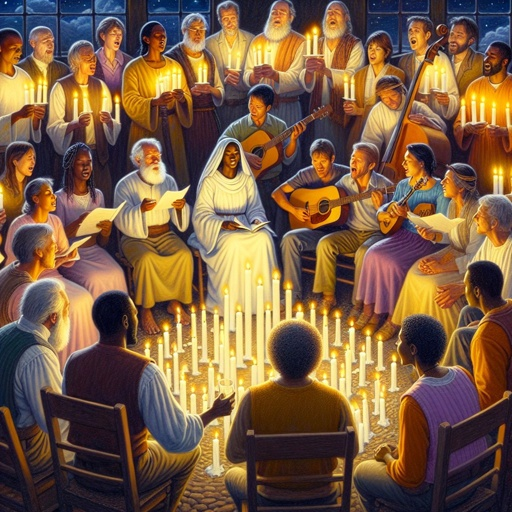
Sing Psalms and Hymns and Spiritual Songs to One Another (Ephesians 5:15-20)

By Bible Art

Be careful, then, how you live, not as unwise people but as wise, making the most of the time, because the days are evil. So do not be foolish, but understand what the will of the Lord is. Do not get drunk with wine, for that is debauchery, but be filled with the Spirit, as you sing psalms and hymns and spiritual songs to one another, singing and making melody to the Lord in your hearts, giving thanks to God the Father at all times and for everything in the name of our Lord Jesus Christ. (New Revised Standard Version)

It’s unlikely I need to tell anyone that the days are evil. The world is upside-down and topsy-turvy with injustice, waywardness, and narrow partisanship. In fact, there is a lot of similarity to the Apostle Paul’s time. Maybe that’s why Paul exhorted the church not to drown their sorrows in a bottle of spirits, but to be filled with the Spirit.

Perhaps, because of the times we live in, you don’t feel much like singing. You might not be finding much in your life right now to sing about. Yet, maybe singing is the very thing we need.

An inebriated person says and does things that they would not typically say or do when they’re sober. The Apostle’s point about being filled with the Spirit is that, instead of doing and saying foolishness, we are to be so filled with God that we do and say wisdom that we wouldn’t typically do and say, if not filled with God. 

Without the fullness of God’s Spirit, we end up mumbling, not singing; worrying, not making music in our hearts; complaining and arguing, not giving thanks. Half-filled Christians can only practice a half-hearted Christianity. And they’re only half-baked in their service and devotion to Christ.

Why sing? 

Because singing is part of being filled with the Spirit of God. Singing happens when we experience God’s overflowing grace in our lives through the blessings of being chosen, adopted, and redeemed into God’s new community. (Ephesians 1:3-11)

Music is powerful. It’s not only a means of expressing praise and commitment to Christ and each other, it is also a powerful means of remembering.

For example, when we first teach kids the alphabet, we teach it in a song. Trying to teach letters in a rote fashion doesn’t work well for pre-school kids. But words set to music is why we can still remember words from old TV shows, because those words were set to a catchy tune (alas, the lyrical theme from Gilligan’s Island will forever be in my head).  Music is why an Alzheimer’s patient doesn’t remember her daughter’s name, yet can flawlessly sing all four verses of Amazing Grace.

Singing is an offering and a sacrifice of praise to God (Hebrews 13:15). And singing is also a vehicle whereby we are taught, encouraged, and built up in the community of believers. We sing to God, one another, and even to ourselves.

Christian music, then, is to be both a means of praising God and a practice of encouraging each other. We accomplish this through singing psalms, hymns, and spiritual songs.

Sing Psalms

The word “psalm” helps us rightly think of the biblical book of Psalms. Singing the psalms is an ancient practice, going all the way back to the Israelites singing psalms in the temple and synagogue. The early church maintained this practice, especially as a means of being faithful to praying without ceasing. 

However, over time, medieval congregations began neglecting the practice. In fact, European congregations eventually gave up most singing altogether. Almost all the singing was done by church choirs and professional musicians employed by the king (there was no separation of church and state) to write, compose, and perform in worship services. 

Five-hundred years ago, during the Reformation, Martin Luther reinstituted congregational singing. He gave music back to the people. One of the results of this change was putting the book of psalms to song – the Psalter.  For many Protestant denominations, the Psalter became the primary means of singing. The Psalter chiefly set prayers to song. It was both a means of expressing prayer to God and learning Scripture.

Singing Hymns

There have always been hymns in the church. Yet, it was not until the Reformation that hymns began to be written and sung by congregations. For the Reformers, hymns were used to teach sound doctrine and theology, as well as a means of confessing the faith together

A mighty fortress is our God,
a bulwark never failing;
our helper he, amid the flood
of mortal ills prevailing.
For still our ancient foe
does seek to work us woe;
his craft and power are great,
and armed with cruel hate,
on earth is not his equal. (Martin Luther, 1529)

Singing Spiritual Songs

Spiritual songs are the present day equivalent of praise and worship choruses, or what some refer to as contemporary songs. These are songs purposefully designed to be emotional expressions of praise to God and to give powerful testimony for what God has done or is doing.

Remember When You Sing…

  • Psalms are used to pray and learn Scripture.
  • Hymns are used to teach us sound doctrine and confess the faith together.  
  • Spiritual songs are an important way of expressing praise to God and being encouraged in the faith. 

Therefore, church music is to serve as both a revelation from God, and as a response from God’s people.

There are two important deductions from the Apostle Paul’s exhortation:

  1. A variety of songs is inferred and expected
  2. Their use is commanded

The reason worship style seems always to be a controversial topic is because everyone has their personal preferences. And yet, if we are to be faithful to today’s New Testament lesson, we will do more than focus on what I want. 

Truth be told, we are selfish people when it comes to music. We want what we want, and we don’t care what somebody else wants. And we’ll persist in that self-absorbed spirit until somebody calls us on it… That somebody is the Apostle Paul. Scripture calls us to encompass psalms, hymns, and spiritual songs – all three of them – in our worship.

I have an old friend who is an accomplished church musician and worship pastor. I once asked him how I can lead a worship service among such a variety of preferences concerning music. He answered my question with a question:

“How highly do people, including and especially your musicians, value the unity of the church? Do they love each other so much that they can allow for a wider range of style, and do so without vocally complaining about it?”

My friend went on to say, “When I arrived at one church as their pastor, some people were in a rather bad habit of saying very openly, ‘Oh I hate that song,’ or, ‘If I hear this song one more time I’m walking out.’ What I tried to do was teach people that this is not the most loving or mature approach; and it does little to build up the rest of the Body of Christ.”

If a group of people are being faithful to Scripture, and doing their best musically, then – if the music seems lifeless, dull, or strange to us – the real issue isn’t style but our hearts.    

A heart filled with the Spirit of God will speak to others using the Psalter, time-honored hymns, and fresh new contemporary songs. The result is believers built up in the faith.

Gracious God, give us grace to take to heart the great dangers we are in by our unhappy divisions about all kinds of things, including music. Take away all hatred and prejudice, and whatever else may hinder us from godly union and harmony, so that as there is but one body and one Spirit, one hope of our calling, one Lord, one faith, one baptism, one God and Father of us all, we may from this time forward be all of one heart and of one soul, united in one holy bond of peace; and may with one mind and one mouth glorify you, through Jesus Christ our Lord. Amen.

The Son (Hebrews 1:1-4)

In the past God spoke to our ancestors through the prophets at many times and in various ways, but in these last days he has spoken to us by his Son, whom he appointed heir of all things, and through whom also he made the universe. The Son is the radiance of God’s glory and the exact representation of his being, sustaining all things by his powerful word. After he had provided purification for sins, he sat down at the right hand of the Majesty in heaven. So he became as much superior to the angels as the name he has inherited is superior to theirs. (New International Version)

For Christians everywhere, we are only a few days until the culmination of Advent season: observing, remembering, and celebrating the birth of our Lord and Savior, Jesus Christ.

Christianity discerns that all of history hinges on it’s midpoint of the incarnation and birth, life and ministry, death and resurrection, and ascension and glorification of Jesus. Everything in the Bible looks to Christ.

The entire Old Testament Scriptures point forward to the time of Christ; the Gospels focus upon him; and all the rest of the New Testament points back to Jesus as the fulfillment of all God’s good promises to people.

Indeed, the Lord Jesus is central to everything in the Christian’s world and life view. Jesus Christ is the center of all Christian worship, Christian belief, Christian practice, Christian ethics, and the entirety of the Christian life.

The New Testament book of Hebrews has a lot to do with this approach to life. It’s overarching theme and focus is to point out and demonstrate the superiority of Jesus over everything and everyone in all of history.

And the reason the author of Hebrews takes pains to do this for a lengthy thirteen chapters, is that his recipients needed the reminder and the exhortation that their difficulties and hardships in living the Christian life is worth it. Jesus is worth completely centering our lives around because he is indeed the central figure of literally everything.

Historically, God spoke through many prophets. Yet, Jesus is the ultimate prophet, because he is not merely a servant of God; Christ is the very Son of God who is over all of God’s big world – and even participated in making the world.

Like Father, like Son. Jesus Christ exemplifies and shows us the very nature of God. He is the light of God’s glory, representing God in all his words and ways of being in the world.

What’s more, Jesus not only came to reveal God to us, but also to get involved in saving us from ourselves by actually becoming one of us. And after all his work was done, and his earthly life over, he sat down in his rightful place – showing us that it is finished, once and for all.

We need no longer try and purify or perfect ourselves, to try and fix all that we have messed up in this life, or to prop up our fragile egos to make it at least look like we have it all together. None of this is needed because the Lord Jesus Christ became our Savior, delivering us from a hole so deep that there was no way we could ever climb out of it on our own.

So, it is rather ironic that people (even and especially Christians) can let Jesus get pushed out of the Advent and Christmas seasons as less than superior to our worries about finances, discouragements about family, and wonderings about the future. Advent is intended to put our focus and our delight where it rightly belongs, in Jesus Christ, our Lord and Savior.

Embedded within the season of Advent are a message and a mission. The Gospel of John begins with the great proclamation that the Word became flesh and made his dwelling among us. God enters into human history in the person of Jesus. It is a message of grace and hope, completely centering around Christ. 

It is also a story – the greatest ever told – of the Creator God loving the creatures so much as to become one of them. This redemption narrative gives shape to our own witness. We simply tell the story of God’s love to humanity through the sending of the Son, Jesus, to deliver us from sin, death, and hell and bring us into a kingdom full of grace, joy, wholeness, and love.

Some may believe that Jesus laid aside his glory in order to be among us. I disagree. I believe that coming to this earth was the logical and loving thing to do in order to show and live into the radiance of God’s glory.

The word “glory” in the Hebrew Scriptures literally means to be “heavy.” In other words, God carries a lot of weight, namely because God is able to do so. That is, God is glorious. To enter this world and bear the great burden of human suffering and sin is perhaps the most glorious thing that God could ever do.

So, when we talk of the glory of God in Jesus Christ, we are really talking about the ultimate burden bearer showing who God is really like. The God, who is Love, is the God of glory, and the two are actually both sides of the same coin.

Therefore, Christians, the little Christs who walk about this earth, show the light of the glory of God in Jesus Christ when they carry one another’s burdens:

Carry each other’s burdens, and in this way you will fulfill the law of Christ. (Galatians 6:2, NIV)

In a few days, gift giving and receiving will take place. And that is appropriate. What is also more than appropriate is to be able to relate to each other in such a way that we are showing the radiance of Jesus Christ in helping others carry their heavy emotional and/or spiritual loads.

As light comes into this world through the birth of the Son, so also let your light shine before others, so that they may see your good deeds and glorify your Father in heaven. (Matthew 5:16) Amen.

Living Stones (1 Peter 2:4-10)

As you come to him, the living Stone—rejected by humans but chosen by God and precious to him—you also, like living stones, are being built into a spiritual house to be a holy priesthood, offering spiritual sacrifices acceptable to God through Jesus Christ. For in Scripture it says:

“See, I lay a stone in Zion,
    a chosen and precious cornerstone,
and the one who trusts in him
    will never be put to shame.”

Now to you who believe, this stone is precious. But to those who do not believe,

“The stone the builders rejected
    has become the cornerstone,”

and,

“A stone that causes people to stumble
    and a rock that makes them fall.”

They stumble because they disobey the message—which is also what they were destined for.

But you are a chosen people, a royal priesthood, a holy nation, God’s special possession, that you may declare the praises of him who called you out of darkness into his wonderful light. Once you were not a people, but now you are the people of God; once you had not received mercy, but now you have received mercy. (New International Version)

The Apostle Peter describes Christians as “living stones” that form the temple of the Lord. In our worship we are like priests, carrying the sacrifices of praise and thanksgiving into the presence of God.

This is who we are; it is our identity. Christians belong to God in Jesus Christ through the power of the Holy Spirit. We have been formed – and continue to be formed – into the people of God as one, holy, catholic, and apostolic Church.

The word for stones in today’s text (Greek λίθος) specifically refers to large stones that have been hewn into shape. So Christians, as God’s holy people, have been set apart and shaped for the purpose of worshiping Jesus Christ. Instead of offering the blood of bulls and goats, like the select group of Old Testament priests did, we are all priests who now offer spiritual sacrifices because Jesus has taken care of the sin issue once for all. 

Christians continually offer to God the worship of Christ, and a holy life, in grateful response to Christ’s sacrificial death on our behalf. Jesus Christ is the Christian’s cornerstone and center, and is to be the Church’s passion and priority. In worship, God builds us into a community of faith who dedicate ourselves to knowing Jesus and making him known.

All of life (and not just a Sunday worship service) is to be a daily rhythm of God’s revelation to us, and our response to God in faith, thanksgiving, and an obedient life.

We were chosen to serve God, and to exist for worship. Worship is grounded in the triune God and centered in Christ. Worship is the heart and life response to the revelation of God in Christ. Genuine encounters of God’s revelation to us, and our response to those experiences, form us into disciples of Jesus.

For those who refuse God’s perspective, Jesus Christ is experienced as an obstacle. He becomes the rock which causes them to stumble and fall. Although the early Christians for whom the Apostle Peter addressed were often humiliated and ostracized, they are nevertheless God’s elect, honored, and precious people.

Peter, who was named “Rock” by the Lord himself, wanted his audience to know that they, too, are known by God as rocks, as precious living stones. So, he explained their identity by pointing out the parallels between them and Christ:

  • Christ is the living cornerstone—Christians are living stones
  • Christ was rejected by humans—Christians are strangers in the world
  • Christ is God’s chosen One—Christians are God’s elect
  • Christ is venerated by God—Christians are esteemed by God

Jesus has so closely identified with us, God’s people, that we are in a vital union with him. On account of Christ’s rising from death, Christians are like living stones who are acceptable to God through Christ.

As the late salesman on television from decades ago, Ron Popeil, used to say, “But wait, there’s more!” Christians have been born again, experiencing rebirth into a new life. Our identity has given us great privilege as building blocks into the following:

  • Incorporation into a new community, a temple that shares in God’s honor and symbolizes God’s presence and power
  • Membership in a holy and royal priesthood, offering spiritual sacrifices of holiness and love (1 Peter 1:15, 22)
  • Inclusion into the chosen people—a disparate people who share together in common values, patterns of living, and redemption
  • Citizens of a holy nation who enjoy a covenant relationship with God and worship the Lord who brought them out of darkness and into light

God has created a community of people in Christ who did not previously exist. Together as Christians and people of God, we celebrate Jesus in worship and revel in his saving mercy, which has given us fresh hope and new life.

Therefore, I humbly and proudly adopt the identification of “Christian.” I am here because of Jesus Christ and all the faithful believers who came before me on the firm foundation of the apostles and prophets. I am part of the great stone structure called the Church. I know who I am. I know who my people are. And that sense of belonging no one can ever take from me.

Soli Deo Gloria

Lord of heaven and earth, we pray that you will bring justice, faith and salvation to all peoples. You chose us in Christ to be your people and to be the temple of your Holy Spirit; we pray that you will fill your Church with vision and hope. In the baptism and birth of Jesus, you have opened heaven to us and enabled us to share in your glory: the joy of the Father, the Son, and the Holy Spirit. May your whole Church, living and departed,

come to a joyful resurrection in your city of light. Amen.

Rituals Are Important (Exodus 13:1-10)

The Passover Meal (Last Supper) by Jess Santos

The Lord spoke to Moses, “Set apart every firstborn male for me. Every firstborn male offspring among the Israelites is mine, whether human or animal.”

Then Moses said to the people, “Remember this day—the day when you left Egypt, the land of slavery. The Lord used his mighty hand to bring you out of there. Don’t eat anything made with yeast. Today, in the month of Abib, you are leaving Egypt. The Lord swore to your ancestors that he would give you the land of the Canaanites, Hittites, Amorites, Hivites, and Jebusites. When he brings you into that land flowing with milk and honey, you must observe this ceremony in this month.

“For seven days you must eat unleavened bread. The seventh day will be a pilgrimage festival in the Lord’s honor. Only unleavened bread should be eaten during these seven days. No sourdough or yeast should be seen anywhere in your territory. On that day tell your children, ‘We do this because of what the Lord did for us when we left Egypt.’ This festival will be like a mark on your hand or a reminder on your forehead that the teachings of the Lord are always to be a part of your conversation. Because the Lord used his mighty hand to bring you out of Egypt, you must follow these rules every year at this time. (God’s Word Translation)

Rituals are an important part of being human. They help us to observe significant events, specials seasons, and daily routines. Ritual activities are meaningful re-telling of stories for us and others. In other words, rituals activate memory, enabling us to remember what is of value.

Religious traditions are typically filled with rituals, in order to remind the faithful of what is significant about their faith. Unfortunately, there are some Christian traditions which have a negative view of ritual, believing it to be “vain repetition.”

The problem, however, is not with rituals themselves; the issue is with the one performing the ritual. If it is done with a disconnect between head and heart, then the ritual does not accomplish it’s intended goal of helping the community to remember and giving meaning in the present time.

“Ritual is not simply an attitude or intention, just as love is not simply a feeling. At its most basic, ritual is something that you do. A man can’t plow a field just by thinking about it; he must go out to the field and get to work. If he is fully present to the work and acts with mindfulness and loving attention – if he brings his whole self along – then even as he turns over the rich soil beneath the plow, he turns it over in his mind and heart, as well. The act of tilling the soil becomes an act of tilling the soul.”

Alison Leigh Lilly

No matter whether folks are religious, or not, all people engage in rituals. For example, here are some rituals many people do in order to remember, celebrate, and renew an old story:

  • Birthdays (remembering and re-telling the birth story)
  • Graduations (remembering and re-telling the story of school)
  • Marriages & Anniversaries (remembering and re-telling the courtship story)
  • National Holidays (remembering and re-telling the patriotic story)
  • Dinner and/or Bedtime (remembering and re-telling stories from the day)
  • Morning (remembering and re-telling my story of purpose and meaning)
  • Earth (remembering and re-telling the seasons of Spring, Summer, Fall, and Winter)
  • Annual sojourns to special places such as vacations, sports stadiums, or reunions (remembering and re-telling the story of friendship and family).

The reasons people do such rituals are to

  • Re-enforce values
  • Have a sense of belonging
  • Mark time in a meaningful way
  • Form personal and healthy habits
  • Remind of us of who we are and what our purpose in this world is

Avoiding rituals can cause a lack of identity and purpose. Failing to observe rituals can also create loneliness, confusion, and emptiness.

“Rituals are those repeated actions done again and again in the interest of things like focus, grounding, tradition, cultural symbolism, predictable life rhythms, and feeling a part of something bigger than ourselves.”

Craig Kelley

The Lord gave divine instructions to the newly freed Israelites. And those commands involved instituting some ritual behavior, to be done year after year. God told them to observe a Passover ritual each year so that the story of Israel’s deliverance from Egyptian slavery would remain alive for the generations to come; and so that the event itself would have meaning for people in the present time.

Because Yahweh spared the firstborn of Israel’s children and livestock – and not the firstborn of Egypt – those same firstborn are to be given to God, in some sort of vicarious ransom. All the symbols of Passover are meant to be reminders of what the Lord had done for Israel.

The exodus event is to be actualized, made real for the generations today. By means of ritual, the relationship between God and the people is remembered and renewed for each new generation. Engaging in the ritual repeatedly helps press the story and it’s reality into both the mind and the heart.

And this is precisely what worship is supposed to do for the Christian. Ideally, a worship service is a re-enactment of Christ’s redemption for believers. Even more, it’s a dialogue between God and the people in which the Lord speaks and the worshipers respond.

One ritual which unites all Christians together is the Lord’s Table (communion, or the Lord’s Supper, or the Eucharist). Each Christian tradition has their particular views and theology surrounding it – yet it’s common to all. Observing the Table is a ritual which has been going on for two-thousand years; and which has it’s roots in the Passover and the original meal at the time of the exodus.

The Table is a time of remembrance, communion, and hope. We retell the story of Christ’s redemption and remember the Lord’s once for all sacrifice on the cross for the whole world. It is a unifying ritual, where believers commune together. And the Table expresses hope – that just as we eat and drink now, we will do so all together at the end of the age at the great supper of the Lamb.

Yes, rituals have meaning and it’s symbols are significant. They help us to express our shared humanity together.

May the love of Christ be active in your heart, be heard in your words, be seen in your actions and inform your choices today and every day. Amen.