Prayer Is the Heartbeat of the Church (Acts 1:12-17, 21-26)

“The Forerunners of Christ with Saints and Martyrs” by Italian painter Fra Angelico (1395-1455)

Then the apostles returned to Jerusalem from the hill called the Mount of Olives, a Sabbath day’s walk from the city. When they arrived, they went upstairs to the room where they were staying. Those present were Peter, John, James and Andrew; Philip and Thomas, Bartholomew and Matthew; James son of Alphaeus and Simon the Zealot, and Judas son of James. They all joined together constantly in prayer, along with the women and Mary the mother of Jesus, and with his brothers.

In those days Peter stood up among the believers (a group numbering about a hundred and twenty) and said, “Brothers and sisters, the Scripture had to be fulfilled in which the Holy Spirit spoke long ago through David concerning Judas, who served as guide for those who arrested Jesus. He was one of our number and shared in our ministry….”

Therefore it is necessary to choose one of the men who have been with us the whole time the Lord Jesus was living among us, beginning from John’s baptism to the time when Jesus was taken up from us. For one of these must become a witness with us of his resurrection.”

So they nominated two men: Joseph called Barsabbas (also known as Justus) and Matthias. Then they prayed, “Lord, you know everyone’s heart. Show us which of these two you have chosen to take over this apostolic ministry, which Judas left to go where he belongs.” Then they cast lots, and the lot fell to Matthias; so he was added to the eleven apostles. (New International Version)

So, what do you do when you don’t know what to do? And what do you do when you have a problem or challenge?

Good old American ingenuity, the Protestant work ethic, and fixing things is the reflexive response of many people. In the belief that we can solve anything, what typically gets left out of the equation is seeking God’s presence and power in order to rightly discern next steps.

But that wasn’t the response of the earliest church. When faced with their small numbers and a large mission to accomplish, they prayed. They more than prayed. They continually got together, just to pray. Prayer was the air they breathed. The believers understood they needed God (not simply to rubber stamp their plans) for moving forward in mission and ministry.

Christians need the vision and imagination that can only come through consistent daily prayer. Otherwise, they will not choose wisely and find themselves in a quandary of their own making.

Imagine not having to purchase what you need the most today.

Maybe you’re in a real pinch. Your financial budget isn’t budging. Perhaps you’re wondering what items you need to do without for a while. It could be that the bills aren’t all getting paid. Or maybe you’re concerned with how in the world you’re going to buy Christmas presents for the family.

Imagine having all the love you need today without working to earn it.

Maybe you have a strained relationship. It might be that you’re hurt from a marriage or a love that has gone sour. Perhaps a friendship is on the rocks, or a family member won’t talk to you. You’re wondering if it will ever be better, wondering if love will find you again.

Imagine continually having a church experience of being full of the grace of Jesus, the love of God the Father, and the power of the Holy Spirit.

Maybe your church has a legalistic bent. Perhaps the church is withdrawn into cliques and special interest groups. It could be that the Spirit hasn’t shown up since 1959. You’re tired, weary of the chronic sameness and status quo of a stagnant place.

For all these things, and so many more of life’s problems and situations, there is good news… really good news!

Prayer is the currency to what you need most, the means of receiving and giving love, and the path to a gracious and powerful Christian and Church life.

Prayer is the heartbeat of the church. The promise of prayer still stands. God gives. We receive. But we must ask!

You didn’t choose me, but I chose you. I have appointed you to go, to produce fruit that will last, and to ask the Father in my name to give you whatever you ask for. (John 15:16, GW)

Sometimes God just gives without us asking. That’s great. Yet, God wants so much more for you and me and our faith communities. God longs for us to be vitally connected to Christ, and that connection happens through prayer. We can bank on the answers to our prayers when we:

  • Stay joined to Jesus (John 15:4)
  • Let Christ’s teachings become part of you (John 15:7)
  • Remain faithful to Christ’s love for you (John 15:9)
  • Obey Jesus (John 15:10)

Imagine having your will align with the perfect will of God.

Stay joined to me and let my teachings become part of you. Then you can pray for whatever you want, and your prayer will be answered. (John 15:7, CEV)

Perhaps you are skeptical. You’ve prayed a long time with nothing happening. You’re discouraged and feel like prayer doesn’t work, or that something is wrong with you. 

There is a mysterious and mystical aspect to prayer that we will never quite understand. However, I do know that Jesus didn’t put a timetable on the answers – they will come when they come. And they will come. 

Maybe we’ll discover that what we want and need the most is to let God’s will and way be done in us, no matter what it is. Perhaps the point is to change us, and not always to change our circumstances.

We have an incredible privilege; we get to ask, without having to buy answers to prayer.

We don’t have to do backflips to get God’s attention. We simply ask. 

We don’t have to try and work to earn God’s favor. We don’t have to draw up detailed plans like some sort of architectural design to see a fruitful, loving, and powerful church. We just ask and remain closely connected to Jesus. 

O Lord, grant me to greet the coming of this day in peace. 

Help me in all things to rely upon Your holy will. 

In every hour of the day, reveal your good and holy will to me. 

Bless my dealings with all who surround me. 

Teach me to treat all that comes to me throughout the day with peace of soul and with the firm conviction that your will governs all. 

In all my deeds and words, guide my thoughts and feelings. 

In unforeseen events, let me not forget that all situations, no matter what, are sent by you. 

Teach me to act firmly and wisely, without embittering and embarrassing others. 

Give me the strength to bear the fatigue of this day with all that it shall bring. 

Direct my will; teach me to pray; pray you yourself in me. Amen.

 –A Prayer from St. Philaret of Moscow (1782-1867)

Think of the Needs of the Group (1 Corinthians 10:23-11:1)

Looking at it one way, you could say, “Anything goes. Because of God’s immense generosity and grace, we don’t have to dissect and scrutinize every action to see if it will pass muster.” But the point is not to just get by. We want to live well, but our foremost efforts should be to help others live well.

With that as a base to work from, common sense can take you the rest of the way. Eat anything sold at the butcher shop, for instance; you don’t have to run an “idolatry test” on every item. “The earth,” after all, “is God’s, and everything in it.” That “everything” certainly includes the leg of lamb in the butcher shop. If a nonbeliever invites you to dinner and you feel like going, go ahead and enjoy yourself; eat everything placed before you. It would be both bad manners and bad spirituality to cross-examine your host on the ethical purity of each course as it is served. On the other hand, if he goes out of his way to tell you that this or that was sacrificed to god or goddess so-and-so, you should pass. Even though you may be indifferent as to where it came from, he isn’t, and you don’t want to send mixed messages to him about who you are worshiping.

But, except for these special cases, I’m not going to walk around on eggshells worrying about what small-minded people might say; I’m going to stride free and easy, knowing what our large-minded Master has already said. If I eat what is served to me, grateful to God for what is on the table, how can I worry about what someone will say? I thanked God for it, and he blessed it!

So eat your meals heartily, not worrying about what others say about you—you’re eating to God’s glory, after all, not to please them. As a matter of fact, do everything that way, heartily and freely to God’s glory. At the same time, don’t be callous in your exercise of freedom, thoughtlessly stepping on the toes of those who aren’t as free as you are. I try my best to be considerate of everyone’s feelings in all these matters; I hope you will be, too.

It pleases me that you continue to remember and honor me by keeping up the traditions of the faith I taught you. (The Message)

“To know how to free oneself is nothing; the arduous thing is to know what to do with one’s freedom.”

Andre Gide

Extreme individualism wants what it wants and doesn’t give a thought about anyone else – which is why we always have such a peck of trouble in the world all the time.

We need to get a phrase into our language which will become a continual mantra we say and observe:

Think of the needs of the group.

Christianity is a religion of community, of being attentive to and meeting one another’s needs, and of caring about the common good of all persons throughout the world. Christians dishonor their Lord and buck their spiritual tradition whenever they go rogue and base everything they say and do on what sort of advantage it is for them without considering others.

Yes, believers in Jesus have freedom in Christ. The cross has released the shackles that kept us in sin’s bondage. But, no, that doesn’t mean we get to do whatever we want, whenever we want. That’s the way individualism looks at it. That’s not how a communal people, the church, are to look at it.

Freedom hinges on two very important and seemingly small grammar prepositions: from and to.

Freedom always involves two elements:

  1. Freedom from what hinders or oppresses us.
  2. Freedom to become who we are meant to be.

In Christianity, believers are saved from sin, death, and hell – released from guilt and shame. There is redemption from the pit of despair. The bonds that hindered are now broken through the cross of Christ. The power of the world, the sinful nature, and the devil are taken away.

Yet, in no way does that now mean that we now get to do whatever we want, as if we’ve finally outgrown childhood and parental authority.

The extreme individualist Christian looks at freedom solely from this vantage. As a result, such a person considers the church as nonobligatory, involvement in issues of justice as optional, the use of personal funds and resources as discretionary, and accountability to others as arbitrary.

Such individualism sees Christianity as a fire insurance policy from hell, and a ticket punched for heaven. Until Christ returns, the reasoning goes, I can do whatever the heck I want. It’s my life, not yours.

Christians, however, are still servants. Whereas we were once enslaved to the dark forces of this world, now we are slaves to Christ. We exchanged masters. Satan is no longer the deceitful and lying task master over us. We are now under new management and have a new Master, the Lord Jesus. We’ve changed allegiances.

And now, submitted to Christ, we embrace our mandate of freedom to become whom we were always meant to be: At peace with our Creator and in harmony with all creation. We are now free to enjoy right relationships with God and others, to walk in faith, hope, and love, and to bless both the church and the world.

The Christian’s freedom came at a price: the very blood of Christ Jesus. Therefore, we are not to abuse that freedom by focusing solely on our freedoms from all that once bound us. We are also responsible and accountable for using that freedom in going to the world and proclaiming the gospel in word and sacrament, as well as loving God and neighbor.

Freedom is only freedom when it has the well-being of everyone in mind.

Think of the needs of the group.

Lord God, almighty and everlasting Father: Help us to live into the freedom you have brought to us. May we exercise our freedom, with the heart of a faithful disciple of Jesus Christ, to serve your purposes. Unite us, protect our sacred liberties and rights, and defend us from every evil. Strengthen your people as a foundation of moral clarity, justice, love, and gospel proclamation. Grant all this by the power of your Holy Spirit and in the Name of Jesus Christ, your Son, our Lord. Amen.

“I Want to See Jesus!” (Luke 19:1-10)

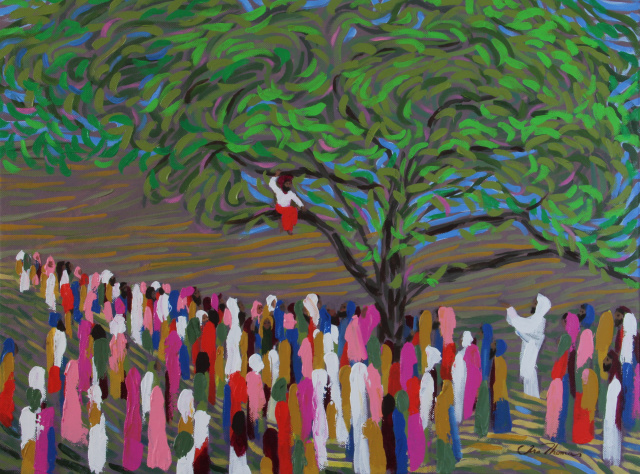
Zacchaeus, by Ira Thomas

Jesus entered Jericho and was passing through. A man was there by the name of Zacchaeus; he was a chief tax collector and was wealthy. He wanted to see who Jesus was, but because he was short he could not see over the crowd. So he ran ahead and climbed a sycamore-fig tree to see him, since Jesus was coming that way.

When Jesus reached the spot, he looked up and said to him, “Zacchaeus, come down immediately. I must stay at your house today.” So he came down at once and welcomed him gladly.

All the people saw this and began to mutter, “He has gone to be the guest of a sinner.”

But Zacchaeus stood up and said to the Lord, “Look, Lord! Here and now I give half of my possessions to the poor, and if I have cheated anybody out of anything, I will pay back four times the amount.”

Jesus said to him, “Today salvation has come to this house, because this man, too, is a son of Abraham. For the Son of Man came to seek and to save the lost.” (New International Version)

Every time I read this story about Zacchaeus climbing up the sycamore tree to see Jesus because he was a short man, I think of the old ‘70s song Short People by Randy Newman. The song was (and still is) criticized by some as being prejudiced against short people. 

Indeed, the criticism seems justified with lyrics such as “short people got no reason to live.” Yet, the song’s intended purpose was really the opposite – to be an attack on the pervasive prejudice of the day, and an attempt to “heighten” (pun intended) awareness of other people’s importance. 

“Short people are the same as you and I. All men are brothers until the day they die” are the lyrics containing the real message within the song.

At first glance, the story of the short Zacchaeus seems to be about his inability to see. Yet the real heart of the story is that:

Zacchaeus is unable to see because the other people are obstacles to his sight. 

In turns out that Jesus is the only person who truly sees Zacchaeus. No one else sees him. No one else seems to care. While everyone else is busy with their own line of sight, Jesus is concerned to see the one person who is unseen: Zacchaeus. 

And here’s the reason why Jesus had his radar attuned to picking up Zacchaeus: Because Jesus came to see people like Zacchaeus; Christ came to seek and to save the lost.

One of the most pertinent applications of this story for us, is that we must not be an obstacle for others coming to Jesus – and instead be a conduit for others to meet Jesus. For that to happen, we need a reformation of both attitude and our action.

Our chief obstacle to realizing a reformation is the sort of hindrance that Zacchaeus overcame in order to see Jesus and experience him:

Zacchaeus did not take himself so seriously.

A very serious Zacchaeus would not have been playful enough and much too respectable to climb a tree. Maybe he was used to living with short jokes all his life; I don’t know. I just see a rich businessman who was lighthearted enough to climb a tree; and who lightened up enough to give a big pile of money away.

As a tax collector, metrics and measurements and figures were his world. All of that accounting can create a serious and sterile environment – concerned with doing more, being more, and getting more.

Reformation – reforming oneself, one’s culture, and one’s institutions – comes through the disposition and willingness of not being so doggone serious all the time.

“Jesus and Zacchaeus” by Soichi Watanabe

Hanging one’s happiness and well-being on other people adopting my opinions, my plans, and my way is a surefire prescription for getting knocked down several pegs by both others and God.

A reformation comes through collegiality, cooperation, and collaboration with others. To acknowledge that God is God, and I am not, and that all people (even the ones I don’t like) are just as important as me, is to see with new eyes. This is the way of seeing Jesus because it’s the willingness to climb trees and to not care how it makes me look to do it.

People short on faith, short on hope, and short on love desperately need the love of God in the gracious person of Jesus Christ. 

Let us then, help, and not hinder, people’s ability to see Jesus.

Jesus said, “You are the light of the world. A town built on a hill cannot be hidden. Neither do people light a lamp and put it under a bowl. Instead they put it on its stand, and it gives light to everyone in the house. In the same way, let your light shine before others, that they may see your good deeds and glorify your Father in heaven.” (Matthew 5:14-16, NIV)

Let us not become discouraged when our expectations obscure our sight.

When John, who was in prison, heard about the deeds of the Messiah, he sent his disciples to ask him, “Are you the one who is to come, or should we expect someone else?”

Jesus replied, “Go back and report to John what you hear and see: The blind receive sight, the lame walk, those who have leprosy are cleansed, the deaf hear, the dead are raised, and the good news is proclaimed to the poor. (Matthew 11:2-5, NIV)

Let us have eyes to see and not be blinded by our own seriousness.

Jesus said, “For judgment I have come into this world, so that the blind will see and those who see will become blind.” (John 9:39, NIV)

Anyone who has seen me has seen the Father. (John 14:9, NIV)

Let us humble ourselves and stoop to see the incredible reality in front of us.

As they entered the tomb, they saw a young man dressed in a white robe sitting on the right side, and they were alarmed.

“Don’t be alarmed,” he said. “You are looking for Jesus the Nazarene, who was crucified. He has risen! He is not here. See the place where they laid him. But go, tell his disciples and Peter, ‘He is going ahead of you into Galilee. There you will see him, just as he told you.’” (Mark 16:5-7, NIV)

Let us see and believe.

“What is mankind that you are mindful of them,
    a son of man that you care for him?
You made them a little lower than the angels;
    you crowned them with glory and honor
    and put everything under their feet.”

In putting everything under them, God left nothing that is not subject to them. Yet at present we do not see everything subject to them. But we do see Jesus, who was made lower than the angels for a little while, now crowned with glory and honor because he suffered death, so that by the grace of God he might taste death for everyone. (Hebrews 2:6-9, NIV)

In God’s kingdom, the tall are short, and the short are tall. And there are plenty of trees to climb so that everyone can see Jesus.

Loving Lord Jesus, give me the grace to see you in all things throughout my days on this earth. Help me to see your benevolent kingdom come and see your ethical will be done, here on earth, as it is always done in heaven. Amen.

The Necessity of Mentoring Relationships: Paul, Tom, and Timothy (2 Timothy 3:10-15)

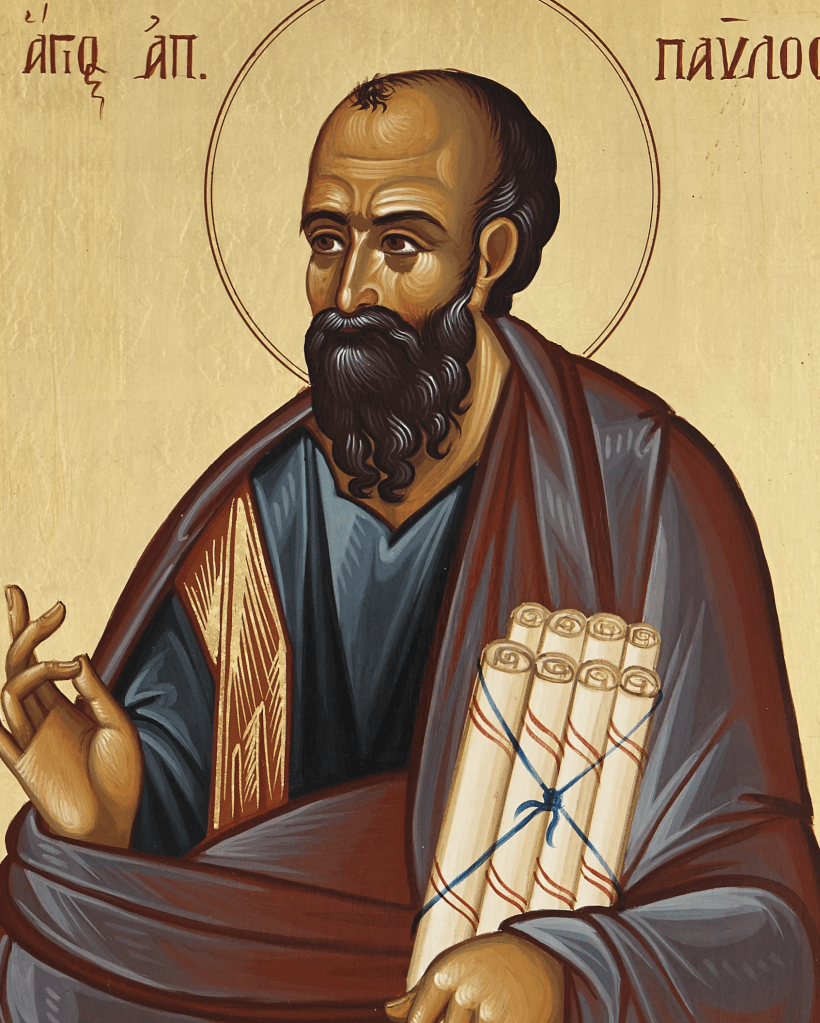
Orthodox icon of St. Paul
Orthodox icon of St. Timothy

You’ve been a good apprentice to me, a part of my teaching, my manner of life, direction, faith, steadiness, love, patience, troubles, sufferings—suffering along with me in all the grief I had to put up with in Antioch, Iconium, and Lystra. And you also well know that God rescued me! Anyone who wants to live all out for Christ is in for a lot of trouble; there’s no getting around it. Unscrupulous con men will continue to exploit the faith. They’re as deceived as the people they lead astray. As long as they are out there, things can only get worse.

But don’t let it faze you. Stick with what you learned and believed, sure of the integrity of your teachers—why, you took in the sacred Scriptures with your mother’s milk! There’s nothing like the written Word of God for showing you the way to salvation through faith in Christ Jesus. (The Message)

Paul and Timothy had a special relationship. Paul, the Apostle and mentor in the faith; and Timothy, the apprentice.

Together, they saw it all – and experienced it all. And through it all, the Christian tradition was passed on because of Paul’s purposeful mentoring of others, especially Timothy, by both verbal teaching and life example. In this, Paul helped set Christianity on a trajectory of modeling the words and ways of Jesus.

Faith is a gift given by God through Scripture and faithful people – and then received by us. Christianity is designed for community; it is not merely a solitary affair between the individual and God. Anyone trying to go it alone in the Christian life will soon discover they are overwhelmed and in over their heads with trouble.

Contemporary pastoral ministry still needs to follow in the footsteps of the Apostle Paul. Just one of the many reasons why churches in the West are in such decline is that Christian leaders are not intentionally focused to passing-on a solid body of teaching, along with a consistent example of how to put it into practice, through close relationships.

Anyone who has been in the pastoral ministry gig for a long time, remaining consistent and faithful, has most certainly had a good spiritual teacher and guide shepherding them through their Christian experience. A good long ministerial life isn’t happenstance; it’s the result of a solid foundation through a Paul-and-Timothy sort of relationship.

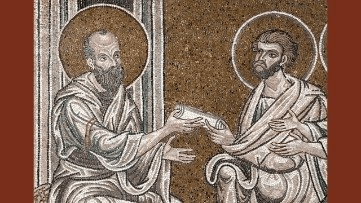
Mosaic of Paul and Timothy, Cathedral of Monreale, Sicily, Italy

By God’s grace, I’ve had several persons influence my life in profound ways in such a relationship. One of the earliest and longest was with Tom – a campus minister on my university who built into my life as an undergraduate and a very young Christian. We remained connected and became good friends for nearly four decades until his untimely death.

Tom knew what he was doing with me. To this day, even with multiple academic degrees and many professional ministry experiences, I attribute most of what I know about Christian faith and practice as simply saying and doing what I saw Tom say and do. And, I might add, Tom consistently saw my true self, even when I didn’t see it myself.

A good model in the faith has the same qualities and insights as the Apostle Paul of old. For example, here are just a few of the important things I learned from Tom:

  • Christian ministry is interpersonal; time must be spent with others, getting to know them and building relationships. Doing pastoral ministry from afar is an oxymoron. From what we know of Paul, at times he had a team of up to seventy persons following him around on missionary endeavors.
  • There are always going to be charlatans and bad apples around. Don’t simply ignore them. Confront them in grace and truth. I still remember a time when I went along with Tom, not knowing where we were going or what he was up to. In retrospect, he probably knew I would bolt if I caught wind of what he was about to do. We went to the dorm room of a believer whom Tom flat-out confronted on his talking and living being inconsistent with his professed Christianity. My eyes got huge when Tom said, “In the name of Jesus Christ I rebuke you and I call you to repent.” This was said in a gracious and conversational tone, not in anger, which communicated concern and love for this individual student.
  • Develop relationships. And the best way of doing this is by having the Timothy tag along with the Paul. Tom continually brought me along to whatever he was doing, whether it was a weekend retreat he was leading, or going to the grocery store. We cannot learn from others if we aren’t around them, and Tom understood this better than most. As a result, I learned more than lessons; I learned a life.
  • It’s not about me. Tom never took himself too seriously. And because of that, I observed him never becoming overwhelmed or obsessing over the trouble he would sometimes get into. In fact, he typically welcomed the trouble whenever he saw it was not of his own making.
  • Openness and vulnerability are necessary. More than once, Tom strolled into a bible study with me and some other guys, flopped down and said, “Man, I really blew it today…” and then went on to explain some boneheaded thing he did. We unpacked the entire situation together. Not once do I ever recall Tom trying to look like the perfect Christian leader. He embraced who he was and was always willing to shine the light on the shadowy places of his heart.
  • Holy Scripture is central to Christian life and ministry. Inevitably, Tom’s question to us, after describing his bonehead move, was to ask, “What are you learning in God’s Word? Do you have any encouragement for me?” On a daily basis, without fail, Tom asked this question of me: “So, what is God teaching you in the Word?”

Through both Holy Scripture and the significant relationships I’ve had throughout my life, I can confidently state that there are two indispensable elements to effective Christian ministry:

  1. It must be firmly grounded in objective theory derived from God’s Word.
  2. It must be intentionally practiced with subjective experience derived from interpersonal relationships.

Objective theory without lived practice leads to being puffed-up with knowledge and no love – because love requires people. And subjective experience without a grounded theory is nothing but a form of spiritual A.D.D. in which whatever shiny thing we see grabs our attention.

I always considered Tom as my spiritual father (and his wife as a dear spiritual mother!). They have shown me not only how to live the faith, but also how to be a spiritual father myself. And as a result, my own dear wife and I have many spiritual children scattered throughout the country.

This is the consummate Christian: Coming to faith by God’s grace, mediated to us through actual flesh-and-blood people; being taught and mentored in that faith by proven Christians; and then, simply saying and doing what you have seen and heard from holy leaders and Holy Scripture.

It’s not rocket science. It’s not abstract art. It’s a life. It’s relationships. And it’s absolutely necessary in order for both the church and the world to be blessed.

But he’s already made it plain how to live, what to do,
    what God is looking for in men and women.
It’s quite simple: Do what is fair and just to your neighbor,
    be compassionate and loyal in your love,
And don’t take yourself too seriously—
    take God seriously. (Micah 6:8, MSG)

Soli Deo Gloria. Amen.