John 13:1-17, 31-35 – Maundy Thursday

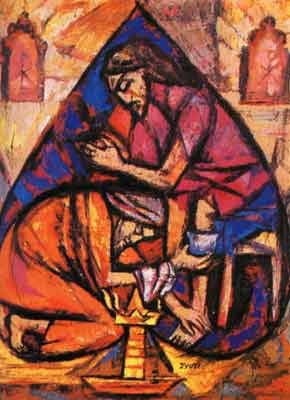
Jesus Washes Peter’s Feet

It was before Passover, and Jesus knew that the time had come for him to leave this world and to return to the Father. He had always loved his followers in this world, and he loved them to the very end.

Even before the evening meal started, the devil had made Judas, the son of Simon Iscariot, decide to betray Jesus.

Jesus knew that he had come from God and would go back to God. He also knew that the Father had given him complete power. So, during the meal Jesus got up, removed his outer garment, and wrapped a towel around his waist. He put some water into a large bowl. Then he began washing his disciples’ feet and drying them with the towel he was wearing.

But when he came to Simon Peter, that disciple asked, “Lord, are you going to wash my feet?”

Jesus answered, “You don’t really know what I am doing, but later you will understand.”

“You will never wash my feet!” Peter replied.

“If I don’t wash you,” Jesus told him, “you don’t really belong to me.”

Peter said, “Lord, don’t wash just my feet. Wash my hands and my head.”

Jesus answered, “People who have bathed and are clean all over need to wash just their feet. And you, my disciples, are clean, except for one of you.” Jesus knew who would betray him. That is why he said, “except for one of you.”

After Jesus had washed his disciples’ feet and had put his outer garment back on, he sat down again. Then he said:

Do you understand what I have done? You call me your teacher and Lord, and you should, because that is who I am. And if your Lord and teacher has washed your feet, you should do the same for each other. I have set the example, and you should do for each other exactly what I have done for you. I tell you for certain that servants are not greater than their master, and messengers are not greater than the one who sent them. You know these things, and God will bless you, if you do them….

Now the Son of Man will be given glory, and he will bring glory to God. Then, after God is given glory because of him, God will bring glory to him, and God will do it very soon.

My children, I will be with you for a little while longer. Then you will look for me, but you won’t find me. I tell you just as I told the people, “You cannot go where I am going.” But I am giving you a new command. You must love each other, just as I have loved you. If you love each other, everyone will know that you are my disciples. (CEV)

Jesus Washing the Feet of His Disciple by Japanese artist Sadao Watanabe (1913-1996)

We all need to receive love and to give love. Without love, there is little to live for. Apart from love, relationships devolve into silent standoffs and destructive triangles. Indeed, with an absence of love the world ceases to spin on its axis.

Yet, where love is present all things are beautiful. Personal relations have meaning and joy. All seems right and just in the world.

Love, however, comes at a cost. Because we live in a broken world full of pride and hubris, greed, and avarice, hate and envy, we are victims of loveless systems and unjust actions. We need love to rescue us, to redeem us from the sheer muck of existence. It’s as if we are constantly walking knee deep through sludge so thick, we can barely get anywhere. We need saving. We need Jesus.

Christians everywhere around the world are journeying through Holy Week, the most sacred time of the year for followers of Christ. When we think about Holy Week, we are familiar with Good Friday and certainly Easter, but Maundy Thursday? 

On this day, the Church remembers the final evening Jesus shared with his disciples in the upper room before his arrest and crucifixion. The experiences in the upper room were highly significant because this was the last teaching, modeling, and instruction Jesus gave before facing the cross. Jesus was careful and deliberate to communicate exactly what was important to him: to love one another.

Maundy Thursday marks three important events in Christ’s Last Supper with his disciples: 

  • The washing of the disciples’ feet (the action of loving service)
  • The instituting of the Lord’s Supper (the remembrance of loving sacrifice)
  • The giving of a “new” commandment to love one another (the mandate of a loving lifestyle). 

For Jesus, his last night with the disciples was all about love, God’s love. On that fateful night, having loved his disciples for the past three years, Jesus showed them the full extent of his love by taking the posture of a servant and washing each one of the disciples’ feet, including Judas. After demonstrating for them humble service, Jesus said,

“I have set you an example that you should do as I have done for you” (John 13:15, NIV). 

This was an incredible act of love. Jesus Christ loves me just as I am, and not as I should be. He loves me even with my dirty stinky feet, my herky-jerky commitment to him, and my pre-meditated sin. 

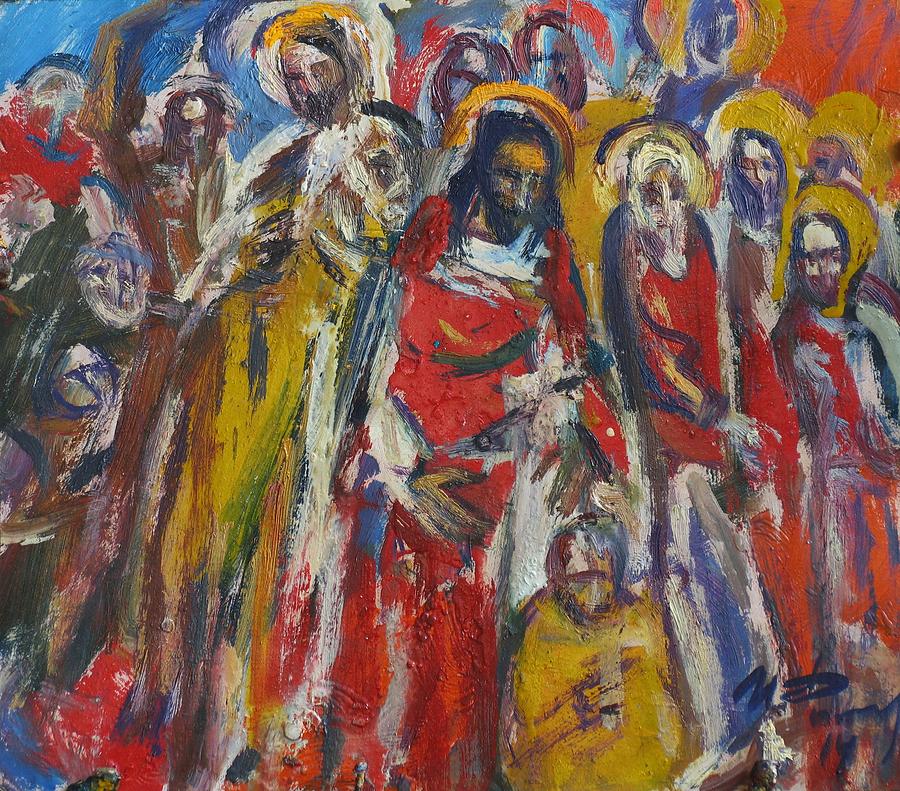
The Last Supper by Indian artist Francis Newton Souza (1924-2002)

Not only did Jesus wash the disciples’ feet, but he lifted the cup of wine and boldly asserted: 

“Take this and divide it among you.  For I tell you I will not drink again of the fruit of the vine until the kingdom of God comes.”  And he took the bread, gave thanks, and broke it, and gave it to them, saying, “This is my body given for you, do this in remembrance of me.”  In the same way, after the supper he took the cup saying, “This cup is the new covenant in my blood, which is poured out for you” (Luke 22:17-20, NIV). 

Because of these words, the church throughout the world, for two millennia, have practiced this communion so that we might have the redemptive events of Jesus pressed firmly into our minds and our hearts by means of the visceral and common elements of bread and wine. We are to not just know about Jesus; we are to experience being united with him.

Having washed the disciples’ feet, and proclaiming to them the meaning of his impending death, Jesus gave them a clear commandment: 

“A new command I give you: Love one another. As I have loved you, so you must love one another.  By this everyone will know that you are my disciples, if you love one another.” (John 13:34-35, NIV)

Love one another, insisted Jesus, by imitating his humble service. We represent Christ on this earth when we carefully, diligently, and persistently practice love. Although love was not a new concept for the disciples, in the form and teaching of Jesus love was shown with four distinctions: 

  1. Jesus is the new model of love.
  2. A new motive of love, that Christ first loved me.
  3. A new motivator to help us love, the Holy Spirit.
  4. A new mission, the evangelization of the world, utilizing the power of Christ’s love to accomplish it.

Maundy Thursday is a highly significant day on the Church Calendar – one which deserves to be observed, and an opportunity to remember the important words and actions of Jesus on our behalf.  Through Jesus Christ we are to live always in love, modeling our life and church ministry after him. 

In Christ, love is to characterize our life together as we proclaim God’s love in both word and deed. A watching world will only take notice and desire to be a part of our fellowship if we are deeply and profoundly centered in the love of God in Christ. This is the reality Maundy Thursday brings to us.

Mark 10:32-34, 46-52 – The Irony of Following Jesus

Jesus healing blind Bartimaeus by Johann Heinrich Stöver, 1861. St John’s Church, Hesse, Germany

They were on their way up to Jerusalem, with Jesus leading the way, and the disciples were astonished, while those who followed were afraid. Again, he took the Twelve aside and told them what was going to happen to him. “We are going up to Jerusalem,” he said, “and the Son of Man will be delivered over to the chief priests and the teachers of the law. They will condemn him to death and will hand him over to the Gentiles, who will mock him and spit on him, flog him and kill him. Three days later he will rise….”

Then they came to Jericho. As Jesus and his disciples, together with a large crowd, were leaving the city, a blind man, Bartimaeus (which means “son of Timaeus”), was sitting by the roadside begging. When he heard that it was Jesus of Nazareth, he began to shout, “Jesus, Son of David, have mercy on me!”

Many rebuked him and told him to be quiet, but he shouted even more, “Son of David, have mercy on me!”

Jesus stopped and said, “Call him.”

So, they called to the blind man, “Cheer up! On your feet! He’s calling you.” Throwing his cloak aside, he jumped to his feet and came to Jesus.

“What do you want me to do for you?” Jesus asked him.

The blind man said, “Rabbi, I want to see.”

“Go,” said Jesus, “your faith has healed you.” Immediately he received his sight and followed Jesus along the road. (NIV)

“Irony” and “ironic” are terms describing when an outcome of an event is contrary or different from what would be expected. Here are a few examples of irony: The firehouse burnt down. The police officer got arrested. When I was a kid, my family physician’s name was Dr. Fail (really!).

There is an overarching ironic lesson to our Gospel story today. The people following Jesus with 20/20 vision are spiritually blind. Their great need is the same as blind Bartimaeus: to have their eyes opened to Jesus and to what God was doing around them. Bartimaeus was marvelously and miraculously given sight by Jesus – the others, however, remained unchanged and in the dark. 

Irony #1: Many followed Jesus, but only a few were his followers.

All kinds of people physically followed Jesus around for all kinds of reasons while he was here on this earth.  Some wanted to bask in the latest celebrity buzz that Jesus generated. Others wanted to see all the cool stuff Jesus did, like healing people. Some were plain curious. And a few were interested in being like Jesus by showing selfless compassion. Jesus continually sought to press the crowd following him into authentic disciples who would follow his teaching.

Many people desire to conform and go with the flow. That’s great if the crowd is good, and not so good if the group is going in a bad direction. In the Old Testament, a few unruly complainers got the Israelites all stirred up with the result of making a golden calf and turning away from God. However, sometimes it is right and necessary to go against the crowd, which leads us to the next irony….

Irony #2: Out of all Christ’s followers, it is a blind man that sees Jesus for who he is, the Son of David.

Spiritual blindness afflicted many people, yet Bartimaeus discerned it was Messiah who was walking by him. So, he went against the crowd and shouted to Jesus. Blind Bartimaeus didn’t care how he looked to others, and it didn’t matter to him that he stuck out like a sore thumb. 

Sometimes we might forget that Jesus often avoided crowds, and that most of his life occurred away from the centers of power and influence. Jesus swam upstream of the prevailing notions of righteousness. Christ did not cow-tow to the crowd, but instead, paid attention to those in need and forgotten by others. Jesus did not “work the crowd” to get ahead and further his agenda. He did not cozy-up to the rich and powerful. And he deliberately avoided celebrity status. Jesus showed extraordinary love to an overlooked person. He used his immense power for one powerless person.

Irony #3: The ones following Jesus were the ones trying to keep a blind man from Jesus.

It seems to me one of the ironies about the church is that Christ’s own followers can be the greatest obstacle to others following him. I can imagine a group of gossipy church folk shushing Bartimaeus: “Don’t bother Jesus, he is such a busy man! He has important work to do!” I can also picture them standing next to blind Bartimaeus saying, “Just stop, man, you’re embarrassing yourself.” 

But Bartimaeus would not stop. He shouted all the louder. True and genuine faith is a needy person crying out in desperation for Jesus to help. Jesus asked a beautiful question: “What do you want me to do for you?”  “I want to see,” Bartimaeus responded. So, Jesus had compassion on him and gave him his sight. Here we have two men, Jesus and Bartimaeus, ignoring all the people around them, and having a divine encounter.

This all makes me wonder why it is so hard for us to simply say what we want. It could be that we don’t want to buck the crowd, or to look different. Maybe we don’t want to admit our need in front of others. So, we just stick to superficial conversations and insist that everything is okay, when it isn’t.

Jesus said, concerning the crowd, “Although they see, they don’t really see.” (Matthew 13:13) If we are concerned about how we will be seen by others, we will likely not be seen by God, and will miss Jesus when he walks right in front of us.

Conclusion

How might we raise our ability to see Jesus and truly follow him as he desires us to?

Listen to Jesus. Jesus was headed to Jerusalem and had a lot on his mind and heart with anticipating his passion and death. What made Christ attentive to Bartimaeus out of all the people around him was that he was listening. If we want to see Jesus and follow him, we must be listeners and attentive to compassion, like Jesus, to the needy and lowly among us. 

I recently read a story from a Christian who lived during Nazi Germany. He said, “I considered myself a Christian. We heard stories of what was happening to the Jews, but we tried to distance ourselves from it, because what could anyone do to stop it? A railroad track ran behind our small church, and each Sunday morning we could hear the whistle in the distance and then the wheels coming over the tracks. We became disturbed when we heard the cries coming from the train as it passed by. We realized it was carrying Jews like cattle in the cars! Week after week the whistle would blow. We dreaded to hear those wheels because we knew we would hear the cries of the Jews in route to a death camp. Their screams tormented us. So, when we heard the whistle blow, we began singing hymns. By the time the train came past our church, we were singing at the top of our voices. If we heard the screams, we sang more loudly, and soon we heard them no more. Years have passed, and no one talks about it anymore. But I still hear that train whistle in my sleep. God forgive me. Forgive all of us who called ourselves Christians yet did nothing to intervene.” 

Respond to Jesus. Once Jesus listened, he responded by asking a question. Christ took the time to heal Bartimaeus. Jesus could have simply healed him without even stopping. He could have even started a healing factory where everyone with a need just moved through a line and got healed. Jesus was doing more than giving sight; he was giving a blessing – the blessing of time and relationship.

The gospel is personal, which is why we ought to resist being non-relational in ministry to others. It’s about more than meeting a physical need. It is about blessing other people with the gift of relationship. It begins with recognizing self as the one who needs Jesus. It starts with having our own eyes opened to see our own need and then the great need of people around us.

God of all compassion, I confess that it is natural for me to do things my way. I recognize that I am limited, but that you know all things. I yield my spiritual eyesight to you so that my spiritual vision will be clear. Jesus Christ came to give sight to the blind and to open our eyes. I commit my ways to you so that I can see your ways and not my own. Amen.

Temptation in the Desert

Christ in the Wilderness by Ivan Kramskoi, 1872

Jesus came from Nazareth in Galilee and was baptized by John in the Jordan. Just as Jesus was coming up out of the water, he saw heaven being torn open and the Spirit descending on him like a dove. And a voice came from heaven: “You are my Son, whom I love; with you I am well pleased.”

At once the Spirit sent him out into the wilderness, and he was in the wilderness forty days, being tempted by Satan. He was with the wild animals, and angels attended him.

After John was put in prison, Jesus went into Galilee, proclaiming the good news of God. “The time has come,” he said. “The kingdom of God has come near. Repent and believe the good news!” (Mark 1:9-15, NIV)

We are in the season of Lent. Beginning with Ash Wednesday, we take a forty-day journey, leading to Holy Week and Easter. Jesus spent forty days in the desert being tempted by Satan. So, the church remembers this event with the season of Lent. This is the time of year in which Christians are to give awareness of the temptations we face on a regular basis. We intentionally seek to fast or give up something for six weeks so that we might see how much we attach ourselves to other things and rely on them, instead of trusting in God.

Just as it was important and significant for Jesus to be in the desert, it is necessary for us, as well. Jesus retraced the steps of his ancestors, the Israelites, who wandered in the desert for forty years. They had an extended time in the wilderness before entering the Promised Land because they needed to re-connect with God after having failed in their faith. Their trust had to be strengthened and developed before they could ever be ready to receive God’s promises.

Jesus faced down the devil and overcame temptation in the desert. The forty days were a necessary preparation for the upcoming three years of ministry that would culminate in Christ’s death, burial, and resurrection. But before any of that could happen, Jesus had to experience the desert.

We, like Jesus, need to have a desert spirituality. If we are not formed into followers of Jesus through learning to overcome temptation, then we are at risk to be shaped into followers of Satan. God desires to strengthen our faith. We, like Jesus, need to face down the devilish temptations which would impede our spiritual development.

In every sport, weightlifting has become a necessary part of athletic training. Athletes now know their muscles must be properly developed for their respective sport. Through weight training the muscle fibers are broken down with stress. Then, with proper hydration, nutrition, and rest, the muscles are re-built as better, stronger, and more agile. 

Christ in the Desert by Julie Lonneman

As Christians, the desert becomes the gymnasium where we are broken down through the stress of temptation so that we might become spiritually stronger in our faith. Without this kind of spiritual training, we become vulnerable to satanic accusations and become easy targets to demonic seduction.

After the baptism of Jesus, the Spirit “sent” him into the desert. The word is perhaps better translated as “thrown” or “hurled.”  It is an extraordinarily strong word conveying that the Spirit flung Jesus out into the desert.

Being tossed into the desert demonstrates how important spending time there was for Jesus. It was in the desert he learned to resist temptation in his ministry. There was real danger in the desert, wild animals, and vulnerability to the elements. Yet, put in that situation and having come through it, Jesus was able to deal with the crafty pursuits of Satan to distract him from his mission. 

Throughout the Gospel of Mark, after tossing demons out of people, Jesus would tell the unclean spirits not to tell anyone who he was. Part of what was happening is that Satan wanted to tempt Jesus to gain fame and power through popularity and accolades. And that was not the way of Jesus. Our Lord was not going to bring in the kingdom of God through the usual avenues of careful marketing and brand recognition.

Another practice Jesus kept up throughout his ministry was to seek places for solitude and prayer. The needs Jesus daily saw and dealt with were large and vast and never ending. Jesus resisted the temptation to continually work without any rest or guidance in prayer. It was through solitude and prayer that Jesus connected with his Father and would move from place to place traveling and proclaiming the good news of the kingdom of God.  Jesus never gave in to the temptation to settle in one place and build a petty kingdom of his own, apart from the Father.

As Jesus went about the countryside telling people to repent and believe the good news, he often spoke in parables designed to encourage thought and reflection. He did not succumb to the temptation to always be black and white about everything, giving just the bottom line of his teaching to people. 

Jesus did not teach to get immediate results or to let people know which side of the fence he occupied concerning the issues of the day. Instead, Christ understood his business – a ministry of building something permanent that would far outlast his mere three years of ministry. Because of the desert, and through his Father’s affirmation, Jesus lived a unique three years on this earth that has never been equaled before or since.

Some years ago, I went on a leadership retreat in the Canadian wilderness.  We were so far out in the sticks that we needed special first aid training before leaving because if someone got severely injured it would be hours before any medical attention could be received. There was no cell phone service, no towns, no anything except mile after square mile of wilderness. We had to be continually vigilant to not attract bears. The wilderness can be a dangerous place. On one of the days in that week, we were each dropped off on our own personal islands for an entire day, alone. Being face to face with yourself can be hard to deal with, which is what a desert experience does – it exposes the idols of our hearts and the ways in which we are tempted.

A person need not be in the Canadian wilderness or in a real desert to experience the effects of desert life. The Holy Spirit has a way of throwing us into the desert through changes of circumstances so that we will flex our spiritual muscles to get into spiritual shape.

The top three temptations of people today are worry, procrastination, and gossip. So, how do we face down those temptations (and others) and retrace our steps back to the path of God?  Here are some lessons I have learned in my own wilderness experiences through God’s Word:

  • Know your weaknesses. Know yourself. Know the temptations of Satan. The three temptations just mentioned all come from a tendency toward perfectionism. We worry about the future and not saying or doing something perfectly. We procrastinate saying or doing things for fear of screwing up and not being perfect. And we gossip to others about their faults and weaknesses because it maintains the illusion that our perfectionism is intact, at least as compared to others. However, perfectionism is slavery. 

We have freedom now because Christ made us free. So, stand strong in that freedom. Do not go back into slavery again. (Galatians 5:1, ERV)

  • Understand the importance of timing.  When are you at your weakest, at your most vulnerable time? What triggers you to sin?  We know that when our kids and grandkids act up, we first wonder if they are tired, hungry, or have some other need. It is the same with us. Carrying a massive sleep debt, skipping meals, or eating poorly because we are constantly in a hurry will set us up for temptation.

Be clearheaded. Keep alert. Your accuser, the devil, is on the prowl like a roaring lion, seeking someone to devour. (1 Peter 5:8, CEB)

  • Look to God and others.  Do not rely solely on your own willpower or think you ought to resist temptation all by yourself, all the time. Even Jesus looked both to his Father and his disciples. During a time of intense stress, Jesus said:

“My soul is overwhelmed with sorrow to the point of death. Stay here and keep watch with me.” Going a little farther, he fell with his face to the ground and prayed, “My Father, if it is possible, may this cup be taken from me. Yet not as I will, but as you will.” Then he returned to his disciples and found them sleeping. “Couldn’t you men keep watch with me for one hour?” he asked Peter. “Watch and pray so that you will not fall into temptation. The spirit is willing, but the flesh is weak.” (Matthew 26:38-41, NIV)

  • Have a plan. Flying by the seat of your pants will not always work. One of the major ways I personally resist temptation is by having a daily plan of worshiping God, praying, and reading Scripture at set times throughout the day.

A prudent person foresees danger and takes precautions. The simpleton goes blindly on and suffers the consequences. (Proverbs 22:3, NLT)

  • Overcome evil with good. If we apply this to the top three temptations people face, that means the worrier will love his/her enemies and pray for those who persecute. It means the procrastinator will take intentional steps of faith and risk, being real and vulnerable with others through accountable relationships. It means the gossip will seek to speak words of encouragement that build others up.

Do not be overcome by evil but overcome evil with good. (Romans 12:21, NRSV)

  • Realize you are never alone.  Angels attended Jesus. Even the Son of God was never on his own.  Whatever you are facing is likely not unique to you. Others face similar struggles. Our brothers and sisters throughout the world are undergoing the same kind of problems when they seek to walk with Christ.

Let the desert shape and strengthen your faith. If the Holy Spirit has thrown you into a dry place, learn all you can about resisting temptation so that you can come out the other end a stronger, more faithful follower of Jesus Christ. 

Matthew 9:2-13 – Why Jesus Came

Healing by Russian painter Ivan Filichev

Some men brought to Jesus a paralyzed man, lying on a mat. When he saw their faith, Jesus said to the man, “Take heart, son; your sins are forgiven.”

At this, some of the teachers of the law said to themselves, “This fellow is blaspheming!”

Knowing their thoughts, Jesus said, “Why do you entertain evil thoughts in your hearts? Which is easier: to say, ‘Your sins are forgiven,’ or to say, ‘Get up and walk’? But I want you to know that the Son of Man has authority on earth to forgive sins.” So, he said to the paralyzed man, “Get up, take your mat and go home.” Then the man got up and went home. When the crowd saw this, they were filled with awe; and they praised God, who had given such authority to man.

As Jesus went on from there, he saw a man named Matthew sitting at the tax collector’s booth. “Follow me,” he told him, and Matthew got up and followed him.

While Jesus was having dinner at Matthew’s house, many tax collectors and sinners came and ate with him and his disciples. When the Pharisees saw this, they asked his disciples, “Why does your teacher eat with tax collectors and sinners?”

On hearing this, Jesus said, “It is not the healthy who need a doctor, but the sick. But go and learn what this means: ‘I desire mercy, not sacrifice.’ For I have not come to call the righteous, but sinners.” (NIV)

The late Abigail Van Buren, better known as the newspaper columnist, “Dear Abby,” was the person who made famous the phrase: “The church is a hospital for sinners, not a museum of saints.” That quote is an accurate reflection of what Jesus was doing and saying. We occasionally need words like Dear Abby’s to remind and reorient us toward why the church exists.  

The church of the Lord Jesus does not remain on this earth solely for our benefit, any more than a hospital exists for the benefit of the doctors or insurance companies! Rather, the church lives to extend the mission of Jesus through proclamation of good news with the restorative touch of grace. The church’s calling is not to find others who can help them with their tithing and keep warm seats in the pew. Instead, the church is the community of the redeemed, gathered and sent to be the continuing presence of Jesus on this earth.

Some who are reading this are not healthy. Some are sick with sin; others are heart-sick; yet others are plain sick-and-tired of being sick-and-tired. Jesus came neither to condemn nor heap a pile of unrealistic expectations on us. Christ points us to the source of healing and change and invites us to admit our need and come to him. 

Conversely, many others today are healthy, spiritually alive, and well. It is our job to roll up our sleeves and serve, participating fully in the mission of Jesus to the world. The question I want us to grapple with is this: Why did Jesus come to this earth? The answer to that question is to also answer the question of our own purpose and existence as followers of Christ.

Jesus came to forgive sin and transform sinners.In today’s Gospel healing, it was a case where the person’s sin was connected to his paralysis – and the paralytic found in Jesus not only physical healing, but new spiritual life.

The religious insiders observed the healing. Yet there was no rejoicing by them about the transformation. Instead, they became hung up on Jesus claiming to be God. Granted, this was a hard truth for them to get a hold of. But Jesus labeled such thinking as evil – the inability to see and perceive the situation as a divine intervention, and that Jesus really is the Lord who graciously did it. Because they wrongly discerned who Jesus is, they wrongly interpreted the situation. 

Therefore, it is important to see Jesus as the Human One who extends compassion and forgiveness. If we fail to see this about Christ, we will get caught up in all kinds of silly matters of personal preference and ridiculous power plays, based in how we think things should go, rather than the gospel.

Jesus came to forgive sin. Healing the body is good but not enough. Just focusing on the physical well-being of individuals was not why Christ came. At the heart of the human condition is spiritual brokenness, and Jesus is all about taking away guilt and shame, creating a new person and a new community. It is a radical vision which seeks to encompass all persons – which means Jesus touched many people overlooked by others.

Jesus came to call the despised people of society, the “sinners.” He called Matthew, a tax collector. Tax collectors were hated. They were corrupt characters who extorted money from innocent people. Jesus not only called the despised Matthew but had dinner with him and all his unsavory buddies. This kind of behavior by Jesus was deeply offensive to upstanding citizens.

However, Jesus did not back down. He responded by saying that it is not the healthy who need a doctor, but the sick. And he backed up his social actions with Scripture by encouraging offended folks to meditate on what this biblical phrase means: “I desire mercy, not sacrifice.” (Hosea 6:6)

For I desire mercy, not sacrifice, and acknowledgment of God rather than burnt offerings.

hosea 6:6, niv

It is possible to engage in outward rituals of worship, do all the right things, fulfill our duty, yet still miss the heart of God wants for humanity. Mercy is what God wants. Jesus knew this. So, Christ entangled himself with sinners to bring spiritual healing and restoration.

When Corrie Ten Boom sought to bring deliverance of the Jews from the Nazis during World War II, she had to entangle herself with Jewish refugees. When Christian missionaries seek to be the light of Jesus to people, they must entangle themselves with the people’s culture. If we want to see God deliver people from their situations, we must entangle ourselves with them, into complicated lives that are not pretty, with persons who have been tainted by sin. 

Lots of people are in awful predicaments. Christians, like their Lord, will need to get their hands dirty and their feet wet to extend Christ’s ministry of mercy and forgiveness. The gospel was never intended to be proclaimed from afar, but up close and personal through entanglement in people’s lives. If the merciful mission of Jesus is to occur, it requires the following three activities:

  1. Intimacy with Jesus. Engaging in the spiritual disciplines of prayer, giving, fasting, reading, and meditating on Scripture are the activities which help us to know Christ better and know and how to respond with mercy.
  2. Intimacy with fellow believers. We are hard-wired by God for community. Superficial relationships can only provide superficial community. Christians need to help one another with spiritual growth. They must hold one another accountable for the mission of Christ.
  3. Intimacy with “sinners.” This world is filled with sick, needy, hurting, lonely, unhealthy people who are locked in unhealthy patterns of living. They need a merciful change of life that comes from the merciful Jesus acting through merciful Christians. 

Mercy, not judgment, is at the heart of all change. If we desire others to be different, we will need to be acquainted with the mercy of God.

Most merciful God, we confess we have sinned against you in thought, word, and deed, and by neglect. We have not held fast to your commandments and have strayed from your teachings. We turn from our self-centered actions and pride. For the sake of your Son, Jesus Christ, have mercy on us and forgive us so that we are released from anything that seeks to keep us from delighting in your presence. Empower us with your wisdom, revelation, and discernment so that we might be your merciful hands, feet, and words to one another and those who do not yet know you. Amen.