Are You Ready for Advent? (Matthew 24:36-44)

Advent Starry Night #5 by Virginia Wieringa

Jesus said, “But about that [judgment] day or hour no one knows, not even the angels in heaven, nor the Son, but only the Father. As it was in the days of Noah, so it will be at the coming of the Son of Man. For in the days before the flood, people were eating and drinking, marrying and giving in marriage, up to the day Noah entered the ark; and they knew nothing about what would happen until the flood came and took them all away. That is how it will be at the coming of the Son of Man. Two men will be in the field; one will be taken and the other left. Two women will be grinding with a hand mill; one will be taken and the other left.

“Therefore keep watch because you do not know on what day your Lord will come. But understand this: If the owner of the house had known at what time of night the thief was coming, he would have kept watch and would not have let his house be broken into. So you also must be ready, because the Son of Man will come at an hour when you do not expect him. (New International Version)

The best way of observing the first advent of Christ, his incarnation, is by preparing ourselves for his second advent, his return to the earth.

Just because there is sun today doesn’t mean everyday will be that way. The storm clouds are gathering; the Day of the Lord is at hand. Will you be ready?

Satan once called to him some demons of hell and said he wanted to send one of them to earth to aid women and men in the ruination of their souls. He asked which one would want to go.

One creature came forward and said, “I will go.” Satan said, “If I send you, what will you tell the children of men?” He said, “I will tell the children of men that there is no heaven.” Satan said, “They will not believe you, for there is a bit of heaven in every human heart. In the end everyone knows that right and good must have the victory. You may not go.” 

Then another came forward, darker and fouler than the first. Satan said, “If I send you, what will you tell the children of men?” He said, “I will tell them there is no hell.” Satan looked at him and said, “Oh, no; they will not believe you, for in every human heart there’s a thing called conscience, an inner voice which testifies to the truth that not only will good be triumphant, but that evil will be defeated. You may not go.” 

Then one last creature came forward, this one from the darkest place of all. Satan said to him, “And if I send you, what will you say to women and men to aid them in the destruction of their souls?” He said, “I will tell them there is no hurry.” Satan said, “Go!” (C.S. Lewis, The Screwtape Letters)

Most people’s crime in not some gross sin, but indifference, without much thought to a coming judgment. It seems we are all spiritual procrastinators. Why do today what we can put off till tomorrow? 

But the spiritually indifferent won’t know what hit them. 

So we need to be deeply concerned for the coming Day of the Lord, which may be very soon. 

The question for us is not, “When will Christ return?” Rather, the question is, “Are you ready for Christ’s return?” We must:

  • Keep watch, stay alert, and be ready, like a watchman on an ancient city wall scanning the horizon for an advancing army.
  • Remain vigilant and not forget that Jesus is coming again. 
  • Live every moment of our lives in light of the promise of Christ’s return. 
  • Be busy (not busybodies) because we don’t know the day of Christ’s second advent.

What does it mean to keep watch, be ready, and stay alert? 

In between these two advents of Christ, believers are to bear witness to a world going about their merry way unaware of the judgment that is about to overtake them. Like Noah, we actively build the ark of the church instead of living as if Jesus weren’t coming.

Noah was a preacher of righteousness in both word and deed, building an ark in a place and around a people who had never seen rain. What’s more, constructing the massive ark took a solid one-hundred years. This was no easy feat.

Like Noah, we must plug away and be faithful stewards, doing the tedious and patient work given to us. We aren’t supposed to be like the irresponsible teenager who, when given the responsibility of watching over the house while the parents are gone for the weekend, throws a big party and trashes the place. The parents will come home at a time that the teenager does not expect, and then there will certainly be weeping and gnashing of teeth. 

When the Lord returns, we don’t know who will be taken and who will be left. Two different people might look the same on the outside, doing the same work, but each of those persons working side by side can really be very different on the inside. So, let us be patient as we await the coming of Christ and avoid losing sight of what is truly important.

One day a man named Denis Waitley was trying to catch a flight but running late. So he literally ran through the airport terminal and got to the gate the split second the flight attendant closed the door. Denis explained his situation, that he had a speaking engagement and needed to be on that flight, but the attendant didn’t budge. 

Denis stormed out of the boarding area and back to the ticket counter to register a complaint and reschedule his flight. His anger intensified as he waited for more than twenty minutes in a line that barely moved. Just before he got to the counter an announcement over the intercom changed his life. 

The plane he missed getting on, Flight 191 from Chicago to Los Angeles, crashed on takeoff and killed every person on board the plane. Denis Waitley never registered his complaint. In fact, he never returned his invalidated ticket.

He took the ticket home and pinned it on a bulletin board in his office to remind him whenever he got frustrated or upset that life is more than day to day impatience and worry and complaints. It’s about serving a lost world destined to slide away from God apart from the grace that can turn judgment into blessing.

It could be today. Every day we must live with the reality that Christ’s return is imminent. Until that happens, we are to be faithful servants of God by serving a world that is tremendous need of getting on the ark and being saved from the judgment that will come. 

Almighty God, give us grace to cast away the works of darkness, and put on the armor of light, now in the time of this mortal life in which your Son Jesus Christ came to visit us in great humility; that in the last day, when he shall come again in his glorious majesty to judge both the living and the dead, we may rise to the life immortal; through him who lives and reigns with you and the Holy Spirit, one God, now and forever. Amen.

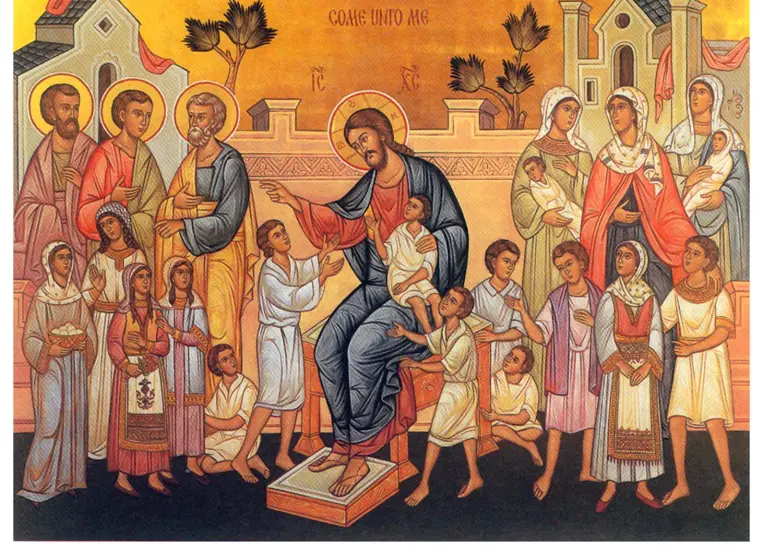
Let the Little Children Come (Luke 18:15-17)

People were also bringing babies to Jesus for him to place his hands on them. When the disciples saw this, they rebuked them. But Jesus called the children to him and said, “Let the little children come to me, and do not hinder them, for the kingdom of God belongs to such as these. Truly I tell you, anyone who will not receive the kingdom of God like a little child will never enter it.” (New International Version)

I happen to believe that kids are closer to the kingdom of God than most adults.

Us big people have developed a lot of baggage over the years. And all that stuff tends to obscure God’s kingdom and the light of Christ within us.

Kids, however, especially small children, still haven’t discerned any veil between the seen and unseen worlds. They freely move between them both without any problem.

So, of course, Jesus wanted to be around children. If he had any homesickness at all, I’m sure the presence of kids made him feel at home more than anywhere else on this earth.

Jesus is our Immanuel, God with us.

The kingdom of God is here within us.

The disciples of Jesus had some difficulty with Christ’s branding of the message because it was not exclusive enough for them. They wanted limits on the us part.

Kids are part of that mass of people that God is with. Children deserve as much or more attention than adults. More than simply saying that we care about kids, we need to be like Jesus. He let the children come to him and was intolerant of anyone preventing kids from doing so.

Since the disciples were, ironically, still living in a small world, they rebuked those who brought little children to Jesus.

We aren’t specifically told why the disciples rebuked the adults bringing children to Jesus. Maybe the children were making a lot of noise and were being a nuisance in the middle of Jesus’ teaching. Perhaps the disciples had Jesus on a tight time schedule and this bringing kids to Christ thing was causing a delay. It could be that the disciples simply saw children as an interruption to the “important” work of ministry. 

I tend to think that the disciples simply failed to appreciate the children. The dominate view of kids in the ancient world was to see them as potential adults. Kids were pretty low on the ladder of society. The disciples likely saw no reason for children to be involved in what was happening.

The babies and toddlers and small children were brought so that Jesus might place his hands on them and pray for them. That still seems to me to be the best reason to bring kids to Jesus. 

“This story teaches us that Christ does not receive only those who voluntarily come to Him of a holy desire and moved by faith, but also those who might not yet be old enough to realize how much they need His grace….  From this we gather that His grace reaches to this age of life also….  It would be cruel to exclude that age from the grace of redemption.”

John Calvin

“Jesus does not only save repentant adults; he also saves dependent children and all those whom we think are incompetent to respond to Jesus.”

Frederick Dale Bruner

Jesus flat out rebuked his disciples for hindering the little children from coming to him. He wanted just the opposite of what was taking place. Why? Because the kingdom of heaven belongs to such little people as these. 

As mentioned, children were at the bottom of the societal pecking order in the ancient world. Their place in that society was to be respectful and quiet, to speak only when spoken to, and to never interrupt an adult.

Yet, Jesus took the time to touch them and pray for them. He invited this interruption to his schedule. Christ bluntly told his disciples that they were the ones being the hindrance, not the kids.

I baptize all sorts of people, including kids and babies. Why? Because in baptism, I recognize that the smallest ones among us can come to this holy sacrament. I understand that in baptism the Holy Spirit begins and initiates the process of salvation that will take that little one from infancy to adulthood and eventual death. I discern that, ideally, the child grows to live into their baptism by recognizing by faith that Jesus died and rose from the dead and grants grace and forgiveness to all who come to him. 

In that process of salvation, of coming to know Jesus, we have the sacrament of the Lord’s Table to strengthen our faith and demonstrate to us that the saving work of Jesus that has been accomplished. It is a Table of grace for all the members of Christ’s Church. 

In my Reformed Christian tradition, we believe that Jesus is not physically, but spiritually present at the Table.  Because Jesus is present, we are able to receive the grace available to us as Christ’s members. So why, in light of this reality, and the words and practice of Jesus toward children, would we ever hinder and prevent the smallest members among us from participating at the Table?

Here’s a thought: If Jesus himself were serving communion in a church, and a group of 2-year-old children came toddling up to the Table to see Jesus, would you stop them from doing so? Or much like the disciples, would you rebuke those bringing children to Jesus?

As for me, I’d rather not be rebuked by my Lord.

Jesus gave children the three gifts they most need: time, touch, and prayer. Parenting and teaching are holy vocations, and we have the wonderful privilege of bestowing these same gifts on our children, grandchildren, and students.

Time, touch, and prayer are ways we bless children. And, what’s more, as God’s children, we are all to approach Jesus and spend time with him, allow him to touch us, and interact with him through prayer. 

May we all have the humility to bend down at eye level to the littlest among us so that we and others will know that the kingdom of God is among us.

The Longing of Christ’s Heart (Matthew 23:37-24:14)

“If Thou Had’st Known” by William Brassey Hole (1846-1917)

“Jerusalem, Jerusalem, you who kill the prophets and stone those sent to you, how often I have longed to gather your children together, as a hen gathers her chicks under her wings, and you were not willing. Look, your house is left to you desolate. For I tell you, you will not see me again until you say, ‘Blessed is he who comes in the name of the Lord.’”

Jesus left the temple and was walking away when his disciples came up to him to call his attention to its buildings. “Do you see all these things?” he asked. “Truly I tell you, not one stone here will be left on another; everyone will be thrown down.”

As Jesus was sitting on the Mount of Olives, the disciples came to him privately. “Tell us,” they said, “when will this happen, and what will be the sign of your coming and of the end of the age?”

Jesus answered: “Watch out that no one deceives you. For many will come in my name, claiming, ‘I am the Messiah,’ and will deceive many. You will hear of wars and rumors of wars but see to it that you are not alarmed. Such things must happen, but the end is still to come. Nation will rise against nation, and kingdom against kingdom. There will be famines and earthquakes in various places. All these are the beginning of birth pains.

“Then you will be handed over to be persecuted and put to death, and you will be hated by all nations because of me. At that time many will turn away from the faith and will betray and hate each other, and many false prophets will appear and deceive many people. Because of the increase of wickedness, the love of most will grow cold, but the one who stands firm to the end will be saved. And this gospel of the kingdom will be preached in the whole world as a testimony to all nations, and then the end will come. (New International Version)

Christ’s cry of love for the city of Jerusalem– the longing to bring the people together and shepherd them with care and compassion – came after a very pointed pronouncement of woes against a distorted religion that was in vogue at the time. Jesus saw the current state of worship, found it to be terribly wanting, gave a scathing rebuke, and saw ahead to its ultimate demise.

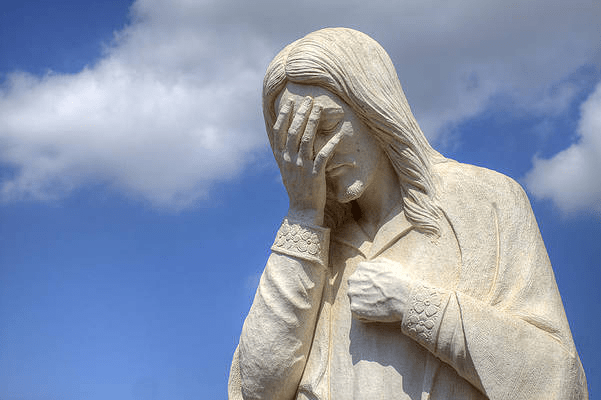
Jesus did not just blast the establishment, then humph and walk away disgusted. Instead, he looked with sadness over the city and broke into a tear-filled, heart-wrenching love song for his wayward people. Jesus was both angry and sad because of his deep concern for all people to know the true worship of God and to find their ultimate purpose and meaning in him.

“And Jesus Wept” statue in Oklahoma City, Oklahoma

Any religious fool can rant about the ills of the world, ungodly persons, and defective institutions. However, it takes a person with the heart of Jesus to weep over it all and follow him into suffering on behalf of others so that they might come to the peaceable kingdom of righteousness. 

If our hearts are not unraveled over the sin and injustice of the world, we are in no position to rant about anything. That’s because grace and mercy is the currency of God’s economy. 

Thus, we need to repent like we mean it, pray as if our lives depended on it, and proclaim the good news of Christ as if there is not a tomorrow.

In a results-driven culture, congregations want clear strategy plans for ministry. Yet, a group of people can implement the best of ministries and still not realize their well-laid plans. If Jesus didn’t see what he wanted to happen come to fruition in Jerusalem, then I’m not sure how any of us can always expect success in ministry. We may fail in many ways; but let us not fail to weep over our communities and neighborhoods and long for them to know Christ.

It’s okay that neither every ministry goes as planned nor every person is blessed by what we do. If we find it hard to accept this, and feel out of control, then we want to know the future – how everything is going to shake-out. This is precisely what the disciples wanted to know, since their expectations weren’t realized.

Jesus essentially told them that things were going to get even tougher. Therefore, they need to be ready and persevere through the adversity. And some of that trouble will be downright cataclysmic. Jesus did not give his disciples a seminar on having a successful ministry; he simply told them to endure suffering and focus on proclaiming the gospel.

But for that to happen, we need to accept that we cannot control every variable of ministry and plan for every contingency. The only guarantees we have is that God is with us, and Christ is coming again. That’s it, my friends.

So, instead of control, we must accept our limitations and practice self-control. We can continually monitor our own internal motivations and desires so that they are in constant alignment with the words and ways of Jesus – including a heart of love that weeps over the brokenness and stubbornness of the world. 

Followers of Jesus walk the only true road of Christian discipleship: the path of humility. Out of all the characteristics that Jesus could have described himself, the only two words he ever used were “gentle and humble.” (Matthew 11:29)

Jesus Weeping Over Jerusalem, by Enrique Simonet Lombardo (1866-1927)

Jesus is the perfect example of a leader who always ministered with a complete sense of his divine power, human limitations, and concern for others. Christ never believed he was the reason for his own success, nor thought he was the reason for another’s failure of faith. Instead, Jesus always connected what he was doing to the will of his Father in heaven.

You can only avoid the seduction of arrogant pride when you recognize that you are not God and need the help of others. Truly humble folk dig a hole, throw their ego into it, and pour concrete on top of it. This allows them to listen deeply, give generously, and encourage others liberally.

Standing firm to the end doesn’t come through crafting complicated charts of the end times; it comes through being humble, being grounded in the here-and-now, being attentive to the people around us, and being a guide for the lost. More importantly, it’s what Christ wants us to be.

Loving Lord Jesus, let me have your zeal for God’s house and your heart for lost people! Change my heart, O God, and let it reflect your grace and truth in everything I say and do; through Christ my Savior, who with you and the Holy Spirit, reign now and forever. Amen.

Think of the Needs of the Group (1 Corinthians 10:23-11:1)

Looking at it one way, you could say, “Anything goes. Because of God’s immense generosity and grace, we don’t have to dissect and scrutinize every action to see if it will pass muster.” But the point is not to just get by. We want to live well, but our foremost efforts should be to help others live well.

With that as a base to work from, common sense can take you the rest of the way. Eat anything sold at the butcher shop, for instance; you don’t have to run an “idolatry test” on every item. “The earth,” after all, “is God’s, and everything in it.” That “everything” certainly includes the leg of lamb in the butcher shop. If a nonbeliever invites you to dinner and you feel like going, go ahead and enjoy yourself; eat everything placed before you. It would be both bad manners and bad spirituality to cross-examine your host on the ethical purity of each course as it is served. On the other hand, if he goes out of his way to tell you that this or that was sacrificed to god or goddess so-and-so, you should pass. Even though you may be indifferent as to where it came from, he isn’t, and you don’t want to send mixed messages to him about who you are worshiping.

But, except for these special cases, I’m not going to walk around on eggshells worrying about what small-minded people might say; I’m going to stride free and easy, knowing what our large-minded Master has already said. If I eat what is served to me, grateful to God for what is on the table, how can I worry about what someone will say? I thanked God for it, and he blessed it!

So eat your meals heartily, not worrying about what others say about you—you’re eating to God’s glory, after all, not to please them. As a matter of fact, do everything that way, heartily and freely to God’s glory. At the same time, don’t be callous in your exercise of freedom, thoughtlessly stepping on the toes of those who aren’t as free as you are. I try my best to be considerate of everyone’s feelings in all these matters; I hope you will be, too.

It pleases me that you continue to remember and honor me by keeping up the traditions of the faith I taught you. (The Message)

“To know how to free oneself is nothing; the arduous thing is to know what to do with one’s freedom.”

Andre Gide

Extreme individualism wants what it wants and doesn’t give a thought about anyone else – which is why we always have such a peck of trouble in the world all the time.

We need to get a phrase into our language which will become a continual mantra we say and observe:

Think of the needs of the group.

Christianity is a religion of community, of being attentive to and meeting one another’s needs, and of caring about the common good of all persons throughout the world. Christians dishonor their Lord and buck their spiritual tradition whenever they go rogue and base everything they say and do on what sort of advantage it is for them without considering others.

Yes, believers in Jesus have freedom in Christ. The cross has released the shackles that kept us in sin’s bondage. But, no, that doesn’t mean we get to do whatever we want, whenever we want. That’s the way individualism looks at it. That’s not how a communal people, the church, are to look at it.

Freedom hinges on two very important and seemingly small grammar prepositions: from and to.

Freedom always involves two elements:

  1. Freedom from what hinders or oppresses us.
  2. Freedom to become who we are meant to be.

In Christianity, believers are saved from sin, death, and hell – released from guilt and shame. There is redemption from the pit of despair. The bonds that hindered are now broken through the cross of Christ. The power of the world, the sinful nature, and the devil are taken away.

Yet, in no way does that now mean that we now get to do whatever we want, as if we’ve finally outgrown childhood and parental authority.

The extreme individualist Christian looks at freedom solely from this vantage. As a result, such a person considers the church as nonobligatory, involvement in issues of justice as optional, the use of personal funds and resources as discretionary, and accountability to others as arbitrary.

Such individualism sees Christianity as a fire insurance policy from hell, and a ticket punched for heaven. Until Christ returns, the reasoning goes, I can do whatever the heck I want. It’s my life, not yours.

Christians, however, are still servants. Whereas we were once enslaved to the dark forces of this world, now we are slaves to Christ. We exchanged masters. Satan is no longer the deceitful and lying task master over us. We are now under new management and have a new Master, the Lord Jesus. We’ve changed allegiances.

And now, submitted to Christ, we embrace our mandate of freedom to become whom we were always meant to be: At peace with our Creator and in harmony with all creation. We are now free to enjoy right relationships with God and others, to walk in faith, hope, and love, and to bless both the church and the world.

The Christian’s freedom came at a price: the very blood of Christ Jesus. Therefore, we are not to abuse that freedom by focusing solely on our freedoms from all that once bound us. We are also responsible and accountable for using that freedom in going to the world and proclaiming the gospel in word and sacrament, as well as loving God and neighbor.

Freedom is only freedom when it has the well-being of everyone in mind.

Think of the needs of the group.

Lord God, almighty and everlasting Father: Help us to live into the freedom you have brought to us. May we exercise our freedom, with the heart of a faithful disciple of Jesus Christ, to serve your purposes. Unite us, protect our sacred liberties and rights, and defend us from every evil. Strengthen your people as a foundation of moral clarity, justice, love, and gospel proclamation. Grant all this by the power of your Holy Spirit and in the Name of Jesus Christ, your Son, our Lord. Amen.