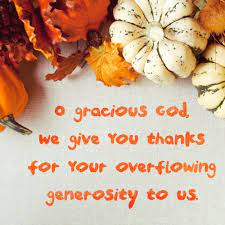
Generosity and Thanksgiving (2 Corinthians 9:6-15)

Remember this: Whoever sows sparingly will also reap sparingly, and whoever sows generously will also reap generously. Each of you should give what you have decided in your heart to give, not reluctantly or under compulsion, for God loves a cheerful giver. And God is able to bless you abundantly, so that in all things at all times, having all that you need, you will abound in every good work. As it is written:

“They have freely scattered their gifts to the poor;
    their righteousness endures forever.”

Now he who supplies seed to the sower and bread for food will also supply and increase your store of seed and will enlarge the harvest of your righteousness. You will be enriched in every way so that you can be generous on every occasion, and through us your generosity will result in thanksgiving to God.

This service that you perform is not only supplying the needs of the Lord’s people but is also overflowing in many expressions of thanks to God. Because of the service by which you have proved yourselves, others will praise God for the obedience that accompanies your confession of the gospel of Christ, and for your generosity in sharing with them and with everyone else. And in their prayers for you their hearts will go out to you, because of the surpassing grace God has given you. Thanks be to God for his indescribable gift! (New International Version)

Generosity is at the heart of any good family, neighborhood, workplace, organization, church, and individual. To be generous is to reflect the image of God, who is wildly generous, giving freely and liberally on our behalf.

We often associate being generous with giving a handout or money to someone or some organization in need. It is that, but much more. Generosity doesn’t have to do with the size of our check or the amount of our contribution. 

We can be generous with our time, abilities, words, and with what little or much we have of money, as well. Generosity means to go above expectations – to give with magnanimity, to go out of your way to do good when no one is looking – and experience giving as its own reward.

Jesus, for whom the Apostle Paul learned about the true nature of being generous, embraced generosity as a way of life while he was here on this earth. No one expected Christ to go out of his way to call the least, the lowly, the lost, and the last of society. The people on the margins of respectable culture had no expectations that the Messiah would head their way. But he did. 

Christ the Lord even went so far as to hang out with the despised tax collectors, and freely talk with sexual deviants. The high brows of society couldn’t raise their eyebrows high enough for Jesus. It was just too much for them. Not only was Jesus making them look bad with his generosity as a way of life, but he was also, in their minds, generous to the wrong sort of people.

The follower of Jesus does so by surveying the landscape of human need and giving to people in places where no one expects a handout. 

It’s interesting that Christ lived a simple life with little to no money. He largely depended on the generosity of others. Yes, my friend, generosity is a two-way street. Being generous to others is the easy part for many people; receiving the generosity of other people is often much harder.  Yet, Jesus did both – he gave and received.

Jesus was generous in ways which were consistent with the Father’s will. Christ gave of his time, and of his divine ability to heal and forgive. He was perhaps the most magnanimous person of all-time, due to his generosity of compassion, kindness, love, and humble service to others. 

And the height of Christ’s generosity was in giving his life so that you and I could live a life free from the power of guilt and shame. Such deliverance, through the cross, is offered and given, free of charge. That’s over-the-top generous.

Money is merely a barometer of one’s generosity, that is, of our stance and approach toward money. You don’t need to be rich to be generous. A large and expansive heart always finds ways to have a generosity of spirit wherever it goes.

Jesus warned against using generosity in order to be noticed:

“When you do good deeds, don’t try to show off. If you do, you won’t get a reward from your Father in heaven. When you give to the poor, don’t blow a loud horn. That’s what show-offs do in the meeting places and on the street corners because they are always looking for praise. I can assure you that they already have their reward. When you give to the poor, don’t let anyone know about it. Then your gift will be given in secret. Your Father knows what is done in secret, and he will reward you.” (Matthew 6:1-4, CEV)

A generous heart is a heart of gratitude. Giving thanks is the logical and organic way of expressing generosity.

Consider just a few biblical verses that encourage us toward thanksgiving: 

Let us come before him with thanksgiving and sing joyful songs of praise. (Psalm 95:2, GNT) 

Enter his gates with a song of thanksgiving.
Come into his courtyards with a song of praise.
Give thanks to him; praise his name. (Psalm 100:4, GW)

O give thanks to the Lord, for he is good; his steadfast love endures forever! (Psalm 118:1, NRSV)

In the Gospel of Luke, a story is told of ten men with leprosy who were miraculously healed by Jesus. A Samaritan, the lowliest of the low, was the lone person who came and fell at Christ’s feet with intense gratitude. While the other nine went about their lives free from disease and glad for it, only one guy took the time to thank Jesus. (Luke 17:11-19) 

Indeed, sometimes we must be reminded to give thanks and to show gratitude for the ways in which God has provided for us. Yet, if our hearts are abundantly full of generosity, no reminder is needed; it just comes pouring forth.

Those who have small hearts will only realize small blessings. But those who plant many seeds of generosity and gratitude will see abundant blessings.

May it be so, to the glory of God.

Parable of the Three Servants (Matthew 25:14-30)

Parable of the Three Servants, a woodcut by Jan Luiken, 1712

Jesus said, “The Kingdom of Heaven can be illustrated by the story of a man going on a long trip. He called together his servants and entrusted his money to them while he was gone. He gave five bags of silver to one servant, two bags of silver to another servant, and one bag of silver to the last servant—dividing it in proportion to their abilities. He then left on his trip.

“The servant who received the five bags of silver began to invest the money and earned five more. The servant with two bags of silver also went to work and earned two more. But the servant who received the one bag of silver dug a hole in the ground and hid the master’s money.

“After a long time their master returned from his trip and called them to give an account of how they had used his money. The servant to whom he had entrusted the five bags of silver came forward with five more and said, ‘Master, you gave me five bags of silver to invest, and I have earned five more.’

“The master was full of praise. ‘Well done, my good and faithful servant. You have been faithful in handling this small amount, so now I will give you many more responsibilities. Let’s celebrate together!’

“The servant who had received the two bags of silver came forward and said, ‘Master, you gave me two bags of silver to invest, and I have earned two more.’

“The master said, ‘Well done, my good and faithful servant. You have been faithful in handling this small amount, so now I will give you many more responsibilities. Let’s celebrate together!’

“Then the servant with the one bag of silver came and said, ‘Master, I knew you were a harsh man, harvesting crops you didn’t plant and gathering crops you didn’t cultivate. I was afraid I would lose your money, so I hid it in the earth. Look, here is your money back.’

“But the master replied, ‘You wicked and lazy servant! If you knew I harvested crops I didn’t plant and gathered crops I didn’t cultivate, why didn’t you deposit my money in the bank? At least I could have gotten some interest on it.’

“Then he ordered, ‘Take the money from this servant, and give it to the one with the ten bags of silver. To those who use well what they are given, even more will be given, and they will have an abundance. But from those who do nothing, even what little they have will be taken away. Now throw this useless servant into outer darkness, where there will be weeping and gnashing of teeth.’ (New Living Translation)

What would you do with a million dollars?…  Maybe you would pay off some debts, finish some work on your house, or quit your job and take a vacation. Perhaps you might invest a good portion of it. Whatever you do with it, your investment of money is only as good as your level of trust. 

When I worked at a senior citizen healthcare facility, there was a resident living in an independent living apartment, but he still owned his house. During one conversation, the old man admitted to me that over the past sixty years, he had secretly bored holes in every door jamb of his house and had stuffed away $100,000 dollars in cash! This dear resident had personally experienced the run on banks which began the Great Depression in 1929. He had zero trust for investment banking.

The three servants responded their master’s generosity according to their view of him. Two of the servants regarded the master as gracious and generous, and so, freely took their hefty bags of money and confidently invested them to create even more money. They took risks, invested, worked, and acted with the idea that they were secure in their relationship with their master. 

The third servant, however, perceived his master as stern, serious, and angry. So therefore, he did nothing with his bag of money because he was afraid.

If we consider God as primarily an angry Being, then we will almost certainly not use the gifts he has given us, for fear of messing up and experiencing God’s wrath. 

Yet, the truth is, God is gracious and generous. The Lord has generously give to everyone; and God expects us to use what was given and not hide it away in a door jamb! If we want to hear the Lord Jesus say, “Well done, good and faithful servant,” then taking faithful initiative is necessary.

Fear is perhaps the devil’s greatest tool in preventing God’s people from being productive Christians in serving the church and the world. Beneath the fear can be powerful feelings of inferiority, inadequacy, and an inner conviction of not being enough. Oftentimes, a low view of self can come from a low view of God.

Being continually afraid, wastes whatever impact we could have for God in the world, and diminishes our resolve to act so that our lives are ineffective.

We are meant to enjoy the gracious and generous God, and in our enjoyment of the Lord, godly dreams will be placed within us that God is pleased to fulfill:

Our enjoyment of God gives us the security and confidence to act upon godly desires and produces a generous harvest of righteousness and peace. We then can share the bounty with others, as a way of giving back to God. 

Yet, if fear gets thrown into the mix, it dilutes and destroys everything. Fear paralyzes us, and we do nothing, like the third servant in the parable who did nothing. What’s more, fear leads us into hiding, just like the servant hid and buried his big bag of money. 

We might wrap a lot of our fears in morbidly sanctified self-belittling, that is, of feeling good about feeling bad. Those self-deprecating feelings stop us from exploring God’s dream and vision for us. Yet, we really can speak and act in the world with confidence because we serve a God who is gracious and generous.

Some of the greatest fears that hold back people from exploring their faith is:

  • Fear of criticism – being afraid of what others may think or say 
  • Fear of taking a risk – being afraid of going outside the comfort zone of how something has always been done
  • Fear of ourselves – being afraid to explore our vast inner world with its guilt, shame, insecurity, and mixed motives

If you once had a dream and you think that dream is dead because of your sins and bad habits, you are wrong.  Dreams are destroyed by fear, by being duped into believing that we are not enough, and never will be. So, we end up doing nothing.

Living in a way that is always looking over your shoulder to see if God is going to rap your knuckles with a ruler is no way to live.

The hardest people to get along with are those who have a low view themselves. Because they do not like themselves, they do not like others. They continually wonder if God is upset with them about something. The man in the parable blamed God for his lack of investment. Blaming others is really our own fear and insecurity seeping through – it helps no one, especially ourselves. 

“I can’t!” is the cry of the person locked in fear. I cannot stand up in front of people, meet strangers, serve like others, or love like Jesus did. I cannot because I am afraid, and I only have one measly bag of money! 

Yet, God typically uses tongue-tied people like Moses; worriers like Abraham; lowly tax-collectors like Matthew, and prostitutes with sordid pasts like Mary Magdalene – and not superstars. The less talented a person is, the more God gets to show up and show off with generous power and gracious ability through that person.

Conclusion

God loves you, and really does have wonderful plans for you. God created you with your unique personality, gave you unparalleled experiences, and gifted you with uncommon abilities. God wants you to tap into that passion and dream placed down deep in your heart to serve the world. 

What would you do with a million dollars? You already have it. Now, go and invest it.

Soli Deo Gloria

A Real Change of Life (Matthew 12:43-45)

“When an evil spirit leaves a person, it goes into the desert, seeking rest but finding none. Then it says, ‘I will return to the person I came from.’ So it returns and finds its former home empty, swept, and in order. Then the spirit finds seven other spirits more evil than itself, and they all enter the person and live there. And so that person is worse off than before. That will be the experience of this evil generation.” (New Living Translation)

Nature abhors a vacuum. A tilled plot of soil will be overtaken with weeds if nothing is planted and nurtured in the turned-over dirt. 

The pecking order of a brood of chickens cannot handle the death of the top hen without filling the position almost immediately. 

In the spiritual realm, the exorcising of a demon will not simply leave a person empty of evil – their life will be filled with something in its place.

Jesus told a story about a man who was delivered from an unclean (evil) spirit. It’s a powerful and simple narrative on the necessity of true repentance, that is, on what a real change of life is like. 

Genuine freedom is more than getting rid of something bad and destructive; the evil must be replaced with something good and useful. In other words, biblical repentance, a true transformation of a person, is both a turning away from ungodliness and an embrace of righteousness.

We are delivered from evil so that we can start living into right and peaceful relationships, as God intends for us.

For example, the Apostle Paul exhorted the Ephesian believers to not only stop stealing but also to get a job and start sharing with others. They were not only to stop lying and using their tongues for gossip and slander and start using their words to speak truth that builds up others. (Ephesians 4:25-32)

The spiritual principle is the same as the nature principle: A empty vacuum will always be filled. The man who did not fill his life with God ended up having a problem with evil seven times greater than when he started. If anything, or anyone, is emptied of its unhealthy elements and practices, it is imperative that the hole be immediately filled with healthy disciplines for life.

Whether dealing with addictions, bad habits, or any kind of evil influence, a two-pronged approach is needed for its eradication. We expel the evil by replacing it with godliness. 

For example, the man struggling with pornography or adultery must not only stop the behavior but take up the mantle of being a champion for women’s issues; or the woman who has no healthy boundaries and allows herself to be used and abused must not only separate from the problem or person but adopt her identity in Christ as a precious child of God and enforce righteous limitations. 

These examples are not meant to be simplistic answers to complex situations. Rather, they illustrate why so many people do not experience freedom and continue to have even greater enslavement to their passions and sufferings. Freedom is realized through replacing old practices with new disciplines that directly attack the old.

We all have needs. How we get those needs met is often a mixed bag of both legitimate and illegitimate ways. In a perfect world, everyone would be aware of their needs and be able to express them to one another without shame, anxiety, or anger. Since we live on a blemished fallen planet, we end up trying to meet our needs indirectly through hustling for love, hoarding resources, and controlling others – all harmful ways which destroys souls and relationships.

In order to focus on meeting our needs in a wise and healthy manner, we must take a step beyond ending a toxic relationship, cutting up a credit card, or saying “no” to another responsibility. We often get into our mess to begin with because we are out of touch with ourselves and our needs. We need affection and encouragement, and there is no shame in needing this. We need security and safety, and there is no problem in acquiring this. There are some things we need to control, and that is okay.

If we fail to address our needs, we might do the necessary work of deliverance, then turn right around and become worse off than before by filling the empty place of our lives with:

  • Being all things to all people, as if we were the Messiah.
  • Being successful so that we stay ahead of being needy.
  • Pulling inside ourselves and trusting nobody.
  • Distancing from our needs and pretending they are not there.
  • Being continually vigilant so that we are never hurt that way again.
  • Keeping a positive spin on everything, as if there is no negative stuff in the world.
  • Challenging other’s opinions and behaviors to keep the focus off our needs.
  • Becoming a wallflower so that we can never be the brunt of someone else’s vitriol or evil.

Instead, we can let Jesus fill the emptiness with love, purpose, peace, joy, attention, and grace. Christ is the Savior who delivers us from evil, and the Holy Spirit is the Sanctifier who carefully applies the work of salvation to our lives. When our hearts and minds are full of God, there is no place for the demons to get in.

True change and transformation equally forsakes evil and embraces righteousness; replaces the unhealthy with the healthy; jettisons the illegitimate and seeks the legitimate; and puts away unnecessary suffering and pursues peace and joy in the Spirit.

O God, I no longer want to live with saying I’m sorry and going right back to the old pig slop of sin. I cannot change on my own. I need Jesus to both take away the sin and give me a new life of living for him. Help me to make choices that put to death the old way of life, and the courage to live into my forgiveness in the power of the Holy Spirit. Amen.

Real Life (1 Thessalonians 3:6-13)

But Timothy has just now come to us from you and has brought good news about your faith and love. He has told us that you always have pleasant memories of us and that you long to see us, just as we also long to see you. Therefore, brothers and sisters, in all our distress and persecution we were encouraged about you because of your faith. 

For now we really live since you are standing firm in the Lord. How can we thank God enough for you in return for all the joy we have in the presence of our God because of you? Night and day we pray most earnestly that we may see you again and supply what is lacking in your faith.

Now may our God and Father himself and our Lord Jesus clear the way for us to come to you. May the Lord make your love increase and overflow for each other and for everyone else, just as ours does for you. May he strengthen your hearts so that you will be blameless and holy in the presence of our God and Father when our Lord Jesus comes with all his holy ones. (New International Version)

What does it mean to really live? Everyone has their own conceptions of what the good life is. But to live life to the full, to really live in sync with how life actually is (and is supposed to be) brings us true satisfaction, contentment, and meaning.

In the radical individualism of the West, it may seem foreign or strange to us that the Apostle Paul’s life was very much bound up in the lives of others – in the churches he established and with the believers who had come to faith in Christ. For Paul, to really live was to see spiritual growth and development in the places where he ministered.

The thing that really got Paul excited, what really melted his butter, was leading others to Christ, forming them into churches, and watching them carry out their missional mandate by doing the same things that he did with them. I can relate to Paul’s joy and satisfaction over Christian discipleship.

There’s nothing quite like mentoring others in the faith, helping them mature in that faith, and sending them out to live according to the model of faith that you’ve demonstrated for them. To see the Word of God take root in individuals and communities of people is like no other sort of joy and contentment.

In the midst of discouraging circumstances of persecution and distressing situations of opposition, it was gratifying, encouraging, and motivating for Paul to hear a good spiritual report from his protégé Timothy about the Thessalonian church’s faith.

Whether we acknowledge it or not, or like it or not, every one of us is inextricably connected to the other. And that is especially true in families, and in the family of God. The Thessalonian believers’ steadfast commitment to Christ and the Christian faith was a crucial and important dimension of Paul’s own persevering faith.

The Apostle had been on the front lines of faith – taking the good news of grace and forgiveness in Christ to the nations. To have his churches endure through all their own troubles and challenges is a great boon to Paul. They each derive confidence and inspiration from the other. Everyone’s faith is confirmed and strengthened when everyone is striving to live for Christ.

All the believers in Christ were really living because they stood firm in the Lord and were immovable in their faith commitments. Assurance and reassurance comes not in isolation, but through the interdependence and interaction with others who share the same values.

Parents don’t really live, unless they see their children living a life of abundant joy and satisfaction. And it’s the same with spiritual mothers and fathers; they truly live when their spiritual children are walking in faith and patience with the Lord.

This is why Paul was grateful and could not thank God enough for the Thessalonians’ life of faith. God’s powerful and gracious work in the church brought out all kinds of thanksgiving. With that sort of dynamic happening, Paul could face any tribulation with the confidence and trust needed to keep going.

Prayer is the logical response to a healthy spiritual and relational dynamic of faith. The greater the good relations, the greater the desire to come and keep imparting needed teaching and encouragement for the Christian life. In other words, spiritual growth begets spiritual growth.

The best way the Thessalonian converts and all the churches become rooted in faith is by God helping them to have their love increase and overflow for each other, and for everyone else. What’s more, God intends that the love Christians have for one another be a model and a witness to and for the world.

Christian community is the place we learn to love. As we practice again and again how to love one another in the church, we then take this love into the world in loving even our enemies. For if we are to follow our model and leader, Jesus Christ, then we will infuse each word and every action with the love of God in Christ – which is the light that draws others into a healthy spiritual and relational dynamic.

We must pray, as Paul did, for love to increase amongst us, so that our hearts are strengthened with genuine purity and holiness of life. For unless love grows and flowers, selfish desires will increase and turn our love inward to the point of taking love away from God and the world.

It is imperative that we have a genuinely loving stance toward each other as believers, and toward others in the world. Apart from this love – given graciously to us through the cross and resurrection of Christ – there is little hope for anything bad in this old fallen world to ever be better.

The bottom line is that churches wither and die because they lose sight of love; Christians lose faith and go their own way because they forget about love; and believers throughout the world continue on because loving prayers, loving ways, and loving words come their way, despite difficulty and hardship they face.

So, let us love one another as Christ loved us. For this is the way our faith is strengthened and our hope is kindled to keep enduring until Jesus returns to this earth and makes all things new and right. This is real life.

May almighty God give you grace to persevere with joy, so that the work of love begun in you may be completed, through Jesus Christ our Lord. Amen.