The End of the World (Matthew 24:1-14)

The Final Sign

Jesus left the temple and was walking away when his disciples came up to him to call his attention to its buildings. “Do you see all these things?” he asked. “Truly I tell you, not one stone here will be left on another; every one of them will be thrown down.”

As Jesus was sitting on the Mount of Olives, the disciples came to him privately. “Tell us,” they said, “when will this happen, and what will be the sign of your coming and of the end of the age?”

Jesus answered: “Watch out that no one deceives you. For many will come in my name, claiming, ‘I am the Messiah,’ and will deceive many. You will hear of wars and rumors of wars, but see to it that you are not alarmed. Such things must happen, but the end is still to come. Nation will rise against nation, and kingdom against kingdom. There will be famines and earthquakes in various places. All these are the beginning of birth pains.

“Then you will be handed over to be persecuted and put to death, and you will be hated by all nations because of me. At that time many will turn away from the faith and will betray and hate each other, and many false prophets will appear and deceive many people. Because of the increase of wickedness, the love of most will grow cold, but the one who stands firm to the end will be saved. And this gospel of the kingdom will be preached in the whole world as a testimony to all nations, and then the end will come. (New International Version)

I am a suspicious person when it comes to end-time gurus. I find most of them to be false teachers, trying to scare people into their own little group, like a bunch of nuts in a fruitcake.

Yet, Jesus is an end-time preacher, giving an answer to those who asked him about the future and how things will literally shake up and shake out at the end of the world. So, because I trust him when he lays out what will happen, I believe there is a time coming when there shall be a judgment of the living and the dead.

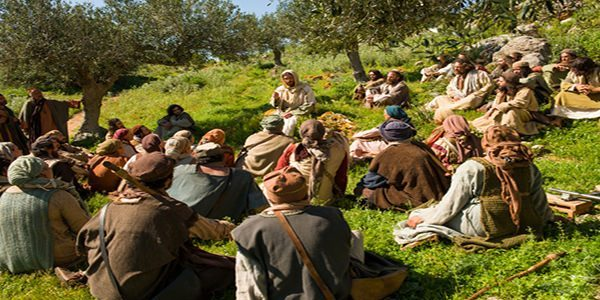
Christ’s disciples had heard Jesus pronounce doom on the Jerusalem temple, and wanted to know about when this was going to happen, along with the signs leading to it. Jesus then went on to tell them about a much bigger picture than what the disciples were asking for; Jesus described not only the end of the temple, but also the end of the world as we know it.
I often find myself warning people about buying into those who constantly and confidently talk of the end, as if they have the inside track on it. Jesus did the same; so I’ll take my cues from him. Notice the warnings he offered his disciples concerning signs of the end time:

Don’t let anybody fool you

Watch out for deceivers. False teachers are those who claim to be Christians and have insider information from all their great study. Stay clear of them. Their sense of superiority, because of their supposed knowledge, will trick many people. Don’t be fooled by them.

Don’t be afraid

Anyone who pays any sort of attention to the news – whether local, national, or international – is likely to be concerned about the state of our world. We may even become terrified. But Jesus wants us to avoid being fearful all the time. And that will only happen if we listen as much or more to him than we do people who whip up a frenzy and get us all upset – much like talk radio hosts do to their audiences; or hack preachers do to spiritually vulnerable Christians.

We can be wise and discerning without being fearmongers and constantly worried. In times of crisis and disaster, Christians really ought to be the calmest people on the planet.

Armies may surround me,
    but I won’t be afraid;
war may break out,
    but I will trust you. (Psalm 27:3, CEV)

Wars, rumors of wars, coups, famines, and earthquakes happen. All these, and more, are signs – just like a woman with labor pains, about to give birth. When we look ahead, we may feel apprehensive, upset, and afraid with pain. But our fear will eventually give way to joy. Before things get better, things will get a lot worse. Disaster and destruction will lead to the renewal of all things.

The world will hate you

Because there is fear and deception, the Church will become an oppressed victim. The world hates those who truly follow Christ. All that has been simmering underground will break out in persecution against believers.

So, it ought not surprise any Christian or any Church when there is intolerance and disdain against them. Anyone following Jesus should expect the same treatment he received in his last days on earth.

Many “Christians” will turn against each other and hate each other. They will drop out and refuse association with Christ or his Church. The outside pressure will become intense enough to force a crumbling of the Church on the inside. Parishioners will tear each other to pieces.

Unfortunately, the world’s hate leads to the church’s apostasy – a turning away from faith. And this situation is a ripe situation for false teachers to rise and have their way. People will glory in their shame.

The ones who stick it out will be saved

The true believer holds onto faith, despite the intense pressure of hatred. This isn’t salvation by works; it’s salvation by a faith that is authentic, genuine, and the real deal. This faith remains as a testimony to all that love still exists and will never be extinguished.

And then the end will come.

There shall always be the good news in the middle of all the terribly bad news. Divine sovereignty will always be above the world’s hate and disorder.

Therefore, let the believer be the herald of good news and give themselves to the mission of faith, grace, hope, and love in Christ. No matter where or when you locate the time of great tribulation, it is always open season on gospel proclamation.

God will make something out of nothing. Trouble, hardship, oppression, persecution, and death are the signs of the end. Now is the time for faith and patience. Now is the opportunity to love with the light that penetrates the darkness of hate.

Eternal God, you are the light of the minds that know you, the joy of the hearts that love you, and the strength of the wills that serve you. Grant us to know you that we may truly love you; to love you so that we may truly serve you, through Jesus Christ our Lord. Amen.

The Trumpets of Judgment (Revelation 8:6-9:12)

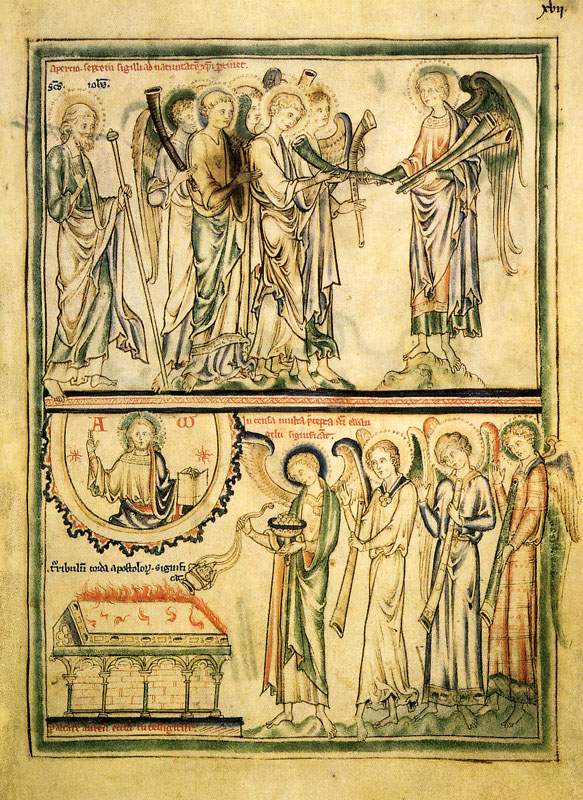
The seven angels with seven trumpets, and the angel with a censer, c. 1020 C. E.

Then the seven angels who had the seven trumpets prepared to sound them.

The first angel sounded his trumpet, and there came hail and fire mixed with blood, and it was hurled down on the earth. A third of the earth was burned up, a third of the trees were burned up, and all the green grass was burned up.

The second angel sounded his trumpet, and something like a huge mountain, all ablaze, was thrown into the sea. A third of the sea turned into blood, a third of the living creatures in the sea died, and a third of the ships were destroyed.

The third angel sounded his trumpet, and a great star, blazing like a torch, fell from the sky on a third of the rivers and on the springs of water—the name of the star is Wormwood. A third of the waters turned bitter, and many people died from the waters that had become bitter.

The fourth angel sounded his trumpet, and a third of the sun was struck, a third of the moon, and a third of the stars, so that a third of them turned dark. A third of the day was without light, and also a third of the night.

As I watched, I heard an eagle that was flying in midair call out in a loud voice: “Woe! Woe! Woe to the inhabitants of the earth, because of the trumpet blasts about to be sounded by the other three angels!”

The fifth angel sounded his trumpet, and I saw a star that had fallen from the sky to the earth. The star was given the key to the shaft of the Abyss. When he opened the Abyss, smoke rose from it like the smoke from a gigantic furnace. The sun and sky were darkened by the smoke from the Abyss. And out of the smoke locusts came down on the earth and were given power like that of scorpions of the earth. 

They were told not to harm the grass of the earth or any plant or tree, but only those people who did not have the seal of God on their foreheads. They were not allowed to kill them but only to torture them for five months. And the agony they suffered was like that of the sting of a scorpion when it strikes. During those days people will seek death but will not find it; they will long to die, but death will elude them.

The locusts looked like horses prepared for battle. On their heads they wore something like crowns of gold, and their faces resembled human faces. Their hair was like women’s hair, and their teeth were like lions’ teeth. They had breastplates like breastplates of iron, and the sound of their wings was like the thundering of many horses and chariots rushing into battle. They had tails with stingers, like scorpions, and in their tails they had power to torment people for five months. They had as king over them the angel of the Abyss, whose name in Hebrew is Abaddon and in Greek is Apollyon (that is, Destroyer).

The first woe is past; two other woes are yet to come. (New International Version)

Angels receiving seven trumpets, c. 1255 C.E.

Woah; this isn’t exactly some light bedtime reading. It has to do with the end of all things, with God’s judgment upon the earth. Seven angels with seven trumpets are about to sound them with disastrous results. The last three trumpets are also referred to as the three woes upon the earth.

The first four trumpets are bad, yet not nearly as terrible as the last three. The first four affect the natural world and one-third of the earth; whereas the last three directly impact the earth’s inhabitants and affect the entire world.

As hard as it may be to accept biblical readings like today’s, God is not only the author of abundant flourishing, but also of devastating destruction. And it’s in direct answer to the prayers of the saints. (Revelation 8:3)

Although hail and blood remind the biblical student of the plagues of judgment in ancient Egypt before the great exodus of Israelites, it’s the fire that does damage to the trees and grass of the earth. A third of the earth’s land resources are completely burned up.

The second angel blowing the second trumpet results in a great mountain being hurled into the sea. This is reminiscent, for those familiar with the Gospels, of Jesus stating that one with a small amount of faith can command a mountain to be thrown into the sea, and it will be done. (Mark 11:23)

Going back into the Old Testament, in the giving of the Law on the mountain, and with the disobedience of the people at the foot of the mountain, Mount Sinai was ablaze with fire and the glory of God. The New Testament scene in Revelation appears to be something of a Mount Sinai taken up and thrown into the sea – signifying that the grace of Christ has supplanted the curse of the law.

As a result of the second trumpet, a third of all the great oceans are destroyed.

Although C.S. Lewis gave the name “Wormwood” to a fictional agent of Satan, the Wormwood here is a messenger of God, a star that falls from the sky as a result of the third trumpet blown. A third of all the earth’s drinkable water becomes bitter because of the star – which seems to be a link to previous times of judgment from God:

“I will make them eat bitter food
    and drink poisoned water,
because from the prophets of Jerusalem
    ungodliness has spread throughout the land.” (Jeremiah 23:15, NIV)

“They have followed the stubbornness of their hearts; they have followed the Baals, as their ancestors taught them.” Therefore this is what the Lord Almighty, the God of Israel, says: “See, I will make this people eat bitter food and drink poisoned water. (Jeremiah 9:14-15, NIV)

There’s nothing that falls from the sky with the blast of the fourth trumpet. Yet a third of the sun, moon, and stars are dimmed. This is a portent that something worse is about to happen – which is what the “eagle” [vulture] announces against the earth’s inhabitants.

Another star falls to the earth, but with even more disaster than the previous star – opening a pit in the heart of the earth. Smoke comes billowing out, darkening the sun. Then, locusts with the stinging power of scorpions, come upon the land.

Rather than humans having authority to trample on snakes and scorpions, these demonic insects carry the ability and the authority to harm humanity – much like the great locust horde of judgment during the time of the prophet Joel (Joel 2:1-11). The difference with John’s Apocalypse is that these are a demonic host with Apollyon the Destroyer leading them.

The previous judgments were from above; this first woe is from below – connecting the powers of death, destruction, and the grave together with the force of evil. It’s a time of sheer torture; a traumatic five months of horrendous agony.

Conclusion

None of these terrible scenes of judgment are meant to scare the hell out of anybody and put the fear of heaven into them. Instead, the New Testament book of Revelation (also known as the Apocalypse of John) is meant for devoted believers in Jesus to be encouraged that an end is coming. They can persevere in following Jesus because it will be worth it.

The hardships, difficulties, and persecutions experienced – for following the words and ways of Jesus – will not last; a time is coming soon when God will judge the living and the dead. Evil will be dealt its final blow. And we will enter a realm of unending peace with the God for whom we have given our all.

Therefore, since we are receiving a kingdom that cannot be shaken, let us be thankful, and so worship God acceptably with reverence and awe, for our “God is a consuming fire.” (Hebrews 12:28-29; Deuteronomy 4:24)

May the Lord answer you in the day of trouble!
    The name of the God of Jacob protect you!
May he send you help from the sanctuary
    and give you support from Zion.
May he remember all your offerings
    and regard with favor your burnt sacrifices. Selah

May he grant you your heart’s desire
    and fulfill all your plans. Amen. (Psalm 20:1-4)

Paul the Missionary (Acts 13:1-12)

Elymas the sorcerer is struck blind by Paul, before Sergius Paulus. painting by Raphael (1483-1520)

Now in the church at Antioch there were prophets and teachers: Barnabas, Simeon called Niger, Lucius of Cyrene, Manaen (who had been brought up with Herod the tetrarch) and Saul. While they were worshiping the Lord and fasting, the Holy Spirit said, “Set apart for me Barnabas and Saul for the work to which I have called them.” So after they had fasted and prayed, they placed their hands on them and sent them off.

The two of them, sent on their way by the Holy Spirit, went down to Seleucia and sailed from there to Cyprus. When they arrived at Salamis, they proclaimed the word of God in the Jewish synagogues. John was with them as their helper.

They traveled through the whole island until they came to Paphos. There they met a Jewish sorcerer and false prophet named Bar-Jesus, who was an attendant of the proconsul, Sergius Paulus. The proconsul, an intelligent man, sent for Barnabas and Saul because he wanted to hear the word of God. But Elymas the sorcerer (for that is what his name means) opposed them and tried to turn the proconsul from the faith. Then Saul, who was also called Paul, filled with the Holy Spirit, looked straight at Elymas and said, “You are a child of the devil and an enemy of everything that is right! You are full of all kinds of deceit and trickery. Will you never stop perverting the right ways of the Lord? Now the hand of the Lord is against you. You are going to be blind for a time, not even able to see the light of the sun.”

Immediately mist and darkness came over him, and he groped about, seeking someone to lead him by the hand. When the proconsul saw what had happened, he believed, for he was amazed at the teaching about the Lord. (New International Version)

Most, if not every, follower of Jesus wants to hear the voice of God’s Spirit. Yet, many don’t. Why? Because they have not yet put themselves in a position to listen and learn.

We can only hear if we are attentive. We cannot hear if we are distracted doing other things.

The Antioch Church heard the Holy Spirit speak to them because they deliberately arranged their Christian lives so that they could learn God’s Word and clearly hear God’s voice. Notice what helped them:

  1. A diversity of leaders. The Church purposely had Christians from various backgrounds, races, ethnicities, and cultures, including Barnabas, a Jewish Levite from the island of Cyprus; Simeon, a Black man from sub-Saharan Africa; Lucius, a Roman from North Africa; and Manaen, an upper class Jew from Judea. They knew that the Spirit’s voice was not limited to one particular group of people, and could come to anyone.
  2. Worship and fasting. Together, the prophets and teachers worshipped the Lord and committed themselves to the spiritual practice of fasting. They knew that focusing on God by abstaining from food for a time, and using that time for prayer, would help them be ready to hear and respond to the Spirit.

As a result, the Church heard the Holy Spirit’s instructions for them to send Barnabas and Saul [Paul] as missionaries to the Gentiles. The Christians obeyed God, blessed the team, and sent them off to do their work.

It was the missionaries practice to find the Jewish synagogues wherever they went. There they would proclaim the good news of God’s grace in Jesus Christ as the fulfillment of divine promises to the people. Early on, Barnabas and Paul encountered Elymas, an esoteric individual who had the ear of the Roman authority in Paphos, a city in Cyprus.

Elymas was, frankly, a spiritual pest who kept interfering with Paul’s ministry to the Roman official. Paul, having many gifts of the Spirit, saw exactly who Elymas was – a windbag who deceived and cheated people for his own advantage.

Paul got down to it with Elymas, bluntly informing him that he has finally come up against God himself, and his trickery is over. Paul declared that Elymas was about to go blind for a good long time. And sure enough, the supposed magician was plunged immediately into a shadowy mist; he stumbled around, begging people to take his hand and show him the way.

It was only fitting that a person who promoted dark ways and crooked paths should be subject to that darkness and have to grope around for a time.

When the Roman official saw what happened, he became a believer on the spot, full of enthusiasm over what Barnabas and Paul were saying about Jesus.

So began years of ministry for the Apostle Paul, missionary to the Gentiles. There never seemed to be a dull moment with him around, making gracious waves of good news for those coming to God; and a tsunami of judgment for people, like Elymas, who were stuck in their selfish ways.

Paul, like Jesus, demonstrated his authority over the forces of darkness. He thus proved himself in Christian mission. The conversion experience and the commissioning of Paul became real and complete at the beginning of this missionary journey.

It is from this point on that the former Saul is now consistently referred to as Paul – signifying his change of status as a person who once opposed Christ to one who is dedicated to serving Christ and making him known throughout the Roman Empire.

Years of mature learning, spiritual growth, and discovering Jesus went into Saul’s life before he then became the missionary Paul. Although Paul was an extremely gifted person with a large intellect, he still needed to go through what we all must go through in the Christian life – put the time and effort into spiritual growth and maturity needed within the church, in order to go out and change the world with the good news of Jesus.

Gracious and almighty God, you have given pastors and teachers to equip us to do your work and to build up the church, the Body of Christ. Help us all together to realize unity in the faith, and knowledge of your Son, so that we will be spiritually mature in Christ, in whose name we are bold to pray. Amen.

Grateful to God (1 Thessalonians 2:13-20)

Apostle Paul, by Ivan Filichev

And we also thank God continually because, when you received the word of God, which you heard from us, you accepted it not as a human word, but as it actually is, the word of God, which is indeed at work in you who believe. For you, brothers and sisters, became imitators of God’s churches in Judea, which are in Christ Jesus: You suffered from your own people the same things those churches suffered from the Jews who killed the Lord Jesus and the prophets and also drove us out. They displease God and are hostile to everyone in their effort to keep us from speaking to the Gentiles so that they may be saved. In this way they always heap up their sins to the limit. The wrath of God has come upon them at last.

But, brothers and sisters, when we were orphaned by being separated from you for a short time (in person, not in thought), out of our intense longing we made every effort to see you. For we wanted to come to you—certainly I, Paul, did, again and again—but Satan blocked our way.For what is our hope, our joy, or the crown in which we will glory in the presence of our Lord Jesus when he comes? Is it not you? Indeed, you are our glory and joy. (New International Version)

Reception and Acceptance of God’s Word

The Apostle Paul, in all of his letters to the churches, was attentive to affirming those things which are good amongst the believers; and not only the aspects of church life that needed change and/or repentance.

For the Thessalonians, Paul was profoundly grateful to God for the people’s receiving of the Word and their accepting it as from God. Perhaps there is no greater affirmation than this for the Christian.

In order to receive and accept God’s Word, people must know it. And people cannot know God’s Word unless they take the time and effort to read it and discover it for themselves.

Scripture reading is a foundational spiritual practice for Christians everywhere, and for all of Christ’s Church throughout the earth. Church worship liturgies, as well as individual Christians’ daily disciplines of faith, ought to be thoroughly saturated with Holy Scripture. Yet, many churches are believers, sadly, are not.

I am specifically calling out the conservative evangelical church on this. Although they claim to be Bible-centered, with an extended time for the sermon, there is a paucity of actual Scripture contained within those gathered times.

Too much of the preaching fails to truly explain Scripture, and there are virtually no Scripture readings or references outside the sermon and in the worship service. This is a travesty, and also a testament to the biblical ignorance of so many evangelicals.

What’s more, the evangelical impulse for a “personal quiet time with the Lord” is, in reality, practiced by precious few believers – and usually consists of little more than a daily crumb of the Bible.

I perhaps sound cranky and crotchety. Yet in a previous life, I was an evangelical Pastor for many years, and know the frustrations and challenges of attempting to bring biblical literacy to such churches and Christians. There’s a better way, but alas, that is a topic for another time and another post.

Imitators and Sufferers with God’s Churches

The true muster of a Christian and any Christian Church is the desire, speech, and action of actually following the words and ways of Jesus. It was the Lord Jesus himself who said:

“Remember what I told you: ‘A servant is not greater than his master.’ If they persecuted me, they will persecute you also.” (John 15:20, NIV)

“In this world you will have trouble. But take heart! I have overcome the world.”

Jesus (John 16:33, NIV)

Paul was thankful for the Thessalonians because of their solidarity with the other churches; and their willingness to suffer as Jesus did. What’s more, they did not try to reinvent the wheel, but affirmed the sound practices they saw in the original churches of Judea and imitated those good things.

This was not a matter of pragmatism, that is, just doing something that worked somewhere else and adopting it for yourself. Instead, Paul was talking about following the example of the first and earliest of churches. Those churches were made up of Jewish Christians who received a lot of persecution from their fellow Jews.

The Thessalonians, too, received grief and belligerence from the same sort of people, trying to bully them around and tell them what to do. But the believers held fast to the pattern of teaching and living they observed from both Paul and the churches who endured suffering in Judea.

It’s one thing to express belief. It’s quite another thing to suffer for those beliefs and experience persecution for them. God will handle the persecutors on Judgment Day, not us. It’s our job to remain faithful and persevere in the Christian life until that Day comes.

Glory and Joy in God’s Presence

For the Apostle Paul, glory and joy was not found in his great intellect and persuading many people, or his many accomplishments of planting churches and defending the faith. Paul’s highest joy was found in people coming to know Christ and living for Jesus.

His glory was in the hundreds of relationships established with people, and all the believers he mentored. In other words, Paul’s glory and joy was the real names and faces of people he encountered and gathered into the one Church, for whom Christ died and sacrificed himself.

It wasn’t even a thought in the Apostle’s big old head to gain glory for himself, or to pursue joy for it’s own sake. Rather, Paul discovered that real joy and glory comes in fulfilling the mission give to him by Christ:

To make disciples of all nations, baptizing them in the name of the Father, and of the Son, and of the Holy Spirit; teaching them to receive and accept God’s Word, to become imitators and sufferers with God, and to glory and joy in God’s presence.

Almighty God, Father of all mercies, we your unworthy servants give you humble thanks for all your goodness and loving-kindness to us and to all whom you have made.

We bless you for our creation, preservation, and all the blessings of this life; but above all for your immeasurable love in the redemption of the world by our Lord Jesus Christ; for the means of grace, and for the hope of glory.

And, we pray, give us such an awareness of your mercies, that with truly thankful hearts we may show forth your praise, not only with our lips, but in our lives, by giving up ourselves to your service, and by walking before you in holiness and righteousness all our days, through Jesus Christ our Lord, to whom, with you and the Holy Spirit, be honor and glory throughout all ages. Amen.