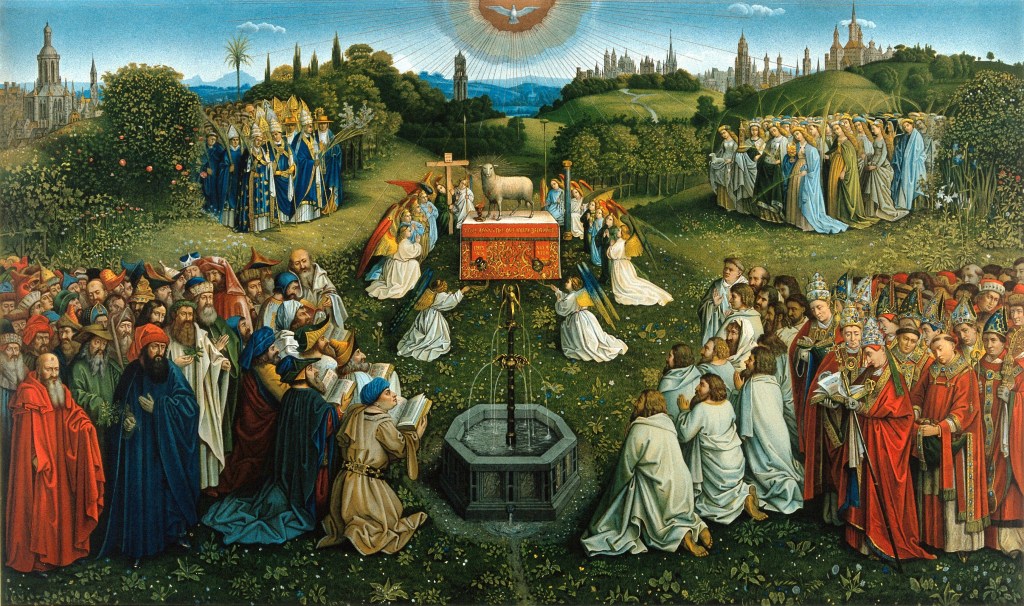
Adoration of the Lamb by Renaissance artist Jan van Eyck, 1432
After this I heard what sounded like the roar of a great multitude in heaven shouting:
“Hallelujah! Salvation and glory and power belong to our God, for true and just are his judgments. He has condemned the great prostitute who corrupted the earth by her adulteries. He has avenged on her the blood of his servants.”
And again, they shouted:
“Hallelujah! The smoke from her goes up for ever and ever.”
The twenty-four elders and the four living creatures fell and worshiped God, who was seated on the throne. And they cried:
“Amen, Hallelujah!”
Then a voice came from the throne, saying:
“Praise our God, all you his servants, you who fear him, both great and small!”
Then I heard what sounded like a great multitude, like the roar of rushing waters and like loud peals of thunder, shouting:
“Hallelujah! For our Lord God Almighty reigns. Let us rejoice and be glad and give him glory! For the wedding of the Lamb has come, and his bride has made herself ready. Fine linen, bright and clean, was given her to wear.”
(Fine linen stands for the righteous acts of God’s holy people.)
Then the angel said to me, “Write this: Blessed are those who are invited to the wedding supper of the Lamb!” And he added, “These are the true words of God.” (NIV)
Things will not always be this way. There is coming a time when pandemics and poverty will end. In the age to come there will be no more grief, tears, oppression, hardship, and suffering. The day will arrive when, together with all saints past and present, and along with the angelic host, we will collectively shout, “Hallelujah!”
Time is simply the relationship between events. When all events are ended, there will be no more time – only unending eternity in the presence of God. For the Christian, this is our hope and ultimate salvation. Our deliverance from sin, death, and hell will be complete.
So, we wait and watch, preparing ourselves for the consummation of God’s kingdom. Meanwhile, we are truly in an awkward time between the two advents of Christ. It is the already/not yet time. We are already saved, yet not fully; we are holy, yet not completely; we have our adoption papers as children of God, yet still wait for our celebration feast with Christ.
Second Coming by English painter Kevin Derek Moore
There are few times more awkward, agonizing, joyful, and hopeful than a marriage engagement. Its as if two people are inextricably connected but not yet completely together. I still remember the downright weird feeling of the six months between my engagement to my heart’s love and standing at the altar marrying my bride.
Those months included every emotion imaginable, from exuberant happiness to terrible impatience, along with hopeful anticipation and sheer nervousness. It was a time, for me, of unique joy and unwanted suffering. Since I was separated by two-thousand miles from my beloved for most of our engagement, it was an unparalleled longing for the marriage to occur.
That is likely how believers have felt throughout the ages as they anticipate the second coming of Christ. In a period of hardship and even persecution, Christians long for their Savior – to be with Jesus forever and be shed of the world, the flesh, and the devil.
In this present age, we have received the Holy Spirit as a sort of engagement ring, a continual sign and presence to help us until the marriage happens with Christ as groom and the Church as bride. Since we have not yet experienced this, it is difficult for us to anticipate just how incredible and inconceivable the coming age will be.
Yet, the Christian intuitively knows, by means of the Spirit, that the upcoming marriage supper will be a heavenly paradise – and so we long for it, especially in these days of uncertainty and difficulty.
Presently, the great harlot attempts to seduce the believers, if that were possible, away from Christ. However, along with all God’s holy angels, we will join in the heavenly chorus which continually sings, “Hallelujah!” to Father, Son, and Spirit.
The book of Revelation describes the end of history for the purpose of encouraging the saints of God in the present. God will once and for all destroy evil and faithful believers will be united with Christ forever in glory.
So, as we draw near to a close of this Christian Year with its anticipation of the new, beginning with Advent, we are mindful of both advents, both comings of Jesus. As we remember the first, we anticipate and gaze longingly for the second. Holding them both together, the past and the future, guides us in the present because Jesus Christ bookends our lives with the mercy of the cross and the grace of his coming again.
Hello, friends! Welcome to Christ the King Sunday, a day which reminds us that in the coming Advent season, we look for both a baby and a king. Click the video below and let us acknowledge and worship King Jesus…
There is perhaps no better hymn for this day than Crown Him with Many Crowns:
For a contemporary song, it is appropriate today and every day to Sing to the King:
Now to Him who is able to keep you from stumbling, And to present you faultless Before the presence of His glory with exceeding joy, To God our Savior, Who alone is wise, Be glory and majesty, Dominion and power, Both now and forever. Amen.
Stained glass window at the Annunciation Melkite Church in Roslindale, Massachusetts
Christ the King Sunday is intended to help us see the cosmic reality that Jesus reigns over all creation as the only rightful Sovereign of the universe. This Sunday always comes just before Advent so that we remember to anticipate both a baby and a king.
Christ as Lord of all exposes three problems humanity faces:
Building our own petty kingdoms and setting ourselves up as masters over our own small worlds. People who have been hurt (all of us) often attempt to seize power for themselves in order to avoid ever being hurt again, or in the belief that wielding power could have prevented others from being hurt. The classic villains of movies and literature are ones who seek to destroy the earth so that they rebuild it in their own idea of how the world should operate. It is protection of self and loved ones from pain. The irony is that much hurt is inflicted to alleviate such pain.
Bowing to other kings besides King Jesus. When we are distressed, we might rely on alternative authorities to address our hard circumstances. We might expect other people to give us only what Jesus can. Instead of repentance and faith in Christ, we may run to the politicians or pastors we have set up in his place to cope with whatever is going on in our lives.
Lacking awareness of the power we possess as subjects of King Jesus. Christians possess authority in Jesus Christ. As believers in Jesus, we reign with him and can exercise authority over every dominion that exists, especially the dominion of darkness.
The Apostle Paul’s letter to the Ephesian believers provides God’s design for the church. It is a plan for believers in Jesus to know their spiritual blessings and exercise the power they have as Christians united to Christ. God wants us to understand this power and authority, and to actively use it. We will know King Jesus better by availing ourselves of his authority given to us as believers. (Ephesians 1:15-23)
We have a clear understanding from Ephesians of how to pray: To know Jesus better. There is probably no higher prayer. Paul prayed that believers in Jesus would know the hope to which we have been called and the incomparably great power accessible to us.
The word for “power” in the New Testament (Greek dunamis, pronounced “doon-a-miss”) is where we get our English word “dynamite.” When I was a kid, we had a neighbor who had a fondness for playing with dynamite, especially when he drank too much. Even though he lived a mile down the road, when he blew up a tree stump or anything else on his property, it would shake our house and feel like the windows were going to break. One stick of dynamite is nothing compared to God’s power, an incredible might without equal.
This divine power is for us who believe in Jesus the King. It is the same power used to raise Jesus from the dead and which exalted Christ as Lord of the universe. The rule and reign of Jesus is far above any other existing authority – including powers and authorities of the dark domain.
When it comes to dealing with the powers of darkness, we have the authority of Jesus Christ. We have a vital and inseparable union with Jesus Christ, because of his resurrection and exaltation. Jesus redeemed us and we belong to him. We are adopted children of God. Since all earthly and spiritual powers are subject to Christ, they are also subject to us. The imagery of Jesus as Head, and believers in Jesus as the Body of Christ means we have an inseparable union together. Since we are united with Christ, we share his authority over all spiritual powers.
It is one thing to know this information; it is quite another thing to use it. God wants us to experience Christ’s power through exercising our authority as believers. We are to pray in a way which links faith and knowledge together in a confident use of spiritual authority. We have unimaginable rights as blood-bought children of God.
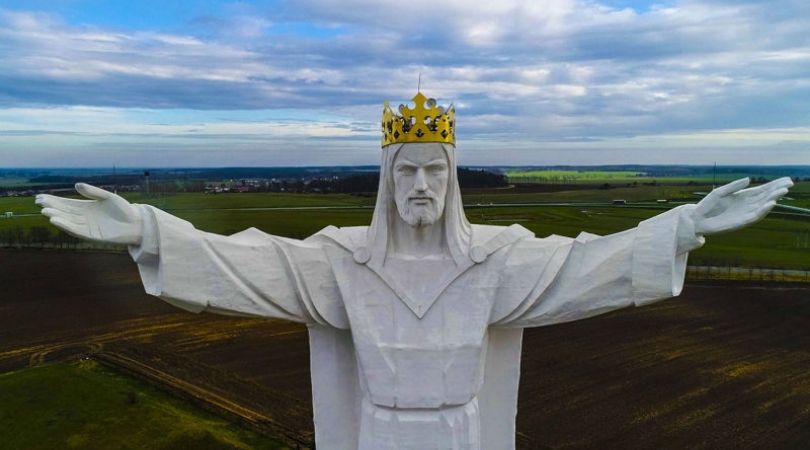
The 118 feet high Christ the King statue in Świebodzin, Poland
Tackling the forces of darkness needs to be a communal activity; going it alone is dangerous. So, let us pray the following prayer together, united in Christ and with one another in spiritual bond a million times stronger than superglue. This is a prayer that boldly exercises authority in Jesus Christ. So, let us come confidently before the throne of God’s grace.
God Almighty, we bow in worship and praise before You. We thank you that the Lord Jesus Christ is King over all creation, and that he is the rightful Sovereign of the universe. We thank you that because of this truth, we have power together with Jesus. Since Jesus is King, we surrender ourselves completely in every area of our lives to You. Since Christ’s authority extends over every dominion, including the dominion of darkness, we now take a stand against all the work of Satan that would hinder us now in prayer. We address ourselves only to the True and Living God and refuse any involvement of Satan in our prayers.
Therefore, Satan, we command you, in the Name of the Lord Jesus Christ, to leave our presence with all your demons. We bring the blood of Jesus Christ between us.
Sovereign God, we recognize You are worthy to receive all glory, honor, and praise. We renew our allegiance to You and ask that the Holy Spirit will enable us to pray. We are thankful, Lord God, that You have loved us from eternity past and that You sent the Lord Jesus Christ into the world to die as our substitute. We are thankful that Christ has completely forgiven us; You have adopted us into Your family; You have given us eternal life; You have offered Yourself to us to be our daily help and strength.
Glorious God open our eyes so that we will see how great You are and how complete Your provision is for today. We are thankful the victory Jesus Christ won for us on the cross and in His resurrection has been given to us and that we are seated with the Lord Jesus in heaven. We take our place with Him and recognize by faith that all wicked spirits and Satan himself are under our feet. We declare that Satan and his demons are subject to us in the name of the Lord Jesus Christ.
We are thankful for the spiritual armor You have provided. We put on the belt of truth, the breastplate of righteousness, the sandals of peace and the helmet of salvation. We lift the shield of faith against all the fiery arrows of the enemy; and we take in our hands the sword of the Spirit, the Word of God. We choose to use Your Word against all the forces of evil in our lives. We live and pray in complete dependence upon You, Holy Spirit.
We are grateful the Lord Jesus Christ disarmed all power and authorities, triumphing over them by the cross. We claim all victory for our lives today. We reject all the insinuations, accusations, and temptations of Satan. We affirm that the Word of God is true, and we choose to live today in the light of God’s Word. Almighty God, we choose to live in obedience to You and in fellowship with You. Open our eyes and show us the areas of our lives that do not please You. Cleanse us from anything that would give Satan a foothold against us. We stand into all that it means to be Your adopted children and we welcome all the ministry of the Holy Spirit in our lives today.
By faith and in complete dependence upon You we now put off the old sinful person and stand into all the victory of the crucifixion where the Lord Jesus Christ provided cleansing from the sinful nature. We put on the new person and stand into all the victory of the resurrection and the provision Christ has made for us to live above sin.
Today we put off the old sinful nature with its selfishness and put on the new nature with its love. We put off the old nature with its fear and put on the new nature with its courage. We put off the old nature with its deceitful lusts and put on the new nature with its righteousness, purity, and honesty.
In every way we stand into the victory of Jesus Christ’s ascension and glorification, in which everything was made subject to Him. We claim our place in Christ as victorious with Him over all the enemies of our souls. Holy Spirit, we pray that you would fill us with the righteousness of Christ. Break down every idol and cast out every enemy of our souls.
We are thankful, mighty God, that You have blessed us with every spiritual blessing in Christ. We are grateful You have given us new life into a living hope by the resurrection of Jesus from the dead. We are thankful You have made provision for us so that today we can live filled in the Holy Spirit with love, joy, peace, patience, kindness, goodness, gentleness, and self-control. We recognize and affirm that this is Your will for us and so we reject and resist all the attempts of Satan and his demons to rob us of God’s will.
We are thankful, Blessed Holy Trinity, that our spiritual weapons have divine power to demolish demonic strongholds, arguments, and every pretention that sets itself up against the knowledge of God. We take captive every thought to make it obedient to Christ. Therefore, we tear down the strongholds of Satan and smash the plans of Satan that have been formed against us. We affirm You have not given us a spirit of fear but a spirit of power, love, and self-discipline. We choose to make right decisions of faith.
Powerful God, show us the ways Satan is hindering, tempting, lying, and distorting the truth in our lives. Help us to be aggressive in prayer and faith. Help us to think rightly, and actively practice Your Word. Help us to give You Your rightful place in our lives. We now cover ourselves with the blood of the Lord Jesus Christ and pray that You, Holy Spirit, would bring all the work of Christ’s crucifixion, resurrection, ascension, and all Your work of Pentecost into our lives today. We deliberately surrender ourselves to King Jesus. We refuse to be discouraged because You are the God of all hope. You have proven Your power by resurrecting Jesus from the dead, so we claim this victory over all satanic forces in our lives, our families, our neighborhoods, our workplaces, and our faith communities. We pray in the Name and through the blood of the Lord Jesus Christ with thanksgiving. Amen.
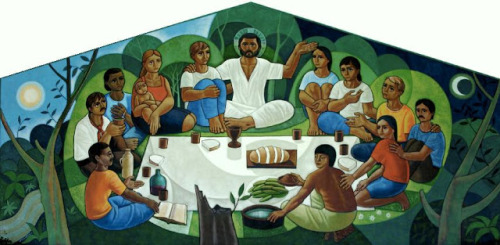
En la Cena ecológica del Reino (At the Ecological Kingdom Dinner) by Spanish artist Cerezo Barredo
While Jesus was still talking to the crowd, his mother and brothers stood outside, wanting to speak to him. Someone told him, “Your mother and brothers are standing outside, wanting to speak to you.”
He replied to him, “Who is my mother, and who are my brothers?” Pointing to his disciples, he said, “Here are my mother and my brothers. For whoever does the will of my Father in heaven is my brother and sister and mother.” (NIV)
Jesus obviously did not get the memo that blood is thicker than water. When his own blood family were waiting outside for him, Jesus used the occasion to speak of what makes up a true follower of God. Christ boldly asserted that his true family is made up of people who do God’s will. By saying this, Jesus brought the point home that the kingdom of God turns on obedience.
Rather than solely confessing belief, or appealing to a family heritage of faith, Jesus said that a genuine believer in God is one who listens to God’s words and then promptly obeys them. Therefore, a Christian is defined by allegiance to Jesus, and not by having a certain bloodline.
Identity determines activity. For example, if I identify myself primarily as a worker at my job, my activity will show it – I will spend long hours at my labor, and will do whatever it takes to please my boss and gain promotions. If I identify myself primarily as an athlete, I will spend long hours honing my skills, and do whatever it takes to please the coach and to win. If my identity is mostly wrapped around being a husband and father, I will focus most of my attention on my family and seek to please my spouse and children in all things.
If my identity is first and foremost as a Christian, I will always seek to please Jesus. I will then view my job as an opportunity to express the ethics of God’s kingdom, as a calling from God, and as a means for God to transform me for his glory. I will view athletics as means to glorify God, and not as an end in and of itself but as a special gift for God to teach me about the importance of community and working together.
If my identity is clearly in Christ, I will view my kids as belonging to God and I will steward the trust of children given me by doing whatever it takes to teach and train them in the way of Jesus. I will thank God for my family and not confuse them with being God by idolizing them.
In today’s Gospel lesson, Jesus was inside a house, with his family on the outside. So, why were the family members of Jesus not inside the house sitting at his feet, taking the posture of a disciple? The disciple Matthew wanted to communicate more than physical distance between Jesus and his physical family – being “outside” was meant to convey the posture of Christ’s family as spiritually distant, skeptical of him, and indecisive about who he was and what he was up to. In fact, the disciple Mark made this spiritual and emotional distance clear:
Jesus entered a house. A crowd gathered again so that it was impossible for him and his followers even to eat. When his family heard what was happening, they came to take control of him. They were saying, “He’s out of his mind!” (Mark 3:20-21, CEB)
Christ’s earthly family were not looking for Jesus to give them warm-fuzzies and have a family group hug. They were there to tell him: “Cut it out, Jesus, because you’re acting like a nut-cake and embarrassing us all!” The kid brothers of Jesus (James and Jude) would go on to become powerful Christian preachers and each pen a New Testament letter, but that does not happen till after Jesus’ resurrection.
Ethiopian Orthodox Church depiction of Christ and his disciples
Jesus was saying that identifying only with a biological family leads to only pleasing that family. However, identifying with Jesus leads to a radical form of following God that seeks to please him instead of submitting to family practices, mores, and beliefs which are inconsistent with the kingdom of God.
For the follower of Christ, the church is the family of God, and we are to act consistent with being in such a family. We are to go hard after God’s will, serve one another, and adopt outsiders into our family. The church is a family, not a restaurant. When we go to a restaurant, we either like the food and the service, or not. If the experience was unpleasant, we might complain to the waitress and may or may not come back. Try doing that with your mother and see where it gets you! As a biological family, we are committed to each other. There is no complaining about mom because of dad’s wrath. Instead, we are expected to clear our plates and put them in the dishwasher, to sweep the floor and clean the table, and to work together for the benefit of the entire family. In the same way, following Jesus means being committed to his family, the church.
Priority is to be given in doing God’s will, regardless of blood, because obedience to Christ identifies us as being in the family of God. Our actions and the way we live points to what we honestly believe and where our commitments truly lie.
The first step of God’s desire for us is quality focused time in sitting at Christ’s feet and listening to him because this is at the heart of all Christian discipleship. We cannot do God’s will until we have clearly heard it; and we cannot hear God’s will unless we take the time to be at the feet of Jesus.
Both listening and doing are necessary. Listening without engaging the world is a failure of mission; and doing without first listening leads to misguided acts and eventual burn-out. Allow Jesus to call the shots and let him instruct us so that we can act wisely and obediently.
Jesus did not devalue blood relatives as irrelevant. Rather, Christ emphasized that our primary allegiance is to him, and not to our biological family. The kingdom of God seeks to restore and redeem all things, including family. Both church and family are important. The relationships within each are to be nurtured.
The family of Jesus, the church, is important because Christ suffered and died for her. So, we are to be committed to the church, love the church, and serve the church because we are family. If we have a good grasp of this, we will make decisions based in what we believe God’s will is, instead of whether a relative will get upset, or not.
Our biological families are important. Jesus never pitted one against the other, because he wants to see families redeemed and work together as the family of God. Every Christian family can do this:
Appoint a time to read Scripture together and listen to Jesus and discuss it.
Show hospitality so that we can eat and drink our way into the kingdom of God.
We need to persistently pray for spiritually lost family members, and those whom we are estranged from. Most families have at least a few toxic persons in their orbit. Here is how we might pray for them:
That God will arrange divine appointments between them and other believers who love Jesus.
That God will draw them to the mercy of Christ.
That God will hinder the devil’s schemes against them.
That they will understand and respond to the good news of God’s grace.