Acts 28:23-31 – Focused on Mission

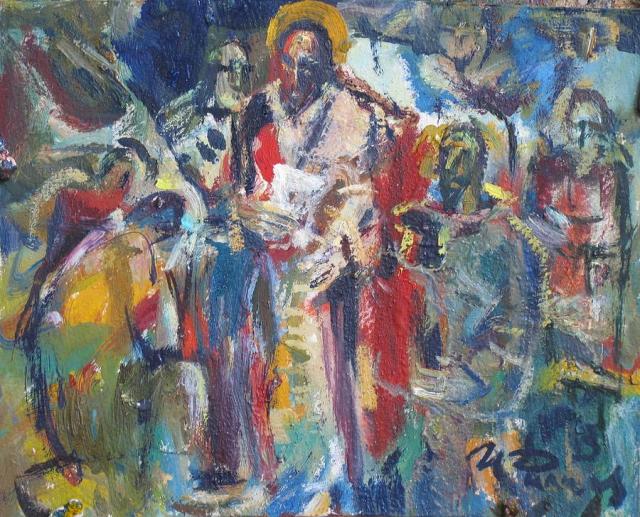
Apostle Paul by Ivan Filichev

They arranged to meet Paul on a certain day and came in even larger numbers to the place where he was staying. He witnessed to them from morning till evening, explaining about the kingdom of God, and from the Law of Moses and from the Prophets he tried to persuade them about Jesus. Some were convinced by what he said, but others would not believe. They disagreed among themselves and began to leave after Paul had made this final statement: “The Holy Spirit spoke the truth to your ancestors when he said through Isaiah the prophet:

“‘Go to this people and say,
“You will be ever hearing but never understanding;
    you will be ever seeing but never perceiving.”
For this people’s heart has become calloused;
    they hardly hear with their ears,
    and they have closed their eyes.
Otherwise they might see with their eyes,
    hear with their ears,
    understand with their hearts
and turn, and I would heal them.’

“Therefore, I want you to know that God’s salvation has been sent to the Gentiles, and they will listen!”

For two whole years Paul stayed there in his own rented house and welcomed all who came to see him. He proclaimed the kingdom of God and taught about the Lord Jesus Christ—with all boldness and without hindrance! (New International Version)

The Apostle Paul took quite a licking throughout his Christian life. Incredibly, Paul not only physically survived whippings, beatings, stoning, arrests, shipwreck, and imprisonment – he also came through it all with a robust spirit and a dogged determination to live his life with purpose and mission.

Acts 28 is the final chapter in the book. Paul is in Rome under house arrest. Even in this situation, he kept finding ways to engage others. Since he couldn’t go to them, he had others come to him – lots of them.

Paul described to the visitors his own experience of encountering the risen Christ. He reasoned with his fellow Jews and vigorously debated with them from the Scriptures. It was always the deep desire and hope of Paul that his own people come to faith in Christ, just as he had. Although some did, most didn’t.

Many decades ago, my grandfather was approached by one of his friends about investing in a new insurance company startup. For a lot of reasons, grandpa ended up not participating in his friend’s venture. So, the friend asked others. Eventually, the startup happened and steadily grew. Today, Nationwide Insurance has over 250 billion dollars of assets. Good old gramps just didn’t know what he was rejecting.

The good news of Jesus Christ, I believe, is worth infinitely more than an insurance company. Christian mission, I believe, is worth investing my life into. I’m glad the gospel was proclaimed to Gentiles because I am a recipient of such grace. And I’m grateful that Paul tenaciously kept interacting with people for the last two years of his life under arrest.

Despite, and even because of, Paul’s sufferings and his house arrest, the message of faith and forgiveness in Christ was confidently and consistently presented to a steady flow of people, including the highest heads of state. Difficulties are no problem for God. The Lord bends all circumstances to divine and good purposes, creating new avenues of faith, hope, and love that wouldn’t be possible under “normal” times.

“He is no fool who gives what he cannot keep to gain that which he cannot lose.”

Jim Eliot

In fact, Paul endured five years of imprisonment: two in a Caesarea jail; two under house arrest in Rome; and nearly a year in transport between the two cities. For a personality like Paul, we might imagine this would drive him nuts. Yet, several letters to the churches, now contained in the New Testament, were written during that time.

Whether we like it, or not, nothing proves, affirms, and grows our faith quite like our willingness to endure suffering for the gospel. Witness, suffering, and martyrdom are inextricably bundled together in God’s economy. When suffering is viewed as a necessary means to an altruistic and noble end, then, although the pain is no less real, there is the opportunity for both willing endurance and genuine joy.

Paul was willing to labor on behalf of people who were very different from himself. His concern was for all people everywhere – both his own people, the Jews, as well as Gentiles. Paul never gave in and never gave up. He had a magnanimous spirit and even greater spiritual gifts. He willingly and gladly used that spirit and gifts for the benefit of humanity.

In 64 C.E. Paul was condemned and executed. Before his death, he wrote that he had fought the good fight, finished the race, and kept the faith. Now, the next generations of new believers must follow in his footsteps and continue the work

This is precisely why the book of Acts ends so abruptly, with no resolution, no tidy conclusion – because the work is still being done and will carry on until Christ returns.

Gracious and loving God, you work everywhere reconciling, loving, and healing your people and your creation. In your Son Jesus, and through the power of your Holy Spirit, you invite each of us to join you in your work. We ask you to form us more and more in your image and likeness, through our prayer and worship of you and through the study of Holy Scripture so that our eyes will be fully opened to your mission in the world. Then, God, into our communities, our nation, and the world, send us to serve with Christ, taking risks to give life and hope to all people and all of your creation, through Jesus Christ our Lord.. Amen.

Isaiah 12:2-6 – Grace Changes Us

The Prophet Isaiah by Marc Chagall, 1968

“Surely God is my salvation;
    I will trust and not be afraid.
The Lord, the Lord himself, is my strength and my defense;
    he has become my salvation.”
With joy you will draw water
    from the wells of salvation.

In that day you will say:

“Give praise to the Lord, proclaim his name;
    make known among the nations what he has done,
    and proclaim that his name is exalted.

Sing to the Lord, for he has done glorious things;
    let this be known to all the world.
Shout aloud and sing for joy, people of Zion,
    for great is the Holy One of Israel among you.”
(New International Version)

The large Old Testament book of Isaiah is thick with a message of judgment for both Israel and the surrounding nations. The sins of ancient Israel, seven-hundred years before the birth of Christ, were many. The primary offenses were injustice toward the needy; the have’s taking advantage of the have-not’s; and empty worship rituals toward God.

Social and spiritual corruption was rampant. God pleaded with the people through the prophets to stop doing wrong and start doing right by encouraging the oppressed and defending the powerless. (Isaiah 1:10-17)

Although God’s judgment was imminent, via the powerful Assyrian Empire, God would not annihilate the people. God promised a Righteous Branch would grow from the seemingly dead stump of Israel. A child will be born, a Messiah given. There will be hope in Israel. Heartfelt praise, and proclamation of God’s great name, will again fill the air.

For me, what is so remarkable about all this is the grace of God. The Lord made promises to Israel not based upon what they would or would not do; God made promises to the people by God’s own radically free love. This wasn’t a matter of playing Let’s Make a Deal with God saying, “If you get your act together, then I will be good to you.” No, before Israel even had a chance to return to the Lord, God was already choosing to be merciful.

I am absolutely convinced with the firmest conviction possible that the Scriptures of the Old and New Testaments are all about God and God’s own unbounded, unfettered, free, crazy, illogical, and wildly wonderful grace. Because God is love, the Lord constantly goes out of the way to be gracious so that we will be together and enjoy our divine/human relationship.

If we miss the message of God’s grace in the Holy Scriptures, we have missed salvation – because only grace can save us. Without grace, we are lost. Today’s Old Testament lesson is full of praise because it’s a response to the undeserved grace which God freely gives. 

Any Christian preacher worth their salt is a preacher of grace. Grace is the very thing that is distinctive about Christianity. Grace is love that seeks you out when you have nothing to give in return. Grace is recklessly generous. Grace does not use carrot sticks, scorecards, or power politics. Grace never demands – it only gives. 

Grace is unconditional acceptance given to an undeserving person by an unobligated giver. 

That is what God did for Israel… and for us. And when we get a hold of this truth, even a little bit, our hearts become bubblers of praise.

The prophecy of Isaiah is an adventure of God’s reckless love toward unlovable people, which is why it is one of the most quoted books of the Old Testament by Jesus. Jesus came because of grace. 

Jesus came to release us from our obsessive need to be right, our compulsion to be rewarded, and our demands to be respected. 

Because Jesus came to set sinful captives free, life does not have to be a joyless effort to justify and validate ourselves before others. The grace of God in Christ is a game-changer. And with but a glimpse of it, we are forever undone by its mercy.

Grace causes us to praise God.

There was once a pastor who had a three-year old daughter who was going around the house singing the chorus “We Exalt Thee” except that she kept mispronouncing one of the words: “I exhaust thee, I exhaust thee, I exhaust thee, O Lord!” Perhaps she was right. Maybe too many folks are exhausting God with folded arms instead of hands raised in praise and worship.

Grace causes us to trust God.

Grace alleviates our fears. For, if God is for us, who can be against us? God takes care of us despite our weaknesses and failures. 

Grace causes us to have joy in God.

With joy we draw water from the wells of salvation. Jesus is the Living Water we can continually draw from and drink. Grace keeps giving without an end in sight. We get to keep coming to God with an inexhaustible supply of fresh grace.

Grace causes us to give thanks to God in prayer.

Gratitude to God ought to characterize our corporate gatherings. Expressing thanks is more than for the individual in their prayer closet – it is to be offered in the gathered assembly of believers. Grace eliminates self-consciousness altogether because there is nothing to be self-conscious about with God. The Lord has seen you at your worst, and still loves you.

What’s more, we need not be self-conscious about appearing ignorant, looking silly, or not having all the answers in making known among the nations what God has done. If we are influenced by grace, then we can freely speak of God to all kinds of people we encounter. 

“God forbid that I should travel with anybody a quarter of an hour without speaking of Christ to them.”

George Whitefield (1714-1770)

Grace causes us to sing together to God. 

When grace takes hold of a congregation, there is no mumbling of songs – there are loud shouts and singing for joy because God is good! God wants some noisy worship! 

Grace brings such gladness that we don’t care how we appear to other people; we are going to shout, sing, and express our joy! Yes, there is an important place for contemplative, reverent, and reflective worship. And there is also a place for letting go, becoming unhinged, and dancing before Jesus!

The world mostly ignores God. Even some Christians take God’s grace for granted.  Israel’s greatest sin was assuming everything was fine. But it wasn’t. There was no grace. And with no grace there is no God. Eventually, Israel found joy in the most unlikely of places – in exile. God’s grace would transform a terrible time of trouble into raising of voices in song.

Isaiah’s prophecy is about returning to the Lord. The season of Advent is all about God’s relentless pursuit of wayward people – the anticipation of grace coming in the form of an infant – and the bringing of grace to a people living in darkness.

Let us, then, return to the Lord. Let us be captivated by grace. Let us renew our love for Jesus. Let us lose ourselves in praise and adoration of the One who gave everything for us. Let us worship Christ the King. Let us proclaim the name of Jesus as exalted over everything.

Great God of grace, be merciful to us as we limp to you with all of our wounds and brokenness. We have made such a mess of our lives with our bad attitudes, ugly words, selfish actions, and our ignoring of you through it all. So, we come to you with nothing but ourselves in all of our sin. Forgive us, cleanse us, renew us, revive us, refresh us, and reform us according to the ways of Jesus Christ. Thank you for your undeserved grace. We give you praise for the lengths you went to secure our forgiveness. With a joy too deep for words, we humbly offer to you our lives so that the name of Jesus will be exalted in us individually and corporately. Amen.

Luke 7:18-30 – Use the Right Color

John’s disciples told him about all these things. Calling two of them, he sent them to the Lord to ask, “Are you the one who is to come, or should we expect someone else?”

When the men came to Jesus, they said, “John the Baptist sent us to you to ask, ‘Are you the one who is to come, or should we expect someone else?’”

At that very time Jesus cured many who had diseases, sicknesses and evil spirits, and gave sight to many who were blind. So, he replied to the messengers, “Go back and report to John what you have seen and heard: The blind receive sight, the lame walk, those who have leprosy are cleansed, the deaf hear, the dead are raised, and the good news is proclaimed to the poor. Blessed is anyone who does not stumble on account of me.”

After John’s messengers left, Jesus began to speak to the crowd about John: “What did you go out into the wilderness to see? A reed swayed by the wind? If not, what did you go out to see? A man dressed in fine clothes? No, those who wear expensive clothes and indulge in luxury are in palaces. But what did you go out to see? A prophet? Yes, I tell you, and more than a prophet. This is the one about whom it is written:

“‘I will send my messenger ahead of you,
    who will prepare your way before you.’

I tell you, among those born of women there is no one greater than John; yet the one who is least in the kingdom of God is greater than he.”

(All the people, even the tax collectors, when they heard Jesus’ words, acknowledged that God’s way was right, because they had been baptized by John. But the Pharisees and the experts in the law rejected God’s purpose for themselves, because they had not been baptized by John.) (New International Version)

For a short time in my life, I had a side business doing some painting. I once painted an interior apartment in a large beautiful Victorian house. When I was done, it looked great. However, there was a bit of a problem. The owner came to check on my progress only to find that I had painted with the wrong color! I was certain I had it right, but, alas, the job ended up taking twice as long as anticipated.

Sometimes, we can be so sure about our plans, only to discover our expectations were off. John the Baptist was sitting in jail, not for any crime other than offending the king. As he sat there, John began to doubt. He started wondering about Jesus. Maybe he had been wrong about him. Perhaps he was not the Messiah, after all. 

John had been doing ministry with the expectation that Jesus would beat up the Romans, usher in a renewed political Israel, and put down all threats to his Lordship. But that was not happening. John was now uncertain. So, he sent some of his disciples to Jesus to ask, “Are you the one who is to come, or shall we look for another?”

John reasoned that if Jesus were really a sovereign king, he would not be languishing in a prison and facing imminent death. Jesus responded to John’s uncertainty by quoting the prophet Isaiah and letting him know that the kingdom takeover was going exactly as planned. 

“Huh!?” John must have wondered. Maybe something was lost in translation. But no. The problem was that John had been using the wrong paint. John’s plans and expectations did not fully sync with Jesus.

It’s easy to doubt when unexpected and unwanted adversity strikes. When things don’t go according to our expected plans, then what? 

This is why it is so vitally important to continually seek the Scriptures and seek the Lord Jesus so that we might not only paint the right building but also use the paint Jesus expects us to use. 

The thing John got right was pursuing Jesus. When in doubt, he sought the Lord – and that is something we all can emulate.

As we paint the portrait of our lives, let’s be sure to use the colors Jesus gives us.

Lord Christ, you came into the world as one of us, and suffered as we do. As I go through the trials of life, help me to realize that you are with me at all times and in all things; that I have no secrets from you; and that your loving grace enfolds me for eternity. In the security of your embrace, I pray. Amen.

2 Peter 1:2-15 – We Have Everything We Need

May grace and peace be yours in abundance in the knowledge of God and of Jesus our Lord.

His divine power has given us everything needed for life and godliness, through the knowledge of him who called us by his own glory and goodness. Thus, he has given us, through these things, his precious and very great promises, so that through them you may escape from the corruption that is in the world because of lust and may become participants of the divine nature. For this very reason, you must make every effort to support your faith with goodness, and goodness with knowledge, and knowledge with self-control, and self-control with endurance, and endurance with godliness, and godliness with mutual affection, and mutual affection with love. For if these things are yours and are increasing among you, they keep you from being ineffective and unfruitful in the knowledge of our Lord Jesus Christ. For anyone who lacks these things is short-sighted and blind and is forgetful of the cleansing of past sins. Therefore, brothers and sisters, be all the more eager to confirm your call and election, for if you do this, you will never stumble. For in this way, entry into the eternal kingdom of our Lord and Savior Jesus Christ will be richly provided for you.

Therefore, I intend to keep on reminding you of these things, though you know them already and are established in the truth that has come to you. I think it right, as long as I am in this body, to refresh your memory, since I know that my death will come soon, as indeed our Lord Jesus Christ has made clear to me. And I will make every effort so that after my departure you may be able at any time to recall these things. (New Revised Standard Version)

One of the greatest deceptions which befall humanity is the lie that we aren’t enough – that somehow we lack something in our core personhood. Another great deception is that God is holding out on us – that we’ve gotten the short end of things.

It is my hope and prayer that today’s New Testament lesson puts a stake through the heart of those twin deceiving vampires. Erroneous beliefs only suck the life out of us. Instead, we must imbibe deeply of sound theology which enables us to live robustly in this old fallen world.

The Lord is my shepherd;
   I have all that I need.

Psalm 23:1, NLT

We have everything we need to grow in grace. God’s provision for us is total and complete. By grace, we can discern between truth and error; endure hostility, hardship, even persecution; live with patience as we await the new heaven and new earth; and face anything in this present life with confidence and hope because we’ve been equipped for it all.

Core to all this provision is the very life of Christ. Jesus is the source of the power and grace needed to live this incredible life. The same resurrection power which raised Christ from the grave is available and provided to us.

Believers are not in some weird holding pattern, like a plane circling the airport waiting to land, twiddling our thumbs until Christ returns. No! This present life is to be fully engaged with the tools given us of faith, hope, and love. And those spiritual implements are sufficient to walk with boldness through the valley of the shadow of death.

It continually must be borne in mind that we are to take up the gifts given us and use them in our present sojourn on this earth. Let us put significant energy into our faith development through knowing our call to holiness; and knowing Christ Jesus our Lord, his power and suffering.

Carefully and confidently using our faith, we are to fully participate in God’s divine power through the qualities of:

  • Goodness. Cultivation of moral excellence is both helpful and needed in all our relationships. Goodness is like a seed planted. We need to give it proper amounts of water and sun and keep the weeds away.
  • Knowledge. There are two words in the ancient Greek for knowledge: one is a reference to acquiring information; and the other refers to actively using the information provided. The Apostle Peter uses the latter – an experiential knowledge which is wise, discerning, and discreet.
  • Self-Control. This is the ability to get a grip on yourself, to avoid controlling others and focus on all things within your own control. Ultimate control belongs to God; and we are called to self-control.
  • Endurance. To see the big picture, to look ahead and keep your eye on the goal, is the lived practice of endurance or perseverance. Everyone has patience. It’s rather a matter of whether we will tap into it, or not.
  • Godliness. The heart of godliness is awareness of self, others, and God – rightly relating to them all with wholeness and integrity.
  • Mutual Affection. Basic human kindness is imperative between two people, especially with fellow believers.
  • Love. This is the Christian’s consummate virtue. Whereas affection is to be mutual, love can always be done whether someone loves us back, or not. Genuine love can be directed at the unlovely, even enemies.

We are to be effective and productive in adding divine virtues to our lives. It’s not a matter of more but better.

Even a smidge of faith can move a mountain.

A kernel of goodness can produce a harvest of righteousness.

A little bit of knowledge can be turned into love.

Small self-control can develop into immense self-control.

Keeping our head up for a few seconds can help us see the goal and endure to the end.

One insight can create a cascade of godliness.

A single act of kindness can change a life forever.

Love, no matter how big or small, can change the world.

We possess all these qualities and are in want of nothing. We are enough because Christ is enough.

Lord, make us instruments of your peace. Where there is hatred, let us sow love; where there is injury, pardon; where there is discord, union; where there is doubt, faith; where there is despair, hope; where there is darkness, light; where there is sadness, joy. Grant that we may not so much seek to be consoled as to console; to be understood as to understand; to be loved as to love. For it is in giving that we receive; it is in pardoning that we are pardoned; and it is in dying that we are born to eternal life. Amen. – A Prayer of St. Francis of Assisi