Luke 2:41-52 – We Lost God

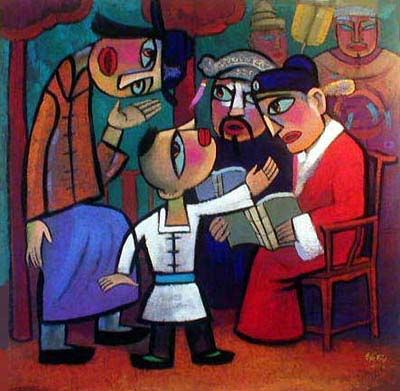
The Boy Jesus in the Temple by He Qi

Every year Jesus’ parents went to Jerusalem for the Festival of the Passover. When he was twelve years old, they went up to the festival, according to the custom. After the festival was over, while his parents were returning home, the boy Jesus stayed behind in Jerusalem, but they were unaware of it. Thinking he was in their company, they traveled on for a day. Then they began looking for him among their relatives and friends. When they did not find him, they went back to Jerusalem to look for him. After three days they found him in the temple courts, sitting among the teachers, listening to them and asking them questions. Everyone who heard him was amazed at his understanding and his answers. When his parents saw him, they were astonished. His mother said to him, “Son, why have you treated us like this? Your father and I have been anxiously searching for you.”

“Why were you searching for me?” he asked. “Didn’t you know I had to be in my Father’s house?” But they did not understand what he was saying to them.

Then he went down to Nazareth with them and was obedient to them. But his mother treasured all these things in her heart. And Jesus grew in wisdom and stature, and in favor with God and man. (New International Version)

It’s a terrible sinking feeling to lose a kid. Unfortunately, I’ve done it with all three of mine – and multiple times with the youngest. I’ve even lost other people’s kids. Oy. Yet, I can say that I’ve never had the dubious distinction of losing God.

We have come through the season of Advent and anticipated the birth of Christ. We have celebrated Jesus on Christmas Day. Now, we’re looking to perhaps settle back into a more normal routine of life. Joseph and Mary were trying to do the same, too.

One year, when Jesus was young, they were traveling back to Nazareth – only to discover Jesus was not with them! They lost God.

They aren’t the only ones to search for Jesus. A lot of other people are searching for him, too. They’ve traveled throughout their lives thinking Jesus was with them – only to find he isn’t with them. They lost God. 

Too many people go about their daily lives without realizing Jesus is even missing. They simply assume he’s here. But he isn’t. So, let’s search for him. And in finding him, may we see Jesus as we have never saw him before, so that our faith in God might be strengthened and we do not end up losing him yet again.

Joseph and his family traveled in a large caravan, which was common for that day. They were on their camels an entire day before they discovered Jesus was missing. Mary likely assumed Jesus was riding on the other camel with Uncle Zechariah. 

But he was neither with him nor with cousin John or Aunt Elizabeth. So, the second day Joseph and Mary traveled back, hoping and praying they wouldn’t find Jesus in the ditch, like in the story of the Good Samaritan. Having not found him along the road, they spent the third day scouring Jerusalem in search of Jesus. 
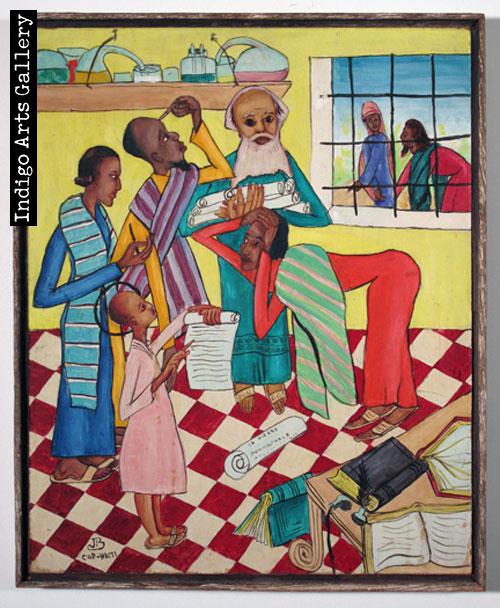
Young Jesus in the Temple by Haitian artist Jean-Baptiste Bottex

Turns out, this whole time, Jesus was at the temple. A parent myself, I’m not a bit surprised that a twelve-year-old stayed behind and thought nothing of it. 

Jesus was curious and inquisitive with the rabbis at the temple. Those ancient teachers taught in a different way than we do today. They gave instruction more like a modern day counselor or therapist. The rabbis didn’t just impart information; they asked questions to help people discover truth for themselves. And the rabbis were amazed at Jesus’ ability to discover truth.

Keep in mind that Jesus was not a thirty-year-old adult in a twelve-year-old body. Christ was sinless but still immature. The human experience involves growth and maturation. Jesus shared fully in our humanity, not partially. When Christ was born, he was not a fully aware adult looking through baby eyes.

Because Jesus is fully human, he had to grow up just like us and learn in every way, just like us. Staying in Jerusalem was not a rebellious act by Jesus. It was typical. Twelve-year-old’s do all kinds of things without saying anything to their parents. There’s a world of difference between being rebellious and plain old garden variety immaturity. It’s unwise for adults to expect adult behavior from adolescent kids.

Jesus felt a deep need to stay and talk with the rabbis. As a human boy, he had to go through the process of self-discovery… of discovering he was the Son of God… of reading the scriptures for himself and learning… and finding he was reading about himself! 

We believe in one Lord, Jesus Christ, the only Son of God,
eternally begotten of the Father,
God from God, Light from Light,
true God from true God,
begotten, not made,
of one being with the Father;
through him all things were made.
For us and for our salvation
he came down from heaven:
was incarnate of the Holy Spirit and the Virgin Mary,
and became truly human.

Nicene Creed, 325 C.E.

To say that Jesus simply knew everything because he was God is to fall into a heresy the early church condemned at the Council of Nicaea called Docetism. It is the belief that Jesus is fully God and only appeared to be human. No, the Council said, Jesus was really a human being and didn’t just appear to be one. He is like us, in every way, except sin.

Well, of course, Joseph and Mary finally found Jesus. It seems Jesus got the third degree from his mother: “What do you mean putting your father and I through this? I gave you birth, and you treat us like this?  What were you thinking?  What part of meeting at the two-humped camel at 9:00 don’t you understand?”

Since Jesus grew in wisdom and stature and in favor with God and others, how much more do we need to put ourselves in a position to grow and learn and develop and mature? 

There is no spiritual zap machine in which God miraculously imparts into our brains all the wisdom and knowledge we need. Rather, emulating our Lord, we must learn, grow, read, pray, ask questions, struggle, and dialogue about the good news of Jesus Christ with each other. In short, we must discover the truth of God.

Perhaps Jesus is asking us, as he did to Mary and Joseph, “Why were you searching for me?  Didn’t you know that I had to be in my Father’s house?” 

One person tells the following story: 

“Back when my wife and I were dating, she worked as a temp at a bank. In the first two weeks of that job, she noticed some very unprofessional behavior among the team and their supervisor. The supervisor took long coffee breaks with the employees, sitting and gossiping with them.”

“A new employee, a woman in her thirties who came on staff a week before my wife, was shunned. If she walked up and tried to join the conversation during a coffee break, the conversation ended. The group, including the supervisor, made jokes about her behind her back and laughed at the way she dressed. They rolled their eyes and winked at each other when she was present. It was obvious this newbie worker was perceived as an unnecessary intrusion.”

“Two weeks into the temp job, my wife walked into the office on a Monday morning and was surprised to find a much different scenario. No gossiping, no kidding around, no long coffee breaks. All the employees were diligently working. The previous supervisor had been replaced. The cliquish team addressed the new supervisor with formal, businesslike respect. The new supervisor was not a stranger. It was the 30-something woman who had been shunned and mocked.”

“It turned out the bank had hired her to be the new supervisor from the first day she came on the job three weeks before, but the bank had concealed her true identity so she could observe the work style of the team.”

In some ways, this resembles the coming of Christ to earth. In his first coming, Jesus Christ revealed his true identity and glory to his true followers, but to those who did not believe, his glory was largely hidden by his humanity. Following his resurrection, Christ ascended to the right hand of God, where he rules all things. One day he is coming again to the earth to establish his glorious kingdom over everything. At that time there will be no mistaking who is in charge. 

Let us not lose our way and lose God in our every-day life.  Let us be with Jesus and with him grow in wisdom and stature, and in favor with God and others. 

Luke 13:31-35 – Blessed is He Who Comes in the Name of the Lord

Blessed is He Who Comes in the Name of the Lord, by José Luis Castrillo

At that time some Pharisees came to Jesus and said to him, “Leave this place and go somewhere else. Herod wants to kill you.”

He replied, “Go tell that fox, ‘I will keep on driving out demons and healing people today and tomorrow, and on the third day I will reach my goal.’ In any case, I must press on today and tomorrow and the next day—for surely no prophet can die outside Jerusalem!

“Jerusalem, Jerusalem, you who kill the prophets and stone those sent to you, how often I have longed to gather your children together, as a hen gathers her chicks under her wings, and you were not willing. Look, your house is left to you desolate. I tell you – you will not see me again until you say, ‘Blessed is he who comes in the name of the Lord.’” (New International Version)

King Herod of Judea, who was in the pocket of the Roman Empire, was issuing threats against Jesus. And those threats had some teeth behind them. Herod had recently beheaded Christ’s friend and cousin, John the Baptist (Luke 9:7-9). Yet, Jesus seemed unconcerned by the warnings. He made it clear that he was going to keep doing what he was doing, unfazed by Herod’s bluster.

Jesus had no intention of halting his travels, even because of a credible threat by the governing powers. Christ emphasizes his words by assuring his listeners that the work he is doing will be done today, and the next, and the day after that—building ultimately to his greatest work of securing redemption through his crucifixion and resurrection. 

I hope to be always journeying towards Jerusalem with a heart full of compassion that will not waver in the midst of violent killing and injustice. That isn’t easy, yet I know that my humble pilgrimage with Jesus will be worth it all, in the end.

Yet, for now, I need to make a stop in Bethlehem. I must follow the star to the place where Christ the newborn king is lying in a simple stinky feeding trough. The juxtaposition of that reality could not be more pronounced. The rightful Lord of all, far more powerful than old King Herod or the Roman Emperor, comes to earth not to be served, but to serve, and give his life as a ransom for many. (Mark 10:42-45)

What’s more, Jesus deliberately donned the clothing and postured himself as a lowly servant throughout his earthly ministry. Whereas Herod acted the predictable part of a power hungry worldly ruler, squelching all rivals to the throne, Jesus shared his authority with others, along with a promise of continual presence. (Matthew 2:16-18, 28:16-20)

“Almighty God, give us grace to cast away the works of darkness and put on the armor of light, now in the time of this life, in which your Son Jesus Christ came to visit us in great humility; So that, at the last day, when he shall come again in his glorious majesty to judge the living and the dead, we may rise to the life immortal.” 

Book of Common Prayer

Jesus is down for the struggle. He knows that injustice and systemic evil must be carefully rooted out. He understands that hearts and minds aren’t changed overnight. It will take time. Yet, Christ is in it for the long haul. The Lord is patiently, and sometimes imperceptibly, using divine power and authority to preserve the good and weed out the bad.

It will take a long time, and will be an extended process, because there are so many hard hearts. Jesus was ready, willing, and able to gather people together, as a mother hen gathers her chicks – yet there was an unwillingness to it. And Christ isn’t in the business of twisting arms and manipulating others, like Herod.

Jesus invites. He doesn’t squeeze people like an orange to get their juice. Christ carefully prepares a meal. He sets the table himself. He gives of himself. Like some wildly potent superfood, a bit of wine and morsel of bread is more than enough to fill the hungry soul and thirsty spirit.

There is always room at the Table.

There is room for you and for me. There is room for every kind of person – from every nation, race, gender, ethnicity, class – no matter the distinctions and no matter the past. It is the love of God in Christ, not the judgment, which brings people peace and salvation. It comes through a baby, not some wily old fox of a ruler.

Eventually, the phrase will be uttered, “Blessed is he who comes in the name of the Lord.” Jesus pulled this phrase from the Old Testament psalms. He did this, knowing quite well the context surrounding the verse:

The stone the builders rejected
    has become the cornerstone;
the Lord has done this,
    and it is marvelous in our eyes.
The Lord has done it this very day;
    let us rejoice today and be glad.

Lord, save us!
    Lord, grant us success!

Blessed is he who comes in the name of the Lord. (Psalm 118:22-26, NIV)

The chicks might scatter and refuse to be gathered. The builders may reject the crucial cornerstone and still try to build. Yet, it will not always be this way. As we celebrate the first advent of Christ in his incarnation, the second advent is continually in view. Christ is coming… again. The time is near….

Look! He comes with the clouds of heaven.
    And everyone will see him—
    even those who pierced him.
And all the nations of the world
    will mourn for him.
Yes! Amen! (Revelation 1:7, NLT)

The triumphal entry of Jesus on Palm Sunday is followed by a triumphal entry into my heart, and the hearts of many. And there is coming yet another triumphal entry, back to this earth. All things will made new….

“There will be no more death, no more grief or crying or pain. The old things have disappeared.” Then the one who sits on the throne said, “And now I make all things new!” (Revelation 21:4-5, GNT)

May it be so, to the glory of God.

Hebrews 10:10-18 – Out with the Old, In with the New

Because Jesus Christ did what God wanted him to do, we are all purified from sin by the offering that he made of his own body once and for all.

Every Jewish priest performs his services every day and offers the same sacrifices many times; but these sacrifices can never take away sins. Christ, however, offered one sacrifice for sins, an offering that is effective forever, and then he sat down at the right side of God. There he now waits until God puts his enemies as a footstool under his feet. With one sacrifice, then, he has made perfect forever those who are purified from sin.

And the Holy Spirit also gives us his witness. First he says,

“This is the covenant that I will make with them
    in the days to come, says the Lord:
I will put my laws in their hearts
    and write them on their minds.”

And then he says, “I will not remember their sins and evil deeds any longer.”So, when these have been forgiven, an offering to take away sins is no longer needed. (Good News Translation)

As I sit at my computer, easily keyboarding my thoughts, it is almost inconceivable to me that I made it through my undergraduate college days in the early 1980s with a manual typewriter and notetaking with the old-fashioned pen and spiral notebook.  No cell phone, no tablet, no electronic devices aiding me through my education. Typewriters are now obsolete, along with corded dial telephones and wringer washers.

Yet even more incredible is the complete replacement of an old mundane system of ritual sacrifice to a religion of the heart in which God remembers the people’s sins no more. This is such a radical change that it would be like having self-cleaning dishes or total speech-to-text “writing” of “papers.” 

The new order of things described in Hebrews is so much more than a labor-saving device; it is a completely different system that leaves the old system obsolete forever. That is what Jesus Christ’s once-for-all sacrifice did on our behalf.

We live in a New Covenant era in which God has put divine laws on our hearts and written them on our minds. No typewriter, no computer, no keyboard necessary, because the blood of Christ has introduced a seminal change in how we relate to God. 

There is now a thorough forgiveness that no longer requires any labor, ritual, or work. Indeed, it is finished. Now, we have the privilege and opportunity of living into the new reality graciously provided for us. It is an era of great peace, joy, and goodwill.  It is so good that it would be absolutely ridiculous to go back to the old way.

So, slow down enough in this season to connect or re-connect with a most wonderful truth: Jesus Christ came to save sinners. Gratitude for our salvation from sin, death, and hell, recognized and acknowledged each day, helps to stave off living in the past.

Continually looking at a bygone era as the good old days probably wasn’t, in reality, near as great as it’s remembered. That’s because when things are hard in the present, we often reflexively retreat into the past, cherry-picking some good memories, then constructing a mental narrative without all the bad stuff which actually went along with it.

Instead, in this Advent season, Christians purposely focus upon and remember God’s merciful descent to live among humanity. Christ lived, died, rose from death, and is alive – interceding for us continually. Past and present come together in the person of Jesus.

The Word became flesh and blood,
    and moved into the neighborhood.
We saw the glory with our own eyes,
    the one-of-a-kind glory,
    like Father, like Son,
Generous inside and out,
    true from start to finish. (John 1:14, MSG)

The good news of Christianity is that we are gloriously forgiven and redeemed because of Christ, given for us, the once for all sacrifice for sin.

May this season be full of grace and wonder for you, as you pilgrim to the manger and adore Christ the newborn king.

Saving God, you have completely taken care of the sin issue once and for all through the blood of your Son.  Forgive me for my predilection to retreat into old obsolete ways of trying to earn peace and joy, instead of adopting the new, which sometimes seems almost too good to be true.  Thank you for deliverance and new life in Jesus Christ.  Amen.

Luke 7:31-35 – Dealing with the Dull and Foolish

Jesus went on to say, “To what, then, can I compare the people of this generation? What are they like? They are like children sitting in the marketplace and calling out to each other:

“‘We played the pipe for you,
    and you did not dance;
we sang a dirge,
    and you did not cry.’

For John the Baptist came neither eating bread nor drinking wine, and you say, ‘He has a demon.’ The Son of Man came eating and drinking, and you say, ‘Here is a glutton and a drunkard, a friend of tax collectors and sinners.’ But wisdom is proved right by all her children.” (New International Version)

I am sure all of us, at some point in our lives, have been in a no-win type of situation. Even Jesus experienced it. 

John the Baptist came as an ascetic, eating no bread and being a teetotaler. Some people thought he had a demon. Then, when Jesus came on the scene doing just the opposite – eating, drinking, and having a grand old time – the people accused him of being a drunkard and a glutton. 

Jesus was like the Rodney Dangerfield of the ancient world – he never got any respect from the religious authorities.

I’m actually a bit relieved that Jesus went through that kind of scenario. Sometimes, it just seems that, with some people, they’ll grump and complain at us, no matter what we do or say. Wise King Solomon was familiar with such people; he called them fools: 

Do not answer a fool according to his folly,
    or you yourself will be just like him.
Answer a fool according to his folly,
    or he will be wise in his own eyes. (Proverbs 26:4-5, NIV) 

So, which is it? How do I handle a fool? The answer is: you don’t. A fool is going to be a fool no matter what you do or say. Handling them is a no-win situation.

It seems to me the way Jesus responded to the foolish around him was to express something of a lament. The saying he quoted has to do with weddings and funerals. Jesus was lamenting that the crowd standing right in front of him, seeing him and seeing his works, are like people who don’t dance at weddings, and don’t cry at funerals. 

In other words, they are plain dull and stupid. They have Jesus right in front of their faces, and they don’t see him because they are expecting someone else. The people just cannot get over the fact that Jesus hangs out with people other than them.

Jesus was likening the religious authorities to a bunch of bratty little kids. They sit and do nothing but heckle and bully others walking by, while they idly wait for their idea of Messiah to come waltzing along.

Messiah did come along. And they foolishly and dully missed it, and treated Jesus like any other Joe Schmo.

So, what do we do with such irritating and obnoxious people, like those who were never happy with Jesus? 

Well, frankly, Jesus just went about his mission – despite what the foolish generation was saying about him. 

And we must do the same. Some folks are going to backbite, gossip, slander, misunderstand and misrepresent you – and there’s not a dang thing you can do about it. We are not to take our cues from fools. We are to find our security and our solace in Jesus. We are to focus on living and loving, just like him.

And, as for the self-appointed critics and judges among us, let them blow their empty words out their blowholes into the air. The wise don’t have time to engage such blowhards. Leave them to God.

Wise Jesus, you handled people as well as anyone could, yet they still criticized you. Help me to live a sage life, and speak with circumspection, so that when irrational people talk their sinful jabbering, it isn’t because of my foolishness, but because of my love. Amen.