Welcome, friends! Luke 4:14-30 is the account of Jesus reading the words of Isaiah the prophet to proclaim good news to the poor, freedom for prisoners, recovery of sight for the blind, and release for prisoners. How Christ used those words caused a huge commotion, and still does. Let’s find out together what happened. Click the videos below and let us consider Jesus….
Pastor Tim Ehrhardt, Luke 4:14-30
Gracious God, you bring glad tidings to the poor, heal the brokenhearted and free prisoners from jails. Please come to us and send us out, as forgiven people, to the poor, the brokenhearted, and the imprisoned. Amen.
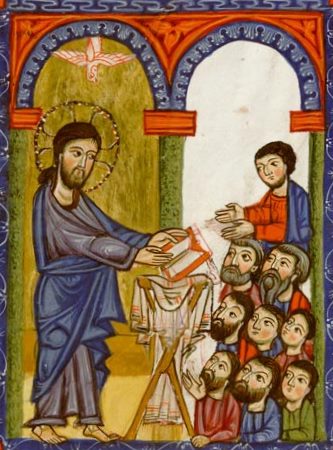
Jesus Unrolls the Scroll in the Synagogue, by French artist James Tissot (1836-1902)
Jesus returned to Galilee in the power of the Spirit, and news about him spread through the whole countryside. He was teaching in their synagogues, and everyone praised him.
He went to Nazareth, where he had been brought up, and on the Sabbath day he went into the synagogue, as was his custom. He stood up to read, and the scroll of the prophet Isaiah was handed to him. Unrolling it, he found the place where it is written:
“The Spirit of the Lord is on me, because he has anointed me to proclaim good news to the poor. He has sent me to proclaim freedom for the prisoners and recovery of sight for the blind, to set the oppressed free, to proclaim the year of the Lord’s favor.”
Then he rolled up the scroll, gave it back to the attendant and sat down. The eyes of everyone in the synagogue were fastened on him. He began by saying to them, “Today this scripture is fulfilled in your hearing.”
All spoke well of him and were amazed at the gracious words that came from his lips. “Isn’t this Joseph’s son?” they asked.
Jesus said to them, “Surely you will quote this proverb to me: ‘Physician, heal yourself!’ And you will tell me, ‘Do here in your hometown what we have heard that you did in Capernaum.’”
“Truly I tell you,” he continued, “no prophet is accepted in his hometown. I assure you that there were many widows in Israel in Elijah’s time, when the sky was shut for three and a half years and there was a severe famine throughout the land. Yet Elijah was not sent to any of them, but to a widow in Zarephath in the region of Sidon. And there were many in Israel with leprosy in the time of Elisha the prophet, yet not one of them was cleansed—only Naaman the Syrian.”
All the people in the synagogue were furious when they heard this. They got up, drove him out of the town, and took him to the brow of the hill on which the town was built, in order to throw him off the cliff. But he walked right through the crowd and went on his way. (New International Version)
Jesus was the hometown boy of Nazareth, the rising star who was putting the small village on the map. He walked into the synagogue on the Sabbath with the people all watching with pride, their chests puffed with delight over one of their own making it to the big time.
It just so happened that on that day the Old Testament reading was from the prophet Isaiah – a prophecy of grace and healing that fit the budding ministry of Jesus. Here was the hope of Israel. It was all bunnies and butterflies, until Jesus decided to say a few words to them all….
Jesus took the prophecy of Isaiah about proclaiming liberty to captives and the oppressed and then applied it, not to his fellow Jews who were present, but to, of all people, Gentiles!
Jesus just had to open his mouth and point out that in the days of Elijah, the prophet was sent to a Gentile woman. In addition, Jesus let everyone know the prophet Elisha cleansed a Gentile. The gathered synagogue worshipers understood exactly what Jesus was doing – claiming to be the ultimate prophet, sent for those people.
It was too much for the people gathered for worship. All hell broke loose as the “worshipers” became so angry and insolent that they drove Jesus out of town and tried to kill him. Jesus had that kind of effect throughout his earthly ministry by saying and doing the unexpected.
The people of Nazareth seemed to have always interpreted the message of Isaiah and the prophets as being for themselves, not others. Whenever any believer or church loses sight of a biblical message and re-interprets it as being for only us, then we end up like the Nazarenes of old who did not recognize Jesus for who he really is and what he really came to do.
Some believers and churches need a question asked of them: Are you ready to throw Jesus off a cliff?
Our faith is not merely individual; it is meant to impact the world. In the beginning the earth was created by God and it was good. Yet, it didn’t take long for things to go sideways. The fall of humanity into sin and disobedience brought death and decay to the world. Ever since, the human condition has been dominated by guilt, shame, indifference, violence, taking advantage of others, pride, and selfishness.
However, God did not leave the world to its own demise. The Lord began the process of reconciliation, culminating in the person and work of Jesus Christ. And now, Christians are a new society, the community of the redeemed, the church. As the people of God, we are called to do justice, love mercy, and walk humbly.
Jesus came to save us from our predicament, and to proclaim good news to the poor, freedom for prisoners, recovery of sight for the blind, and freedom for those oppressed by others. The kingdom of God is to extend over every square inch of this earth, every nation, every race and ethnicity, every institution and organization, and every individual. It all belongs to God’s rule and reign in Christ.
Jesus has made us, his disciples, ambassadors of reconciliation. Ever since the fall of humanity, God is reclaiming and redeeming, even now, all of creation back to himself. The Lord is seeking to bring people back into the harmony that existed in the Garden of Eden. Although this will only be fully realized when Christ returns, we presently now have the responsibility to be gracious agents of God’s kingdom, restoring all areas of this world and all people to their rightful place, at peace with God.
There is every reason to hope because a new world began emerging at the resurrection of Jesus Christ from death. As Christians, we accept struggle and hardship in this life and endure all things because, even though disease, destruction, and death claim so many lives, the love of God in Christ will never change nor die.
Because of the risen and ascended Christ, who is the light for all people everywhere, Christ’s disciples are able to respond to the great mass of human suffering with compassion.
This is important since compassion might not be our initial reaction to human suffering. Like the villagers in Christ’s hometown of Nazareth, we can chafe at the thought of compassionately reaching out to the poor, the prisoner, the blind, and the oppressed. We might either resist ministry to the “other” because we believe they caused their own poverty and adverse situation, or because we simply don’t believe we are wired for ministry to them.
If you knew me before I was a Christian, you might not recognize me. I didn’t love anybody. I had no compassion for anyone. It wasn’t until I experienced the love and compassion of Jesus Christ that my life turned upside-down. I began responding to human need with a deep concern. I sought to connect with all kinds of people. I wanted to make a difference in the world.
Back then I was (and to some degree still am) something of an agitator. Maybe that’s one reason I am so drawn to the compassion of Christ. For compassion is actually a radical form of criticism, declaring that our pains and our hurts are to be taken seriously, that they are not to be accepted as natural but abnormal and unacceptable for the human condition. It’s not supposed to be this way!
The compassion of Jesus needs to be understood as a totally subversive action against the kingdom of darkness, a bold and daring affront against all that keeps people locked into systems of oppression and poverty.
The world needs to experience the Church everywhere as a place and a people of good news – expressed in both word and deed – in which they are hospitably invited into the very life of God and experience the fullness of peace and joy in the Holy Spirit. In other words, we are not only in the personal transformation business, but we are also in the business of transforming society so that the common good of all persons is upheld.
As the church proclaims and seeks to establish the kingdom of God, it comes to see that all human need is important – whether it is spiritual, physical, mental, or emotional. We “do justice” by helping others experience the reality of God’s love in Christ and compassionately meet their holistic needs. We “love mercy” by showing hospitality and inviting folks very different from ourselves into our lives. We “walk humbly” with our God by emulating the compassionate ministry of Jesus to all people.
What is your “compassion quotient?” That is, how much compassion do you have in your life right now?
What are some tangible ways we can work on raising our level of compassion and demonstrating compassionate action to those around us and in our city?
It is questions like these that enable us to sync our lives with the heart of Jesus, who still desires to bring good news to the world.
Almighty God, you sent your Son Jesus Christ to reconcile the world to yourself: We praise and bless you for sending your people in the power of the Spirit to preach the Gospel to all nations. We thank you that in all parts of the earth a community of love has been gathered together by many prayers and labors, and that your people share in your mission of restoring all people to unity with yourself and one another in Christ; for the kingdom and the power and the glory are yours forever. Amen.
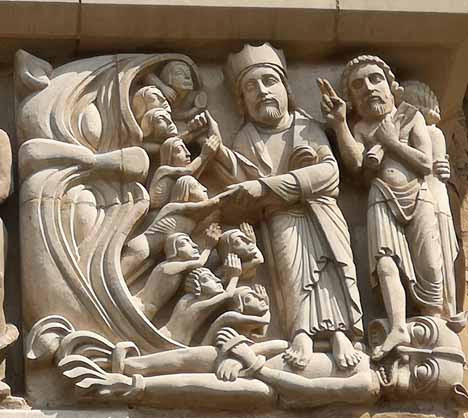
The Plundering of Hell by Jesus, Lincoln Cathedral, England
Jesus was driving out a demon that could not talk; and when the demon went out, the man began to talk. The crowds were amazed, but some of the people said, “It is Beelzebul, the chief of the demons, who gives him the power to drive them out.”
Others wanted to trap Jesus, so they asked him to perform a miracle to show that God approved of him. But Jesus knew what they were thinking, so he said to them, “Any country that divides itself into groups which fight each other will not last very long; a family divided against itself falls apart. So, if Satan’s kingdom has groups fighting each other, how can it last? You say that I drive out demons because Beelzebul gives me the power to do so. If this is how I drive them out, how do your followers drive them out? Your own followers prove that you are wrong! No, it is rather by means of God’s power that I drive out demons, and this proves that the Kingdom of God has already come to you.
“When a strong man, with all his weapons ready, guards his own house, all his belongings are safe. But when a stronger man attacks him and defeats him, he carries away all the weapons the owner was depending on and divides up what he stole.
“Anyone who is not for me is really against me; anyone who does not help me gather is really scattering. (Good News Translation)
Watching the Green Bay Packers on television does not make one a professional football player. Voting in an election doesn’t make somebody a politician. Paddling around on a lake does not make anyone a duck. And just as sitting in a garage doesn’t make someone a car, so sitting in a church worship service does not make someone a Christian.
Responding to criticism about casting out demons, Jesus summarized his actions and the actions of others by saying that whoever is not with Jesus is against him, and whoever does not gather with Jesus, scatters.
Jesus was all about the kingdom of God breaking-in to this mixed-up fallen world and giving it a thorough transformation. So, that meant Jesus was going to push back hard on the kingdom of darkness.
Participating with Jesus in his kingdom enterprise is a watershed test of whether someone is genuinely following God, or not. There are a million armchair quarterbacks who will freely give their advice and opinion about how things should have gone and what those playing on the field ought to be doing. Jesus was, and still is, calling people out to get off their butts and follow him. To merely watch him is to be against him, not for him.
Faith is not a checklist of beliefs to affirm and mark off. Rather, believing in Jesus is a dynamic participation with him in his great kingdom influence for the world. Christ calls us to leave the critical spirit, haughty attitude, and selfish expectations in the bleachers. We are to get on the playing field. To simply have our hands in our pockets is to actually work against Jesus.
Are you willing to gather with Jesus? How does God want to you to serve? Are you only a fan of Jesus? Do you play armchair preacher on Monday morning?
God is presently working to bring all things under the authority of Jesus Christ, the rightful ruler of the universe. Unlike so many present kingdoms of darkness on this planet, Christ’s reign is a kingdom of light, bringing benevolent grace to all.
Christ is the visible image of the invisible God. He existed before anything was created and is supreme over all creation, for through him God created everything in the heavenly realms and on earth. He made the things we can see and the things we can’t see— such as thrones, kingdoms, rulers, and authorities in the unseen world. Everything was created through him and for him. He existed before anything else, and he holds all creation together. Christ is also the head of the church, which is his body. He is the beginning, supreme over all who rise from the dead. So he is first in everything. For God in all his fullness was pleased to live in Christ, and through him God reconciled everything to himself. He made peace with everything in heaven and on earth by means of Christ’s blood on the cross. (Colossians 1:15-20, NLT)
The kingdom of God has come upon us. Let us follow Jesus and participate in the renewal of the world so that truth, kindness, grace, mercy, goodness, and peace will shine.
Mighty God, Jesus is the strong man who has bound Satan and is ushering in a new kingdom. Let me be a part of what you are doing in this world so that my faith is confirmed, strengthened, and used for your gracious and benevolent purposes, through the power of your Holy Spirit. Amen.
“No one lights a lamp and puts it in a place where it will be hidden, or under a bowl. Instead, they put it on its stand, so that those who come in may see the light. Your eye is the lamp of your body. When your eyes are healthy, your whole body also is full of light. But when they are unhealthy, your body also is full of darkness. See to it, then, that the light within you is not darkness. Therefore, if your whole body is full of light, and no part of it dark, it will be just as full of light as when a lamp shines its light on you.” (New International Version)
We don’t typically frame our words in a phrase like, “Your eye is the lamp of the body.” The idea of healthy or unhealthy eyes as determining how well we are doing might seem weird or awkward to us. We need to keep in mind that Jesus the Jew communicated in distinctly Jewish ways. Speech was often expressed in metaphors and word pictures.
The word “body” serves as a way of saying “life” and the word “eye” represents our contemporary word “goal.” So, then, let’s restate the verse: “Your goals determine the direction of your life. When your goals are good, your entire life is healthy, but when your goals are bad, it messes up your life.”
Our goals, whether stated or unstated, set the focus and direction of our lives. If the orientation of our lives is the pursuit of selfish gain and temporary satisfaction, then we will move in that direction, and it will not end well. However, if our goals are toward God and the accomplishment of God’s will, then we will be light for the world. It’s all a matter of focus and where we set our attention.
But more than anything else, put God’s work first and do what he wants. Then the other things will be yours as well.
Jesus (Matthew 6:33, CEV)
In our goal setting, we are to be careful, deliberate, and sensitive to the ways of Jesus. That means Christians will focus on the kind of people they want to be, that is, like Jesus Christ. Instead of simply making big resolutions, we can implement small decisions, practiced every day, which will help us grow spiritually.
For example, if we have some besetting sin which tends to dog us, we might try to summon the willpower and energy to take it on. On some days, that works. On most days, it doesn’t. That’s because if we maintain the same daily habits that led to being ensnared in sin, we’ll continually be looking for that unusual burst of energy to overcome that sin.
We need a new system of living. If we imagine our lives as a house, and a room in your house needs a complete restoration and makeover, it won’t do to enthusiastically rearrange the furniture. It’s a superficial goal which doesn’t address the systemic change of habits needed to thoroughly reform that area of your life.
And if we try and change our results, our sinful actions, chronic failure is likely in our future. What we really need to change are the systems that cause those results. When we solve problems at the results level, it’s only a temporary fix.
In order to have some permanent improvement, we need to solve problems at the systems level. That’s why problems like racism, poverty, hunger, and a thousand other issues will never be truly solved unless there is a complete transformation of the systems which keep people locked into those tragic situations.
We need some good healthy biblical goals. And we equally need a reformation of habits to actually realize those worthy goals.
Our goals need not be big and audacious; they just need to be consistent with living the Christian life according to the words and ways of Jesus. That means choosing one thing and ruthlessly eliminating everything else. We don’t really need more time to accomplish the will of God; we simply need to decide that we are following Jesus. Spiritual growth and maturity happen not with more but with less.
Jesus said, “I am the true grapevine, and my Father is the gardener. He cuts off every branch of mine that doesn’t produce fruit, and he prunes the branches that do bear fruit so they will produce even more.” (John 15:1-2, NLT)
Proper goals bring us into the light. And when we establish a routine rule of daily life – small practices of faith done every day – then our light can shine in the darkness of the world.
Loving Lord Jesus, help me to set my life’s gaze on the living and doing of your teaching. Enable me to set godly and worthy goals and grant me the power to see them realized through your Holy Spirit. Amen.