Luke 12:22-31 – Do Not Worry

Then Jesus said to his disciples: “Therefore I tell you, do not worry about your life, what you will eat; or about your body, what you will wear. For life is more than food, and the body more than clothes. Consider the ravens: They do not sow or reap; they have no storeroom or barn; yet God feeds them. And how much more valuable you are than birds! Who of you by worrying can add a single hour to your life? Since you cannot do this very little thing, why do you worry about the rest?

“Consider how the wild flowers grow. They do not labor or spin. Yet I tell you, not even Solomon in all his splendor was dressed like one of these. If that is how God clothes the grass of the field, which is here today, and tomorrow is thrown into the fire, how much more will he clothe you—you of little faith! And do not set your heart on what you will eat or drink; do not worry about it. For the pagan world runs after all such things, and your Father knows that you need them. But seek his kingdom, and these things will be given to you as well. (New International Version)

Worry is debilitating. It sucks the life out of us. And Jesus doesn’t want us to live that way. So, he makes it clear that we don’t have to.

Jesus cares about your whole life, not just the spiritual part. Your physical, mental, and emotional needs are also important to God. The Lord wants you and I to thrive and flourish in this life – free from worry.

In our anxiety about the future, Jesus guides us to embodying a non-anxious presence as we move from day to day.

Do Not Worry About Your Life

Worry is that sinking feeling you get whenever you face surgery; or your friend is depressed and suicidal; or someone close to you is diagnosed with major mental illness; or you lose a job, a spouse, a reputation, or a million other things that happen to us in this world. 

Jesus is not saying that we should never be concerned about the significant situations we face; what he is saying is that when we worry, we are displaying an inability to see beyond my own little world. We are exhibiting feelings about the future of which we know nothing about. And we are letting those feelings hinder us in our ability to serve God, express faith, love others, and function in well-being on a daily basis. 

We are to acknowledge those sinking feelings and face them, rather than ignoring them, wishing they would go away, or stuffing them down. Why acknowledge them?

Because Life Is More Than Food and Clothes

Whenever we experience worry about how the necessities of life are going to be met, let’s back up the truck and take a big picture view of what’s going on. 

We must remind ourselves that God cares for life itself, all of it. The Lord knows what it takes to live in this world and make it on this earth. If God cares about life, which is so valuable, he will sustain us with what we need to live that life.

Because God Cares for the Birds In Creation 

People are the apex of God’s creation. Since God cares for every other creature on this earth, and sustains their lives, the Lord will certainly care for us, as well. 

Worry begins to melt away, and replaced by faith, not when we try and work up feelings of trust, but when we take the time to observe creation – watching the birds and seeing how God takes care of them. 

Birds don’t worry; they just enjoy God’s providence. 

They work hard, but they aren’t farmers who do the work of planting and harvesting crops. Yet, God sustains them for what they need. So then, if God provides for small creatures that don’t even make plans to avoid starvation, how much more will the Lord sustain you!?

Because Worry Accomplishes Nothing 

Worry is like a rocking chair; it gives you something to do; but doesn’t get you anywhere – it’s not helpful.

Because God Cares for the Flowers and Grass In Creation 

God can dress the flowers better than we ever could dress ourselves (which is what your wife has been telling you for years). 

Jesus chooses flowers and grass because they clearly illustrate something that is not here for very long, as well as something that is fragile. 

The logic is from the lesser to the greater: If God cares for something as fragile and temporary as flowers and grass, how much more will he care for you, Jesus says, “you of little faith.”

Jesus links our worry with a small faith. 

Here’s how it happens: We have expectations in life about how things ought to go. If we have expectations based on God’s promises, then, when adverse circumstances come, we will tend toward responding in peace and with trust.

However, if we expect the future to turn out a certain way in order to be happy, then the worry sets in. As the worry seeps into the soul, we begin to take matters into our own hands. 

If the situation ends up not turning out how we want, then we start questioning if God is good, or not. We wonder if God really has our best interests at mind – or is even there, at all.

Tethering ourselves to specific outcomes, instead of specific promises, will come around to bite us in the backside every time. We must bank on God taking care of us, no matter the situation, with outcomes of divine design, and not our shortsighted half-baked human plans.

Do Not Worry About It 

Why?

Because Your Heavenly Father Knows What You Need 

Unlike other deities, who are aloof and do not pay attention to people, God always watches us and knows our every need. Fickle deities may or may not come through for people – which keeps their worshipers forever worrying about whether they’ll get their needs met, or not. 

To know God is to be a stranger to worry. Just as my girls used to jump from our stairway steps in a leap of faith – because they knew for sure that Dad was going to catch them – so also your heavenly Father is a trustworthy God.

Because the Necessities of Life Will Be Given To You

God’s business is to provide for our necessities; our business is to seek first God’s kingdom and righteousness.  The verb form of “seek” communicates a continuous action, that is, we are to keep on seeking. 

We are to continually seek God’s kingdom by:

  • Submitting to Christ’s lordship
  • Being obedient to kingdom values 
  • Praying, “your kingdom come”
  • Bringing all of life under the gracious authority of Christ
  • Dethroning wealth and possessions as our first pursuits, and instead, seeking heavenly treasure as defined by Jesus
  • Pursuing social reform, political reform, church reform, private and public institutional reform

We are to continually seek God’s righteousness by: 

  • Being peacemakers
  • Forgiving others
  • Showing mercy, instead of judgment 
  • Pursuing right relations with family members, co-workers, neighbors, and fellow parishioners 
  • Providing for the needs of others
  • Agitating for justice in every sphere of society
  • Proclaiming the gospel to all nations

For the believer, there is to be no room for worry because we are busy with kingdom business. Whenever we are diverted from seeking God’s kingdom and righteousness, worry is sure to set in.

May God’s richest blessings rest upon you, as you seek to value what God values, and as you seek the Lord with all your heart, mind, soul, and strength.

Colossians 4:2-6 – Circular Praying

Devote yourselves to prayer, being watchful and thankful. And pray for us, too, that God may open a door for our message, so that we may proclaim the mystery of Christ, for which I am in chains. Pray that I may proclaim it clearly, as I should. Be wise in the way you act toward outsiders; make the most of every opportunity. Let your conversation be always full of grace, seasoned with salt, so that you may know how to answer everyone. (New International Version)

Ever since I blew into my first musical instrument, I’ve been fascinated with circular breathing. It’s a technique used by the instrumentalist (or singer) to produce a continuous tone without interruption. In other words, you can keep blowing or singing without doing the traditional stopping to inhale. 

By breathing in through the nose while simultaneously pushing air out through the mouth, using air stored in the cheeks, the person can maintain the sound. This might sound difficult, but it really isn’t. It’s just that circular breathing takes a lot of practice. 

The hard part is unlearning how you typically breathe. I can do it, yet I’ve made the personal observation that it doesn’t happen unless you can be very relaxed, connected to your body, and grounded in what you’re doing.

I imagine that we all sometimes feel like admonitions to devote ourselves to prayer, pray continually, and never give up praying, are something like circular breathing. 

Maybe the prayer thing is best left to the experts and the professionals, we may think. Yet, the Apostle Paul encouraged the entire Colossian church to keep up the praying, both leaders and laity.

“Never give up praying,” (Colossians 4:2, CEV) might sound unattainable. It isn’t. The catch to it is this: You’ll need to unlearn some old ways of praying before devotion to prayer is realized. 

The ancient Colossians had fallen into the wrongheaded belief that Christianity could be reduced to a nice neat, packaged formula of do’s and don’ts. Do the right things. Say the right things. Don’t do the list of the terrible ten or the nasty nine, or whatever checklist you are using to live by your form of “Christianity.” 

Paul was telling the Colossians to completely jettison such an approach to the Christian life. Instead, persevere in prayer without knowing the outcome. Pray relying on God and the mystery of Christ. Pray with uncertainty instead of continually believing you need sure answers to everything for everyone.

The Christian life cannot be forced into some geeky algorithm so that we can avoid suffering, know all the right things to say in a conversation, and always keep God happy. 

God is not some algebra equation to figure out. The Lord is not a gumball machine to put a quarter in and get what you want. The almighty is not Santa God. 

Christianity requires living in the tension of not knowing everything, and yet, having cogent answers for others who inquire about our faith. It is a dynamic relationship, in which we must continually interact in prayer to God, while mostly improvising our lives, spontaneously applying the understanding we have for each situation before us.

Breathing in and breathing out at the same time – that’s what prayer is really like.

Paul’s desire was to keep the church vigilant in prayer. He wanted all the churches to maintain an ongoing dialogue with the God who answers in his own good time, according to his own good will.

The believers were being taught a kind of circular praying whereby they make good use of the time God has given through choosing wise words to say, while simultaneously carrying on a silent prayer conversation with God. 

This is a Christianity that’s far above rules and laws and checklists. It’s Christianity as it’s meant to be lived, depending on Jesus, and relaxed in the Spirit.

But again, the catch is this: Circular praying takes practice, practice, practice. 

Failure is both inevitable and expected. And that’s okay. We’re not living by lists and human contrived rules.  We’re living a new life in the power of Christ’s resurrection. So, it takes a new kind of praying.

God of Mystery, the One who conceals and reveals, forgive me for my attempts at reducing faith to a few spiritual rules to keep. Help me to speak in ways which are gracious, loving, and redemptive. May the person and work of Jesus come tumbling out of my mouth while I inhale the breath of your Holy Spirit. Amen.

Luke 12:13-21 – The Parable of the Rich Fool

The angel of death surprises a rich man by Jim Janknegt

A man in a crowd said to Jesus, “Teacher, tell my brother to give me my share of what our father left us when he died.”

Jesus answered, “Who gave me the right to settle arguments between you and your brother?”

Then he said to the crowd, “Don’t be greedy! Owning a lot of things won’t make your life safe.”

So, Jesus told them this story:

A rich man’s farm produced a big crop, and he said to himself, “What can I do? I don’t have a place large enough to store everything.”

Later, he said, “Now I know what I’ll do. I’ll tear down my barns and build bigger ones, where I can store all my grain and other goods. Then I’ll say to myself, ‘You have stored up enough good things to last for years to come. Live it up! Eat, drink, and enjoy yourself.’ ”

But God said to him, “You fool! Tonight, you will die. Then who will get what you have stored up?”

“This is what happens to people who store up everything for themselves but are poor in the sight of God.” (Contemporary English Version)

Let’s be honest before God because there’s no way we are going to fool him. The truth is, we all worry. 

And the more stuff we accumulate, the more worried we get. And the more worried we get, the stingier we become – to the point where we encase ourselves around more stuff, which requires bigger places to store all our stuff.

Here’s a bit of a reality check: We are not self-sufficient independent automatons who are meant to function by themselves without ever needing help.

The Rich Fool by Rembrandt, 1627

If we have some success in this independence venture, we then expect that others ought to be able to do it, too. Such thinking leads to a lack of generosity, believing that others just need to work harder or smarter or better. They’re lazy, we may reason. So, I’ve got no responsibility to share any of my largess with slackers.

We seek after whatever it is we desire. If we seek the kingdom of God, we will pursue the Lord Jesus and aim our love toward knowing him. But if we seek materialism, wealth, and the accumulation of stuff, we will never have enough because worry and fear shall always overwhelm the voice of God. 

I make it sound easy, as if the choice were so clear. On one level it is, but, like most things, it’s complicated because we are all a weird hybrid of competing loves and desires.

So, let’s make a few distinctions that might help us clarify our kingdom calling. Materialism is not the same thing as hard work. 

Materialism:

  • Is a shield we lug around to protect us from failure and poverty
  • Puts us on a performance treadmill, and is tied to our self-worth
  • Is a never-ending quest for security and protection
  • Seeks to avoid the criticism of others by seeking their approval with stuff
  • Believes that money will take away feelings of hurt, pain, and discomfort

Whereas hard work:

  • Is about healthy achievement and a patient growth of assets
  • Seeks to improve and is satisfied with a job well done
  • Takes away fear and worry 
  • Brings gratitude and joy

Any worldly fool can make money; but the wise and righteous person is able to manage resources in a way that glorifies God, builds up the church, and blesses the world. 

And it all begins with knowing the difference between depending on God versus depending on self and stuff.

The rich farmer in Christ’s story is a fool not because he is wealthy or because he saves for the future, but because he lives only for himself, and because he believes he can secure his life with his abundant possessions.

In the parable, the rich guy only talks to himself – not to anyone else. The man doesn’t express any gratitude to God. There is neither any thanking the workers who have helped him plant and harvest this bumper crop, nor any sharing his wealth through giving them a bonus.

The farmer has more than he could ever hope to use, yet he seems to have no thought of sharing it. And there is clearly no thought of what God might require of him. The rich man is outright blind to the fact that his life is not his own to secure, that his life belongs to God, and that God can demand it back at any time.

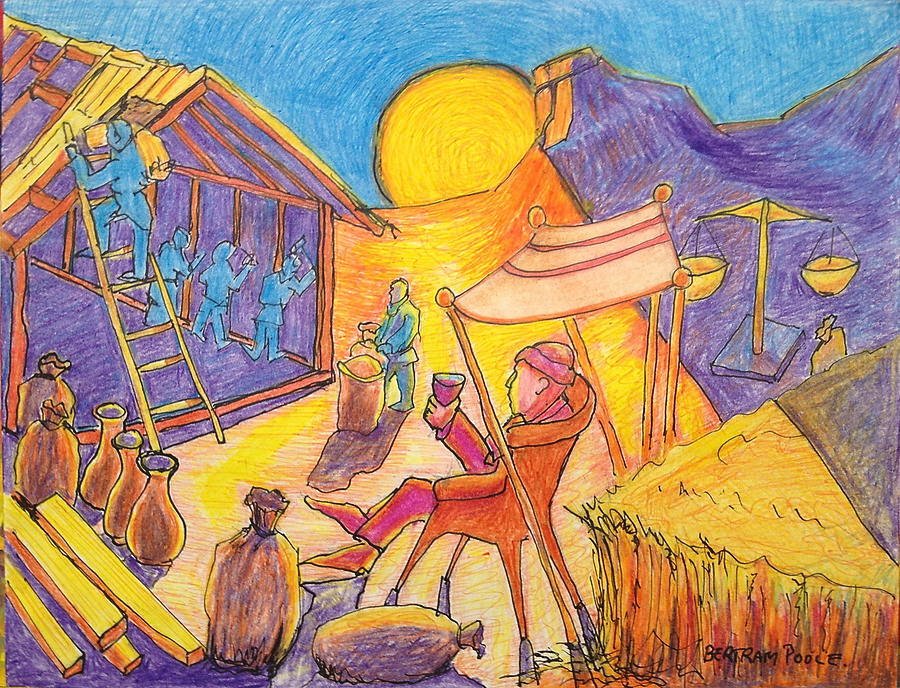
The Rich Fool by Bertram Poole

No amount of wealth can give any of us what we need most in life: healthy relationships, the love and enjoyment of friends and family, or eternal life. Nobody can buy their way into heaven or eternal bliss. What’s more, money cannot provide protection from disease and disaster.

Here’s another reality check: The rich and the poor all die, just the same. And the one who is wealthy cannot take a bit of it with him.

At issue here, for Jesus, is neither saving for retirement or for future needs, nor enjoying the good things in life. In fact, that’s wisdom.

The issue, for Jesus, is about what’s most important to God. It’s about priorities. God cares deeply about how we invest our lives and use the gifts given us. The Lord is vested in us, so he cares about how we love God and neighbor. God wants us to orient our lives toward the divine mission to bless and redeem the world.

In other words, God cares about whether we care, or not, about others.

As a hospital chaplain, I’ve seen my share of death. And I have never once heard anyone say, “Gosh, chaplain, I sure wish I hadn’t given so much money and stuff away. I wish I had kept more for myself.” But I’ve sure heard plenty of the opposite.

A spiritual reality check: We, and our resources, all belong to God.

We are merely stewards of everything we own. God gave it to us. God can take it away. Including our life.

The good news is that, since we, and everything we have, belongs to God, our future is secure in Christ.

Merciful God, thank you for giving me everything I need for life and godliness in this present world. Forgive me for ever doubting your goodness and ability to provide for me. Let my life bless the name of Jesus, and may I steward all that you have given me with care and compassion. Amen.

Mark 10:17-22 – Jesus Intervenes

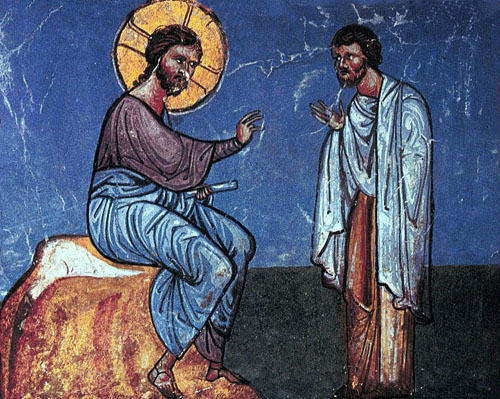
Eastern Orthodox mural of Jesus and the rich man

As Jesus started on his way, a man ran up to him and fell on his knees before him. “Good teacher,” he asked, “what must I do to inherit eternal life?”

“Why do you call me good?” Jesus answered. “No one is good—except God alone. You know the commandments: ‘You shall not murder, you shall not commit adultery, you shall not steal, you shall not give false testimony, you shall not defraud, honor your father and mother.’”

“Teacher,” he declared, “all these I have kept since I was a boy.”

Jesus looked at him and loved him. “One thing you lack,” he said. “Go, sell everything you have and give to the poor, and you will have treasure in heaven. Then come, follow me.”

At this the man’s face fell. He went away sad because he had great wealth. (New International Version)

We are all addicts. 

We all have our own sin addictions which keep us stuck in guilt and shame.

We may not all struggle with the same sin. Yet we all have some besetting sin(s) that we must be weaned off of. The most pervasive addiction found in Holy Scripture is neither substance abuse nor alcohol – it is the addiction to wealth and money.

Maybe your initial response was of someone else, besides yourself: “I don’t have as much money as____” or, “So-and-so has a real problem with that!” Those statements are what we call, in terms of addiction, denial. 

In truth, all of us are in some sort of denial about how much we really trust in paychecks, bank accounts, investments, and owning material stuff. I’m no exception. I own more books than I’ll be able to read in a lifetime, and yet, I tend to believe I don’t have enough of them.

Even the poor can have an addiction wealth and money by thinking about it and wishing for it to an unhealthy degree, as if wealth is the thing that will ultimately make them happy.

People in denial rarely have any idea how much they are hurting others, themselves, and God.  In fact, the consistent witness of the early church fathers is that the sheer accumulation of stuff is the same as stealing from the poor. 

Because of denial, people need an intervention. They need to be jolted back to their senses. Intervention is a gift. Someone cares enough about the person to intervene. Yet, interventions don’t always work. The person can choose to walk away and refuse to change.

Jesus did a gracious intervention with a rich young man. The man was addicted to wealth and money, but he didn’t see it. In fact, he thought he was quite godly and spiritual. It’s a sad story because the man walks away untransformed by his encounter with Jesus and did not accept the gracious invitation to follow the Lord. 

Chinese depiction of Jesus and the rich man, 1879

The man simply did not see himself as hopeless and desperately needing to change. He held to his denial.

The man approached Jesus with a question: “What must I do to inherit eternal life?” Whereas I would probably get all excited about being asked a question like this and launch into some long-winded gospel answer, Jesus immediately picked up on the attitude and the need behind the question. 

What must I do to get? It’s almost as if the man wants to acquire eternal life like he would acquire wealth. “I am a successful businessman with plenty of money, and a respected citizen with lots of wealth – now I want to be a success with God, as well.” 

The question may have been sincere, yet it was misguided. Eternal life is not spiritual real estate for an upwardly mobile person to acquire and possess. The man seems to believe he can purchase eternal life, as if everyone has their price, even God. “After all,” he may have been reasoning, “I have gotten everything else in life, so why not obtain eternal life?”

Jesus questioned the question. He went after the underlying assumption of doing something good to obtain eternal life. The fact of the matter is that the man cannot do anything. He can’t because only God is good. Jesus points him to God by changing the action from getting to entering. And he changed the language from a market acquisition to entering into a journey.

Jesus was inviting the man to walk with him.

Eternal life is a journey of faith in the God who is good, and not a transaction to get it. And, we too, must be careful not to treat eternal life as if it were a transaction, as if we must get a person to sign on the dotted line through a “sinner’s prayer” or some other formula that will seal the deal for eternal life. 

Instead, eternal life is a walk of obedience with God and his commands.

Jesus responded to the rich man with the Ten Commandments, specifically the ones which focus on human relationships. Jesus wanted him to realize that the path into the kingdom of God and eternal life goes through and not around how we treat our fellow human beings.

Christ and the Rich Young Ruler by Heinrich Hofmann, 1889

The Lord sought to expose the impossibility of continuing in life on the rich man’s terms. The guy just could not imagine what he might be lacking. So, Jesus helped him out. Christ gave him some major interventional language…. Sell. Give. Follow.

Sell everything. Give to the poor. Come, follow me.

One cannot simply add Jesus to their life, like adding a new car or a new fishing rod. Rather, one’s heart must change in order to accommodate real, genuine eternal life. 

Jesus offered the rich man someone to be, rather than something to get

It’s one thing to give from what you have; it’s another thing to surrender your life and all you have. 

In the New Testament Gospels, there are no easy conversations with Jesus. He gets personal in every encounter and gets under everybody’s skin. Christ doesn’t settle with superficial small talk when there are people whose hearts are little more than idol factories. 

Jesus never leaves us alone, because there is always the invitation to “Come, follow me.”

Christ exposed the wealthy man’s divided loyalties – he was trying to serve both God and money. But he would have to choose between the two. 

And that is our choice, as well. 

The question for us is not, “Am I completely devoted to money?” Instead, the question from our Gospel story today is, “Am I trying to serve God while maintaining a moonlighting job with the world?” 

God wants from us an undivided heart; the Lord desires absolute allegiance.

Jesus is looking for those who are poor in spirit, who recognize their great need for God – instead of believing that they are okay and just need to add a little Jesus to their lives. 

God is looking for spiritual beggars who understand their desperate situation and don’t practice denial by sugar-coating their actual spiritual state.

Like a drunkard who won’t give up his vodka; like a sex addict who won’t give up strip clubs or emotional affairs; or like a workaholic who just can’t come home; the rich man would not give up his disordered love for money and possessions. 

So, Jesus did an intervention. 

The Lord Jesus didn’t ask everybody to do exactly as he called the rich man to do. He didn’t ask the very wealthy Zacchaeus to do it, and he didn’t tell Peter to sell his fishing business. 

But Jesus does tell us to do something which seems impossible. Yet, where the impossible exists, so exists grace.

Blessed Lord, you have taught us that all our doings without loving generosity are worth nothing. Send your Holy Spirit and pour into our hearts your gift of love, the true bond of peace and of all virtues, without which whoever lives is counted dead before you. Grant this for the sake of your only Son Jesus Christ, who lives and reigns with you, in the unity of the Holy Spirit, one God, now and forever. Amen.