
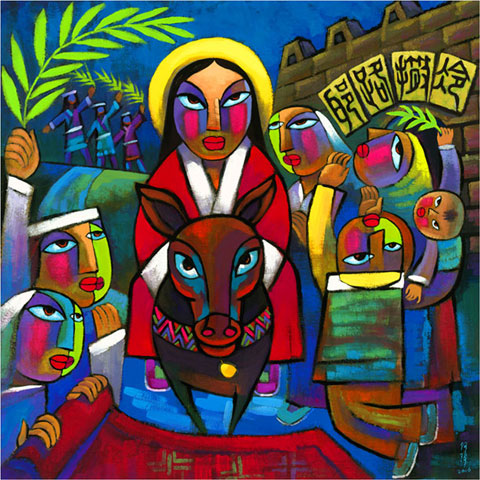
The Gentle King (Matthew 21:1-11)

The Triumphal Entry, by He Qi

As they approached Jerusalem and came to Bethphage on the Mount of Olives, Jesus sent two disciples, saying to them, “Go to the village ahead of you, and at once you will find a donkey tied there, with her colt by her. Untie them and bring them to me. If anyone says anything to you, say that the Lord needs them, and he will send them right away.”

This took place to fulfill what was spoken through the prophet:

“Say to Daughter Zion,
    ‘See, your king comes to you,
gentle and riding on a donkey,
    and on a colt, the foal of a donkey.’”

The disciples went and did as Jesus had instructed them. They brought the donkey and the colt and placed their cloaks on them for Jesus to sit on. A very large crowd spread their cloaks on the road, while others cut branches from the trees and spread them on the road. The crowds that went ahead of him and those that followed shouted,

“Hosanna to the Son of David!”

“Blessed is he who comes in the name of the Lord!”

“Hosanna in the highest heaven!”

When Jesus entered Jerusalem, the whole city was stirred and asked, “Who is this?”

The crowds answered, “This is Jesus, the prophet from Nazareth in Galilee.” (New International Version)

A Humble Leader

Gentle humility and strong leadership are not mutually exclusive concepts. They can and should co-exist together.

Los Angeles County traffic cops receive plenty of complaints about their work. After all, most motorists don’t think they deserve a ticket. Each complaint gets documented and placed in the officer’s personnel file. One officer, however, Deputy Sheriff Elton Simmons, made 25,000 traffic stops over a span of 20 years, without a single complaint on his record.

When his supervisor started looking through Simmons’ file, he was stunned to find plenty of commendations, but not a single complaint. It was so unusual, that a CBS News crew was assigned to follow Simmons in an attempt to learn his secret. They described Deputy Simmons as having a “pitch-perfect mix of authority and diplomacy” without a trace of arrogance or self-righteousness.

Although handing out plenty of tickets, they never came with a guilt trip.  Deputy Simmons described his mentality: “I’m here with you. I won’t look down at you.” 

One driver who got a ticket from Simmons said, “It’s his smile. How could you be mad at that guy?”  “Apparently, you can’t,” concluded the CBS News team. “Time after time, ticket after ticket, we saw Officer Simmons melt away a polar ice cap of preconceptions.”

A Meek Celebrity

As Jesus entered Jerusalem for the last week of his life, he was at the height of his fame. Christ’s teaching and healing ministry touched thousands of people. Jesus was the most famous celebrity to come into town since David captured the city a thousand years before. 

But Jesus did not ride into Jerusalem as a great and mighty warrior who conquered Jerusalem in a military battle. There is coming a time, at the end of the age, when Jesus will take on this role, but that was not his purpose on this occasion. 

Hosanna in the Highest, by Malaysian artist Hanna-Cheriyan Varghese

One of the challenges for people in every era is to properly balance scriptural truth. Many Jews emphasized King David’s victories in battle, and his great political dynasty, and so, tended to overlook that David was also a humble servant. 

King David showed steadfast love and kindness to his subjects and submitted himself to God in such a way that, even with opportunities to seize the kingship from Saul who was trying to take his life, he left vengeance to God alone.

Christ’s triumphal entry portrays Jesus as King, the Son of David, but as a gentle king. He embodied both powerful authority and gentle humility. Jesus wanted the crowd to understand that he was not like most kings – he was a lowly king. 

Jesus as a meek celebrity seemed so odd that many people saw that combination of gentle authority as being wishy-washy. Jesus didn’t fit any of the typical labels that people expected. They wondered, “Is he a Pharisee? Or a Zealot? What’s his position on the Romans?  How is he going to lead us out from under Gentile rule?” There was lots of anxiety and concern over Jesus; the people could not nail down exactly what kind of guy he was.

A Servant Pastor

Over the years, as a Pastor, many people have wanted to label me as something, but have had a hard time doing it. Am I liberal or conservative? liturgical or non-liturgical? open or closed to particular people or groups? e.g. LGBTQ folks, Black Lives Matter, etc.

The problem with all this is that it assumes you cannot be both, as if life is all either/or, instead of both/and. It makes ministry about choosing sides, instead of breaking down barriers.

Meekness and strength, gentleness and authority, humility and leadership, grace and truth, love and anger, are all meant to be together – not compartmentalized in sequestered ghettos of the mind.

Jesus sought to hold kingly authority and divine righteousness together, at the same time, all the time. Christ came into Jerusalem to face the cross and take upon himself the sin of the whole world. He came as a gentle king.

Yet, many people do not want this kind of leader because they think leadership is all about power – taking charge with strong authority, telling people what to do, and controlling every aspect of the realm.  

Jesus, at times, acts like a decisive and absolute authority. He knocks over the tables of the money changers in the temple, curses fig trees, and refuses to answer direct questions. But then he turns around and goes against the people’s expectations of him as a leader by riding on a lowly donkey, inviting tax collectors and prostitutes to join him, going after the lost, and embracing the least persons in society.

A Donkey Lord

Jesus displayed a combination that seemed confusing and wishy-washy to many. Christ is both sovereign lord, and humble servant. Jesus riding on a donkey seemed a strange fusion of authority and humility. 

On the one hand, a donkey was the beast of burden for most working class poor people. Donkeys are ordinary, and not like war horses. Kings didn’t ride into conquered cities on donkeys. But, on the other hand, the donkey is also linked to Messiah’s power and authority.

Rejoice, rejoice, people of Zion!
    Shout for joy, you people of Jerusalem!
    Look, your king is coming to you!
He comes triumphant and victorious,
    but humble and riding on a donkey—
    on a colt, the foal of a donkey.

The Lord says,

“I will remove the war chariots from Israel
    and take the horses from Jerusalem;
    the bows used in battle will be destroyed.
Your king will make peace among the nations;
    he will rule from sea to sea,
    from the Euphrates River to the ends of the earth.” (Zechariah 9:9-10, GNT)

Jesus is the ultimate leader who uses his authority for the benefit of others, to bring peace. Jesus did not use his authority to consolidate power and squish enemies, but instead, gave his life so that others might live. 

Gentle and meek does not mean being a washrag or a limp noodle. Rather, it means to have power under control, e.g. a broke horse; it is power for useful purposes to serve people, not like other kings who were concerned with getting, consolidating, and keeping power, at all costs.

Jesus is the crucified Messiah; the modest leader; the lowly Lord; the God Man. We must hold it all, not emphasizing one aspect above another, so that we have the complete picture of Christ.

A Gracious Royal

Believers and followers of Jesus are royal children of the King. That means we live in the way of Jesus by bestowing grace to others. What does this “look like?”

  • In our families, Christian parents do not merely bark orders at kids, but love and support them by humbly and gently coming alongside and helping. 
  • In our neighborhoods, Christian citizens pray for the welfare of their neighbors, even and especially the ones who we may not like very well.   
  • In our work, Christian workers use their skills and abilities to serve others, transforming what we do from a secular job to a sacred vocation. 
  • In our daily life, Christians scan the horizon to seek people whom we might show God’s kindness, instead of just waiting for something to fall into our laps, if it ever does.

A Talking Donkey

From the Old Testament, we know that donkeys can talk (Numbers 22:21-38). If Christ’s donkey could speak, I imagine him saying: 

“King Jesus, why did you choose a lowly donkey like me to carry you to ride in your parade? Didn’t you have a friend who owned a horse – a spirited royal mount, fit for a king to ride? Why choose me, a small unassuming beast of burden, trained to plow and not to carry kings?”

It is a privilege to be a Christian. Perhaps you will say: 

“King Jesus, why did you choose me, a lowly unimportant person to bear you in my world today? I am poor and unimportant, trained to work, and not to carry kings – let alone the King of kings; and yet, you’ve chosen me to carry you in triumph in this world’s parade. King Jesus, keep me humble, so everyone may say, ‘Blessed is he who comes in the name of the Lord,’ and not ‘what a great Christian he is.’”

God of all, you gave your only begotten Son to take the form of a servant, and to be obedient, even to death on a cross: give us the same mind that was in Christ Jesus that, sharing in his humility, we may come to be with him in his glory, who lives and reigns with you and the Holy Spirit, one God, now and forever. Amen.


On the Need for Humble Leaders (1 Peter 5:1-11)

I appeal to your spiritual leaders. I make this appeal as a spiritual leader who also witnessed Christ’s sufferings and will share in the glory that will be revealed. Be shepherds over the flock God has entrusted to you. Watch over it as God does: Don’t do this because you have to, but because you want to. Don’t do it out of greed, but out of a desire to serve. Don’t be rulers over the people entrusted to you but be examples for the flock to follow. Then, when the chief shepherd appears, you will receive the crown of glory that will never fade away.

Young people, in a similar way, place yourselves under the authority of spiritual leaders.

Furthermore, all of you must serve each other with humility because God opposes the arrogant but favors the humble. Be humbled by God’s power so that when the right time comes he will honor you.

Turn all your anxiety over to God because he cares for you. Keep your mind clear and be alert. Your opponent the devil is prowling around like a roaring lion as he looks for someone to devour. Be firm in the faith and resist him, knowing that other believers throughout the world are going through the same kind of suffering. God, who shows you his kindness  and who has called you through Christ Jesus to his eternal glory, will restore you, strengthen you, make you strong, and support you as you suffer for a little while. Power belongs to him forever. Amen. (God’s Word Translation)

“The most powerful weapon to conquer evil is humility. For evil does not know at all how to employ it, nor does it know how to defend itself against it.”

St. Vincent DePaul

The real mettle of a person, especially a leader, is not seen in their very visible public service. Rather, solid spiritual leadership is forged in the invisible places, in the daily mundane tasks which no one ever sees.

It is in our most unguarded times that we really demonstrate who we are. This is the sacred space where humility is learned and developed. Therefore, to know a genuinely humble leader, one must follow that person in the common course of daily life.

Leaders without such a foundation of daily and consistent faithfulness will eventually crack. Ministry gradually becomes more duty than delight. Service to others is eventually measured by church attendance, monetary offerings, and public image. The soul shrinks over a long stretch of time, almost imperceptibly.

In a slow drift, faith fades, and anxiety fills the emptiness; glory grows dim, and greed grows destructively. Safety and security are ensconced as primary values to mitigate the nagging sense of worry. The original adventure of confident faith, conviction of purpose, and compassionate ministry becomes a bygone era.

Thus, it is most necessary to return to the queen of all virtues, the ideal Christian ethic for all followers of Christ: humility.

God opposes the proud but gives grace to the humble (Proverbs 3:34; James 4:6-7). With humility, our eyes are filled with spiritual sight, seeing and honoring the larger realities of the universe. Without humility, there is blindness, an inability to recognize the need for God’s grace.

The sinister approach of sinful pride is revealed in the wrongheaded thought, “I’m fine. I can do it on my own. I don’t need you, thank you very much.” 

So, how’s that been working for you lately? Are you frustrated, worried, despondent? 

“Do you wish to rise? Begin by descending. Do you plan a tower that will pierce the clouds? Lay first the foundation of humility.”

St. Augustine

Humility opens to us the wide vistas of God’s love and mercy. It is neither weakness nor a cenobite self-abnegation into denying my personhood. Instead, a humble spirit:

  • Renews hope. Spiritually and emotionally healthy leaders make for spiritually and emotionally healthy congregations. Humility discerns that all Christian ministry rests with the sufficiency of Christ, not me, thus kindling a future hope in realities bigger than me.
  • Relieves anxiety. Humility knows and rests in the hands of a good and merciful God, rather than a perceived need to “look out for number one.”
  • Resists the devil. A robust faith always has a strong foundation of humility, helping us see that Satan has nothing we want. 
  • Remains steady. Humility is willing and privileged to share in the sufferings of Christ, and so, can persevere through both bad circumstances and boredom.

As individuals, we all need to gain and maintain a humble spirit. Humility really is the virtue to which everyone must aspire. It delivers what we need the most: To rest secure in the merciful arms of God. 

In this old fallen world, every family, neighborhood, organization, institution, corporation, and government is in desperate need of humility. We’ve already made quite enough mess of things with our human pride.

Within the church, and inside of every religious community, it is most necessary to reinforce all leadership appointments and staffing with humility. No amount of human intelligence, skill, and hard work can make up for a lack of humility. 

God is sovereign and in control. So, the sooner we sync our lives with this truth, the better off we will be.

Sovereign God, you cause people and nations to rise and to fall. I place my complete trust and devotion in you. With all the humility I can muster, I bow to you and submit to your gracious work in my life and in the life of the world. 

Shoo all sinful pride far from me, create in me a pure and humble heart, and let me share in your sufferings so that I might share in your glory, through Jesus Christ, your Son, my Lord, who with you and the Holy Spirit are one God, now and forever. Amen.

Philippians 3:17-20 – Follow a Good Example

Join together in following my example, brothers and sisters, and just as you have us as a model, keep your eyes on those who live as we do. For, as I have often told you before and now tell you again even with tears, many live as enemies of the cross of Christ. Their destiny is destruction, their god is their stomach, and their glory is in their shame. Their mind is set on earthly things. But our citizenship is in heaven. And we eagerly await a Savior from there, the Lord Jesus Christ. (New International Version)

Who do you imitate? What examples do you follow? How are you influenced by others?

Good Examples Are Virtuous

Because we are social creatures, we mimic and then pass on things we learn from others. So, it’s imperative we learn from people who demonstrate the values and ideals we aspire to possess ourselves.

In the people we listen to, either virtually or in person, as well as the authors we read, we are to live according to an example of virtue, sacrifice, and commitment.

We must imitate those Christian leaders who have a proven character in persevering in faith in the face of pain and suffering and have done it with great humility.

This does not necessarily mean we emulate those who eruditely speak the Word of God, have superior gifts and abilities, and enjoy success in ministry. It does mean, however, we ought to imitate, and have as mentors, those persons who imitate Christ.

We can leave behind and ignore those who are self-promoting peacocks, concerned with pursuing admiration and praise. Let’s, instead, mimic those who have proved themselves in hardship.

A Christian leader who has not undergone fiery trials and been purged of sinful pride are more easily seduced by their own importance. However, leaders who have seen their share of hard circumstances, pain, and suffering, and have come through it loving God and serving others out of grace and humility, are leaders worth imitating. They will likely serve well as good models of faith and ministry.

Good Examples Are In Community

Please notice there is more in today’s New Testament lesson than individually following a good example; we are to join with others in doing so. Community is needed for proper spiritual mimicking to take place.

Watch what God does, and then you do it, like children who learn proper behavior from their parents. Mostly what God does is love you. Keep company with him and learn a life of love. Observe how Christ loved us. His love was not cautious but extravagant. He didn’t love in order to get something from us but to give everything of himself to us. Love like that.

Ephesians 5:1-2, MSG

This is why the Apostle Paul wrote a letter telling Titus to ensure that he was being an example within the church community – and why he gave detailed instructions on virtue to make sure the older saints of God were teaching and mentoring the younger generations with a good example to show them. (Titus 1:5, 2:1-4, 3:1-2)

Following an example doesn’t take place in isolation. Like a duckling, we need to be with other ducklings following Mama Duck. Otherwise, we are at risk of getting lost and losing our faith, maybe even our lives.

Be a Good Example

It is also good to consider the kind of example we ourselves are displaying for others. In all our words and behaviors, whether we recognize it or not, we are modeling what is genuinely important to us. And sometimes what we do not say, or choose not to do, says as much or more about our character, beliefs, and ethics.

Our character is revealed in the way we treat people. How we treat those who cannot give something back to us tells more about our character than how we treat people we think are important.

People who are honest, kind, and fair – only when there’s something to gain – shouldn’t be confused with people of real character who demonstrate virtuous qualities habitually, under every circumstance. Individuals and groups of people are never to be handled as things or mechanisms to get what we want and achieve our goals.

Character is also revealed in the way we deal with the pressures and temptations which come our way. If we are one way whenever situations are going well, and then another way when things go sideways, it reveals something of our inner self.

Doing the right thing, whether someone is watching, or not, is always a hallmark of a good example.

It takes a lot of confidence in our way of life to say to another, like the Apostle Paul did, “follow my example.” If we have learned with humility and curiosity the words and ways of Jesus, and lovingly put them into practice, then we can be emboldened to mentor others in the faith and demonstrate for them what laboring for justice, righteousness, holiness, and godliness looks like in this fallen world.

Good Examples Together

More than ever, we need a cadre of solidly committed folks who have been mentored well in the ways of grace to serve as a beacon of light in the darkness of this world’s besetting sins of structural racism, hedonistic consumerism, discriminatory ageism, oppressive patriarchalism, biased hierarchism, disparity classism, religious anarchism, and a hundred other “isms” which keep people from flourishing in this life as God intended.

It is vital we learn from and emulate others who have a proven track record of promoting the common good of all persons. And it is equally important we become part of the ranks of those who are good examples of citizens in God’s benevolent and ethical kingdom.

Lord God, help me as your disciple to follow you in every thought, word, and deed. Give me a heart of faith and obedience so that I will live with confidence in the example and in the way of Jesus. Enable me to recognize your good and perfect will, even when it may seem nonsensical to me. I want to follow you all the days of my life. Please give me the strength to do so in the strength of your Holy Spirit. Amen.

Mark 10:42-45 – True Leadership

Jesus called them together and said, “You know that those who are regarded as rulers of the Gentiles lord it over them, and their high officials exercise authority over them. Not so with you. Instead, whoever wants to become great among you must be your servant, and whoever wants to be first must be slave of all. For even the Son of Man did not come to be served, but to serve, and to give his life as a ransom for many.” (New International Version)

Leadership as Service

I remember a time when all politicians, government officials, and police were known as “public servants.” It was routinely assumed that such persons served the common good of all persons, regardless of who they are. I am also not delusional about the fact that, back in the day, just as today, there are those who served themselves first. However, at least, the ideal and vision of service was continually before the people.

Power is to be wielded for the benefit of the powerless. Authority is to be used to help those who cannot help themselves. Contemporary understandings of authority for many people today often do not have the common good as their guiding principles of leadership.

Misuse of Leadership

Rather, authority becomes the means of convincing others of the leader’s opinion or position. Power is used to influence, even arm-twist people toward the leader’s ideas. What’s more, those who enabled the leader to come to power expect that leader to use authority to benefit a particular agenda and only one slice of the human population. Lost is the vision of meeting needs for everyone, not just a certain constituency.

The ultimate use of power is to share it, even lay it down. Jesus did it in his incarnation, life, and death. He only took it up again after his mission was finished. We are to follow his cues on power and authority. We have opportunities galore to follow Christ in his leadership practice. For example, I once lived in a community with a large single parent family population. After talking with the elders of my church about this situation, they became excited about the prospects of reaching moms and children struggling to make it day to day.

The discussion did a hard turn of direction when I suggested we have some of those moms come in, sit around the table with us, and dictate what would constitute effective ministry which meets their needs. I was intentionally proposing that we, as church authority figures, share our power with the moms. The elders weren’t having it. One of them said outright, “Well, we can’t do that! We know better!” (than the moms do)

Whenever those in power and authority believe it is their mandate to make decisions without even having conversations with those whom those decisions effect, then they have become masters of small worlds, lords of folly, and ideational bullies. It is not the way of Jesus.

Appropriate Use of Leadership

Proper use of authority doesn’t mean we boss people around. It means we do what we need to do to help everyone in our scope of power. Taking charge must always begin with self. The self-control and self-discipline of the leader is the basis of leadership.

The heart of Christianity is loving service to one another as Christians, and humble service to a world which doesn’t believe, or act like us. Christian leaders are to focus on others’ well-being, success, and growth. They are to value character over career.

Christian disciples follow Jesus in the use of power and authority through:

  • Taking a humble posture of consulting and collaborating with others. And when decisions are made, they maintain relational connections.
  • Including others, and never vilifying or casting blame when stating a case for something.
  • Dealing with trouble and working to clear a toxic environment of noxious attitudes.
  • Directly confronting those they have an issue with, without creating destructive triangles to diffuse responsibility.
  • Encouraging a healthy dynamic of love and service which seeks listening before acting.

Leadership is more about being than about doing. Responsible use of authority comes from the person who understands themselves, is curious about others, and seeks to wisely apply Christ’s compassion to meet human need.

The Leadership of Jesus

Jesus healed people and delivered them from evil, sometimes at great risk to himself. He continually eschewed the perks of power to single-mindedly pursue the Father’s will. Even in his selection of disciples, Jesus purposely overlooked others to choose a rather motley band of men made up of uneducated country bumpkins, the poor, and the overzealous.

The Lord Jesus proclaimed a kingdom that belongs to children, using power to drive out demons and forgive sins. Christ delegated his authority to the disciples to do this same sort of work.

Jesus isn’t offering leadership theories; he is offering himself. Christ is our model of the appropriate use of power. Therefore, humbling ourselves must become our ambition! Our Lord, the ultimate authority above all authorities, humbled himself. Though being powerfully divine, he took the form of a servant, and became obedient to death, even the particularly shameful death on a cross—the ultimate humiliation. Yet God exalted Jesus Christ as Lord of the universe. (Phil 2:5-11)

Will you divest yourself of the pride in believing you know what is best for everyone around you? Will you cease speaking and start listening? Will you follow Jesus to the risky place of sharing power and authority with the powerless?

God, I am far too often influenced by what others think of me. I am always pretending to be either richer or smarter or nicer than I really am. Please prevent me from trying to attract attention. Don’t let me gloat over praise on one hand or be discouraged by criticism on the other. Nor let me waste time weaving imaginary situations in which the most heroic, charming, witty person present is myself. Show me how to be humble of heart, like you. Amen.
