Changing the System (Philemon 1-25)

A mosaic of Philemon’s slave, Onesimus

Paul, a prisoner of Christ Jesus, and Timothy our brother,

To Philemon our dear friend and fellow worker—also to Apphia our sister and Archippus our fellow soldier—and to the church that meets in your home:

Grace and peace to you from God our Father and the Lord Jesus Christ.

I always thank my God as I remember you in my prayers, because I hear about your love for all his holy people and your faith in the Lord Jesus. I pray that your partnership with us in the faith may be effective in deepening your understanding of every good thing we share for the sake of Christ. Your love has given me great joy and encouragement, because you, brother, have refreshed the hearts of the Lord’s people.

Therefore, although in Christ I could be bold and order you to do what you ought to do, yet I prefer to appeal to you on the basis of love. It is as none other than Paul—an old man and now also a prisoner of Christ Jesus—that I appeal to you for my son Onesimus, who became my son while I was in chains. Formerly he was useless to you, but now he has become useful both to you and to me.

I am sending him—who is my very heart—back to you. I would have liked to keep him with me so that he could take your place in helping me while I am in chains for the gospel. But I did not want to do anything without your consent, so that any favor you do would not seem forced but would be voluntary. Perhaps the reason he was separated from you for a little while was that you might have him back forever—no longer as a slave, but better than a slave, as a dear brother. He is very dear to me but even dearer to you, both as a fellow man and as a brother in the Lord.

So if you consider me a partner, welcome him as you would welcome me. If he has done you any wrong or owes you anything, charge it to me. I, Paul, am writing this with my own hand. I will pay it back—not to mention that you owe me your very self. I do wish, brother, that I may have some benefit from you in the Lord; refresh my heart in Christ. Confident of your obedience, I write to you, knowing that you will do even more than I ask.

And one thing more: Prepare a guest room for me, because I hope to be restored to you in answer to your prayers.

Epaphras, my fellow prisoner in Christ Jesus, sends you greetings. And so do Mark, Aristarchus, Demas and Luke, my fellow workers.

The grace of the Lord Jesus Christ be with your spirit. (New International Version)

Orthodox depiction of Saints Apphia, Philemon, and Archippus

Tucked away near the end of the 66 books of the Holy Bible is the little letter of Philemon. Many Christians have neither heard a sermon preached on it, nor ever discussed it. Yet, there it is, contained as part of the New Testament canon. So, it could use some attention from us.

The letter is an appeal to Philemon concerning his slave Onesimus – who fled from his master and subsequently ended up converting to Christianity through the Apostle Paul’s influence.

At the time, Paul was imprisoned and Onesimus attended to his needs. Although Paul desired to keep Onesimus with him, he sent the slave back to Philemon. The Apostle was wanting the master to receive the slave as a beloved brother in the Lord, and not just as a servant. Then, Paul hoped Philemon would send Onesimus back to him, thus smoothing out the master/slave relationship and having his own needs met, as well.

The bottom line of the letter is that Paul very much desired that Onesimus be freed from his servitude by Philemon. He didn’t want to pull rank and twist Philemon’s arm to do it. Even though we don’t precisely know what happened in response to Paul’s letter, it’s likely that Onesimus was freed, since the appeal was included in the New Testament.

Christianity, ideally, is meant to transform lives, to change social relationships, to establish a truly egalitarian society in which the status of humans owning other humans would be done away with. Men ought to become brothers with one another and not highly stratified and separated with gross power inequities between them.

Now, in Christ, it doesn’t matter if you are a Jew or a Greek, a slave or free, male or female. You are all the same in Christ Jesus.

Galatians 3:28, ERV

Sitting where we are now, a few millennia later, we might find it curious that Paul and other biblical writers didn’t simply call for the outright abolition of slavery altogether. And yet, slavery was such an ensconced part of the ancient world (some places in the Roman Empire had up to 70% of the population as slaves) that to do so immediately would have likely brought such shock to the system that more harm than good may result.

In Paul’s experience, he continually went about the business of agitating for change by proclaiming a gospel of grace for all people. And the places where he did so saw great societal transformation – which is why Paul got so much pushback from so many authorities who benefited from keeping others under their feet.

In the household of faith, all persons are sisters and brothers and useful servants of one another and of the Lord.

The healings by Jesus in the Gospels not only restored one’s physical health but also restored the individual back to the community. The leper’s social stigma was lifted; the woman’s isolation due to bleeding was done away with; and stereotypes of those born with disabilities were overturned.

No one is inferior in the kingdom of God. Everyone is inherently worthy and has a vital purpose in God’s new society. Since the cross of Christ has erased all barriers, Christian community is to be realized through respectful equality, mutual love, and caring fellowship.

That’s how the system is changed.

Almighty God, by your Holy Spirit you have made us one with your saints in heaven and on earth. May our earthly pilgrimage be always supported by this fellowship of love and prayer, and know ourselves surrounded by their witness to your power and mercy; through Jesus Christ our Lord. Amen.

Luke 14:1, 7-14 – How Can I Be Blessed?

Jesus eating with “sinners.”

One Sabbath, when Jesus went to eat in the house of a prominent Pharisee, he was being carefully watched….

When he noticed how the guests picked the places of honor at the table, he told them this parable:“When someone invites you to a wedding feast, do not take the place of honor, for a person more distinguished than you may have been invited. If so, the host who invited both of you will come and say to you, ‘Give this person your seat.’ Then, humiliated, you will have to take the least important place. But when you are invited, take the lowest place, so that when your host comes, he will say to you, ‘Friend, move up to a better place.’ Then you will be honored in the presence of all the other guests. For all those who exalt themselves will be humbled, and those who humble themselves will be exalted.”

Then Jesus said to his host, “When you give a luncheon or dinner, do not invite your friends, your brothers or sisters, your relatives, or your rich neighbors; if you do, they may invite you back and so you will be repaid. But when you give a banquet, invite the poor, the crippled, the lame, the blind, and you will be blessed. Although they cannot repay you, you will be repaid at the resurrection of the righteous.” (New International Version)

A lot of people live by the old adage, “You scratch my back and I’ll scratch yours.” It’s a phrase referring to reciprocity. In other words, if you give me something I want, I will then respond by giving you something you want.

That old adage works fine, that is, unless you have no ability to give or give back to another. If we only operate by the principle of reciprocity, a large chunk of people automatically get left out. And this situation is untenable and unacceptable to Jesus.

Christ observed that the religious insiders of his day were keeping entire groups of people on the outside through their practice of scratching one another’s backs.

We need to get ahold of the reality that God loves us, as well as everyone else – even the people we may not give the time of day to. God so loved the world that he sent his Son. Jesus has come to feed us all, not just some.

Jesus eats with sinners by Sieger Köder (1925-2015)

The kingdom of God is about food. The food given by Jesus is to feed the hungry by staging a banquet. It is a feast of God’s abundance. Yet, many seem to hoard the resources they have, only thinking about their friends, family, and people just like them. They act as if there is no need to invite outsiders, consumed as they are with their own daily lives.

We have an incredible abundant feast contained in Scripture – in fact, Jesus said that his food and drink was to do the Father’s will, that Scripture was his bread. (Matthew 4:4; John 4:34) 

It’s much too easy to take our blessings of food for granted. After all, when we are well-fed, it’s easy to assume that everyone else is, too. Feeling healthy, it’s easy to forget that others are hurting. Making money, it’s easy to think there are not many poor people around. Living in a community with plenty of churches and more bibles than people, it’s natural to assume that everyone knows the gospel of Jesus – but they don’t!

Then, whenever we get around to acknowledging there are people who need Jesus, we keep devising ways to reach them without having to change or accommodate our own lives to do it.

Christ’s call to faithful discipleship requires people to change from having a narrow focus on our small circle of friends, to including those who have no means to pay us back.

Table fellowship by Sieger Köder 

The gospel of Jesus Christ is open to outcasts and failures, to problem people and unimpressive persons. People with needs and flaws are especially dear to Jesus. It’s the people who outwardly have it all together who are being replaced wholesale with those who admit their need. 

We must not be picky about who we invite to participate in the largess of abundance we possess. We are to avoid the spiritual snobbery of looking down our noses at the needy and less fortunate, who have nothing to offer us in return.

Those who give need to do so without prejudice or favoritism. Even the lazy, the fool, and the sinner still need basic resources to live. By opening our hearts in almsgiving, we open ourselves to Christ, who is present in the least of those among us.

Refusing mercy to people deemed as unworthy, givers then actually shut themselves off from the very mercy God desires for them. There is no reward from God when there is only reward from others.

“If we are going to examine lives, we will never have mercy upon any human being; rather, hindered by this inopportune meddlesomeness, we will remain fruitless and destitute of all help ourselves.”

St. John Chrysostom, On Repentance and Almsgiving

It’s not only the poor who suffer when the rich fail to give. In judging whether or not a particular person is worthy of love and aid, the wealthy person rejects the spiritual fruit that he would have received by giving with humility.

Giving to the poor, simply to relieve our own conscience, is not real charity; it doesn’t consider the other. We attend fully to the other by observing their spiritual and holistic needs for community, purpose, respect, and dignity. Dispassionate giving from a distance, without relationship, refuses to acknowledge the whole person. It exploits the poor for the mental comfort of the rich.

We need to be involved in people’s lives, and that takes a lot of blood, sweat, and tears. There are too many lost people who need Jesus – and, I may add, too many Christians who are the walking wounded and need the healing touch of Jesus – for us to pay scant attention to the call of Jesus to invite the needy into our lives. 

Seeing people come into God’s great banquet, and into a joyous and vital relationship with Christ, will likely take ten times more work than what you are thinking it does right now. Yet, this is the pathway of true blessing – to having God’s stamp of approval on our lives.

How can I be blessed? Not by posturing for the best place in the room but by being a blessing to the most vulnerable and needy amongst us.

Merciful God, thank you for the abundance of life, relationships, health, comfort, and wealth you have provided to so many. Thank you that, even in times of need, despair, and brokenness, you are there. Please, put your arms around children and families in  poverty and disability so that they feel your comfort and hope. Meet their needs both physically and spiritually. And guide me so I can be your hands and feet pursuing justice for the poor and upholding the cause of the needy, in the way of Jesus Christ our Lord. Amen.

1 Peter 4:7-11 – Be Hospitable

One of the Family, Frederick George Cotman, 1880

The end of all things is near; therefore, be serious and discipline yourselves for the sake of your prayers. Above all, maintain constant love for one another, for love covers a multitude of sins. Be hospitable to one another without complaining. 

Like good stewards of the manifold grace of God, serve one another with whatever gift each of you has received. Whoever speaks must do so as one speaking the very words of God; whoever serves must do so with the strength that God supplies, so that God may be glorified in all things through Jesus Christ. To him belong the glory and the power forever and ever. Amen. (New Revised Standard Version)

One of the most practical and biblical ways of demonstrating love is through hospitality.

Hospitality, at its heart, is an invitation to come into my home and into my life. It is a ministry of acceptance, encouragement, restoration, and healing. 

The loving work of hospitality “covers a multitude of sins” through the power of influence. When we have face-to-face conversations around the table, it prevents us from engaging in sins that would otherwise be committed if left to ourselves.

Because the end of all things is near, we need our wits about us through a determined focus on prayer, love, and hospitality.

The word “hospitality” literally means, “love of the stranger.” I invite someone whom I do not know very well into my home and befriend them. This is what Jesus did for us. Although we were all estranged from God and on the outside, Jesus came to eat with us.

“Listen! I stand at the door and knock; if any hear my voice and open the door, I will come into their house and eat with them, and they will eat with me.” (Revelation 3:20, GNT)

Jesus invites us into the life of God; and so, we are to invite others into our lives. Jesus has so closely identified with his people that when we practice hospitality, we are inviting Jesus in. In fact, we may not realize that some people we host are angels: 

Do not forget to show hospitality to strangers, for by so doing some people have shown hospitality to angels without knowing it. (Hebrews 13:2, NIV)

Inviting another person into my home and my heart takes time and effort. Doing it without grumbling is a necessity.

In an ideal world, we always receive something back for our work of hospitality – an invitation from the other person, or, at least, a simple thank you. That does not always happen; it must not be the driving reason why we are generous.

Hospitality is a work of love which originates from a heart that has been touched by the hospitality of God. Our earthly hospitality is a form of saying “thank you” to God for the grace given to us.

Complaints break into the house like unwanted burglars when we expect to receive, and do not. If you receive another person as though they were Christ himself, grumbling will likely be far from you. Instead, there will be rejoicing over the opportunity to serve Jesus.

Jesus said, “Anyone who welcomes you welcomes me. And anyone who welcomes me also welcomes the one who sent me.”

Matthew 10:40, CEV

In the New Testament world, a concrete expression of love to other believers in Jesus was providing food and shelter for Christians traveling throughout the Roman Empire. Often, the traveling strangers were itinerant evangelists spreading the message of the gospel from place to place. 

Dear friend, you are faithful in what you are doing for the brothers and sisters, even though they are strangers to you. They have told the church about your love. Please send them on their way in a manner that honors God. It was for the sake of the Name that they went out, receiving no help from the pagans. We ought therefore to show hospitality to such people so that we may work together for the truth. (3 John 5-8, NIV)

At times, believers were deprived of necessities due to occasional waves of persecution. The people Peter addressed were mostly Jewish Christians. As they faced persecution in Jerusalem, they fled to geographical places dominated by pagan Gentiles.

As refugees, they were often poor and needy; and the townspeople where they went were not hospitable. So, they had to rely on the love and hospitality of those believers they could connect with who had the means to help.

Contribute to the needs of God’s people, and welcome strangers into your home.

Romans 12:13, CEB

There is a great need for hospitality in our world. 

Many American’s circle of friends is shrinking. According to one study, the number of people who said they had no one to talk to about important matters has more than doubled in the past 10 years. Over 35 million Americans now live alone (28% of all households). 

Hospitality cuts both ways for us. We are to invite the lonely into our hearts and homes; and the lonely are to invite others into their hearts and homes, instead of waiting for somebody to just show up.

Food is to hospitality what weightlifting is to bodybuilders; you really need food, meals, and the sharing that goes with it to make a difference in another’s life.

In biblical times, eating a meal together was a sacred affair.  To have another person in your house, sitting around your table, was a way of communicating acceptance, care, and friendship. That’s why the religious leaders had such difficulty seeing Jesus eat with “sinners.” Jesus was unequivocally loving and accepting of such persons.

Looking at our world, it can often be a sad place. We may wonder:

  • Can people of different races live in peace? 
  • Can Democrats find common ground with Republicans? 
  • Can a Christian family carry on a civil friendship with neighbors down the street far from Christianity? 
  • Can people worlds apart from each other get along? 

The early church did. And they did it without all the stuff we have – through the simplest tool of the home.

No matter our gifts and abilities, each one of us can be hospitable. Something mystical happens at a dinner table that does not happen anywhere else – it opens the door to true community.

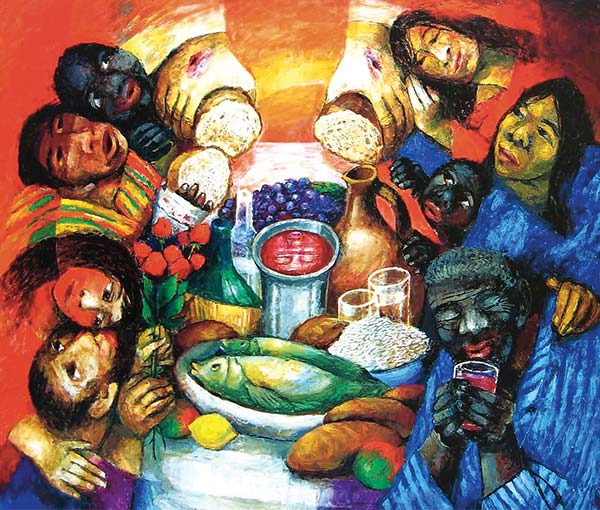
“Table of Hope” by Joey Velasco

While they were eating, Jesus took a loaf of bread, and after blessing it he broke it, gave it to the disciples, and said, “Take, eat; this is my body.” Then he took a cup, and after giving thanks he gave it to them, saying, “Drink from it, all of you; for this is my blood of the covenant, which is poured out for many for the forgiveness of sins. (Matthew 26:26-28, NRSV)

For the Christian, eating and ingesting bread and wine serves as a tangible way of understanding what life is to be like. We take Jesus into the depths of our lives. We ingest him, that is, we engage in an intimate relationship whereby the two of us can never be separated.

We are meant for life together, to enjoy eating and drinking together. True life is sharing both our resources and our hearts with one another. 

Loving God, thank you for your generosity. I am a stranger in this world, yet you invite me to be your guest. You lavishly offer me your hospitality and welcome me into your family. You invite me to share in the abundance of your kingdom. Help me remember that when I offer hospitality to others, I am receiving Christ into my home.

Gracious God, I open my heart to those who are wounded; those who have wounded me; those who are outcasts; and to all who are searching. I want my everyday ordinary life to please you. I am grateful that there is always room at your Table; through Jesus, my Lord. Amen.

Matthew 25:31-46 – Meeting Jesus

On a bright Sunday morning, Lefty and his wife Goatrude were sitting at home enjoying a leisurely cup of coffee together. Lefty was slowly going through some of his emails.

And then, it happened.

“Oh, my goodness, look at this!” said Lefty to Goatrude. “I got an e-mail from Jesus! It says he will be here at 10am on Sunday. Egad! That’s any minute now!”

“The house is a mess! Hurry! Let’s get this all picked up.” said Goatrude. “And, for God’s sake, where is that big Bible? It needs to be here on the coffee table when Jesus gets here!”

“I think I know where that Bible is….” said Lefty. After rummaging around a junk closet, Lefty found the Bible dusted it off, and placed it prominently on the coffee table as the centerpiece of the living room.

As Goatrude and Lefty were hurriedly trying to make everything just right for Jesus, there was a knock at the door.

“That must be Jesus!” said Goatrude. “Answer it, Lefty. And, for goodness sake, stand up straight and be polite. We want Jesus to see us at our best.”

Lefty answered the door, surprised to see a ragged looking young man on the step.

“I’m sorry to bother you on a Sunday morning, but I haven’t had anything to eat all weekend. Might you have some food to spare?”

Perturbed with this interruption, Lefty answered the young man harshly. “No, I don’t. You need to go, right away. I have an important guest coming, and he’ll be here anytime now.” And he slammed the door shut.

Lefty had barely began getting back to tidying the living room when another knock came at the door.

“He’s here!” said Goatrude, moving quickly toward the door. But when she opened it, there stood a harried looking woman.

“Hello. My car broke down and I can’t get it started. And my cell phone died. Might I come in for just a few minutes so that I can get a bit warmed up and make a phone call?” said the woman.

Goatrude rudely responded, “We all have problems lady. I’ve got my own right now. You try and get ready for a visit from Jesus at the last minute. Try someone else.” And with that, Goatrude shut the door.

Lefty and Goatrude continued their hasty preparations for a visit from Jesus, when yet a third knock came at their door. This time, they answered it together, believing this to be Jesus for sure.

But when they opened the door, a frantic husband immediately said, “My wife just fell on the sidewalk. Please help me!”

“For God’s sake, man, we’re about to have Jesus here! We can’t be seen with a woman lying in front of our house! Get her up and go next door. And make it quick!”

Together, Goatrude and Lefty shut the door. Then, they sat down and anticipated Jesus to show.

Minutes pass… It’s now 10:15 and no Jesus. So, Goatrude, looking at Lefty, says, “I never figured Jesus to be somebody who is late. Maybe he got held up.”

“Hey, how about if I open this Bible and read something. When Jesus gets here, we’ll impress him with some knowledge. We’ll be the talk of the town, hosting Jesus.”

So, Lefty opened the big book, randomly turned to a page, and began reading….

“When the Son of Man comes in his glory, and all the angels with him, he will sit on his glorious throne. All the nations will be gathered before him, and he will separate the people one from another as a shepherd separates the sheep from the goats. He will put the sheep on his right and the goats on his left.

“Then the King will say to those on his right, ‘Come, you who are blessed by my Father; take your inheritance, the kingdom prepared for you since the creation of the world. For I was hungry, and you gave me something to eat, I was thirsty, and you gave me something to drink, I was a stranger and you invited me in, I needed clothes and you clothed me, I was sick, and you looked after me, I was in prison, and you came to visit me.’

“Then the righteous will answer him, ‘Lord, when did we see you hungry and feed you, or thirsty and give you something to drink? When did we see you a stranger and invite you in, or needing clothes and clothe you? When did we see you sick or in prison and go to visit you?’

“The King will reply, ‘Truly I tell you, whatever you did for one of the least of these brothers and sisters of mine, you did for me.’

“Then he will say to those on his left, ‘Depart from me, you who are cursed, into the eternal fire prepared for the devil and his angels. For I was hungry, and you gave me nothing to eat, I was thirsty, and you gave me nothing to drink, I was a stranger, and you did not invite me in, I needed clothes and you did not clothe me, I was sick and in prison and you did not look after me.’

“They also will answer, ‘Lord, when did we see you hungry or thirsty or a stranger or needing clothes or sick or in prison, and did not help you?’

“He will reply, ‘Truly I tell you, whatever you did not do for one of the least of these, you did not do for me.’

“Then they will go away to eternal punishment, but the righteous to eternal life.” (New International Version)