The Time Is Ripe (Galatians 4:1-7)

What I am saying is that as long as an heir is underage, he is no different from a slave, although he owns the whole estate. The heir is subject to guardians and trustees until the time set by his father. So also, when we were underage, we were in slavery under the elemental spiritual forces of the world. 

But when the set time had fully come, God sent his Son, born of a woman, born under the law, to redeem those under the law, that we might receive adoption to sonship. Because you are his sons, God sent the Spirit of his Son into our hearts, the Spirit who calls out, “Abba, Father.” So you are no longer a slave, but God’s child; and since you are his child, God has made you also an heir. (New International Version)

The three greatest persons in biblical history – Abraham, Moses, and Jesus – are connected. God entered into a covenant with Abraham and promised to bless everyone on the earth through his progeny. God gave Moses the Law as a sort of school teacher and guide, alongside Abraham’s covenant. God fulfilled the covenant promise in Jesus. Thus, everyone who is led and tutored toward Christ, inherits all of God’s promises.

Under the Law

The Apostle Paul, speaking to a group of new believers who were confused about the relation between the Law and Christ, helped them understand with a metaphor. It’s like a boy who is the heir to a great estate. Someday, it will all be his. But now, he’s too young to possess it. So, during his childhood, he’s subject to trustees who oversee the estate, and teachers who instruct him in how to actually use the wealth once he actually inherits it.

While the boy is in the middle of the guidance, he’s not in control of much, just like the servants on the estate. The child will remain in this state until his time comes, until the date in which his father says he can take possession of the inheritance.

Before Christ, people were under the Law. They were heirs to God’s great kingdom promises. Yet, they needed the Law to guide and instruct them until it was time for them to receive the inheritance. Much like a present day kid in school, they see themselves in a sort of bondage, even though it’s a necessary part of their lives.

It’s bondage in the sense that the Law, the schoolmaster, has no power or ability to give the inheritance nor to save them from their current condition. In other words, the Law is good, yet lacks the potency to actually deliver one from sin, death, and hell.

What’s more, the elemental spirits of the age, namely Satan and his wicked spirits, wormed their way into the process of guidance and twisted the Law for their own advantage, to keep people in bondage. Just as the guardian of the boy may mistreat him in ways his father never intended, so the devil has exploited the Law in order to have it be a tyrannical presence over people.

Whereas God intended the Law to reveal humanity’s sin and drive them to a Savior, evil uses the Law to shame people and drive them to despair. The Law was meant for good, to be a gracious leading of people to the Messiah; yet Satan co-opted the Law to bring condemnation to folks and keep them under his insidious thumb.

In Christ

But when the time was ripe, God sent the Son so that people would be done with their guardians and inherit divine promises. To use yet another metaphor, when the scaffolding on a building has served it’s intended purpose in construction, it’s taken down; it’s no longer needed. It would be weird if the shiny new building were erected, and the owner decided to keep the scaffolding beside the structure.

The Law of Moses had done its work of preparing people for Christ. So, God sent Jesus, the Son, to redeem humanity, to transform slaves into sons and daughters. The Lord adopted us and granted us full rights as children of the King.

Christ redeemed us from the curse of the Law by becoming a curse for us—because it is written, Everyone who is hung on a tree is cursed.

Galatians 3:13, CEB

Jesus is uniquely qualified to be such a Redeemer of humanity. He is God’s Son, born of a human mother. Therefore, as both divine and human – the God Man – Jesus is the person for whom all the covenant promises of God have their fulfillment.

In the past God spoke to our ancestors many times and in many ways through the prophets, but in these last days he has spoken to us through his Son. He is the one through whom God created the universe, the one whom God has chosen to possess all things at the end. He reflects the brightness of God’s glory and is the exact likeness of God’s own being, sustaining the universe with his powerful word. After achieving forgiveness for the sins of all human beings, he sat down in heaven at the right side of God, the Supreme Power. (Hebrews 1:1-3, GNT)

In Christian trinitarian theology, God is Three in One, the Holy Trinity. God sent the Son into the world, of which believers celebrate the incarnation of Christ each year at Christmas. God sent the Spirit into our hearts; and from that place we cry “Abba! Father!” The Spirit testifies with our own spirit that we are truly adopted children of God. (Romans 8:15-16)
The Spirit is like the seal on a document, proving that our inheritance papers are all in order. And, much more than that, the Spirit also does this sealing work with affection. Christianity is not merely a legal transaction; it’s an experience of grace and love in which we enter into a new life, free from bondage, and alive to all the possibilities that humanity was originally meant for.

Both our status and our sensibilities are changed. It happens because of God’s good grace and purpose, fulfilled in Christ and impressed on us by the Spirit.

Conclusion

The French philosopher and writer, Blaise Pascal (1623-1662), once said that there is a God-shaped vacuum in the heart of each person which needs to be filled:

“There was once in man a true happiness, of which all that now remains is the empty print and trace. This he tries in vain to fill with everything around him, seeking in things that are not there the help he cannot find in those that are, though none can help, since this infinite abyss can be filled only with an infinite and immutable object; in other words by God himself.” Blaise Pascal, Pensées

If we want to find happiness, satisfaction, and goodwill, then the empty void within us creatures and within the systems and the cultures we create, needs to be filled with our Creator.

The Christian season of Advent is an appropriate time to reconnect with the infinite and the immutable. The time is ripe to be filled not only with love and goodness, but with the very source of Love itself.

May it be so, to the glory of God.

Spiritual Renewal (Isaiah 30:19-26)

People of Zion, who live in Jerusalem, you will weep no more. How gracious he will be when you cry for help! As soon as he hears, he will answer you. Although the Lord gives you the bread of adversity and the water of affliction, your teachers will be hidden no more; with your own eyes you will see them. Whether you turn to the right or to the left, your ears will hear a voice behind you, saying, “This is the way; walk in it.” Then you will desecrate your idols overlaid with silver and your images covered with gold; you will throw them away like a menstrual cloth and say to them, “Away with you!”

He will also send you rain for the seed you sow in the ground, and the food that comes from the land will be rich and plentiful. In that day your cattle will graze in broad meadows. The oxen and donkeys that work the soil will eat fodder and mash, spread out with fork and shovel. In the day of great slaughter, when the towers fall, streams of water will flow on every high mountain and every lofty hill. The moon will shine like the sun, and the sunlight will be seven times brighter, like the light of seven full days, when the Lord binds up the bruises of his people and heals the wounds he inflicted. (New International Version)

Better days are ahead.

In this time of year, there are many people who simply don’t have to think twice about purchasing and giving gifts for Christmas. They have blessings, both material and spiritual. And they can always identify other persons who are in much more need than them. Some of them may even believe that those in need are in that position because of unwise individual choices. 

But we must maintain a focus on our own lives. We need to recognize the maladies of our hearts. The state of our lives is as important, and is just as real and needy, as someone else’s life who is in more humble circumstances. 

There are specific conditions in our lives that leave us in bondage and in need of restoration, renewal, and revitalization, just like all kinds of other people. 

Being a vital part of a local church does not automatically immune one from having serious needs. And having a good steady income doesn’t inoculate one from need or privation.

We must not suppress those realities and needs, but instead, name the conditions which are packed away in a closet of our heart deep inside us – such things as the love of possessions and money; broken relationships; old grudges; hidden addictions; domestic violence; denial of depression; secret affairs; cutting; fear; anger; greed; hatred; and much more. 

Outward smiles and small talk conversations may hide the truth from others, but they do nothing to hide from a God for whom everything is laid bare.

The good news is not just something for someone else who has “obvious” needs; the gospel must touch our lives and bring us freedom.

Only then can we pass on the good news to the legion of social ills that make our world sick. There are people all around us who need spiritual, emotional, and material help. Yet, we will not have eyes to see them, or have hearts to help, if we are stuffing our own burdens so deep within that we are blind to others.

Far too many Christians, especially the church-going kind, have become expert emotional stuffers and deniers of need. 

We may believe “those other people” need ministries of justice and help. But the truth is: Many of us are one paycheck, one prodigal kid, one mental health diagnosis, one serious illness, one drink, one affair, or one bad decision away from being one of “those people” – the people we typically identify as in need – the ones that bad things happen to – the ones we do not want next door to us.

We may not yet be vulnerable enough to admit our situation; and so, we keep practicing the denial of our spiritual poverty. 

What to do? Turn from the things that have caused us to be in poverty and be prisoners (not just secretly!) and hope in the Lord’s restorative grace. God takes all sorts of seemingly impossible situations of destruction and death, creating fresh new growth in the form of a little green sprout. 

God will rebuild our ruined souls; restore the places of our lives that have been devastated; and renew the places that have not seen renewal for generations. 

It begins with you and me allowing the justice of God to work within us, not just others. 

If we want comfort, we need to mourn. If we desire joy, then there needs to be some lamenting of a dire situation. If we hope for an oak of righteousness, there must be a confession of despair. For there to be a resurrection, there has to be a death.

What is your real situation and the true realities of your life that need to be named? 

Where will you go to address those needs and truths? 

Will you keep stuffing them, or will you become able to voice your inner personal needs? 

How might you be vulnerable enough to allow others to minister grace to your needy soul?

Let us have a vision of Jesus coming into our lives and replacing a tattered hat of grief with a crown of beauty. 

Let us picture the Lord placing on us a garment of praise to replace our stinky clothes of grumbling. 

Let us allow our lives to display the grace of God in Christ because we have been profoundly touched by the justice of God. 

Let us herald the coming of the Christ child as the hope of us all.

Soli Deo Gloria

The Tension of Advent (Hebrews 11:32-40)

What else can I say? There isn’t enough time to tell about Gideon, Barak, Samson, Jephthah, David, Samuel, and the prophets. Their faith helped them conquer kingdoms, and because they did right, God made promises to them. They closed the jaws of lions and put out raging fires and escaped from the swords of their enemies. Although they were weak, they were given the strength and power to chase foreign armies away.

Some women received their loved ones back from death. Many of these people were tortured, but they refused to be released. They were sure they would get a better reward when the dead are raised to life. Others were made fun of and beaten with whips, and some were chained in jail. Still others were stoned to death or sawed in two or killed with swords. Some had nothing but sheep skins or goat skins to wear. They were poor, mistreated, and tortured. The world did not deserve these good people, who had to wander in deserts and on mountains and had to live in caves and holes in the ground.

All of them pleased God because of their faith! But still they died without being given what had been promised. This was because God had something better in store for us. And he did not want them to reach the goal of their faith without us. (Contemporary English Version)

God has entered history through the incarnation of Jesus Christ. In this season of Advent, Christians everywhere enter a time of anticipation, waiting, and hoping. Advent is meant to stir our awareness of God’s actions – past, present, and future.

During this time of year, we need to feel the tension between what is and what is yet to come. Christ has come, in his first advent, to seek and save the lost. And yet, not all things have reached completion. Our deliverance from sin, death, and hell has been accomplished through the cross of Christ; yet this salvation isn’t here in it’s fullness. That will come when Jesus returns in his second advent to judge the living and the dead.

Which is why today’s New Testament lesson is perfect for the Advent season. It captures this awkward tension between already having something but not yet possessing it. It’s the tension of the Christian life. Celebration and hope are practiced together because we rejoice in what is, while confidently expecting what is not yet.

Throughout every era, people of faith have lived with the rubber band existence of feeling the extreme stretch without being broken by the pressure. Our spiritual ancestors didn’t break because of their hope. And the persons mentioned by the author of Hebrews inspire us to join them on this journey of perseverance until the promises of God are fully realized.

Gideon, Barak, Samson, and Jephthah all defeated large armies with just a few people because their robust faith melted circumstantial fear.

David, Samuel, and the prophets proclaimed truth, justice, and righteousness, knowing there would be adverse circumstances to speaking up and out.

People overcome dark times, establish what is just and right, gain what is promised, and do incredible things because they are looking beyond the present here-and-now of their difficulty to see something better. They know that their actions now will connect to better times ahead.

That’s what Shadrach, Meshach, and Abednego did in the face of overwhelming heat in a fiery furnace. It’s what Moses, Elijah, and David did by escaping the edge of the sword. They all refused to be thwarted in their mission and purpose for the world.

There were those who willingly endured torture and death rather than get sidetracked from their purpose. They were able to do it because they truly believed that their suffering and death was not the end of it. Better days were ahead and not even death could stop it.

This tends to make our own proclivities toward giving up when things are hard look really wimpy. Far too many folks have their focus in the wrong place – trying to change circumstances and other people – instead of focusing on simply being faithful to what God calls us to do.

We likely won’t have to undergo joint dislocations, torture racks, crushed bones, catapults, thumbscrews, branding irons, and a hundred other devious devices for trying to make a human’s spirit break.

Yet, we are presently enduring the subtly evil machinations of gaslighting, emotional manipulation, mental torture, spiritual abuse, and a hundred other sinister ways of attempting to break our will and commitment to what is right, just, and true.

The present awful consequences mean little whenever we’re able to connect what we’re doing to our coming heavenly reward. If the faithful people of the past could live and die in faith, no matter the circumstances, so can we.

Someday, everything will be made right by God. And when that day happens, we will experience it together as one people of God – all the believers of the past and us together. Right now, this present moment, the saints who have gone before us are patiently waiting for us….

Almighty God, give us grace to cast away the works of darkness, and put on the armor of light, now in the time of this mortal life in which your Son Jesus Christ came to visit us in great humility; that in the last day, when he shall come again in his glorious majesty to judge both the living and the dead, we may all rise together to eternal life, through him who lives and reigns with you and the Holy Spirit, one God, now and forever. Amen.

The Time Is Near (Revelation 22:8-21)

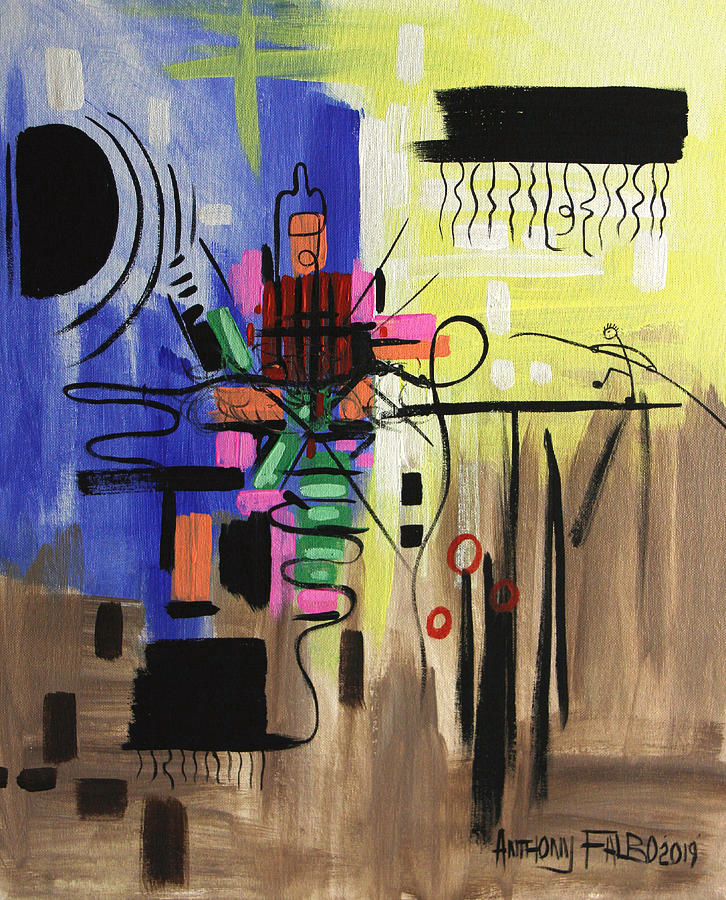
“The Time Is Near, Revelation 22:10-12” by Anthony Falbo, 2019

I, John, am the one who heard and saw these things. And when I had heard and seen them, I fell down to worship at the feet of the angel who had been showing them to me. But he said to me, “Don’t do that! I am a fellow servant with you and with your fellow prophets and with all who keep the words of this scroll. Worship God!”

Then he told me, “Do not seal up the words of the prophecy of this scroll, because the time is near. Let the one who does wrong continue to do wrong; let the vile person continue to be vile; let the one who does right continue to do right; and let the holy person continue to be holy.”

“Look, I am coming soon! My reward is with me, and I will give to each person according to what they have done. I am the Alpha and the Omega, the First and the Last, the Beginning and the End.

“Blessed are those who wash their robes, that they may have the right to the tree of life and may go through the gates into the city. Outside are the dogs, those who practice magic arts, the sexually immoral, the murderers, the idolaters and everyone who loves and practices falsehood.

“I, Jesus, have sent my angel to give you this testimony for the churches. I am the Root and the Offspring of David, and the bright Morning Star.”

The Spirit and the bride say, “Come!” And let the one who hears say, “Come!” Let the one who is thirsty come; and let the one who wishes, take the free gift of the water of life.

I warn everyone who hears the words of the prophecy of this scroll: If anyone adds anything to them, God will add to that person the plagues described in this scroll. And if anyone takes words away from this scroll of prophecy, God will take away from that person any share in the tree of life and in the Holy City, which are described in this scroll.

He who testifies to these things says, “Yes, I am coming soon.”

Amen. Come, Lord Jesus.

The grace of the Lord Jesus be with God’s people. Amen. (New International Version)

“St. John the Divine” by David Raber, 2013. The top corners are the Greek letters Alpha and Omega, representing the Beginning and the End; the corresponding letters in Hebrew are at the bottom corners. The Apostle John holds a scroll, a symbol of Christ as the Lamb of God who takes away the sins of the world.

The very last chapter of the big thick Bible let’s us know that the time is near for the end of the world as we know it. Jesus himself tells us that he is coming soon. That might sound weird, considering we are reading Christ’s words two millennia later. There’s nothing soon about 2,000 years in the past. So, how can the time of Christ’s return be “soon?”

Time is viewed differently by God than by us, especially in this modern and/or postmodern era. Whereas we orient ourselves around chronological time by measuring minutes and hours, the Lord is much more event oriented.

Throughout Holy Scripture we have major events of creation, fall, and redemption. Now, there is only one event left on God’s celestial timetable: Christ coming to judge the living and the dead, and the full establishment of a world without any sin or Satan. In that sense, the time is near and very soon.

“Time” itself is really a human yardstick. It’s merely the relationship between events – and we humans like our measurements and metrics. Yet, the Lord is above time. God simultaneously sees the past, present, and future. And when all things are eventually made right, there will be no need for time anymore because all events have run their course.

But how does any of that stuff about time help me in the here-and-now?

We still have time. As long as it is still Today, everyone has the opportunity to change, to do better, to “come” to the eternal wellspring of living water.

None of our lives can ever be reduced to a single event or action. The screw-up or outright sin that we did back there in our lives doesn’t define us. If it did, all of us would be soundly condemned. Instead, it is the habitual offenders, the ones who repeatedly and intentionally do wrong and/or chronically ignore their fellow humanity (and God); it is they who shall be on the outside of a restored Paradise.

So, it’s not too late. The call is out. Jesus himself invites everyone who hears to come.

And since the call is out there, ringing in history for the past two-thousand years, a warning is there for those who either subtract or add to the simple invitation.

Yet no matter the past guilt nor the present moment, grace is the final word. It is, quite literally, the final verse of the Bible.

In a book filled with a vision of end time judgment, it is divine graciousness which has the ultimate and final say. Even with a world under a curse, and with the earth facing judgment, divine blessings abound. The word “blessing” in Scripture simply means to have God’s stamp of approval. Within John’s Apocalypse, we have several instances of blessing:

God blesses (approves) the one who reads the words of this prophecy to the church, and he blesses all who listen to its message and obey what it says, for the time is near. (Revelation 1:3, NLT)

Then I heard a voice from heaven say, “Put this in writing. From now on, the Lord will bless everyone who has faith in him when they die.” The Spirit answered, “Yes, they will rest from their hard work, and they will be rewarded for what they have done.” (Revelation 14:13, CEV)

“Keep watch! I come unannounced, like a thief. You’re blessed if, awake and dressed, you’re ready for me. Too bad if you’re found running through the streets, naked and ashamed.” (Revelation 16:15, MSG)

Then the angel said to me, “Write the following: Blessed are those who are invited to the banquet at the wedding celebration of the Lamb!” He also said to me, “These are the true words of God.” (Revelation 19:9, NET)

Blessed and holy are those who share in the first resurrection. Over these the second death has no power, but they will be priests of God and of Christ, and they will reign with him a thousand years. (Revelation 20:6, NRSV)

“Listen, I am coming soon! Great blessings belong to the one who obeys the words of prophecy in this book.”

Jesus (Revelation 22:7, ERV)

God’s grace allows us to have solidarity with one another as believers throughout the world, no matter the culture, no matter the church or particular Christian tradition.

Grace strengthens us to persevere and labor in hope, no matter the naysayers around us.

Grace gives us courage to face both our present troubles and future uncertainties, no matter the anxiety which fills the earth.

The presence of God is grace. Christ is alive and will come very soon. Be ready, my friends. The time is near.

May you walk in a manner worthy of our spiritual calling and draw near to Christ so you can triumph over the sufferings of this present time.

May you taste and see the goodness of the Lord and be assured of God’s great love for you.

And may the blessing of almighty God – Father, Son, and Spirit – abide with you always. Amen.