Luke 4:38-44 – Every One of Them

“Healing” by Ivan Filichev, 2014

After leaving the synagogue he entered Simon’s house. Now Simon’s mother-in-law was suffering from a high fever, and they asked him about her. Then he stood over her and rebuked the fever, and it left her. Immediately she got up and began to serve them.

As the sun was setting, all those who had any who were sick with various kinds of diseases brought them to him; and he laid his hands on each of them and cured them. Demons also came out of many, shouting, “You are the Son of God!” But he rebuked them and would not allow them to speak, because they knew that he was the Messiah.

At daybreak he departed and went into a deserted place. And the crowds were looking for him; and when they reached him, they wanted to prevent him from leaving them. But he said to them, “I must proclaim the good news of the kingdom of God to the other cities also; for I was sent for this purpose.” So, he continued proclaiming the message in the synagogues of Judea. (New Revised Standard Version)

One of the most fundamental truths about the person of Jesus is that he heals all kinds of people. 

Even people who know very little about the historical Jesus know that he was a guy who brought healing to people while he was here on this earth.  For many Christians, the fact that Christ healed people is almost a “ho-hum” moment because we are so familiar with the Gospel stories about him doing the supernatural. 

Observation: Christ Healed Every One of Them

Yet, as with most Scripture stories we encounter, we really need to slow down a bit and let the story sink in. Then, we are likely to make simple but profound observations of the text. One of those observations is this: When people brought the sick and infirmed to Jesus, he healed every one of them. Christ laid his hands on each and every one of them and cured them.

Every one of them, Jesus healed. There is apparently no disease, no infirmity, no sickness, no malady, and no situation too much for Jesus to heal. Without exception, no matter the problem, every individual who came to Jesus was healed by Jesus. 

Observation: Every One of Them Were Healed Through Others

Here’s another simple but profound observation of the story: All those who had any who were sick brought them to Jesus. In other words, those needy folks didn’t come to Jesus on their own. It was their family, friends, and neighbors of the sick persons who brought them to Jesus for healing.

It is good to care for the sick. It is also good to encourage them to look to Jesus for their help and healing. Yet, it is also very good when we bring them to Jesus ourselves. 

Perhaps one of the main reasons we are not seeing more healing and new life in the Western church is because we are not bringing the needy to Jesus. Maybe it is our lack of faith and action, and not the sick person’s, that prevents healing from being realized. 

Methinks that a profound dearth and lack of prayer for others might be at the core of all the physical, mental, and spiritual sickness that abounds in this world. So, let us bring people to Jesus so that he will heal and cure every one of them.
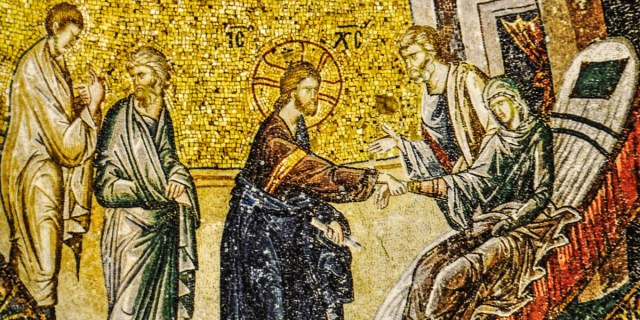
A mosaic of Jesus healing Peter’s mother-in-law, from a Byzantine Church, c.1100 C.E.

Observation: Christ Cares about Every One of Them

Jesus accepts, heals, and cures those at the margins of society. The sick, infirmed, and demon-possessed were the most marginalized people in the ancient world. They were at the mercy of a caring relative, that is, if they had one. If not, the only way of making it was to beg and rely on public charity. Yet, that was difficult because, in many cases, depending upon the illness, they were considered impure. No one would get near them. They couldn’t participate in the community.

But Jesus welcomed them. He took the time and attention to place his hands on each one of them. Their divine healing was much more than physical; being cured meant they no longer needed to be at the margins, unaccepted and unwanted. Jesus was giving them full inclusion to society.

The good news of Jesus Christ consists of meeting the holistic needs of people for health and community. Our Lord desires to integrate excluded people into society. If that takes the miraculous healing of sickness to do it, then Jesus will make it happen.

Observation: Christ Looks to Heal and Care for Every One of Them, Besides Just Us

It can be a real temptation to believe that our little group has the corner on Jesus. We don’t. Jesus was given for the life of the world – not just a few people who look, think, and act like you and me. In today’s story, the people didn’t want Jesus to go. That’s understandable. Yet, Christ left them because there were others in need of healing of both body and soul.

Christ’s mission is so much broader than we sometimes see or expect. Evangelical Christians camp on saving the soul. Progressive Christians hang their hat on social justice and the real physical needs of people. In reality, the gospel involves both body and soul. To only focus on one aspect is to truncate the gospel as only okay news, not good news.

I would argue there is far too much proclaiming of okay news today. Christianity needs a full-orbed gospel that addresses the holistic needs of people, just like Jesus did. It needs a robust Trinitarian theology with the love of God the Father, the grace of Jesus Christ, and the empowerment of the Holy Spirit delivering souls from spiritual death and saving bodies from worldly injustice.

Anything less is simply picking and choosing what we want and trying to keep Jesus to ourselves. Let’s not do that. Instead, let’s preach the gospel, a kingdom message in which the power of God comes upon people – transforming them from the inside-out and bringing them from the outside-in.

Healing God, we bring to you all those who are discouraged, depressed, diseased, disordered, and damaged in some way by the sin of this world. Cure them by your mighty power so that they will be included into our communities, as well as your heavenly kingdom. Amen.

Luke 11:14-23 – If You’re Not For Him, You’re Against Him

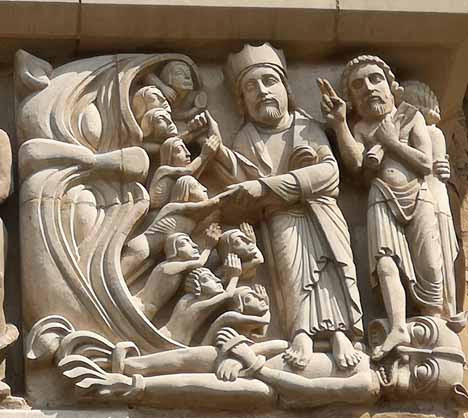
The Plundering of Hell by Jesus, Lincoln Cathedral, England

Jesus was driving out a demon that could not talk; and when the demon went out, the man began to talk. The crowds were amazed, but some of the people said, “It is Beelzebul, the chief of the demons, who gives him the power to drive them out.”

Others wanted to trap Jesus, so they asked him to perform a miracle to show that God approved of him. But Jesus knew what they were thinking, so he said to them, “Any country that divides itself into groups which fight each other will not last very long; a family divided against itself falls apart. So, if Satan’s kingdom has groups fighting each other, how can it last? You say that I drive out demons because Beelzebul gives me the power to do so. If this is how I drive them out, how do your followers drive them out? Your own followers prove that you are wrong! No, it is rather by means of God’s power that I drive out demons, and this proves that the Kingdom of God has already come to you.

“When a strong man, with all his weapons ready, guards his own house, all his belongings are safe. But when a stronger man attacks him and defeats him, he carries away all the weapons the owner was depending on and divides up what he stole.

“Anyone who is not for me is really against me; anyone who does not help me gather is really scattering. (Good News Translation)

Watching the Green Bay Packers on television does not make one a professional football player. Voting in an election doesn’t make somebody a politician. Paddling around on a lake does not make anyone a duck. And just as sitting in a garage doesn’t make someone a car, so sitting in a church worship service does not make someone a Christian. 

Responding to criticism about casting out demons, Jesus summarized his actions and the actions of others by saying that whoever is not with Jesus is against him, and whoever does not gather with Jesus, scatters.

Jesus was all about the kingdom of God breaking-in to this mixed-up fallen world and giving it a thorough transformation. So, that meant Jesus was going to push back hard on the kingdom of darkness. 

Participating with Jesus in his kingdom enterprise is a watershed test of whether someone is genuinely following God, or not. There are a million armchair quarterbacks who will freely give their advice and opinion about how things should have gone and what those playing on the field ought to be doing. Jesus was, and still is, calling people out to get off their butts and follow him. To merely watch him is to be against him, not for him.

Faith is not a checklist of beliefs to affirm and mark off. Rather, believing in Jesus is a dynamic participation with him in his great kingdom influence for the world. Christ calls us to leave the critical spirit, haughty attitude, and selfish expectations in the bleachers. We are to get on the playing field. To simply have our hands in our pockets is to actually work against Jesus. 

Are you willing to gather with Jesus? How does God want to you to serve? Are you only a fan of Jesus? Do you play armchair preacher on Monday morning? 

God is presently working to bring all things under the authority of Jesus Christ, the rightful ruler of the universe. Unlike so many present kingdoms of darkness on this planet, Christ’s reign is a kingdom of light, bringing benevolent grace to all.

Christ is the visible image of the invisible God.
    He existed before anything was created and is supreme over all creation,
for through him God created everything
    in the heavenly realms and on earth.
He made the things we can see
    and the things we can’t see—
such as thrones, kingdoms, rulers, and authorities in the unseen world.
    Everything was created through him and for him.
He existed before anything else,
    and he holds all creation together.
Christ is also the head of the church,
    which is his body.
He is the beginning,
    supreme over all who rise from the dead.
    So he is first in everything.
For God in all his fullness
    was pleased to live in Christ,
and through him God reconciled
    everything to himself.
He made peace with everything in heaven and on earth
    by means of Christ’s blood on the cross. (Colossians 1:15-20, NLT)

The kingdom of God has come upon us. Let us follow Jesus and participate in the renewal of the world so that truth, kindness, grace, mercy, goodness, and peace will shine.

Mighty God, Jesus is the strong man who has bound Satan and is ushering in a new kingdom. Let me be a part of what you are doing in this world so that my faith is confirmed, strengthened, and used for your gracious and benevolent purposes, through the power of your Holy Spirit. Amen.

1 John 5:13-21 – We Know

I write these things to you who believe in the name of the Son of God so that you may know that you have eternal life. This is the confidence we have in approaching God: that if we ask anything according to his will, he hears us. And if we know that he hears us—whatever we ask—we know that we have what we asked of him.

If you see any brother or sister commit a sin that does not lead to death, you should pray, and God will give them life. I refer to those whose sin does not lead to death. There is a sin that leads to death. I am not saying that you should pray about that. All wrongdoing is sin, and there is sin that does not lead to death.

We know that anyone born of God does not continue to sin; the One who was born of God keeps them safe, and the evil one cannot harm them. We know that we are children of God, and that the whole world is under the control of the evil one. We know also that the Son of God has come and has given us understanding, so that we may know him who is true. And we are in him who is true by being in his Son Jesus Christ. He is the true God and eternal life.

Dear children, keep yourselves from idols. (New International Version)

In a world of constant change, the need for people to experience meaning and stability in their lives is more pronounced than ever. 

COVID-19 currently grips the world in a terrible reality of disease, death, and disruption. Just when we think there might be a light at the end of the tunnel, new strains of the virus arise. Meanwhile, life goes on with all it’s typical changes, losses, and devastating natural disasters.

There are people wondering if they will have a job tomorrow – or if they will ever get called back to one. Many parents are anxious about what kind of world their kids will have when they become adults. Others feel adrift in a fast-paced society, glutted with so much news and information that they have little sense of what is real or true. Discouragement and/or depression may seem to never end.

Whenever there are uncertainties all around us, it’s necessary to return to the knowable, to hang our hat on some solid bedrock certainties we are convinced are always there. That’s why the Apostle John wrote his letter, to remind the church of the known and the knowable:

  • “I write these things to you who believe in the name of the Son of God so that you may know that you have eternal life.”
  • “If we know that he hears us—whatever we ask—we know that we have what we asked of him.
  • “We know that anyone born of God does not continue to sin.”
  • “We know that we are children of God.”
  • “We know also that the Son of God has come and has given us understanding, so that we may know him who is true.” 

In English, we have only one word for “know.” Yet, in the ancient Greek of the New Testament there are two different words for “know.” Throughout today’s lesson, the Apostle consistently uses one of those words, then shifts to another at the end. 

All of the “knows” John used refer to an objective knowledge – an information-based understanding which anyone could discover, learn, or know. Then, the Apostle switched to a different word at the end – to know him (Christ) who is true. That particular word has to do with a subjective or experiential knowledge. In other words, it is an inner witness and knowing of objective knowledge.

In American society, we frame the distinction between the two words by saying we need to know something in our heart (subjective knowledge) and not only in our head (objective knowledge).

Cerebral understanding, combined with heartfelt experience, results in a new confidence in prayer, a new attitude toward the world, and a new awareness of God. These are the impact of knowing Jesus Christ, and him crucified, risen, ascended, and coming again.

Knowing God takes both the head and the heart. Only being concerned for sound doctrine creates theological eggheads who dispassionately connect with God and others as if they were merely brains on a stick figure. Conversely, only being concerned for how religion makes us feel causes a kind of spiritual schizophrenia which is unstable and constantly seeks for a new or better experience in worship.

Love and obedience are the sacred pathways to personal and corporate knowledge and peace. Whenever the supreme ethic of love takes place in the believer’s life, through receiving it from God and giving it to others, it brings a sense of divine assurance in a sea of worldly uncertainty. 

Security in God will always outdo the insecurities of life.

Loving God, I know that you listen to me. I pray your love and assurance will fill me to such a place that I have peace amidst the vicissitudes of this life. May I rest in Jesus Christ through the work of your Holy Spirit. Amen.

Ephesians 5:15-20 – Speak to One Another with Psalms, Hymns, and Spiritual Songs

Be very careful, then, how you live—not as unwise but as wise, making the most of every opportunity, because the days are evil. Therefore, do not be foolish, but understand what the Lord’s will is. Do not get drunk on wine, which leads to debauchery. Instead, be filled with the Spirit, speaking to one another with psalms, hymns, and songs from the Spirit. Sing and make music from your heart to the Lord, always giving thanks to God the Father for everything, in the name of our Lord Jesus Christ. (New International Version)

As you likely well know, an inebriated person tends to say and do things that they do not typically say or do when they’re sober. The Apostle Paul’s point about being filled with the Spirit is that, instead of doing and saying stupid things, we are so filled with God that we do things and say things that we would not typically do and say if we were not filled with God – that is, good things. 

Apart from being full of God’s Spirit, we tend toward mumbling, not singing; worry, not making music in our hearts; and complaining and arguing, not giving thanks. Half-filled Christians practice a half-hearted Christianity. They’re only half-baked in their service and devotion to Christ.

Why sing? 

Because singing is part of being filled with the Spirit of God. Singing happens when we experience God’s overflowing grace in our lives through the blessings of being chosen, adopted, and redeemed into God’s new community. (Ephesians 1:3-11)

Music is powerful. It’s not only a means of expressing praise and commitment to Christ and each other, it is also a powerful means of being impressed. For example, when we first teach kids the alphabet, we teach it in a song. Trying to teach letters in a rote fashion typically doesn’t work well for pre-school kids. Words set to music is why we still remember words from old TV shows, because those words were set to a catchy tune.  Music is why an Alzheimer’s patient cannot remember her daughter’s name but can flawlessly sing all four verses of Amazing Grace.

Singing is an offering and a sacrifice of praise to God (Hebrews 13:15). And singing is also a vehicle whereby we are taught, encouraged, and built up in the community of believers. We sing to God, one another, and even ourselves.

Church music, then, is to be both a means of praising God and a practice of encouraging each other. We do it through psalms, hymns, and spiritual songs.

Psalms

The word “psalm” helps us rightly think of the biblical book of Psalms. Singing the psalms is an ancient practice, going all the way back to the Israelites singing psalms in the temple and synagogue. The early church maintained this practice, especially as a means of being faithful to praying without ceasing. 

However, over time, medieval congregations began neglecting the practice. In fact, the congregations eventually gave up most singing altogether. Almost all the singing was done by church choirs and professional musicians employed by the state (no separation of church and state) to write, compose, and perform in worship services. 

Five-hundred years ago, with the Reformation, Martin Luther reinstituted congregational singing. He gave music back to the people. One of the results of this change was putting the book of psalms to song – the Psalter.  For many Protestant denominations, the Psalter became the primary means of singing. The Psalter chiefly set prayers to song. It was both a means of expressing prayer to God and learning Scripture.


Hymns

There have always been hymns in the church. Yet, it was not until the Reformation that hymns began to be written and sung by congregations. For the Reformers, hymns were used to teach sound doctrine and theology, as well as a means of confessing the faith together

Spiritual Songs

Spiritual songs are the present day equivalent of praise and worship choruses, or what some refer to as contemporary songs. These are songs purposefully designed to be emotional expressions of praise to God and to give powerful testimony for what God has done or is doing.

So, what?

Quick review:

  • Psalms are used to pray and learn Scripture.
  • Hymns are used to teach us sound doctrine and confess the faith together.  
  • Spiritual songs are an important way of expressing praise to God and being encouraged in the faith. 

Therefore, church music is to serve as both a revelation from God, and as a response from God’s people.

There are two important deductions from this verse:

  1. A variety of songs is inferred and expected.
  2. Paul commanded their use.

The reason worship style is such a hot topic in a lot of churches is because we all have our personal preferences.  And yet, if we are to be faithful to today’s New Testament lesson, we will not just lock in on what I want. 

Truth be told, we are selfish people when it comes to music. We want what we want, and we don’t care what somebody else wants. And we will persist in that self-absorbed spirit until somebody calls us on it. That somebody is the Apostle Paul. The Word of God calls us to encompass psalms, hymns, and spiritual songs – all three of them – in our worship.

I have a good friend who is an accomplished church musician and worship pastor. I once asked him how I can lead a worship service among such a variety of preferences concerning music. He answered my question with a question: “How highly do people, including and especially your musicians, value the unity of the church?  Do they love each other so much that they can allow for a wider range of style, and do so without vocally complaining about it?”

My friend went on to say, “When I arrived at one church as their pastor, some people were in a rather bad habit of saying very openly, ‘Oh I hate that song,’ or, ‘If I hear this song one more time I’m walking out.’ What I tried to do was teach people that this is not the most loving or mature approach and does little to build up the rest of the Body of Christ.”

If a group of people are being faithful to Scripture, and doing their best musically, then – if the music seems lifeless, dull, or strange to us – the real issue isn’t style but our hearts.       

Is that heart filled with the Spirit of God? If it is, then we will speak to one another using the Psalter, using time-honored hymns, and utilizing fresh contemporary praise songs. And the result will be the Body of Christ, the Church, built up in the faith.

Gracious God, give us grace to take to heart the great dangers we are in by our unhappy divisions about music.  Take away all hatred and prejudice, and whatever else may hinder us from godly union and concord; that, as there is but one body and one Spirit, one hope of our calling, one Lord, one faith, one baptism, one God and Father of us all, so we may from this time forward be all of one heart and of one soul, united in one holy bond of peace, and may with one mind and one mouth glorify you, through Jesus Christ our Lord. Amen.