
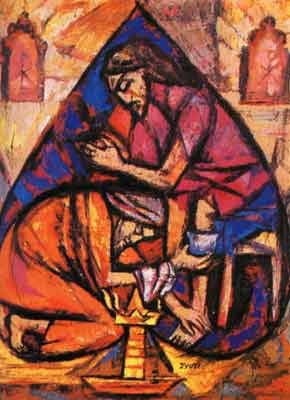
John 13:1-17, 31b-35 – Maundy Thursday

Jesus Washes Peter’s Feet

It was now the day before the Passover Festival. Jesus knew that the hour had come for him to leave this world and go to the Father. He had always loved those in the world who were his own, and he loved them to the very end.

Jesus and his disciples were at supper. The Devil had already put into the heart of Judas, the son of Simon Iscariot, the thought of betraying Jesus. Jesus knew that the Father had given him complete power; he knew that he had come from God and was going to God. 

So, he rose from the table, took off his outer garment, and tied a towel around his waist. Then he poured some water into a washbasin and began to wash the disciples’ feet and dry them with the towel around his waist. 

He came to Simon Peter, who said to him, “Are you going to wash my feet, Lord?”

Jesus answered him, “You do not understand now what I am doing, but you will understand later.”

Peter declared, “Never at any time will you wash my feet!”

“If I do not wash your feet,” Jesus answered, “you will no longer be my disciple.”

Simon Peter answered, “Lord, do not wash only my feet, then! Wash my hands and head, too!”

Jesus said, “Those who have taken a bath are completely clean and do not have to wash themselves, except for their feet. All of you are clean—all except one.” (Jesus already knew who was going to betray him; that is why he said, “All of you, except one, are clean.”)

After Jesus had washed their feet, he put his outer garment back on and returned to his place at the table.

“Do you understand what I have just done to you?” he asked. “You call me Teacher and Lord, and it is right that you do so, because that is what I am. I, your Lord and Teacher, have just washed your feet. You, then, should wash one another’s feet. I have set an example for you, so that you will do just what I have done for you. I am telling you the truth: no slaves are greater than their master, and no messengers are greater than the one who sent them. Now that you know this truth, how happy you will be if you put it into practice!…

Jesus said, “Now the Son of Man’s glory is revealed; now God’s glory is revealed through him. And if God’s glory is revealed through him, then God will reveal the glory of the Son of Man in himself, and he will do so at once. My children, I shall not be with you very much longer. You will look for me; but I tell you now, what I told the Jewish authorities, ‘You cannot go where I am going.’ 

“And now I give you a new commandment: Love one another. As I have loved you, so you must love one another. If you have love for one another, then everyone will know that you are my disciples.” (Good News Translation)

We all need love. 

Without love, relationships devolve into silent standoffs and destructive triangles. The world ceases to spin on its axis. 

But with love, all things are beautiful, personal relations have meaning and joy, and all seems right and just in the world.

This wonderful love, however, comes with a great cost. 

Because we live in a broken world filled with pride and arrogance, greed and avarice, hate and envy, we are victims of loveless, faceless, and unjust systems. 

We need Love to rescue and redeem us from the muck and crud of injustice. 

It’s as if we are constantly walking knee deep through icky sludge so thick that we can barely get anywhere. 

We need saving…. We need Jesus.

Christians everywhere around the world are journeying through Holy Week, the most sacred time of the year for followers of Christ. When we consider Holy Week, many are familiar with Good Friday and certainly Easter, but Maundy Thursday? 

On this day the church remembers the last evening Jesus shared with his disciples in the upper room before his arrest and crucifixion. 

The experiences in the upper room were highly significant because this was the last teaching and modeling that Jesus gave before facing the cross. Jesus was deliberate in communicating exactly what was important to him: Love one another.

Maundy Thursday marks three important events in Christ’s Last Supper with his disciples: 

  • The washing of the disciples’ feet (the action of loving service)
  • The instituting of the Lord’s Supper (the remembrance of loving sacrifice)
  • The giving of a “new” commandment to love one another (the mandate of a loving system). 

For Jesus, the last night with his disciples was all about love, God’s love. On that fateful night, having loved his disciples for the past three years, Jesus showed them the full extent of his love by taking the posture of a servant and washing each and every one of the disciples’ feet, including Judas. 

After demonstrating for them a totally humble service, Jesus said, “I have set you an example that you should do as I have done for you.”

Jesus Christ loves me just as I am, and not as I should be. 

Christ loves me even with my dirty stinky feet, my inconsistent half-hearted commitment to him, and my pre-meditated sin. 

Not only did Jesus wash the disciples’ feet; he also lifted the cup of wine and boldly asserted: 

“Take this and divide it among you.  For I tell you I will not drink again of the fruit of the vine until the kingdom of God comes.”  And he took the bread, gave thanks and broke it, and gave it to them, saying, “This is my body given for you, do this in remembrance of me.”  In the same way, after the supper he took the cup saying, “This cup is the new covenant in my blood, which is poured out for you.” (Luke 22:17-20, NIV)

Because of these words from Jesus, the church throughout the world, for the past two millennia, have practiced this communion so that we might have the redemptive events of Jesus pressed firmly into both our minds and our hearts by means of the visceral and common elements of bread and wine. 

We are to not just know about Jesus – we are to experience being united with him.

Having washed the disciples’ feet and proclaimed to them the meaning of his impending death, Jesus gave them a clear commandment: “A new command I give you: Love one another. As I have loved you, so you must love one another.  By this everyone will know that you are my disciples if you love one another.”

Love one another, insisted Jesus, through imitation of his humble service. We represent Christ on this earth when we carefully, diligently, and persistently practice love. 

Although love was by no means a new concept for the disciples, in the form and teaching of Jesus love was shown with four distinctions: 

  1. A new model of love: Jesus
  2. A new motive of love, that Christ first loved me
  3. A new motivator to help us love, the Holy Spirit
  4. A new mission, the evangelization of the world, utilizing the power of Christ’s love to accomplish it

Maundy Thursday is a highly significant day on the Church Calendar – one which deserves to be observed. It’s an opportunity to remember the important words and actions of Jesus on our behalf.

In Christ, we allow love to characterize our life together as we proclaim God’s love in both word and deed. A watching world will only take notice and desire to be a part of our fellowship if we are deeply and profoundly centered in the love of God in Christ. This is the reality that Maundy Thursday brings to us.

God of love, you have given us a new command to love each other. Help us to show that love in our care of creation, to all nations and ethnicities, in our communities and neighborhoods, through the Church everywhere, and with the persons closet to us and their needs. In all our thoughts, words, and actions may we be your servants and reflect your love, through our Savior, Jesus Christ, your Son, who lives and reigns with you and the Holy Spirit, one God, now and forever. Amen.

Hebrews 12:1-3 – Wednesday of Holy Week

As for us, we have this large crowd of witnesses around us. So then, let us rid ourselves of everything that gets in the way, and of the sin which holds on to us so tightly, and let us run with determination the race that lies before us. Let us keep our eyes fixed on Jesus, on whom our faith depends, from beginning to end. He did not give up because of the cross! On the contrary, because of the joy that was waiting for him, he thought nothing of the disgrace of dying on the cross, and he is now seated at the right side of God’s throne.

Think of what he went through; how he put up with so much hatred from sinners! So do not let yourselves become discouraged and give up. (Good News Translation)

“If there is a meaning in life at all, then there must be a meaning in suffering. Suffering is an ineradicable part of life, even as fate and death. Without suffering and death, human life cannot be complete.”

Viktor E. Frankl

We are moving, step by step, inexorably to the cross of Christ. Along the way we will face opposition, ridicule, misunderstanding, and betrayal. We will be befuddled and feel confused. The path of discipleship is not easy.

And yet, on this Holy Wednesday, today’s New Testament lesson informs us that all the suffering of Christ was motivated and animated because of joy. 

The road to the cross, along with the cross itself, is painful, in every sense of the word. None of this tortuous suffering seems joyful, at all! There’s no definition, in any dictionary, of joy including severe spiritual anguish, bodily harm, and emotional shame. Joy isn’t remotely mentioned when talking about betrayal from someone close to you.

Jesus did not relish the pain. He was no masochist. Pain with no purpose is nothing but tragic despair. Rather, Jesus clearly understood what the end of his suffering would accomplish: the saving of many lives.

It is most necessary that we do not try to sanitize Christ’s death.

Although many beautiful crosses can be found in stores, the cross of Jesus was anything but lovely to look at. It was bloody. The cross was a harsh implement of torture and execution, meant to expose the condemned to public shame.

Trying to make sense of this great sacrifice on our behalf can be difficult. No earthly illustration or word-picture can begin to adequately capture the idea of vicarious suffering. Perhaps, then, we may understand the necessity of discipline, effort, endurance, and yes, pain, in order to accomplish a goal. We know from agonizing experience that the realization of our most important goals requires a great deal of blood, sweat, and tears. 

In a former life I was a cross country runner (back far enough for Sherman to set the way-back machine). Whenever I was running on a road or a golf course, I would sometimes get that very nasty and sharp pain in my side while running. It is called a side cramp, or side stitch. 

If you have never experienced such a cramp, the pain feels like an intense stabbing, as if someone were taking a knife and twisting it inside you. Runners know there’s only one thing to do when this occurs: Keep running through the pain, and then it will subside in a few minutes. To stop running only exacerbates and prolongs getting over the hurt, not to mention losing a race.

Jesus endured the cross knowing he was going to experience terrible excruciating pain. He also knew that avoiding the shame and agony would only make things worse; it wouldn’t take care of the problem of sin. 

Jesus persevered through the foulness and degradation of the cross for you and me. All of the wretched pain was worth it to him. Christ did not circumvent the cross; he embraced it so that the result would be people’s deliverance from guilt and shame, death and hell. 

The end game of Christ’s redemptive work on the cross was joy over deposing the ruler of this dark world and obliterating the obstacles to people’s faith.

Suffering often does not fit into our equation of the Christian life. However, it needs to. No suffering, no salvation. Since Jesus bled and died for us, it is our privilege to follow him and walk with him along the Via Dolorosa, the way of suffering. 

Holy Week is a time to reflect and remember on such a great sacrifice, and to consider our Christian lives in the face of such great love. On this Wednesday, allow yourself to feel the bittersweet experience of simultaneous pain and joy – the very real bitterness of seeing the Lord crucified, along with the exultation of joy over being washed clean by the blood of the Lamb.

Gracious Lord Jesus, I give you eternal thanks for your mercy toward me through the cross. It is a small thing for me to follow you even it means great suffering on my part. My life is yours. Use it as you will, through the power of the Holy Spirit. Amen.

John 12:1-11 – Monday of Holy Week

Six days before the Passover, Jesus went to Bethany, the home of Lazarus, the man he had raised from death. They prepared a dinner for him there, which Martha helped serve; Lazarus was one of those who were sitting at the table with Jesus. Then Mary took a whole pint of a very expensive perfume made of pure nard, poured it on Jesus’ feet, and wiped them with her hair. The sweet smell of the perfume filled the whole house. One of Jesus’ disciples, Judas Iscariot—the one who was going to betray him—said, “Why wasn’t this perfume sold for three hundred silver coins and the money given to the poor?” He said this, not because he cared about the poor, but because he was a thief. He carried the money bag and would help himself from it.

But Jesus said, “Leave her alone! Let her keep what she has for the day of my burial. You will always have poor people with you, but you will not always have me.”

A large number of people heard that Jesus was in Bethany, so they went there, not only because of Jesus but also to see Lazarus, whom Jesus had raised from death.So, the chief priests made plans to kill Lazarus too, because on his account many Jews were rejecting them and believing in Jesus. (Good News Translation)

Jesus entered Jerusalem, the day before, on Sunday, with the people waving and lying down palm branches, along with shouts of “hosanna!” Although Jesus had been speaking about his death, weeks before his triumphal entry, most folks were clueless as to what was about to happen.

But Mary Magdalene did. She truly listened to the Master. Her spiritual ears and eyes were fully opened to the significance of this week. Mary was completely aware.

A woman with a sordid background, Mary Magdalene had her life thoroughly transformed through meeting Jesus. She became a follower, in every sense of the word. As an attentive disciple, Mary knew her Lord. She observed every little thing about Jesus, hung on every word, knew each voice inflection and every gesture.

Now, near the end of Christ’s earthly life, and only days from being arrested, tried, tortured, and killed, Mary sensed what was happening. She saw the pained affect on her Lord’s face that no one else noticed. She was cognizant of what was happening, while the others seemed clueless.

Mary’s own brokenness cracked open to her the true reality of life, the real meaning of the unfolding days, and the deep gravity of this week.

The surface event itself is a touching and tender moment in history. This woman, whom everyone knew as a damaged person, took a high-end perfume, and broke the entire thing open.

Mary then proceeded to anoint Christ’s feet with it. You can imagine the aroma filling the house with an expensive perfume for all to smell. Giving what she had to Jesus, Mary demonstrated the path of true discipleship.

Mary’s act of faith in anointing Jesus was deeply symbolic:

  • The broken jar of perfume shows us the brokenness of Mary and our need to be broken. (Matthew 5:3-4)
  • Mary used an extraordinary amount of perfume, picturing her overflowing love for Jesus. (John 20:1-18)
  • Mary applied the perfume to Jesus with her hair (hair is a cultural symbol of submission and respect). (1 Corinthians 11:14)
  • The perfume directs us to the death of Jesus. (John 19:38-42)
  • The perfume highlights for us the aroma of Christ to the world. (2 Corinthians 2:15-17)
  • There is more to Judas than his words about perfume; he is not actually concerned for the poor. (Matthew 26:15)
  • Judas and Mary serve as spiritual contrasts: Mary opens herself to the sweet aroma of Christ; Judas just plain stinks.
  • The perfume presents a powerful picture of the upcoming death of Christ, for those with eyes to see; he was broken and poured out for our salvation. (Luke 23:26-27:12)

Christianity was never meant to be a surface religion which merely runs skin deep. The follower of Christ is meant for deep personal transformation, inside and out, so that there is genuine healing, spiritual health, and authentic concern for the poor and needy. 

Keeping up appearances is what the Judas’s of this world do. But the Mary’s among us dramatically point others to Jesus with their tears, humility, vulnerability, openness, and love.

In our contemporary social and cultural landscape of fragmented human ecology, our first step toward wholeness and integrity begins with a posture of giving everything we have – body, soul, and spirit – to the Lord Jesus.

Sometimes it takes a woman to show us the way.

On this Monday of Holy Week, a tangible act may help us to express and deepen our faith. Take a bottle of unopened perfume or cologne, pour it completely out into a used tin can, and set the can in a central place in your home, just for the day* The aroma will likely linger into the next few days, as well. Let the smell be a continual reminder of both the sadness of death and the joy of salvation.

Loving Lord Jesus, my Savior, and my friend, you have gone before us and pioneered deliverance from an empty way of life and into a life of grace and gratitude. May I and all your followers emulate the path of Mary and realize the true freedom which comes from emptying oneself out for you. Amen.

*When you are ready, it is appropriate to dispose of the perfume by pouring it down the drain. Even this can be a ritual in which you visualize discarding your old life in order to take up a new one on Easter Sunday.

Descending Into Greatness

Welcome, friends! Philippians 2:5-11 is an appropriate place for us to be on Palm Sunday. Christians everywhere are reminded that Jesus humbled himself by coming and submitting to death. In so doing, Christ absorbed all the guilt and shame of the world on a cruel cross. As we enter this Christian Holy Week, let us do so embracing the mindset of Jesus as a servant to all. Click the videos below and let us declare that Jesus is Lord to the glory of God.

Pastor Tim Ehrhardt, Philippians 2:5-11

God of our salvation,
help us to enter with joy
into the celebration of those mighty acts by which you have given us fullness of life;
through Jesus Christ our Redeemer. Amen.