John 12:1-11 – Monday of Holy Week

Six days before the Passover, Jesus went to Bethany, the home of Lazarus, the man he had raised from death. They prepared a dinner for him there, which Martha helped serve; Lazarus was one of those who were sitting at the table with Jesus. Then Mary took a whole pint of a very expensive perfume made of pure nard, poured it on Jesus’ feet, and wiped them with her hair. The sweet smell of the perfume filled the whole house. One of Jesus’ disciples, Judas Iscariot—the one who was going to betray him—said, “Why wasn’t this perfume sold for three hundred silver coins and the money given to the poor?” He said this, not because he cared about the poor, but because he was a thief. He carried the money bag and would help himself from it.

But Jesus said, “Leave her alone! Let her keep what she has for the day of my burial. You will always have poor people with you, but you will not always have me.”

A large number of people heard that Jesus was in Bethany, so they went there, not only because of Jesus but also to see Lazarus, whom Jesus had raised from death.So, the chief priests made plans to kill Lazarus too, because on his account many Jews were rejecting them and believing in Jesus. (Good News Translation)

Jesus entered Jerusalem, the day before, on Sunday, with the people waving and lying down palm branches, along with shouts of “hosanna!” Although Jesus had been speaking about his death, weeks before his triumphal entry, most folks were clueless as to what was about to happen.

But Mary Magdalene did. She truly listened to the Master. Her spiritual ears and eyes were fully opened to the significance of this week. Mary was completely aware.

A woman with a sordid background, Mary Magdalene had her life thoroughly transformed through meeting Jesus. She became a follower, in every sense of the word. As an attentive disciple, Mary knew her Lord. She observed every little thing about Jesus, hung on every word, knew each voice inflection and every gesture.

Now, near the end of Christ’s earthly life, and only days from being arrested, tried, tortured, and killed, Mary sensed what was happening. She saw the pained affect on her Lord’s face that no one else noticed. She was cognizant of what was happening, while the others seemed clueless.

Mary’s own brokenness cracked open to her the true reality of life, the real meaning of the unfolding days, and the deep gravity of this week.

The surface event itself is a touching and tender moment in history. This woman, whom everyone knew as a damaged person, took a high-end perfume, and broke the entire thing open.

Mary then proceeded to anoint Christ’s feet with it. You can imagine the aroma filling the house with an expensive perfume for all to smell. Giving what she had to Jesus, Mary demonstrated the path of true discipleship.

Mary’s act of faith in anointing Jesus was deeply symbolic:

  • The broken jar of perfume shows us the brokenness of Mary and our need to be broken. (Matthew 5:3-4)
  • Mary used an extraordinary amount of perfume, picturing her overflowing love for Jesus. (John 20:1-18)
  • Mary applied the perfume to Jesus with her hair (hair is a cultural symbol of submission and respect). (1 Corinthians 11:14)
  • The perfume directs us to the death of Jesus. (John 19:38-42)
  • The perfume highlights for us the aroma of Christ to the world. (2 Corinthians 2:15-17)
  • There is more to Judas than his words about perfume; he is not actually concerned for the poor. (Matthew 26:15)
  • Judas and Mary serve as spiritual contrasts: Mary opens herself to the sweet aroma of Christ; Judas just plain stinks.
  • The perfume presents a powerful picture of the upcoming death of Christ, for those with eyes to see; he was broken and poured out for our salvation. (Luke 23:26-27:12)

Christianity was never meant to be a surface religion which merely runs skin deep. The follower of Christ is meant for deep personal transformation, inside and out, so that there is genuine healing, spiritual health, and authentic concern for the poor and needy. 

Keeping up appearances is what the Judas’s of this world do. But the Mary’s among us dramatically point others to Jesus with their tears, humility, vulnerability, openness, and love.

In our contemporary social and cultural landscape of fragmented human ecology, our first step toward wholeness and integrity begins with a posture of giving everything we have – body, soul, and spirit – to the Lord Jesus.

Sometimes it takes a woman to show us the way.

On this Monday of Holy Week, a tangible act may help us to express and deepen our faith. Take a bottle of unopened perfume or cologne, pour it completely out into a used tin can, and set the can in a central place in your home, just for the day* The aroma will likely linger into the next few days, as well. Let the smell be a continual reminder of both the sadness of death and the joy of salvation.

Loving Lord Jesus, my Savior, and my friend, you have gone before us and pioneered deliverance from an empty way of life and into a life of grace and gratitude. May I and all your followers emulate the path of Mary and realize the true freedom which comes from emptying oneself out for you. Amen.

*When you are ready, it is appropriate to dispose of the perfume by pouring it down the drain. Even this can be a ritual in which you visualize discarding your old life in order to take up a new one on Easter Sunday.

Descending Into Greatness

Welcome, friends! Philippians 2:5-11 is an appropriate place for us to be on Palm Sunday. Christians everywhere are reminded that Jesus humbled himself by coming and submitting to death. In so doing, Christ absorbed all the guilt and shame of the world on a cruel cross. As we enter this Christian Holy Week, let us do so embracing the mindset of Jesus as a servant to all. Click the videos below and let us declare that Jesus is Lord to the glory of God.

Pastor Tim Ehrhardt, Philippians 2:5-11

God of our salvation,
help us to enter with joy
into the celebration of those mighty acts by which you have given us fullness of life;
through Jesus Christ our Redeemer. Amen.

1 John 2:18-28 – Who Is the Real Enemy?

Dear children, this is the last hour; and as you have heard that the antichrist is coming, even now many antichrists have come. This is how we know it is the last hour. They went out from us, but they did not really belong to us. For if they had belonged to us, they would have remained with us; but their going showed that none of them belonged to us.

But you have an anointing from the Holy One, and all of you know the truth.I do not write to you because you do not know the truth, but because you do know it and because no lie comes from the truth. Who is the liar? It is whoever denies that Jesus is the Christ. Such a person is the antichrist—denying the Father and the Son. No one who denies the Son has the Father; whoever acknowledges the Son has the Father also.

As for you, see that what you have heard from the beginning remains in you. If it does, you also will remain in the Son and in the Father. And this is what he promised us—eternal life.

I am writing these things to you about those who are trying to lead you astray. As for you, the anointing you received from him remains in you, and you do not need anyone to teach you. But as his anointing teaches you about all things and as that anointing is real, not counterfeit—just as it has taught you, remain in him. (New International Version)

Identifying the Antichrist is almost a spectator sport amongst some Christians. They seem to enjoy advancing particular persons as the archenemy of Christ and the Church.

Throughout Christian history, bloodthirsty kings and ruthless dictators have typically received the moniker of Antichrist. When the Protestant Reformation came along, five-hundred years ago, the Catholic Church often got labeled as the great enemy of Christianity.

The mudslinging that has gone on between different Christian traditions throughout the centuries can make any contemporary political war look like a powder puff football game.

Although some Christian groups tend to view the antichrist as a single enemy, setting-off a bomb of world-ending trauma, the earliest Church, following the teaching of the Apostle John, understood antichrist not as an individual, but as a class of people who deny Jesus is the Christ. 

It has become much too vogue in some circles of Christianity to identify and label enemies outside their small groups, leading to a xenophobic attitude of distrust and finger-pointing toward all kinds of people.


The fingers, however, must first be directed within our own house. It behooves us all to take up the instruction of John to let what we have heard from the beginning abide in us. If what you heard from the beginning abides in you, then you too will abide in the Son and in the Father. 

We are to embrace basic core cardinal truth given us. Then we will not be deceived by some supposed enlightened teacher who detracts from Trinitarian theology.

It is the last hour – but not because of some politician, tyrant, or religious figure. It is the end-times because Jesus has accomplished redemption for us, and the only event left is the return of Jesus to judge the living and the dead. 

Therefore, we must all live with the possibility and tension that it could be today. We are to be prepared. Proper preparation comes through proclaiming Jesus in all we say and do – not by obnoxiously ginning up fearmongering through pointing fingers at those we don’t like. Rather, we emulate our Lord in the way of loving God and neighbor.

When a person or group gets labeled by us as “enemy” or “antichrist” then our hate for them seems divinely justified and sanctioned. God, however, is the judge; not us. We are to follow the ethical instruction of Jesus to love our enemies, not curse them through declaring certain persons a “monster,” “devil,” “animal,” or some other non-human label.

Weaponizing words in a verbal war, which supposedly defends Christianity, only shifts the focus off Jesus and onto how horrible another is.

One of the great problems in our world, including many corners of Christianity, is that we assume we already know what another believes. So, we fail to listen. We cannot care as we ought because we’ve already formed our judgment.

“The moment someone attaches you to a philosophy or a movement, then they assign all the baggage and all the rest of the philosophy that goes with it to you. And when you want to have a conversation, they will assert that they already know everything important there is to know about you because of that association. And that’s not the way to have a conversation.”

Neil deGrasse Tyson

Within Christianity, there is more we have in common across the various traditions, than that which is different. Yes, spiritual charlatans exist. Let’s just make sure we have done our due diligence in listening to another and being curious before we form our opinions.

Despite the differences, the exchange of ideas and debate among various Christian groups in the early centuries of the church helped to clarify and form a sound Christology. While it may be difficult to avoid labeling individuals in an increasingly complex society, we must act in good faith and make the effort.

Perhaps we have already met the real enemy… us.

Gracious God, you are the Divine Gardener who cares for us with love. You call us to see the beauty of each branch united to the vine, the beauty of each person united to you in Christ through the Holy Spirit.

And yet, too often the differences in others make us afraid. We withdraw into ourselves. Our trust in you is forsaken. Enmity develops between us. Come and direct our hearts. Help us to live from your forgiveness so that we may be together and praise your name.

Lord Jesus, Prince of Peace, light the fire of your love in us so that suspicions, contempt and misunderstanding cease in the church. May the walls that separate us fall. Amen.

Luke 9:10-17 – Jesus Feeds Five-Thousand

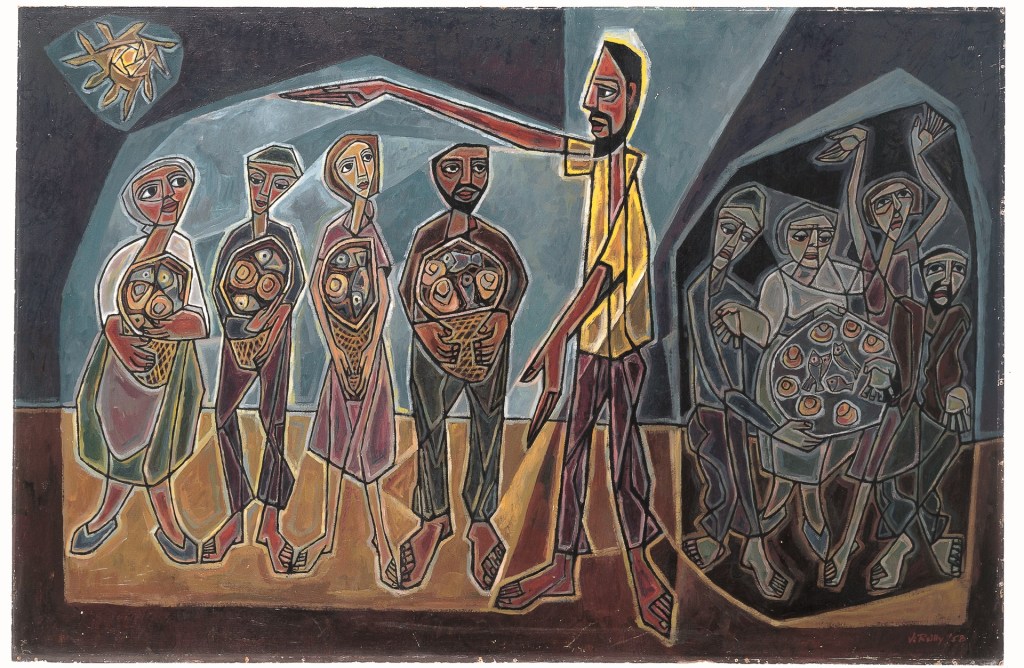
The Feeding of the Five Thousand by John Reilly, 1958

When the apostles returned, they reported to Jesus what they had done. Then he took them with him, and they withdrew by themselves to a town called Bethsaida, but the crowds learned about it and followed him. He welcomed them and spoke to them about the kingdom of God and healed those who needed healing.

Late in the afternoon the Twelve came to him and said, “Send the crowd away so they can go to the surrounding villages and countryside and find food and lodging, because we are in a remote place here.”

He replied, “You give them something to eat.”

They answered, “We have only five loaves of bread and two fish—unless we go and buy food for all this crowd.” (About five thousand men were there.)

But he said to his disciples, “Have them sit down in groups of about fifty each.” The disciples did so, and everyone sat down. Taking the five loaves and the two fish and looking up to heaven, he gave thanks and broke them. Then he gave them to the disciples to distribute to the people. They all ate and were satisfied, and the disciples picked up twelve basketfuls of broken pieces that were left over. (New International Version)

Jesus feeding five thousand people is not just an incredible story that happened a long time ago. Today, Jesus is still in the miracle business because he is still in the kingdom business. Christ still takes our meager resources and turns them into something that has a large impact on a lot of people. 

For that to happen, all we need do, is follow the Lord’s simple instructions: “You give them something to eat,” and, “Bring them [five loaves and two fish] here to me.” Jesus, using a simple act of obedience by his disciples, did one of the most famous miracles in history.

Jesus can multiply whatever little we possess to accomplish his kingdom work through us. 

It is true that Jesus most certainly can do miracles without us. And yet, Christ chooses to use us simple folk to participate in his work. God uses our simple prayers for the miracle of a transformed life. The Lord uses our imperfect speech to bring new life to others. Jesus takes our miniscule bank account to bring a river of financial resources to many through a small act of giving. 

Faith is our true work – to believe God can do the extraordinary through our ordinary loaf of bread and piece of fish.

The Compassion of Jesus Motivates Him To Do Miracles

Jesus withdrew to a solitary place. The crowd, however, did not leave him alone. But rather than being annoyed by the situation because this interruption was not on his divine day planner, Jesus looked at the large group of people and had compassion on them. 

Christ’s heart went out to thousands of people, so he set about the work of healing the sick. Please know that God does not begrudgingly deal with you, as if you were an interruption to his day; the Lord has compassion for you.

The Desire of Jesus is For Us to Participate in the Miracles He Does

After a full day of healing, Christ’s disciples came to him as if he was unaware of the people’s need for food.  They had a very rational and realistic answer to the problem of hunger in front of them; dismiss the crowd so they can go out to eat. 

Jesus calmly responded, “They don’t need to go away; you give them something to eat.” 

I detect perhaps a hint of sarcasm and a slight eye roll in the reply of the disciples, “We have only five loaves of bread and two fish.” But their math was way off because they did not count Jesus. 

The Five Thousand by Eularia Clarke, 1962

Jesus simply said, “Bring them here to me.” My friends, if we have ears to hear, Jesus is still saying this today to us – bring them here to me. Through simple prayer and active obedience, we must give Jesus what we have, no matter how little or insignificant.

Most of what happens in Western Christianity, much like the ancient disciples, is a reasonable doing of rational ministry. Many ministries have little to nothing to do with the impossibility of faith and seeing God work in ways that are incomprehensible to our modern sensibilities.

The earthly miracles of Christ were not an isolated instance. God has always been taking the impossible and making it possible.

Now there was a woman who had been married to a member of a group of prophets. She appealed to Elisha, saying, “My husband, your servant, is dead. You know how he feared the Lord. But now someone he owed money to has come to take my two children away as slaves.”

Elisha said to her, “What can I do for you? Tell me what you still have left in the house.”

She said, “Your servant has nothing at all in the house except a small jar of oil.”

He said, “Go out and borrow containers from all your neighbors. Get as many empty containers as possible. Then go in and close the door behind you and your sons. Pour oil into all those containers. Set each one aside when it’s full.”

She left Elisha and closed the door behind her and her sons. They brought her containers as she kept on pouring. When she had filled the containers, she said to her son, “Bring me another container.”

He said to her, “There aren’t any more.” Then the oil stopped flowing, and she reported this to the man of God.

He said, “Go! Sell the oil and pay your debts. You and your sons can live on what remains.” (2 Kings 4:1-7, CEB)

What if we were to live as if God was interested in doing the miraculous? Would it change the way we pray, and the way we act? 

What if we understood just enough of Jesus, of what he can and wants to do, that we are bold to say:

  • “This might sound crazy, but what if we found out the names of everyone in our community who needs food and go love on them and feed them?” (instead of only the rational means of a food pantry)
  • “This might sound crazy, but what if we used our property to create a community garden and help people grow their own food?” (instead of only the rational means of government aid) 
  • “This might sound crazy, but what if we prayed for one-hundred people, by name, to be healed?” (instead of only the rational means of relying on the pastor to pray)

Most of our plans are humanly possible and doable. Maybe we ought, instead, to seek the impossible.

We may often do nothing out of a sense that God either cannot or does not want to use me or what I have. However, it just won’t do to stand afar off and expect God to work without us giving what we have, whether that something is time, money, conversation, food, hospitality, or whatever. 

Our excuses won’t do for Jesus – my home is too small, I don’t have enough money, I am not smart enough, my schedule won’t allow it, I don’t have enough resources…. In God’s economy you don’t need much, at all. Just a mustard seed worth of faith will do. Jesus wants us to be a part of the miracles he is doing.

Conclusion

I can visualize the disciples befuddled by Christ’s words. I can imagine hearing their excuses. “You want me to do what?  Feed thousands?  Lead someone to Jesus?  Pray in front of others?….” 

The miracle for many a believer is to be open, real, and transparent enough to believe that Christ can do the impossible through confessing sin, participating in ministry, having a spiritual conversation with an unbeliever, or just naming out loud what one actually thinks and feels.  

The question is never, “Can God use me?” The real question is, “What miracle does God want to do through me, and through us as a community of faith?”

It is no accident that when Jesus distributed the bread, it sounds a lot like communion. The Lord’s Supper may seem to be irrelevant – only something we do to remember Jesus, or a mere ritual. But God’s design is much bigger. The Lord wants to do a miracle. 

God wants our observance of Christian communion to bring a healing which the world cannot give. It appears irrational that Jesus can use a small Table to feed and reach thousands. Yet, we don’t serve a God who is limited to work through rational means. 

O God, our heavenly Father, you have blessed us and given us dominion over all the earth. Increase our faith and our reverence for the mystery of life. Give us new insight into your purposes for the human race, and new wisdom and determination in making provision for its future, no matter whether it makes sense, or not, in accordance with your goodwill, through Jesus Christ our Lord. Amen.