The Tension of Advent (Hebrews 11:32-40)

What else can I say? There isn’t enough time to tell about Gideon, Barak, Samson, Jephthah, David, Samuel, and the prophets. Their faith helped them conquer kingdoms, and because they did right, God made promises to them. They closed the jaws of lions and put out raging fires and escaped from the swords of their enemies. Although they were weak, they were given the strength and power to chase foreign armies away.

Some women received their loved ones back from death. Many of these people were tortured, but they refused to be released. They were sure they would get a better reward when the dead are raised to life. Others were made fun of and beaten with whips, and some were chained in jail. Still others were stoned to death or sawed in two or killed with swords. Some had nothing but sheep skins or goat skins to wear. They were poor, mistreated, and tortured. The world did not deserve these good people, who had to wander in deserts and on mountains and had to live in caves and holes in the ground.

All of them pleased God because of their faith! But still they died without being given what had been promised. This was because God had something better in store for us. And he did not want them to reach the goal of their faith without us. (Contemporary English Version)

God has entered history through the incarnation of Jesus Christ. In this season of Advent, Christians everywhere enter a time of anticipation, waiting, and hoping. Advent is meant to stir our awareness of God’s actions – past, present, and future.

During this time of year, we need to feel the tension between what is and what is yet to come. Christ has come, in his first advent, to seek and save the lost. And yet, not all things have reached completion. Our deliverance from sin, death, and hell has been accomplished through the cross of Christ; yet this salvation isn’t here in it’s fullness. That will come when Jesus returns in his second advent to judge the living and the dead.

Which is why today’s New Testament lesson is perfect for the Advent season. It captures this awkward tension between already having something but not yet possessing it. It’s the tension of the Christian life. Celebration and hope are practiced together because we rejoice in what is, while confidently expecting what is not yet.

Throughout every era, people of faith have lived with the rubber band existence of feeling the extreme stretch without being broken by the pressure. Our spiritual ancestors didn’t break because of their hope. And the persons mentioned by the author of Hebrews inspire us to join them on this journey of perseverance until the promises of God are fully realized.

Gideon, Barak, Samson, and Jephthah all defeated large armies with just a few people because their robust faith melted circumstantial fear.

David, Samuel, and the prophets proclaimed truth, justice, and righteousness, knowing there would be adverse circumstances to speaking up and out.

People overcome dark times, establish what is just and right, gain what is promised, and do incredible things because they are looking beyond the present here-and-now of their difficulty to see something better. They know that their actions now will connect to better times ahead.

That’s what Shadrach, Meshach, and Abednego did in the face of overwhelming heat in a fiery furnace. It’s what Moses, Elijah, and David did by escaping the edge of the sword. They all refused to be thwarted in their mission and purpose for the world.

There were those who willingly endured torture and death rather than get sidetracked from their purpose. They were able to do it because they truly believed that their suffering and death was not the end of it. Better days were ahead and not even death could stop it.

This tends to make our own proclivities toward giving up when things are hard look really wimpy. Far too many folks have their focus in the wrong place – trying to change circumstances and other people – instead of focusing on simply being faithful to what God calls us to do.

We likely won’t have to undergo joint dislocations, torture racks, crushed bones, catapults, thumbscrews, branding irons, and a hundred other devious devices for trying to make a human’s spirit break.

Yet, we are presently enduring the subtly evil machinations of gaslighting, emotional manipulation, mental torture, spiritual abuse, and a hundred other sinister ways of attempting to break our will and commitment to what is right, just, and true.

The present awful consequences mean little whenever we’re able to connect what we’re doing to our coming heavenly reward. If the faithful people of the past could live and die in faith, no matter the circumstances, so can we.

Someday, everything will be made right by God. And when that day happens, we will experience it together as one people of God – all the believers of the past and us together. Right now, this present moment, the saints who have gone before us are patiently waiting for us….

Almighty God, give us grace to cast away the works of darkness, and put on the armor of light, now in the time of this mortal life in which your Son Jesus Christ came to visit us in great humility; that in the last day, when he shall come again in his glorious majesty to judge both the living and the dead, we may all rise together to eternal life, through him who lives and reigns with you and the Holy Spirit, one God, now and forever. Amen.

Are You Ready for Advent? (Matthew 24:36-44)

Advent Starry Night #5 by Virginia Wieringa

Jesus said, “But about that [judgment] day or hour no one knows, not even the angels in heaven, nor the Son, but only the Father. As it was in the days of Noah, so it will be at the coming of the Son of Man. For in the days before the flood, people were eating and drinking, marrying and giving in marriage, up to the day Noah entered the ark; and they knew nothing about what would happen until the flood came and took them all away. That is how it will be at the coming of the Son of Man. Two men will be in the field; one will be taken and the other left. Two women will be grinding with a hand mill; one will be taken and the other left.

“Therefore keep watch because you do not know on what day your Lord will come. But understand this: If the owner of the house had known at what time of night the thief was coming, he would have kept watch and would not have let his house be broken into. So you also must be ready, because the Son of Man will come at an hour when you do not expect him. (New International Version)

The best way of observing the first advent of Christ, his incarnation, is by preparing ourselves for his second advent, his return to the earth.

Just because there is sun today doesn’t mean everyday will be that way. The storm clouds are gathering; the Day of the Lord is at hand. Will you be ready?

Satan once called to him some demons of hell and said he wanted to send one of them to earth to aid women and men in the ruination of their souls. He asked which one would want to go.

One creature came forward and said, “I will go.” Satan said, “If I send you, what will you tell the children of men?” He said, “I will tell the children of men that there is no heaven.” Satan said, “They will not believe you, for there is a bit of heaven in every human heart. In the end everyone knows that right and good must have the victory. You may not go.” 

Then another came forward, darker and fouler than the first. Satan said, “If I send you, what will you tell the children of men?” He said, “I will tell them there is no hell.” Satan looked at him and said, “Oh, no; they will not believe you, for in every human heart there’s a thing called conscience, an inner voice which testifies to the truth that not only will good be triumphant, but that evil will be defeated. You may not go.” 

Then one last creature came forward, this one from the darkest place of all. Satan said to him, “And if I send you, what will you say to women and men to aid them in the destruction of their souls?” He said, “I will tell them there is no hurry.” Satan said, “Go!” (C.S. Lewis, The Screwtape Letters)

Most people’s crime in not some gross sin, but indifference, without much thought to a coming judgment. It seems we are all spiritual procrastinators. Why do today what we can put off till tomorrow? 

But the spiritually indifferent won’t know what hit them. 

So we need to be deeply concerned for the coming Day of the Lord, which may be very soon. 

The question for us is not, “When will Christ return?” Rather, the question is, “Are you ready for Christ’s return?” We must:

  • Keep watch, stay alert, and be ready, like a watchman on an ancient city wall scanning the horizon for an advancing army.
  • Remain vigilant and not forget that Jesus is coming again. 
  • Live every moment of our lives in light of the promise of Christ’s return. 
  • Be busy (not busybodies) because we don’t know the day of Christ’s second advent.

What does it mean to keep watch, be ready, and stay alert? 

In between these two advents of Christ, believers are to bear witness to a world going about their merry way unaware of the judgment that is about to overtake them. Like Noah, we actively build the ark of the church instead of living as if Jesus weren’t coming.

Noah was a preacher of righteousness in both word and deed, building an ark in a place and around a people who had never seen rain. What’s more, constructing the massive ark took a solid one-hundred years. This was no easy feat.

Like Noah, we must plug away and be faithful stewards, doing the tedious and patient work given to us. We aren’t supposed to be like the irresponsible teenager who, when given the responsibility of watching over the house while the parents are gone for the weekend, throws a big party and trashes the place. The parents will come home at a time that the teenager does not expect, and then there will certainly be weeping and gnashing of teeth. 

When the Lord returns, we don’t know who will be taken and who will be left. Two different people might look the same on the outside, doing the same work, but each of those persons working side by side can really be very different on the inside. So, let us be patient as we await the coming of Christ and avoid losing sight of what is truly important.

One day a man named Denis Waitley was trying to catch a flight but running late. So he literally ran through the airport terminal and got to the gate the split second the flight attendant closed the door. Denis explained his situation, that he had a speaking engagement and needed to be on that flight, but the attendant didn’t budge. 

Denis stormed out of the boarding area and back to the ticket counter to register a complaint and reschedule his flight. His anger intensified as he waited for more than twenty minutes in a line that barely moved. Just before he got to the counter an announcement over the intercom changed his life. 

The plane he missed getting on, Flight 191 from Chicago to Los Angeles, crashed on takeoff and killed every person on board the plane. Denis Waitley never registered his complaint. In fact, he never returned his invalidated ticket.

He took the ticket home and pinned it on a bulletin board in his office to remind him whenever he got frustrated or upset that life is more than day to day impatience and worry and complaints. It’s about serving a lost world destined to slide away from God apart from the grace that can turn judgment into blessing.

It could be today. Every day we must live with the reality that Christ’s return is imminent. Until that happens, we are to be faithful servants of God by serving a world that is tremendous need of getting on the ark and being saved from the judgment that will come. 

Almighty God, give us grace to cast away the works of darkness, and put on the armor of light, now in the time of this mortal life in which your Son Jesus Christ came to visit us in great humility; that in the last day, when he shall come again in his glorious majesty to judge both the living and the dead, we may rise to the life immortal; through him who lives and reigns with you and the Holy Spirit, one God, now and forever. Amen.

Let the Little Children Come (Luke 18:15-17)

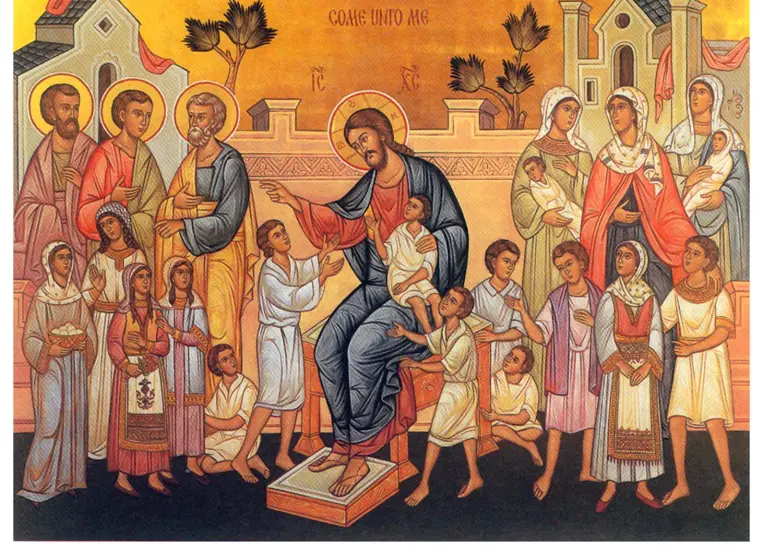
People were also bringing babies to Jesus for him to place his hands on them. When the disciples saw this, they rebuked them. But Jesus called the children to him and said, “Let the little children come to me, and do not hinder them, for the kingdom of God belongs to such as these. Truly I tell you, anyone who will not receive the kingdom of God like a little child will never enter it.” (New International Version)

I happen to believe that kids are closer to the kingdom of God than most adults.

Us big people have developed a lot of baggage over the years. And all that stuff tends to obscure God’s kingdom and the light of Christ within us.

Kids, however, especially small children, still haven’t discerned any veil between the seen and unseen worlds. They freely move between them both without any problem.

So, of course, Jesus wanted to be around children. If he had any homesickness at all, I’m sure the presence of kids made him feel at home more than anywhere else on this earth.

Jesus is our Immanuel, God with us.

The kingdom of God is here within us.

The disciples of Jesus had some difficulty with Christ’s branding of the message because it was not exclusive enough for them. They wanted limits on the us part.

Kids are part of that mass of people that God is with. Children deserve as much or more attention than adults. More than simply saying that we care about kids, we need to be like Jesus. He let the children come to him and was intolerant of anyone preventing kids from doing so.

Since the disciples were, ironically, still living in a small world, they rebuked those who brought little children to Jesus.

We aren’t specifically told why the disciples rebuked the adults bringing children to Jesus. Maybe the children were making a lot of noise and were being a nuisance in the middle of Jesus’ teaching. Perhaps the disciples had Jesus on a tight time schedule and this bringing kids to Christ thing was causing a delay. It could be that the disciples simply saw children as an interruption to the “important” work of ministry. 

I tend to think that the disciples simply failed to appreciate the children. The dominate view of kids in the ancient world was to see them as potential adults. Kids were pretty low on the ladder of society. The disciples likely saw no reason for children to be involved in what was happening.

The babies and toddlers and small children were brought so that Jesus might place his hands on them and pray for them. That still seems to me to be the best reason to bring kids to Jesus. 

“This story teaches us that Christ does not receive only those who voluntarily come to Him of a holy desire and moved by faith, but also those who might not yet be old enough to realize how much they need His grace….  From this we gather that His grace reaches to this age of life also….  It would be cruel to exclude that age from the grace of redemption.”

John Calvin

“Jesus does not only save repentant adults; he also saves dependent children and all those whom we think are incompetent to respond to Jesus.”

Frederick Dale Bruner

Jesus flat out rebuked his disciples for hindering the little children from coming to him. He wanted just the opposite of what was taking place. Why? Because the kingdom of heaven belongs to such little people as these. 

As mentioned, children were at the bottom of the societal pecking order in the ancient world. Their place in that society was to be respectful and quiet, to speak only when spoken to, and to never interrupt an adult.

Yet, Jesus took the time to touch them and pray for them. He invited this interruption to his schedule. Christ bluntly told his disciples that they were the ones being the hindrance, not the kids.

I baptize all sorts of people, including kids and babies. Why? Because in baptism, I recognize that the smallest ones among us can come to this holy sacrament. I understand that in baptism the Holy Spirit begins and initiates the process of salvation that will take that little one from infancy to adulthood and eventual death. I discern that, ideally, the child grows to live into their baptism by recognizing by faith that Jesus died and rose from the dead and grants grace and forgiveness to all who come to him. 

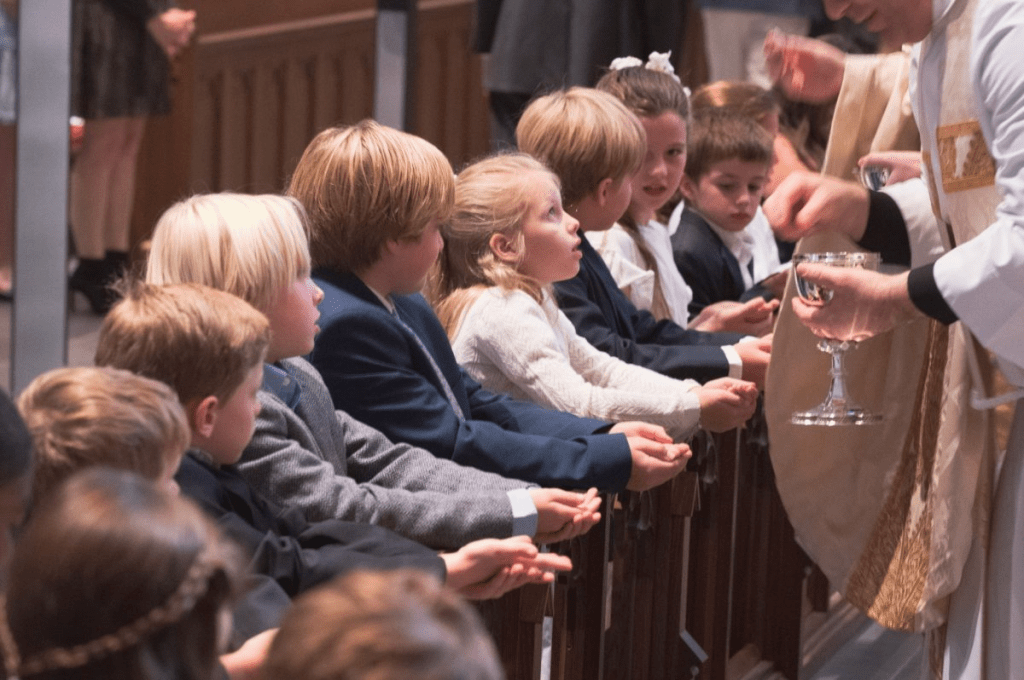
In that process of salvation, of coming to know Jesus, we have the sacrament of the Lord’s Table to strengthen our faith and demonstrate to us that the saving work of Jesus that has been accomplished. It is a Table of grace for all the members of Christ’s Church. 

In my Reformed Christian tradition, we believe that Jesus is not physically, but spiritually present at the Table.  Because Jesus is present, we are able to receive the grace available to us as Christ’s members. So why, in light of this reality, and the words and practice of Jesus toward children, would we ever hinder and prevent the smallest members among us from participating at the Table?

Here’s a thought: If Jesus himself were serving communion in a church, and a group of 2-year-old children came toddling up to the Table to see Jesus, would you stop them from doing so? Or much like the disciples, would you rebuke those bringing children to Jesus?

As for me, I’d rather not be rebuked by my Lord.

Jesus gave children the three gifts they most need: time, touch, and prayer. Parenting and teaching are holy vocations, and we have the wonderful privilege of bestowing these same gifts on our children, grandchildren, and students.

Time, touch, and prayer are ways we bless children. And, what’s more, as God’s children, we are all to approach Jesus and spend time with him, allow him to touch us, and interact with him through prayer. 

May we all have the humility to bend down at eye level to the littlest among us so that we and others will know that the kingdom of God is among us.

A Living Hope (1 Peter 1:3-9)

Let us give thanks to the God and Father of our Lord Jesus Christ! Because of his great mercy he gave us new life by raising Jesus Christ from death. This fills us with a living hope, and so we look forward to possessing the rich blessings that God keeps for his people. He keeps them for you in heaven, where they cannot decay or spoil or fade away. They are for you, who through faith are kept safe by God’s power for the salvation which is ready to be revealed at the end of time.

Be glad about this, even though it may now be necessary for you to be sad for a while because of the many kinds of trials you suffer. Their purpose is to prove that your faith is genuine. Even gold, which can be destroyed, is tested by fire; and so your faith, which is much more precious than gold, must also be tested, so that it may endure. Then you will receive praise and glory and honor on the Day when Jesus Christ is revealed. 

You love him, although you have not seen him, and you believe in him, although you do not now see him. So you rejoice with a great and glorious joy which words cannot express, because you are receiving the salvation of your souls, which is the purpose of your faith in him. (Good News Translation)

There’s no need for hope if everything’s going just the way you like it. I remember when I was a college undergraduate, I hoped for Christ’s return toward the end of every semester. The prospect of all those final exams and the pressure of grades had me longing for heaven.

But that’s life. Maturity, resilience, perseverance, and just about every virtue you can think of comes as a result of life’s trials and sufferings. The Christian has hope, precisely because things aren’t the way they’re supposed to be.

Faith has to be tried and tested. And hard circumstances are the way of purifying it. Like gold being purged of any dross by being exposed to extreme heat, so our faith becomes strong, robust, and genuine by the purgative fires of life’s many large and small sufferings.

The whole point of it all is to make us people worthy of our spiritual calling. Resurrection only happens because there’s been a death. Glory is only realized through suffering.

New life, the Christian life, isn’t a matter of making a new set of resolutions, as if it were nothing more than aspirations at the beginning of a calendar year. Rather, Christian faith is a response to the mercy of God in Jesus Christ.

One of my all-time favorite stories is Victor Hugo’s Les Miserables. It’s a story of grace and new life, of a hopeless man given the chance at hope.

The main character is Jean Valjean, who spends nineteen years in jail for stealing a loaf of bread for his starving family. The experience in prison caused him to become a bitter and cynical man. After his release, Jean Valjean has nowhere to go. 

In desperation, he seeks lodging one night at the home of a Catholic bishop, who treats him with genuine kindness, which Valjean sees only as an opportunity to exploit. In the middle of the night, he steals the bishop’s silver and skedaddles. 

The next day, however, Valjean is caught by the police. When they bring him back to the bishop’s house for identification, the police are surprised when the bishop hands two silver candlesticks to Jean, implying that he had given the stolen silver to him, saying, “You forgot these.” 

After dismissing the police, the bishop turns to Jean Valjean and says, “I have bought your soul for God.” In that moment, by the bishop’s act of mercy, Valjean’s bitterness is broken. Hope springs to life.

Jean Valjean’s forgiveness is the beginning of a new life. The bulk of Victor Hugo’s novel demonstrates the utter power of a redeemed life. Jean chooses the way of mercy, as the bishop had done. Valjean raises an orphan, spares the life of a parole officer who spent fifteen years hunting him, and saves his future son-in-law from death, even though it nearly cost him his own life. 

“Jean Valjean, my brother, you no longer belong to what is evil but to what is good. I have bought your soul to save it from black thoughts and the spirit of perdition, and I give it to God.” ― Victor Hugo, Les Misérables

Throughout Jean Valjean’s new life, there are trials and temptations all along the way. Yet, mercy keeps his faith strong, and hope kindled. Whereas before, Valjean responded to mercy with a brooding melancholy and inner anger, now – after being shown grace – he responds to each case of unjust suffering with gratitude, deeply thankful for the chance to live a new life full of grace.

Hope is kept alive because of suffering. Faith is strengthened by means of adversity. And both originate because of mercy and grace.

Christianity is a worldview perspective that enables one to rejoice in difficulty. For the Christian, there is no empty meaningless grief; there is the hope that our suffering means something. Like the athlete who endures all the painful practice in order to realize a future hope, so the believer in Jesus goes into strict training for the development of faith – all in the confident expectation of a fulfilled salvation.

It’s a hard lesson to learn, this seemingly weird alchemy of faith, suffering, hope, joy, and new life. And every generation of Christians needs to experientially discover it. Each believer eventually learns, in the crucible of hard circumstances, that the promises of God are the ballast to persevere in faith and patience throughout life.

Christian hope is a confident expectation that the promises of God will be completely realized.

A Christian’s salvation encompasses past, present, and future.

We were saved back there in the past when Christ died on the cross for us. We were crucified with him.

We are presently being saved from the world, the sinful nature, and the devil, through the sanctifying work of the Spirit in making us holy.

And we will be saved in the future when Christ returns to judge the living and the dead. Then, our salvation will be fully realized. Since that hasn’t happened yet, we have hope to sustain us.

It was hope that sustained me in college. I endured all the hours of study, all the exams, all the various courses taken, with the confident expectation that I would someday walk across that stage, receive my diploma, and graduate with my intended degree.

We ourselves, who have the first fruits of the Spirit, groan inwardly as we wait eagerly for our adoption to sonship, the redemption of our bodies. For in this hope we were saved. But hope that is seen is no hope at all. Who hopes for what they already have? But if we hope for what we do not yet have, we wait for it patiently. (Romans 8:23-25, NIV)

The Christian’s hope for ultimate deliverance is imperishable, undefiled, and unfading. This means we can live through a difficult day or week or month or a year, or even decades, with spiritual endurance. Our goal shall come in all its fullness. 

Then I saw a new heaven and a new earth, for the first heaven and the first earth had passed away, and the sea was no more. And I saw the holy city, the new Jerusalem, coming down out of heaven from God, prepared as a bride adorned for her husband. And I heard a loud voice from the throne saying,

“See, the home of God is among mortals.
He will dwell with them;
they will be his peoples,
and God himself will be with them and be their God;
he will wipe every tear from their eyes.
Death will be no more;
mourning and crying and pain will be no more,
for the first things have passed away.” (Revelation 21:1-4, NRSV)

Eventually, suffering will have done its work and we will be with Christ forever. Until that day, let us explore all that God has for us, embracing both the meaning and the mystery of faith. 

Since our salvation is assured, let us live with confidence and run the race marked out for us.

Heavenly Father, you created us and lovingly care for us. We accept all our sufferings willingly, and as truly obedient children we submit ourselves to your holy will. Give us the strength to accept your loving visitation to us through adversity, and never let us grieve your heart by giving-in to impatience. We offer you our pains to be used for your honor and glory, through Jesus Christ our Lord, in the strength of the Holy Spirit. Amen.