Christ’s Parable of the Weeds (Matthew 13:24-30, 36-43)

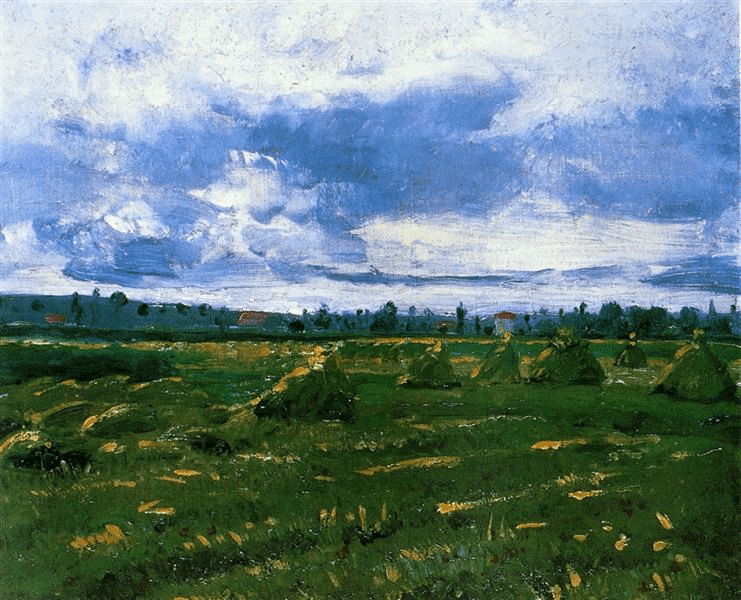
Wheat Fields with Stacks, by Vincent Van Gogh, 1888

Here is another story Jesus told: “The Kingdom of Heaven is like a farmer who planted good seed in his field. But that night as the workers slept, his enemy came and planted weeds among the wheat, then slipped away. When the crop began to grow and produce grain, the weeds also grew.

“The farmer’s workers went to him and said, ‘Sir, the field where you planted that good seed is full of weeds! Where did they come from?’

“‘An enemy has done this!’ the farmer exclaimed.

“‘Should we pull out the weeds?’ they asked.

“‘No,’ he replied, ‘you’ll uproot the wheat if you do. Let both grow together until the harvest. Then I will tell the harvesters to sort out the weeds, tie them into bundles, and burn them, and to put the wheat in the barn….’”

Then, leaving the crowds outside, Jesus went into the house. His disciples said, “Please explain to us the story of the weeds in the field.”

Jesus replied, “The Son of Man is the farmer who plants the good seed. The field is the world, and the good seed represents the people of the Kingdom. The weeds are the people who belong to the evil one. The enemy who planted the weeds among the wheat is the devil. The harvest is the end of the world, and the harvesters are the angels.

“Just as the weeds are sorted out and burned in the fire, so it will be at the end of the world. The Son of Man will send his angels, and they will remove from his Kingdom everything that causes sin and all who do evil. And the angels will throw them into the fiery furnace, where there will be weeping and gnashing of teeth. Then the righteous will shine like the sun in their Father’s Kingdom. Anyone with ears to hear should listen and understand! (New Living Translation)

As you have likely noticed, not everyone in this world is supportive of you and what you’re doing.

The good work we do – no matter how competently and expertly done – will be undermined by others. There will be people with selfish and sinister agendas who put roadblocks in our way to frustrate our ongoing work. They don’t like what we are doing and what we’re trying to accomplish.

Unfortunately, that’s just the way it is. So then, one of the big questions for all of us is this: How do we live with others trying to subvert the good work we are doing for the Kingdom of Heaven?

One of the most popular responses is to strike the enemy on their cheek just as hard or harder in the way they slapped you. It is responding to evil in kind.

But if we will ponder for a moment, we shall realize that is makes no sense to repay evil with evil. Why? Because then the Kingdom of Hell has just snagged this one with doing evil in order to defend good work – which ends-up ruining the whole enterprise.

No, instead let’s heed the words of Christ to turn the other cheek and not retaliate; and live the words of the Apostle Paul who reminded us to overcome evil by doing good. (Matthew 5:38-42; Romans 12:14-21)

Yes, all judgment belongs to the Lord, and not us. In today’s Gospel lesson the reasoning Jesus provides for non-retaliation and non-violence is both reasonable and practical.
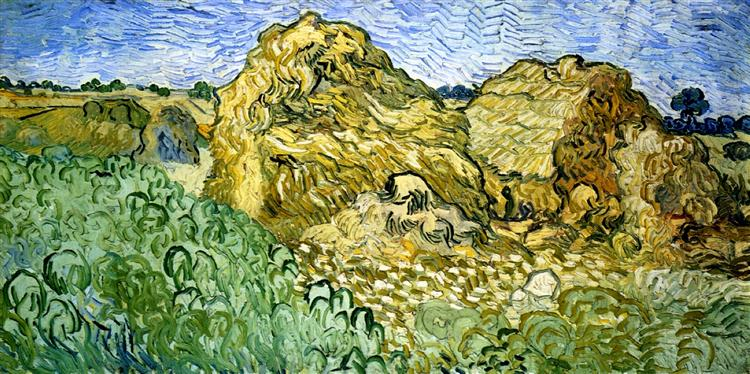
Field with Stacks of Wheat, by Vincent Van Gogh, 1890

Christ told his disciples that the enemy’s efforts at thwarting our good works are sinister enough to bring about a situation where evil is so close to the good that to eradicate the evil is to therefore also do away with the good.

If you have weeds in your field or your garden, you know that some of those nasty weeds cannot be pulled out of the ground without yanking-up the good plant along with it. Instead, you’ll have to wait until you can harvest the plant, and then you can safely get rid of the offending weed.

Let’s think, then, about our own situations right now in this world. For myself, it seems that every single day I am upset and angered over decisions made by those in political power, because they almost always involve oppressing and/or harming powerless people.

Yet, to immediately stop the offending persons and organizations would involve some wicked methods. Instead, if I want to maintain doing good, I will have my time to unseat them through the vote, or writing my Senators, or directly contacting the offices of the institutions, etc.

Some of our responses may seem tepid in comparison to the evil being perpetrated, yet we can be sure that there is a time coming in which the reality of divine judgment will handle the wicked once and for all. At the proper time, heaven’s angels will do their own good work of removing evil and eradicating it forever.

We need to put our efforts into doing the very best at living in harmony with one another, promoting peace, and being peacemakers – using our greatest and most effective tools of humility, gentleness, grace, and love. These are the proper fertilizers which will keep the plants of righteousness and justice growing and thriving, even though they are surrounded by a bunch of close weeds.

As maddening as it is to see those weeds grow up alongside the plants, nowhere in Holy Scripture are we called or encouraged to become judge, jury, and executioner to the wicked.

Furthermore, Christians are nowhere called to force onto others Jesus as King through a theocratic nation, using authoritarian means. We are called, rather, to put our faith where our fear is and exercise a faith that does good work through love. (Galatians 5:6)

Equipped by the Spirit, we urge oppressors, tyrants, and egotists to turn from their selfishness and amend their evil ways. And we are not called to force the Kingdom of Heaven on others by trying to ensconce a form of Christian nationalism. For Americans, many of our ancestors came to the New World in order to flee their home Christian nationalist countries who persecuted them and did evil to them.

“To identify any particular form of government with Christianity is a dangerous error, for it confounds the permanent with the transitory, the absolute with the contingent.” T.S. Eliot

It takes very little prodding for Christians with political power to move into glorifying violence and ignoring biblical injunctions to love enemies, seek peace, and grant grace.

God puts a high premium of looking after the poor and needy, and rescuing them from oppression and violence. The last thing we ought to be doing is becoming the violent oppressors ourselves!

Giving ourselves as ambassadors of reconciliation, speaking truth to power, and doing the work of peacemaking is a narrow and hard road to hoe. The easy way is typically the road of destruction. (Matthew 7:13-14)

As citizens of the Kingdom of Heaven, we are to labor toward the things Jesus himself did: Challenge the arrogant religious types; offer mercy to the lowly and forgotten ones; warn of judgment; encourage faith; forgive generously; and speak words of truth in all places, including the halls of political power.

It is perfectly legitimate to disagree with others, but only if we ourselves are willing to defend their equally legitimate right to be disagreeable.

So, instead of always trying to snuff-out and vanquish our opponents with overt tools of evil, let us do the good work of winning their respect, living in peace with them, and affirming our shared humanity together.

We all have the right to be different; we don’t have the right to do evil and reprise evil with evil. The organizations, institutions, faith communities, corporations, and governments of this world are only as good as the people guarding that goodness through their good work, utilizing good means toward good ends.

Anyone with ears ought to listen and understand.

God of steadfast love and grace: Teach us your way and your truth. Root us in you alone, and help us to grow in grace and love, so that we may fulfill our role and our work in the reign of Jesus Christ our Lord. Amen.

The Severe Mercy of the Easy Yoke (Matthew 11:16-19, 25-30)

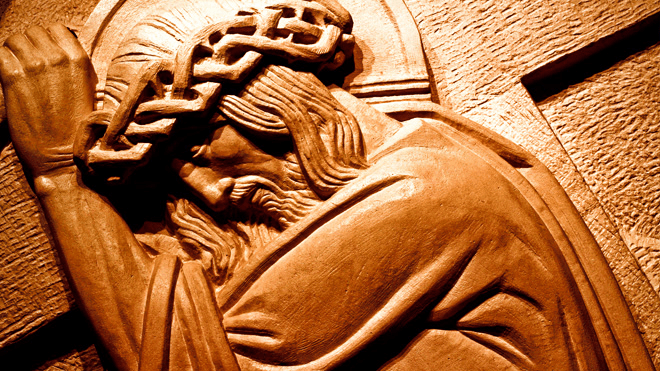
The Burden of Christ, a sculpture of Jesus Christ, in the Oratoire Saint-Joseph, Montreal, Quebec, Canada

“But to what will I compare this generation? It is like children sitting in the marketplaces and calling to one another,

‘We played the flute for you, and you did not dance;
    we wailed, and you did not mourn.’

“For John came neither eating nor drinking, and they say, ‘He has a demon’; the Son of Man came eating and drinking, and they say, ‘Look, a glutton and a drunkard, a friend of tax collectors and sinners!’ Yet wisdom is vindicated by her deeds….”

At that time Jesus said, “I thank you, Father, Lord of heaven and earth, because you have hidden these things from the wise and the intelligent and have revealed them to infants; yes, Father, for such was your gracious will.All things have been handed over to me by my Father, and no one knows the Son except the Father, and no one knows the Father except the Son and anyone to whom the Son chooses to reveal him.

“Come to me, all you who are weary and are carrying heavy burdens, and I will give you rest. Take my yoke upon you, and learn from me, for I am gentle and humble in heart, and you will find rest for your souls. For my yoke is easy, and my burden is light.” (New Revised Standard Version Updated Edition)

Exchanging one yoke for another is really a rather radical act. It is akin to dying to self, so that there can be new life in Christ.

In our anxiety-laden society, filled with multiple fears, worries, and frustrations, we are being invited by Jesus to lay it all down. In other words, every one of us must unequivocably die to self.

Perhaps this might best be illustrated by expressing my own struggle with the pharisaical yoke and the Jesus yoke:

A year-and-a-half ago, I abruptly had to leave my job as a hospital chaplain due to deteriorating health. I am now retired, not because I chose retirement, but because retirement chose me.

So, for the past eighteen months, I have struggled with this reality of no longer being a Chaplain. As hard as I thought and pondered, I’ve gained no understanding as to why I am no longer serving patients, their families, and hospital staff.

What’s more, I have no insight as to why – during my tenure as Chaplain – I experienced an awful time with a gaslighting boss for three of those years. This boss continually made nonsensical decisions, and defied any understanding, even though I sought it out. (I might add that it is super-creepy that the current U.S. President is so eerily like the former boss, as if I’m still under the abuse!).

If I was a good Chaplain doing good work (which I believe I was) then why was I treated so oppressively? Why did my employer turn a blind-eye to it all? Why would God almighty sideline me in such a loathsome health situation. Why must I keep experiencing the awful effects of incompetent political leadership? Why all of the nonsense? It is a terrible yoke for me to carry.

Likely, none of this has to do with me needing to understand any of it. It could be that it is more akin to Abraham being told to sacrifice the son of the promise, Isaac.

It was a completely nonsensical command from God. It defied any sort of understanding on Abraham’s part. And yet he quietly obeyed, with the text of Genesis 22 telling us nothing about any talk-back nor questioning from Abraham. Only obedience. It appears that Abraham was able to exchange yokes, from the oppressive one to the easy one.

In telling Abraham to sacrifice his son, the real death taking place was Abraham’s, not Isaac’s. Abraham was to die to anything that may compete or be likened to some sort of idolatry before God. For even the very good things, like families and jobs, can become idolatrous to us.

I don’t know about your situation, but maybe for me the point is that I must allow the old life to die, and to let a new life grow out of it. Maybe it’s time for a change of yokes. After all, one cannot have a new resurrected life without first experiencing a crucifying death to the old life.

Death is an integral part of life. To exchange yokes is to experience a death. I’ve wanted badly to return to chaplaincy in the hospital. But I am being commanded to sacrifice it on the altar of God. I am being told to die to myself, so that I may live a new life to God.

Any sort of mere earthly hope must die within us, that an unselfish and godly hope may arise anew. And that happens when we deliberately switch-out one yoke for another.

Chaplain Tim, in a way, is dead. I now accept that which is already true of me. It is a death to self. And I am now patiently awaiting my resurrection.

I do not understand this weird liminal space I’m inhabiting; and I need not understand it. I’m deprived of the object of my former job. And so, I let go of it. I will cling no longer to the old life.

What I seem to be currently experiencing is a severe mercy – the mercy from God to not make Christianity wholly understandable, nor boil it down to pharisaical laws of which I can clearly either follow, or not.

Instead, I allow following Christ and taking up his easy yoke to maintain it’s true mystery and grace. If I have died with Christ, I shall also live with him.

Only in hopelessness can we entertain hope. God loves me enough to let me feel the awful severity of Divine nonsense, so that I may experience the real nature of Christ.

I suppose, then, that I am really dead to having to understand everything, and am instead alive to hope. And hope will not disappoint me.

Through dreams and visions, O God, you broaden the horizon and hope of your people, so that they may discover the meaning of your covenant, even in the midst of trial and exile. Increase the number of those who believe in your word so that all people may joyfully respond to your call and share in your promises. Amen.

Remember Your Baptism (Matthew 3:13-17)

Then Jesus came from Galilee to John at the Jordan, to be baptized by him. John would have prevented him, saying, “I need to be baptized by you, and do you come to me?” But Jesus answered him, “Let it be so now, for it is proper for us in this way to fulfill all righteousness.” Then he consented. And when Jesus had been baptized, just as he came up from the water, suddenly the heavens were opened to him and he saw God’s Spirit descending like a dove and alighting on him. And a voice from the heavens said, “This is my Son, the Beloved, with whom I am well pleased.” (New Revised Standard Version)

Today is the Sunday on the Christian Calendar in which the baptism of Jesus is annually remembered. It also marks the first Sunday of the season of Epiphany – a celebration of God’s salvation being extended not only to Jews, but also to Gentiles. In other words, everyone on planet earth is within the scope of Christ’s work of deliverance.

Baptism is important. Remembering is important. Put together, remembering our baptism is highly important. Here’s why….

Baptism is important to Jesus

Baptism is the distinguishing mark or symbol of being a Christian. 

The New Testament knows nothing of an unbaptized Christian – it’s biblically oxymoronic. That’s because baptism is tied to our identity as believers. Each individual baptism is based in the baptism of the Lord who, in his Great Commission, told us to baptize in the name of the Father, Son, and Spirit. 

The absence of baptism is like a bride without a wedding ring; or a football player not wearing a uniform; or a motorcycle gang without tattoos; or like an Iowa farmer without a Pioneer seed corn hat!

Baptism is the outward sign that we belong to God. It is the distinguishing symbol that we have been adopted by God and will receive all the promises of salvation in Christ.

Christ’s baptism fulfilled all righteousness through identification with repentant people

John the Baptist was understandably hesitant to baptize Jesus; he knew Jesus had no need of repentance. Although Jesus had no sin to confess, his baptism is a powerful symbol of his humility. It anticipates his ministry to people who recognize their need for God. 

It was necessary for Jesus to be baptized in order to communicate solidarity with people who are coming to God. “Righteousness” means having a right relationship with both God and other people. By being baptized, Jesus is proclaiming that a renewed and right relationship with God will become a reality through himself.

Baptism is the sign that we belong to God and that our righteousness is tied to our union with Jesus.

It was important for Jesus to identify with sinners; and so, it is important for us, as well. We remember our baptism – that we belong to God – by identifying with “sinners.” We do this by:

  1. Practicing hospitality (love of strangers)
  2. Using our spiritual gifts of speaking and serving on their behalf
  3. Getting to know people very different from ourselves
  4. Meeting people on their turf (not just ours)
  5. Showing respect and upholding dignity
  6. Asking thoughtful and caring questions
  7. Listening with focused attention

It isn’t what we “do” for people that’s as important as affirming our shared humanity with them. We thus lead folks to the ultimate person who can address the needs of their heart: Jesus.

Christ’s baptism fulfilled all righteousness through the affirmation of witnesses

Before Jesus began his ministry, it was necessary to receive validation of what he was about to teach and do. In ancient Judaism, one of the protections guaranteeing that Scripture would be taught according to the way of God, was through an ordination, of sorts. In order for a new rabbi to become a new rabbi, he needed the laying on of hands from two other rabbis who had authority to do so. 

That’s why Christ’s baptism is important. John the Baptist was a powerful teacher and prophet who was recognized by the people as such. John publicly said he wasn’t worthy to carry Jesus’s sandals, that Jesus is the Lamb of God that takes away the sin of the world. So, a baptism by John validated Jesus and inaugurated his ministry. 

And a second voice – another witness from heaven – affirmed Jesus: “This is my Son, the Beloved, with whom I am well pleased.” Then, the Holy Spirit, in the form of a dove, came upon Jesus. This further affirmed that Jesus would save people, not through arm-twisting and great shows of power, but through humility and gentleness.

Baptism was Christ’s first recorded act as an adult. In some ways, it was his first miracle – the miracle of humility in identifying with sinners.

Remember your baptism

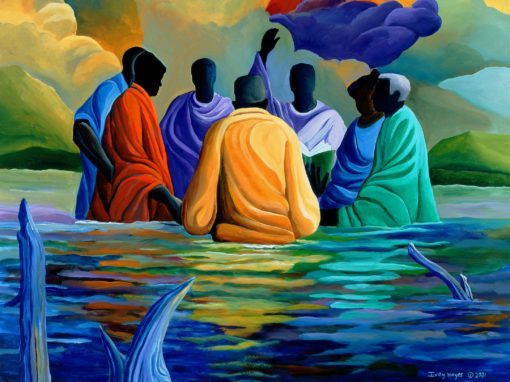
Baptism” by American artist Ivey Hayes (1948-2012)

Baptism is a sign and a seal of God’s grace. Just as Christ’s baptism focused all the promises of God in salvation as being fulfilled in one person, so in our baptism we claim all the promises of God as found in Jesus. Water symbolizes new life, God identifying with us – Immanuel, God with us.

In baptism, God promises and seals to us our union with Jesus so that identity is not found in my past and my profession of faith, but in Christ’s past of bringing redemption to us. Baptism does not so much express faith as call one to a life of faith and sets us apart as belonging to God.

Baptism is a visible declaration of an invisible reality: union with Christ. Just as circumcision was the outward visible sign of the old covenant, so baptism is the sign of the new covenant in Christ – available to both male and female – thus opening the way for women to participate fully in the ministry of the gospel.

In particular, infant baptism confirms that salvation is not initiated by us, but by God. It affirms that one is betrothed to God. As a child, then an adult, grows into the faith, it is our task to remember our baptism, to be reminded that God’s mark is upon us, that we belong to the Lord. 

God has set us apart to be a holy people, given to Jesus to live as he did. We must never forget that baptism is God’s identifying mark upon us; that our union and solidarity with Jesus is affirmed through this practice.

We are not solitary Christians; we belong to Christ and to one another. Baptism is the initiation rite that takes a lifetime to complete. Therefore, we must struggle together in working out our salvation.

Because of our union with Jesus Christ, we must remember:

  • I do not belong to the world. So, I will not live selfishly, only seeking my own comfort agenda. Instead, I will give and serve others from a pure and humble heart.
  • I do not belong to sin. So, I will not give myself over to shameful words or actions, to bullying or manipulating people, to throwing fits and pity parties to get my way, nor using my tongue to speak gossip, slander, or suck-up to others. Instead, I will use my speech wisely, building up others through thoughtful and heartfelt encouragement.
  • I do not belong to the devil. So, I will not seek his agenda of lying, cheating, stealing, and being bitter. 

I belong to Jesus, so therefore:

  • I will uphold biblical justice by championing the cause of the fatherless and the widow, the poor and the needy, the least and the lost among us.
  • I will love others with all the grace God gives me.
  • I will forgive others because Christ has forgiven me.
  • I will consider others better than myself by embracing the humility of Christ.
  • I will hunger and thirst for righteousness by seeking and maintaining right relations with others.
  • I will seek peace and pursue it.
  • I will, give myself to my Lord and Savior Jesus Christ my Savior and Lord – completely and thoroughly, unabashedly and unreservedly.
  • I will live into my baptism and remember it always, because I belong to Jesus!

Creator God, our soul’s delight, your voice thunders over the waters, liberating the future from the past. In the Spirit’s power and the waters of rebirth, Jesus was declared your blessed and beloved Son; may we recall our baptism, and be disciples of the Anointed One. Amen.

It’s Time To Wake Up – First Sunday of Advent (Romans 13:11-14)

Besides this, you know what time it is, how it is already the moment for you to wake from sleep. For salvation is nearer to us now than when we became believers; the night is far gone; the day is near. Let us then throw off the works of darkness and put on the armor of light; let us walk decently as in the day, not in reveling and drunkenness, not in illicit sex and licentiousness, not in quarreling and jealousy. Instead, put on the Lord Jesus Christ, and make no provision for the flesh, to gratify its desires. (New Revised Standard Version)

But make sure that you don’t get so absorbed and exhausted in taking care of all your day-by-day obligations that you lose track of the time and doze off, oblivious to God. The night is about over; dawn is about to break. Be up and awake to what God is doing! God is putting the finishing touches on the salvation work he began when we first believed. We can’t afford to waste a minute, must not squander these precious daylight hours in frivolity and indulgence, in sleeping around and dissipation, in bickering and grabbing everything in sight. Get out of bed and get dressed! Don’t loiter and linger, waiting until the very last minute. Dress yourselves in Christ, and be up and about! (The Message)

I like metaphors, that is, word-pictures that help illustrate and visualize a concept or idea. That’s probably why I like the Apostle Paul, because I find in him a guy who appears to have the same affinity for metaphors that I do.

In the New Testament reading on this First Sunday of Advent, Paul gives four metaphors to help us grab ahold of what he wants to get across to us:

We are not in some holding pattern, passively awaiting heaven. This is because our salvation is not yet complete. Completeness won’t happen until Jesus returns, until the second advent of Christ. Therefore, we are to be active now, working on our faith commitment to Jesus and to his church.

In this advent season, as we remember Christ’s first “advent” (or “coming”) to this earth, we are equally anticipating the second coming of Christ – not knowing quite when that will occur. Only until this event happens will our salvation come in all of its fullness.

The church is a unique community of persons who continually have an eye toward the future return of Jesus. And this future orientation is supposed to give shape to how we live in the present time.

The world-wide Christian community presently follows the way of deliverance. This current time and place is not the arrival point. Today doesn’t mark the time in which our salvation is fully realized or acquired.

In other words, we are to avoid acting as if this is our permanent home. Rather, we are pilgrims on this earth, sojourning through it as if we were but camping out. Our true home is someplace else. And we will get there when Christ comes again.

There is a stark contrast between those who put all their eggs into the present earthly basket, and those who maintain a future orientation of working now with an eye out for Jesus to return. This contrast is illustrated by Paul with images of what it’s like to live for and in the Roman society; and what it’s like to live with Jesus as Lord, instead of Ceasar.

Are you asleep or awake, living for the night or in the day?

Therefore, keep awake, for you do not know when the master of the house will come, in the evening or at midnight or at cockcrow or at dawn, or else he may find you asleep when he comes suddenly. (Mark 13:35-36)

Paul, taking his cues from Jesus, exhorted the believers to stay alert and be prepared for the end when it comes. Living for the nighttime is a metaphor for giving-in to one’s personal sinful desires; whereas living in the daylight hours is a picture of following the words and ways of Jesus.

What are you wearing? What are you taking off, and what are you putting on?

Using the metaphor of clothes – undressing and dressing oneself – Paul is talking about exchanging one set of clothing for another. This isn’t merely putting on a different pair of jeans than what you already have on. It’s much more radical than that. It’s doffing the tuxedo and donning the overalls. The picture is one of doing something completely different than what you’ve been doing before.

Paul wanted a complete makeover, a total change of moral and ethical behavior that is consistent with the gospel of Christ, and not with typical Roman society. It involves taking up one’s cross and following Jesus. It’s gritty and dirty and gets down to it; instead of avoiding hard work and seeking to have someone else do what is unpleasant to me.

Our allegiance and commitment to Christ is on full public display – not in placards with Bible verses on them, but with the sweet aroma of living a humble and just life in all of its simplicity and holiness.

Will you do the works of darkness, or take up the armor of light?

The darkness represents the unjust life of lies, selfishness, conflicts of interest, relational discord, and immoral actions. The light is meant to convey a beautiful life of integrity, wholeness, righteousness, and peace through loving actions.

Christians are to progressively take on the character of Christ, and not of whatever political character happens to be in power.

Using the metaphor of armor points us not only toward the struggle we confront in living a moral and righteous life, but also toward Christ who is our Divine Warrior. Jesus is the One who fights the battle and wins the victory.

Our struggle is not against flesh and blood, but “against the rulers, against the authorities, against the cosmic powers of this present darkness, against the spiritual forces of evil in the heavenly places.” (Ephesians 6:12)

Do you know what time it is? Is there any hopeful expectation?

The Christian is one who knows the time is nearer now than when they first believed. We may not know the precise date on the calendar when Jesus will come again, yet we are convinced that he is returning soon.

Therefore, the believer has no business spending time in trying to predict the day of the end. Instead, the believer must remain faithful and persevere to the end with a firm commitment to Christ, and a dedication to doing what is good, right, and just.

So, herein lies the challenge for every believer: Those of us who name Jesus as Lord will continue to live in a world of injustice and unrighteousness. Christians are continually being pulled in differing directions all at once, all the time.

It’s a hard slog. Yet the Christian finds joy and satisfaction in knowing who they are, who they believe in, and who is coming back to make all things new.

Christianity involves a whole lot more than praying a salvation prayer once, then going on one’s merry way, doing whatever the heck one wants to do.

Rather, Christianity is a radical existence of waking from sleep and changing allegiances from immoral leaders to the true sovereign of the universe.

It’s like moving from seeing shadowy forms just before the dawn to seeing clearly in the sun’s full light of day.

It’s as if I’ve been given a completely new set of clothes to put on, giving up the rags of this world for the raiment of being adopted into royalty.

We remain continually vigilant, always watching, always praying, always believing, always loving – knowing that our salvation is at hand, nearly here, and could happen at any moment.

God of justice and peace, from the heavens you rain down mercy and kindness, so that all on earth may stand in awe and wonder before your marvelous deeds. Raise our heads in expectation, that we may yearn for the coming day of the Lord and stand without blame before your Son, Jesus Christ, who lives and reigns forever and ever. Amen.