Luke 14:15-24 – The Parable of the Great Banquet

When one of those at the table with him heard this, he said to Jesus, “Blessed is the one who will eat at the feast in the kingdom of God.”

Jesus replied: “A certain man was preparing a great banquet and invited many guests. At the time of the banquet, he sent his servant to tell those who had been invited, ‘Come, for everything is now ready.’

“But they all alike began to make excuses. The first said, ‘I have just bought a field, and I must go and see it. Please excuse me.’

“Another said, ‘I have just bought five yoke of oxen, and I’m on my way to try them out. Please excuse me.’

“Still another said, ‘I just got married, so I can’t come.’

“The servant came back and reported this to his master. Then the owner of the house became angry and ordered his servant, ‘Go out quickly into the streets and alleys of the town and bring in the poor, the crippled, the blind and the lame.’

“‘Sir,’ the servant said, ‘what you ordered has been done, but there is still room.’

“Then the master told his servant, ‘Go out to the roads and country lanes and compel them to come in, so that my house will be full. I tell you, not one of those who were invited will get a taste of my banquet.’” (New International Version)

If the gospel of forgiveness in Jesus Christ is such good news, and God is so good, then why aren’t people breaking the door down to get into the Church? 

Today’s Gospel lesson gives us one reason why: They just aren’t interested. The parable Jesus told was of people, when invited to come to the great banquet, kept making one excuse after the other why they couldn’t come.

Keep in mind that Jesus wasn’t talking to sinful outsiders, but the religious insiders – they were the ones making the excuses why they could not participate. 

Let’s cut to the chase: If professing believers in Jesus Christ are not excited about the gospel… If Christians are not enthused over what they possess in the gospel… If the Church is content to go through the motions of Christianity without a concern to be with Jesus… If we are simply too busy to come and attend God’s banquet of grace…

Then, why in the world would any Christian or any Church believe that others ought to show up and be a part of their fellowship, that they would even remotely entertain a thought to profess Christ as Savior and break down the door to get into Christianity?

Jesus was offering a penetrating warning: The unresponsive religious insiders will be replaced by the responsive sinful outsiders. 

If the insiders take for granted what they possess and have better things to do, then God is going to call people who will hear, listen, and respond to the gracious invitation.

The deeply probing question for every believer in Christ today is: Are we so familiar with Jesus, and so content with the way things are that when God breaks into our lives in the form of an invitation that we refuse to respond because we are not interested in going to some stupid banquet? 

There is an incredible abundant feast for us – in fact, Jesus said that his food and drink was to do the Father’s will, that Scripture was his bread. (John 4:34) 

It’s much too easy to take the spiritual abundance of grace and mercy – as well as our physical abundance of food and water – for granted. After all,…

  • Being well-fed, it’s easy to assume that everyone else is, too.
  • Enjoying good health, it’s easy to forget that others are hurting and in pain.
  • Having money and the ability to work hard, it’s easy to think that there are not many poor people around.
  • Living around other Christians all the time, it’s natural to assume that everyone knows the gospel of Jesus – but they don’t!

In Christ’s story, the people making excuses see no real importance to take the invitation to the banquet seriously. And so, they go off to take care of their business and their family.

Like them, we can be much too busy with mundane activities to notice that people need the Lord. And then, when we get around to acknowledging that there are people who need Jesus, we keep devising ways to reach them without having to change our own lives to do it.

Jesus has no intention of calling and inviting us to a discipleship that requires no change on our part. The refusal to alter our lives to accommodate God’s invitation will result in the invitation going out to others. 

So, the master’s servant in the parable goes out into the roads and country lanes and invites any common person to come – anyone he can find.

And that is the scandal of Christ’s gospel – that the invitation to God’s abundant mercy is open to outcasts and failures, to problem people and unimpressive low-life’s, to backwater rednecks and uneducated hicks, to the jobless and the needy, to all sorts of people who are not like your circle of friends. 

People who are flawed are especially dear to Jesus, and not just people who have it all together. It’s the people who outwardly have it all together that are being replaced wholesale with those who admit their guilt, shame, and brokenness. 

Lord, have mercy. Christ, have mercy. Lord, have mercy upon us sinners.

Gracious God, forgive me for wasting time in things that just don’t matter in the scope of eternity. I choose to go out and compel outsiders to come in, so that your house will be full for the great feast at the end of the age. Through Jesus, in the power of the Holy Spirit, I pray. Amen.

Luke 14:1, 7-14 – How Can I Be Blessed?

Jesus eating with “sinners.”

One Sabbath, when Jesus went to eat in the house of a prominent Pharisee, he was being carefully watched….

When he noticed how the guests picked the places of honor at the table, he told them this parable:“When someone invites you to a wedding feast, do not take the place of honor, for a person more distinguished than you may have been invited. If so, the host who invited both of you will come and say to you, ‘Give this person your seat.’ Then, humiliated, you will have to take the least important place. But when you are invited, take the lowest place, so that when your host comes, he will say to you, ‘Friend, move up to a better place.’ Then you will be honored in the presence of all the other guests. For all those who exalt themselves will be humbled, and those who humble themselves will be exalted.”

Then Jesus said to his host, “When you give a luncheon or dinner, do not invite your friends, your brothers or sisters, your relatives, or your rich neighbors; if you do, they may invite you back and so you will be repaid. But when you give a banquet, invite the poor, the crippled, the lame, the blind, and you will be blessed. Although they cannot repay you, you will be repaid at the resurrection of the righteous.” (New International Version)

A lot of people live by the old adage, “You scratch my back and I’ll scratch yours.” It’s a phrase referring to reciprocity. In other words, if you give me something I want, I will then respond by giving you something you want.

That old adage works fine, that is, unless you have no ability to give or give back to another. If we only operate by the principle of reciprocity, a large chunk of people automatically get left out. And this situation is untenable and unacceptable to Jesus.

Christ observed that the religious insiders of his day were keeping entire groups of people on the outside through their practice of scratching one another’s backs.

We need to get ahold of the reality that God loves us, as well as everyone else – even the people we may not give the time of day to. God so loved the world that he sent his Son. Jesus has come to feed us all, not just some.

Jesus eats with sinners by Sieger Köder (1925-2015)

The kingdom of God is about food. The food given by Jesus is to feed the hungry by staging a banquet. It is a feast of God’s abundance. Yet, many seem to hoard the resources they have, only thinking about their friends, family, and people just like them. They act as if there is no need to invite outsiders, consumed as they are with their own daily lives.

We have an incredible abundant feast contained in Scripture – in fact, Jesus said that his food and drink was to do the Father’s will, that Scripture was his bread. (Matthew 4:4; John 4:34) 

It’s much too easy to take our blessings of food for granted. After all, when we are well-fed, it’s easy to assume that everyone else is, too. Feeling healthy, it’s easy to forget that others are hurting. Making money, it’s easy to think there are not many poor people around. Living in a community with plenty of churches and more bibles than people, it’s natural to assume that everyone knows the gospel of Jesus – but they don’t!

Then, whenever we get around to acknowledging there are people who need Jesus, we keep devising ways to reach them without having to change or accommodate our own lives to do it.

Christ’s call to faithful discipleship requires people to change from having a narrow focus on our small circle of friends, to including those who have no means to pay us back.

Table fellowship by Sieger Köder 

The gospel of Jesus Christ is open to outcasts and failures, to problem people and unimpressive persons. People with needs and flaws are especially dear to Jesus. It’s the people who outwardly have it all together who are being replaced wholesale with those who admit their need. 

We must not be picky about who we invite to participate in the largess of abundance we possess. We are to avoid the spiritual snobbery of looking down our noses at the needy and less fortunate, who have nothing to offer us in return.

Those who give need to do so without prejudice or favoritism. Even the lazy, the fool, and the sinner still need basic resources to live. By opening our hearts in almsgiving, we open ourselves to Christ, who is present in the least of those among us.

Refusing mercy to people deemed as unworthy, givers then actually shut themselves off from the very mercy God desires for them. There is no reward from God when there is only reward from others.

“If we are going to examine lives, we will never have mercy upon any human being; rather, hindered by this inopportune meddlesomeness, we will remain fruitless and destitute of all help ourselves.”

St. John Chrysostom, On Repentance and Almsgiving

It’s not only the poor who suffer when the rich fail to give. In judging whether or not a particular person is worthy of love and aid, the wealthy person rejects the spiritual fruit that he would have received by giving with humility.

Giving to the poor, simply to relieve our own conscience, is not real charity; it doesn’t consider the other. We attend fully to the other by observing their spiritual and holistic needs for community, purpose, respect, and dignity. Dispassionate giving from a distance, without relationship, refuses to acknowledge the whole person. It exploits the poor for the mental comfort of the rich.

We need to be involved in people’s lives, and that takes a lot of blood, sweat, and tears. There are too many lost people who need Jesus – and, I may add, too many Christians who are the walking wounded and need the healing touch of Jesus – for us to pay scant attention to the call of Jesus to invite the needy into our lives. 

Seeing people come into God’s great banquet, and into a joyous and vital relationship with Christ, will likely take ten times more work than what you are thinking it does right now. Yet, this is the pathway of true blessing – to having God’s stamp of approval on our lives.

How can I be blessed? Not by posturing for the best place in the room but by being a blessing to the most vulnerable and needy amongst us.

Merciful God, thank you for the abundance of life, relationships, health, comfort, and wealth you have provided to so many. Thank you that, even in times of need, despair, and brokenness, you are there. Please, put your arms around children and families in  poverty and disability so that they feel your comfort and hope. Meet their needs both physically and spiritually. And guide me so I can be your hands and feet pursuing justice for the poor and upholding the cause of the needy, in the way of Jesus Christ our Lord. Amen.

Matthew 20:20-28 – Leadership as Service to Others

Statue of Jesus washing Peter’s feet, in Pittsburgh, Texas. Photo by Carol Highsmith

The mother of Zebedee’s sons came to Jesus with her sons and, kneeling down, asked a favor of him.

“What is it you want?” he asked.

She said, “Grant that one of these two sons of mine may sit at your right and the other at your left in your kingdom.”

“You don’t know what you are asking,” Jesus said to them. “Can you drink the cup I am going to drink?”

“We can,” they answered.

Jesus said to them, “You will indeed drink from my cup, but to sit at my right or left is not for me to grant. These places belong to those for whom they have been prepared by my Father.”

When the ten heard about this, they were indignant with the two brothers. Jesus called them together and said, “You know that the rulers of the Gentiles lord it over them, and their high officials exercise authority over them. Not so with you. Instead, whoever wants to become great among you must be your servant, and whoever wants to be first must be your slave—just as the Son of Man did not come to be served, but to serve, and to give his life as a ransom for many.” (New International Version)

Jesus and his disciples were not on the same page. That’s because they each had differing agendas.

Jesus was clear with the disciples about how things were going to shake out with him: torture, insults, crucifixion, and death was ahead. It seems the disciples and the mother of James and John missed the memo on this. Christ’s words went way over their heads.

It could be the disciples simply did not hear what Jesus was saying to them (repeatedly!). It’s more likely that the message of Jesus got filtered through an existing agenda of how they believed things ought to go.

The disciples, along with a lot of other Jewish folk in the first century, were looking for a Messiah in the mold of King David – a strong leader who would come and beat up the Romans, exert all kinds of power and influence, and establish an earthly rule over all the people they don’t like.

Submission to torture, humility before the very people they detested, and being killed by them were not factors into the disciples understanding of leadership and government.

Much like the powerful Aslan who had a thorough understanding of the world’s deep magic and submitted himself to the White Witch and death in C.S. Lewis’s The Lion, the Witch, and the Wardrobe – Jesus knew what he was doing, while everyone else seemed clueless about the true power which exists in the universe.

Let’s be clear about what that true power really is: grace. Yes, grace. Powerful, resplendent, subversive, scandalous, and radical grace.

Mercy was the missing factor in the disciples’ agenda. Jesus is not like other rulers. He does not operate by throwing his weight around to forcefully impose a crushing my-way-or-the-highway kind of rule (even though, ironically, he is The Way).

No, Jesus freely and unabashedly uses grace with its merciful tools of humility, gentleness, kindness, goodness, and love to introduce and establish a new kind of rule which is not posturing for self-serving authority.

Power, authority, and the positions which go with them are to be used for the common good of all persons. To be in any sort of leadership position is to be a servant of grace for the benefit of humanity and the world.

If Christ’s disciples had looked a bit closer into the Scriptures, they might have noticed, for all his power and authority, that King David trafficked in grace.

David, at the pinnacle of power, looked over the kingdom to see who from the family of his enemy, the former King Saul (who was into the power thing for himself) was around so he could show grace (2 Samuel 9). It was typical of ancient kings to secure their rule and power through killing-off rivals and family members of previous kings. Not so with David. And not so with Jesus.

Wherever there is posturing for position, preening for power, and a pestering for privilege – there you will find everything grace is not:

  • Reliance on making and calling-in favors
  • Arrogant and overinflated egos
  • Unrealistic expectations
  • Hatred and suspicion of others
  • Judgment and condemnation
  • An insistence on recognition
  • Compulsive manipulation and control over everything and everyone
  • Unilateral decision-making
  • Shaming of others
  • Hoarding resources
  • Coups and in-fighting
  • A demand of rights

We in the western world may not be in the habit of offing leaders and killing others to consolidate power, yet we still too often rely on violent speech and language, partisan policies, and good-old-boy systems which are foreign to the way of Christ.

In contrast to this, grace exists. It is the deep magic which resides within. Wherever grace operates, there you will find the heart of a servant:

Attending to the needs of all persons, especially the least, the last, and the lost

  • Freely consulting and collaborating with others
  • Focusing on responsibility
  • Loving discipline
  • Embracing accountability
  • Pursuing truth and integrity
  • Sharing power and resources
  • Encouraging feedback
  • Giving generously
  • Looking for ways to show mercy

This old world desperately needs leaders with a dutiful sense of public service which is compassionate and kind. Wielding authority is not about a show of strength; it is in the understanding that when I am weak, then I am strong.

Yes, this approach to leadership may bring some short-term suffering. Grace, however, results in longevity of righteousness and peace for those who have been trained by it. True service is being a servant of grace.

May it be so, to the glory of God, and for the blessing of the world. Amen.

1 Peter 4:7-11 – Be Hospitable

One of the Family, Frederick George Cotman, 1880

The end of all things is near; therefore, be serious and discipline yourselves for the sake of your prayers. Above all, maintain constant love for one another, for love covers a multitude of sins. Be hospitable to one another without complaining. 

Like good stewards of the manifold grace of God, serve one another with whatever gift each of you has received. Whoever speaks must do so as one speaking the very words of God; whoever serves must do so with the strength that God supplies, so that God may be glorified in all things through Jesus Christ. To him belong the glory and the power forever and ever. Amen. (New Revised Standard Version)

One of the most practical and biblical ways of demonstrating love is through hospitality.

Hospitality, at its heart, is an invitation to come into my home and into my life. It is a ministry of acceptance, encouragement, restoration, and healing. 

The loving work of hospitality “covers a multitude of sins” through the power of influence. When we have face-to-face conversations around the table, it prevents us from engaging in sins that would otherwise be committed if left to ourselves.

Because the end of all things is near, we need our wits about us through a determined focus on prayer, love, and hospitality.

The word “hospitality” literally means, “love of the stranger.” I invite someone whom I do not know very well into my home and befriend them. This is what Jesus did for us. Although we were all estranged from God and on the outside, Jesus came to eat with us.

“Listen! I stand at the door and knock; if any hear my voice and open the door, I will come into their house and eat with them, and they will eat with me.” (Revelation 3:20, GNT)

Jesus invites us into the life of God; and so, we are to invite others into our lives. Jesus has so closely identified with his people that when we practice hospitality, we are inviting Jesus in. In fact, we may not realize that some people we host are angels: 

Do not forget to show hospitality to strangers, for by so doing some people have shown hospitality to angels without knowing it. (Hebrews 13:2, NIV)

Inviting another person into my home and my heart takes time and effort. Doing it without grumbling is a necessity.

In an ideal world, we always receive something back for our work of hospitality – an invitation from the other person, or, at least, a simple thank you. That does not always happen; it must not be the driving reason why we are generous.

Hospitality is a work of love which originates from a heart that has been touched by the hospitality of God. Our earthly hospitality is a form of saying “thank you” to God for the grace given to us.

Complaints break into the house like unwanted burglars when we expect to receive, and do not. If you receive another person as though they were Christ himself, grumbling will likely be far from you. Instead, there will be rejoicing over the opportunity to serve Jesus.

Jesus said, “Anyone who welcomes you welcomes me. And anyone who welcomes me also welcomes the one who sent me.”

Matthew 10:40, CEV

In the New Testament world, a concrete expression of love to other believers in Jesus was providing food and shelter for Christians traveling throughout the Roman Empire. Often, the traveling strangers were itinerant evangelists spreading the message of the gospel from place to place. 

Dear friend, you are faithful in what you are doing for the brothers and sisters, even though they are strangers to you. They have told the church about your love. Please send them on their way in a manner that honors God. It was for the sake of the Name that they went out, receiving no help from the pagans. We ought therefore to show hospitality to such people so that we may work together for the truth. (3 John 5-8, NIV)

At times, believers were deprived of necessities due to occasional waves of persecution. The people Peter addressed were mostly Jewish Christians. As they faced persecution in Jerusalem, they fled to geographical places dominated by pagan Gentiles.

As refugees, they were often poor and needy; and the townspeople where they went were not hospitable. So, they had to rely on the love and hospitality of those believers they could connect with who had the means to help.

Contribute to the needs of God’s people, and welcome strangers into your home.

Romans 12:13, CEB

There is a great need for hospitality in our world. 

Many American’s circle of friends is shrinking. According to one study, the number of people who said they had no one to talk to about important matters has more than doubled in the past 10 years. Over 35 million Americans now live alone (28% of all households). 

Hospitality cuts both ways for us. We are to invite the lonely into our hearts and homes; and the lonely are to invite others into their hearts and homes, instead of waiting for somebody to just show up.

Food is to hospitality what weightlifting is to bodybuilders; you really need food, meals, and the sharing that goes with it to make a difference in another’s life.

In biblical times, eating a meal together was a sacred affair.  To have another person in your house, sitting around your table, was a way of communicating acceptance, care, and friendship. That’s why the religious leaders had such difficulty seeing Jesus eat with “sinners.” Jesus was unequivocally loving and accepting of such persons.

Looking at our world, it can often be a sad place. We may wonder:

  • Can people of different races live in peace? 
  • Can Democrats find common ground with Republicans? 
  • Can a Christian family carry on a civil friendship with neighbors down the street far from Christianity? 
  • Can people worlds apart from each other get along? 

The early church did. And they did it without all the stuff we have – through the simplest tool of the home.

No matter our gifts and abilities, each one of us can be hospitable. Something mystical happens at a dinner table that does not happen anywhere else – it opens the door to true community.

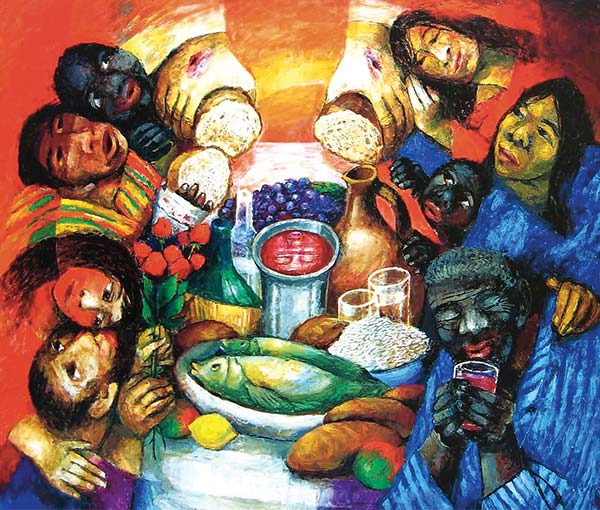
“Table of Hope” by Joey Velasco

While they were eating, Jesus took a loaf of bread, and after blessing it he broke it, gave it to the disciples, and said, “Take, eat; this is my body.” Then he took a cup, and after giving thanks he gave it to them, saying, “Drink from it, all of you; for this is my blood of the covenant, which is poured out for many for the forgiveness of sins. (Matthew 26:26-28, NRSV)

For the Christian, eating and ingesting bread and wine serves as a tangible way of understanding what life is to be like. We take Jesus into the depths of our lives. We ingest him, that is, we engage in an intimate relationship whereby the two of us can never be separated.

We are meant for life together, to enjoy eating and drinking together. True life is sharing both our resources and our hearts with one another. 

Loving God, thank you for your generosity. I am a stranger in this world, yet you invite me to be your guest. You lavishly offer me your hospitality and welcome me into your family. You invite me to share in the abundance of your kingdom. Help me remember that when I offer hospitality to others, I am receiving Christ into my home.

Gracious God, I open my heart to those who are wounded; those who have wounded me; those who are outcasts; and to all who are searching. I want my everyday ordinary life to please you. I am grateful that there is always room at your Table; through Jesus, my Lord. Amen.