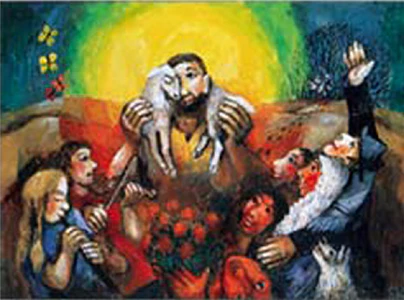
The Parables of the Lost Sheep and the Lost Coin (Luke 15:1-10)

By Sieger Koder (1925-2015)

Now the tax collectors and sinners were all gathering around to hear Jesus. But the Pharisees and the teachers of the law muttered, “This man welcomes sinners and eats with them.”

Then Jesus told them this parable: “Suppose one of you has a hundred sheep and loses one of them. Doesn’t he leave the ninety-nine in the open country and go after the lost sheep until he finds it? And when he finds it, he joyfully puts it on his shoulders and goes home. Then he calls his friends and neighbors together and says, ‘Rejoice with me; I have found my lost sheep.’ I tell you that in the same way there will be more rejoicing in heaven over one sinner who repents than over ninety-nine righteous persons who do not need to repent.“

Or suppose a woman has ten silver coins and loses one. Doesn’t she light a lamp, sweep the house and search carefully until she finds it? And when she finds it, she calls her friends and neighbors together and says, ‘Rejoice with me; I have found my lost coin.’ In the same way, I tell you, there is rejoicing in the presence of the angels of God over one sinner who repents.” (New International Version)

Lost people matter to God… a lot. They matter so much to the Lord that one lost soul who is found is the grounds for a big celestial party. 

Note a simple observation of today’s Gospel lesson: If there is rejoicing in the presence of angels over one sinner who repents, then it is God who is doing the rejoicing. The Lord is absolutely giddy with joy over a lost person being found.

Jesus told two short stories, each teaching the same thing, so that we will be absolutely sure to get it: A loving God has unbounded joy over lost people being found. These parables of Jesus give us a glimpse of God’s own heart. The Lord would do anything to find a lost person, to restore and reconcile that person to right relationships. 

The Lost Sheep by Jorge Cocco Santángelo

God would go dumpster diving and wade through stinky nasty garbage to find just one lost valuable person.

Restoring lost people is such a high priority to God that the Father sent the Son to this earth. Jesus paid the ultimate price of a cruel death on a cross to reconcile a broken lost relationship between people and God.

I have not always been a devoted follower of Christ. I still remember what it felt like to be separated from God and estranged from the Church – it was lonely and awful, like being in a deep black hole with no way of getting out and no one around to help. 

But God mercifully sent people into my life to share good news with me and help me out of my prodigal way of life. I once was lost. But now I am found. When I turned from my path of destruction and embraced Jesus Christ, there was a big party in heaven.

God gathering wayward and lost persons is a gracious activity, seemingly free from criticism. But there was. The rightful Judge of the universe got judged by a group of spiritual simpletons. And because there were complaints leveled at Jesus for purposely going after the lost, it therefore needs to be asked: 

Where do we locate ourselves in these parables? 

The two stories were downright offensive to many of Christ’s original hearers. Those upset with Jesus were so inwardly focused that they believed ministry ought to revolve around them and their needs.

And, what’s more, the religious leaders were offended because they thought all the fuss about sinners would only highlight their sin. In other words, there ought to be no party and no rejoicing for people who have lived an ethically and morally dubious life.

Preaching grace is always offensive to people who work for their salvation. It is scandalous to such persons to hear that Jesus did not come to call the righteous, but sinners to repentance. 

If we hear Christ’s parables and the concern for lost sinners who don’t know Jesus and say, “Well, all this talk about outreach is well and good, but what about us?  What about me? After all, I never went down a path of immorality or hurt anyone. I’m a good person. Where’s my party?” Then, we must locate ourselves as the lost persons in need of being found by God’s grace.

Consider for a moment the worst sinner you can think of – a person for whom you would label as being akin to the devil…. Now picture that person being found by God and becoming a follower of Christ….

Would you attend the party to celebrate that person’s repentance, reconciliation, and recovery? 

If any of us feels justified in our hate, then we are the lost one in need of turning from our sin.

In leaving the ninety-nine sheep in the flock and going after the one sheep, God gave preferential attention to the lost….

Can you live with that? 

These parables of Jesus have significant meaning for church programs, budgets, and committees. By most estimations, only one-in-five lost people in America even knows one Christian. Statistics like that are what keep me up at night; it deeply saddens me. It drives me to prayer.

God’s unconditional mercy and amazing grace is what makes all the difference. 

If we lose the sense of awe and appreciation for what God has done for us in Christ, then there will be no outreach. Finding lost people is not dependent on completing a class on evangelism or getting training in how to answer every question.

Outreach is fueled by passion and desire. Healthy Christians reproduce themselves. I assume you didn’t take a class on how to procreate – you just had the desire and the willingness; and then, you celebrated nine-months later, the birth of new life.

New life always needs to be celebrated because that’s what God does. Yet, the party cannot commence until the lost are found….

O God – blessed Father, Son, and Spirit – sanctify all believers everywhere with your abiding presence. Enlighten the minds of your people more and more with the light of the Gospel. Bring lost people to the knowledge of our Savior Jesus Christ; and those who are walking in the way of life, keep steadfast to the end. Guard those who are strong and prosperous from forgetting you and straying from the flock. Increase in us your grace and love so that we may participate with you in finding the lost. Amen.


John 10:11-21 – The “Good” Shepherd

Jesus, the Good Shepherd, by P. Solomon Raj (1921-2019)

“I am the good shepherd. The good shepherd lays down his life for the sheep. When the hired hand sees the wolf coming, he leaves the sheep and runs away. That’s because he isn’t the shepherd; the sheep aren’t really his. So, the wolf attacks the sheep and scatters them. He’s only a hired hand and the sheep don’t matter to him.

“I am the good shepherd. I know my own sheep and they know me, just as the Father knows me and I know the Father. I give up my life for the sheep. I have other sheep that don’t belong to this sheep pen. I must lead them too. They will listen to my voice and there will be one flock, with one shepherd.

“This is why the Father loves me: I give up my life so that I can take it up again. No one takes it from me, but I give it up because I want to. I have the right to give it up, and I have the right to take it up again. I received this commandment from my Father.”

There was another division among the Jews because of Jesus’ words. Many of them said, “He has a demon and has lost his mind. Why listen to him?” Others said, “These aren’t the words of someone who has a demon. Can a demon heal the eyes of people who are blind?” (Common English Bible)

Many people in today’s urban and suburban world are completely unfamiliar with sheep and shepherds. So, when it comes to picturing Jesus as the good shepherd, idyllic scenes might come to mind, full of green meadows and pastoral landscapes, where there is perfect peace and rest, at all times.

Having been raised in rural Midwest America, I can confidently say there is little romanticism to the life of shepherds and sheep. Sheep eat a lot. They’ll eat just about anything that’s growing out of the ground. Think about how you would feel if you ate copious amounts of plants…. Lots of gas, trips to the bathroom, and stink.

That’s how it is with sheep. They continually poop and the smell is downright awful. A lot of a shepherd’s daily work is helping sheep deal with all the gas inside them. Sheep are easily prone to bloating from excess gas. This isn’t just an uncomfortable situation for a sheep; it’s an emergency life-and-death scenario. The shepherd must continually be vigilant to the sheep and take care of such circumstances immediately and carefully.

Taking care of sheep is dangerous, difficult, and tedious work. Historically, shepherds were rough characters, constantly on the move to find lush pastures for the flock’s voracious appetite. They had to deal with both animal and human predators looking for an easy meal. Being mostly outdoors, even at night, led to their reputation as drinkers – keeping up a consistent nip of spirits to remain warm. And, of course, they smelled bad.

So, when Jesus described himself as the “good shepherd,” this was anything but a pleasing picture for people in the ancient world. The closest equivalents to our modern day might be for Jesus to say, “I am the good migrant worker,” or the “good carny” (carnival employee).

Anyone or any profession in which we might deem a person in that line of work as of dubious character – that is precisely how a shepherd, and their work, were viewed by ancient people. It’s often the low-wage workers of society who get down and dirty. Because of their work, they get a suspicious and contemptuous reputation. Remarkably, Jesus unabashedly aligned himself with such people.

And yet, it is the discounted professions and the dismissed people from which we must pay attention; God is probably at work in their midst.

The despised Samaritan gained the label of “good” by Jesus for giving himself fully to save a stranger. Jesus puts the same adjective in front of shepherd. Whereas no one in polite society would use “good” for shepherd, Jesus labels himself as the Good Shepherd who lays down his life for the sheep.

Jesus, this incredible figure who puts good and shepherd together, also goes out of his way to bring other sheep into his fold. Since Christ identifies himself as a stinky lowly shepherd, he has no problem connecting with everyone. After all, when one is already low, there’s no looking down on another.

People everywhere, no matter their station in life, can hear the voice of Jesus speaking to them when they, too, are low enough to be able to listen.

The Good Shepherd by He Qi

Jesus, the Good Shepherd, is also the sacrificial lamb. In laying down his life he takes it up again (John 10:17). And when we participate in that dying and rising, when we eat the bread and drink the cup of salvation, we know he abides in us(1 John 3:24). Remaining in Christ with our Good Shepherd means, we, too, lay down our lives:

This is how we’ve come to understand and experience love: Christ sacrificed his life for us. This is why we ought to live sacrificially for our fellow believers, and not just be out for ourselves.

If you see some brother or sister in need and have the means to do something about it but turn a cold shoulder and do nothing, what happens to God’s love? It disappears. And you made it disappear.

My dear children, let’s not just talk about love; let’s practice real love. This is the only way we’ll know we’re living truly, living in God’s reality. (1 John 3:16-18, MSG)

Community is messy. People are stinky. Stepping into another’s life is rarely picturesque or idyllic. Yet, it’s at the same time elegant and aromatic. For we discover that our old ideas of beauty are obsolete. We gain a new spiritual sense which is redolent with the fragrance of Christ.

O God, Shepherd of all your people, deliver us from all troubles, worries and cares that assail us so that we may always do what is pleasing in your sight, and remain safe in the care of our Good Shepherd, Jesus Christ our Lord. Amen.

Luke 18:18-30 – A Rich Man’s Question

A certain ruler asked him, “Good teacher, what must I do to inherit eternal life?”

“Why do you call me good?” Jesus answered. “No one is good—except God alone. You know the commandments: ‘You shall not commit adultery, you shall not murder, you shall not steal, you shall not give false testimony, honor your father and mother.’”

“All these I have kept since I was a boy,” he said.

When Jesus heard this, he said to him, “You still lack one thing. Sell everything you have and give to the poor, and you will have treasure in heaven. Then come, follow me.”

When he heard this, he became very sad, because he was very wealthy. Jesus looked at him and said, “How hard it is for the rich to enter the kingdom of God! Indeed, it is easier for a camel to go through the eye of a needle than for someone who is rich to enter the kingdom of God.”

Those who heard this asked, “Who then can be saved?”

Jesus replied, “What is impossible with man is possible with God.”

Peter said to him, “We have left all we had to follow you!”

“Truly I tell you,” Jesus said to them, “no one who has left home or wife or brothers or sisters or parents or children for the sake of the kingdom of God will fail to receive many times as much in this age, and in the age to come eternal life.” (New International Version)

The sorts of questions we ask say a lot about us. We might classify all questions into genuine curiosity and self-justification. This includes the tone of voice and affect in which the question is asked.

The wealthy man in today’s Gospel lesson asked a question. Rather than his tone being one of truly seeking to know, and his affect reflecting an authentic desire to know, instead he had his nose held high with a sanctimonious sounding expression. The man was mostly after a divine sanction of his lifestyle and his spirituality.

It doesn’t take the Son of God to know that this guy was pompously trying to angle for some kudos from Jesus about his superior life. But Christ, rather than blowing off the rich man or just blasting him for being a peacock, answered his question and led the man to what is most important.

One way of looking at the interaction between the rich man and Jesus is that it was an intervention. The rich man was addicted to wealth and money, but he didn’t see it. And he wanted validation that his way of life was sanctioned by the Almighty. 

The rich man believed himself to be quite godly and spiritual – an upstanding citizen, a religious man, attentive to God’s law. It’s a sad story because he walked away un-transformed by his encounter with Jesus and refused to follow him. He didn’t see himself as hopeless and desperately needing to change. He held to his denial.

We are all addicted to sin.  If you want to push back on that statement and are thinking, “Well, I don’t have as much money as _____” or, “So-and-so really has a problem with this…” then you are practicing what we call, in terms of addiction, denial. 

Truth be told, all of us are in some sort of denial about how much we really trust in paychecks, bank accounts, investments, and a wealth of stuff. Even people who are truly in poverty can also be addicted to wealth by always thinking about money and wishing for it as the answer to their problems, as if wealth is the highest good to attain in life.

Jesus put the problem out there for us all to see by communicating to us that sin cannot be managed – rather, sin needs to die. 

The good news is that by honestly facing up to our own addiction to things we can find grace. Grace always has the last word. Grace trumps addiction to money, stuff, and anything else. 

God’s love and acceptance is not conditional. Both the wretched sinner and the pompous peacock will find Christ’s forgiveness through the cross. Jesus put sin to death. We are simply invited to bring it out in the open, confess it, and follow Jesus.

One question that delights the heart of God, and reflects a humble and penitent spirit from us is this: “Will you forgive me, Lord?”

Most merciful God, we confess that we have sinned against you in thought, word, and deed, by what we have done, and by what we have left undone. We have not loved you with our whole heart; we have not loved our neighbors as ourselves. We are truly sorry and we humbly repent. For the sake of your Son Jesus Christ, have mercy on us and forgive us; that we may delight in your will, and walk in your ways, to the glory of your Name. Amen.

1 Timothy 4:6-16 – Train Yourself to Be Godly

If you explain these things to the brothers and sisters, Timothy, you will be a worthy servant of Christ Jesus, one who is nourished by the message of faith and the good teaching you have followed. Do not waste time arguing over godless ideas and old wives’ tales. Instead, train yourself to be godly. “Physical training is good, but training for godliness is much better, promising benefits in this life and in the life to come.” This is a trustworthy saying, and everyone should accept it. This is why we work hard and continue to struggle, for our hope is in the living God, who is the Savior of all people and particularly of all believers.

Teach these things and insist that everyone learn them. Don’t let anyone think less of you because you are young. Be an example to all believers in what you say, in the way you live, in your love, your faith, and your purity. Until I get there, focus on reading the Scriptures to the church, encouraging the believers, and teaching them.

Do not neglect the spiritual gift you received through the prophecy spoken over you when the elders of the church laid their hands on you. Give your complete attention to these matters. Throw yourself into your tasks so that everyone will see your progress. Keep a close watch on how you live and on your teaching. Stay true to what is right for the sake of your own salvation and the salvation of those who hear you. (New Living Translation)

There are several metaphors throughout the New Testament illustrating the nature of the Christian life and Christian community.

God’s people are the temple of the Holy Spirit, the house where the Lord dwells; the Body of Christ, a group working together and strengthening one another in faith; the army of the Lord, advancing with the shared purpose of proclaiming good news and extending God’s benevolent rule – just to name a few.

All the metaphors are embedded with the need for training, for spiritual disciplines and practices which strengthen faith and promote spiritual health.

Just as an army of recruits needs intense basic training and ongoing discipline; and just as the body needs hourly movement and daily exercise of its muscles; so, Christian communities require spiritual development with a variety of forms and functions to elicit and establish a solid godly life.

The curriculum in the school of faith; the liturgy within the spiritual temple; the boot camp for the Lord’s soldier; and the repetitions for Christ’s Body, all involve reading and listening to Holy Scripture. And furthermore, to do so with rhythms of personal and corporate integrity, confident faith, steadfast love, encouraging words, and virtuous behavior.

If we dedicate ourselves to these things, there will be no room for entertaining wacky stories which have no basis in truth. Instead, there will be lush spiritual growth, teachable spirits, humble service, supportive beliefs, compassionate ministry, and open fellowship.

The high values of the worthy servant of Christ need to be both used and guarded. With all of our treasured earthly possessions, whatever they may be, we handle them appropriately and carefully – keeping them in a secure place when not used – and using them with care when out.

Our faith, our life and doctrine, is both a precious possession to be guarded, as well as a necessary tool to do the will of God.

Just as our bodies have physical muscles, so the Body of Christ has spiritual muscles.

Faith is a muscle which needs to be stretched, exercised, rested, and supplied with plenty of protein and necessary nutrients. Overtaxed muscles will fatigue and can be damaged through too much exertion. And underused muscles will wither and atrophy, unable to handle even the smallest of strain when we need them.

So, it is best to have proper spiritual hygiene and exercise through a regimen of tried and true practices designed to improve and maintain healthy faith. If you want to build your faith, consider the following 10 ways:

  1. Increase your amount of reading. There is no substitute for daily repetitions of reading the Bible. Supporting a growing faith will require more voluminous reading.
  2. Focus on listening to the biblical text. Reading is only as good as our listening skills. For the Christian, paying attention to the Holy Spirit’s gentle whispers is a must.
  3. Decrease your media time. For all the good stuff out there, a lot of media information is based in myth, half-truths, and opinions masked as facts – not to mention all the hack and huckster preachers.
  4. Pray more. In fact, pray continually.
  5. Practice gratitude – not complaining. Need I say more?
  6. Snack on good spiritual reading. Consuming a good book before bed keeps the faith muscle fed longer.
  7. Rest! When God created and instituted seven days, the first day was a day of rest; the workdays came after. Don’t flip-flop the divine order.
  8. Supplement with good spiritual conversation. Half-baked theological ideas come from remaining in one’s own cave-like head. Consultation, collaboration, and fellowship help create a rich and full faith.
  9. Don’t overtrain. Good idea: Read the Bible in a year. Bad idea: Read the Bible in a month. Good idea: Digest the contents of ecumenical Creeds and church Confessions. Bad idea: Stuff a bunch of knowledge down your gullet without any love to wash it down. Savor the meal. Don’t be a pig.
  10. Don’t lift too heavy for your faith muscle. The ancient desert fathers spent years developing their faith and could do incredible feats of spiritual strength. Christianity isn’t a competition of keeping up with the Francis of Assisi’s and Martin Luther’s of history. Use the measure of faith given to you and focus on those small daily decisions of trust.

Christianity is a marathon, not a 100-meter sprint. We persevere to the end, not flame out after taxing ourselves with expectations and responsibilities God never gave us.

Be safe. Be strong. Be smart. Be spiritual. We are all in this together.

Gracious God, fill your Church with truth, the truth with peace, and the peace with love. Where our faith is weak, make it strong; where it is misguided and in error, correct and direct it; where it is amiss, reform it; where it is in want, provide for it; where it is divided, reunite it, for the sake of Jesus Christ your Son our Savior. Amen.