A Call for Unity (1 Corinthians 10:1-4)

For I do not want you to be ignorant of the fact, brothers and sisters, that our ancestors were all under the cloud and that they all passed through the sea. They were all baptized into Moses in the cloud and in the sea. They all ate the same spiritual food and drank the same spiritual drink; for they drank from the spiritual rock that accompanied them, and that rock was Christ. (New International Version)

We are all on spaceship earth together. Everyone has the similar experiences of birth, life, death, and the joys and sorrows of it all.

But what we don’t all share is our individual responses to all those events. Some folks do better than others with the ups and downs of life in this world.

So there are two pledges that are most helpful to make to God and to each other, especially when it comes to Christ’s Church:

  1. I will be a unifying person.
  2. I will not make everything about my personal preferences.

Christians need to get along and work together; and that cannot happen if all we want is what we want. 

“Love one another. As I have loved you, so you must love one another. By this everyone will know that you are my disciples if you love one another.” Jesus (John 13:34-35, NIV) 

Unity, forgiveness, reconciliation, love, and communicating the gospel message of forgiveness happens by people being gracious to each other so that a watching world can see the validity of Christ within us.

Followers of Jesus have a responsibility to be a source of unity, not division. 

Make every effort to keep the unity of the Spirit through the bond of peace. There is one body and one Spirit, just as you were called to one hope when you were called; one Lord, one faith, one baptism; one God and Father of all, who is over all and through all and in all. (Ephesians 4:3-6, NIV) 

Unity doesn’t merely happen; it must be pursued and be a common value of all. 

As God’s chosen people, holy and dearly loved, clothe yourselves with compassion, kindness, humility, gentleness and patience. Bear with each other and forgive one another if any of you has a grievance against someone. Forgive as the Lord forgave you. And over all these virtues put on love, which binds them all together in perfect unity. (Colossians 3:12-14, NIV) 

We are to be like-minded, having the same love for one another that we have for Jesus, being united in spirit and purpose. 

Do nothing out of selfish ambition or vain conceit. Rather, in humility value others above yourselves, not looking to your own interests but each of you to the interests of the others. (Philippians 2:3-4, NIV) 

The specific problem in the Corinthian Church was their allegiance to different individuals; each person and clique had their favorite preacher. And they grouped themselves around how that particular pastor taught and ministered. 

The situation was a classic case of church folk saying to each other, “That’s not how so-and-so did it!” But that approach of following pet preachers ends up in division – the focus becomes on the methods of ministry rather than the substance of the ministry itself. 

Christians must keep in mind that the heart of all Christian ministry is the cross of Christ that saves us from our pettiness and transforms us into forgiven people who spread forgiveness and healing. Therefore, our primary loyalty is to Christ and the message of the cross, and not to particular personalities or programs.

The sin of the Corinthians was misguided loyalties; and the answer to wrong priorities is to have Jesus and the cross as our central and guiding allegiance. 

The Corinthian believers were emotionally tied to the leader who baptized them and who was a significant force for good in their lives. Its more than understandable to have a special relationship with someone who was there for you. However, what’s not okay is following that person as if they’re Jesus himself, and then insisting that everything be done the way my favorite does it. 

Christian unity means to agree with one another about the good news of Christ, and let everything else be a matter of lesser importance. Can you live with that?

A sobering reality is this: Not everyone in every church is there to follow Jesus. And as long as that’s a reality, there will be schisms, factions, cliques, divisions and disunity. The visible church always has a mix of righteous and unrighteous people within it, concerned more about power politics than humbly following Jesus and spreading the gospel. 

At the same time, yet another reality is that the church has taken unity and purity seriously throughout its history and sought to preserve the collective integrity of its fellowship. Sin was discerned as the community’s responsibility to address. It’s only been in the past 300 years that sin has been viewed as something which is only a matter between the individual and God. 

In the early centuries of the Church, believers desiring to repent of their sins would typically spend a period of time fasting and praying, then appearing before the entire church to make a public confession. 

Don’t freak out. I’m not necessarily endorsing that method for us, but nevertheless, the message remains essential: Agree with one another, make peace, and bring spiritual healing to all. The power of Christianity is in the blood of Jesus to forgive sins, and not by trying to ensure things get done, the way we think they ought to get done, in the way our favorite people do them.

Maybe you recognize or can relate to some of these common behavior patterns in many churches:

  1. Worship wars. One or more factions in the church want the music and the liturgy just the way they like it. Any deviation is met with anger and complaining.
  2. Preservation of the church building as of the highest priority (above spiritual growth and maturity).
  3. Protection of programs and ministries held in such high regard that, even if they are not effective, the church keeps doing them.
  4. Attitudes of entitlement. A sense of deserving special treatment and attention.
  5. Concerns about changing things, and yet, no real concern about changing lives.
  6. Apathy and avarice. A lack of motivation and energy to build relationships with outsiders and share the gospel; and hoarding spiritual resources for the insiders.

There is to be unity around the things most important to God. 

Christian unity isn’t about keeping everyone happy; it’s about the good news of Jesus and being anchored to the Rock of our salvation, Christ. All the practical and important stuff of human life must be shaped and governed by the cross of Jesus, because that’s where God’s power saved the world, and where hope is found. 

Lord Jesus, you prayed that we might all be one. We pray for the unity of Christians everywhere, according to your will and your methods. May your Spirit enable us to experience the suffering caused by division, to see our sin for what it is, and to hope beyond all hope. Amen.

Changing the System (Philemon 1-25)

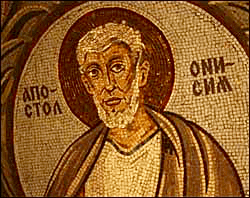
A mosaic of Philemon’s slave, Onesimus

Paul, a prisoner of Christ Jesus, and Timothy our brother,

To Philemon our dear friend and fellow worker—also to Apphia our sister and Archippus our fellow soldier—and to the church that meets in your home:

Grace and peace to you from God our Father and the Lord Jesus Christ.

I always thank my God as I remember you in my prayers, because I hear about your love for all his holy people and your faith in the Lord Jesus. I pray that your partnership with us in the faith may be effective in deepening your understanding of every good thing we share for the sake of Christ. Your love has given me great joy and encouragement, because you, brother, have refreshed the hearts of the Lord’s people.

Therefore, although in Christ I could be bold and order you to do what you ought to do, yet I prefer to appeal to you on the basis of love. It is as none other than Paul—an old man and now also a prisoner of Christ Jesus—that I appeal to you for my son Onesimus, who became my son while I was in chains. Formerly he was useless to you, but now he has become useful both to you and to me.

I am sending him—who is my very heart—back to you. I would have liked to keep him with me so that he could take your place in helping me while I am in chains for the gospel. But I did not want to do anything without your consent, so that any favor you do would not seem forced but would be voluntary. Perhaps the reason he was separated from you for a little while was that you might have him back forever—no longer as a slave, but better than a slave, as a dear brother. He is very dear to me but even dearer to you, both as a fellow man and as a brother in the Lord.

So if you consider me a partner, welcome him as you would welcome me. If he has done you any wrong or owes you anything, charge it to me. I, Paul, am writing this with my own hand. I will pay it back—not to mention that you owe me your very self. I do wish, brother, that I may have some benefit from you in the Lord; refresh my heart in Christ. Confident of your obedience, I write to you, knowing that you will do even more than I ask.

And one thing more: Prepare a guest room for me, because I hope to be restored to you in answer to your prayers.

Epaphras, my fellow prisoner in Christ Jesus, sends you greetings. And so do Mark, Aristarchus, Demas and Luke, my fellow workers.

The grace of the Lord Jesus Christ be with your spirit. (New International Version)

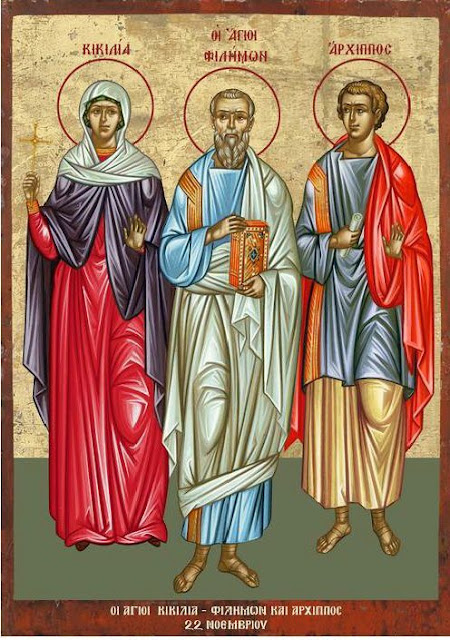
Orthodox depiction of Saints Apphia, Philemon, and Archippus

Tucked away near the end of the 66 books of the Holy Bible is the little letter of Philemon. Many Christians have neither heard a sermon preached on it, nor ever discussed it. Yet, there it is, contained as part of the New Testament canon. So, it could use some attention from us.

The letter is an appeal to Philemon concerning his slave Onesimus – who fled from his master and subsequently ended up converting to Christianity through the Apostle Paul’s influence.

At the time, Paul was imprisoned and Onesimus attended to his needs. Although Paul desired to keep Onesimus with him, he sent the slave back to Philemon. The Apostle was wanting the master to receive the slave as a beloved brother in the Lord, and not just as a servant. Then, Paul hoped Philemon would send Onesimus back to him, thus smoothing out the master/slave relationship and having his own needs met, as well.

The bottom line of the letter is that Paul very much desired that Onesimus be freed from his servitude by Philemon. He didn’t want to pull rank and twist Philemon’s arm to do it. Even though we don’t precisely know what happened in response to Paul’s letter, it’s likely that Onesimus was freed, since the appeal was included in the New Testament.

Christianity, ideally, is meant to transform lives, to change social relationships, to establish a truly egalitarian society in which the status of humans owning other humans would be done away with. Men ought to become brothers with one another and not highly stratified and separated with gross power inequities between them.

Now, in Christ, it doesn’t matter if you are a Jew or a Greek, a slave or free, male or female. You are all the same in Christ Jesus.

Galatians 3:28, ERV

Sitting where we are now, a few millennia later, we might find it curious that Paul and other biblical writers didn’t simply call for the outright abolition of slavery altogether. And yet, slavery was such an ensconced part of the ancient world (some places in the Roman Empire had up to 70% of the population as slaves) that to do so immediately would have likely brought such shock to the system that more harm than good may result.

In Paul’s experience, he continually went about the business of agitating for change by proclaiming a gospel of grace for all people. And the places where he did so saw great societal transformation – which is why Paul got so much pushback from so many authorities who benefited from keeping others under their feet.

In the household of faith, all persons are sisters and brothers and useful servants of one another and of the Lord.

The healings by Jesus in the Gospels not only restored one’s physical health but also restored the individual back to the community. The leper’s social stigma was lifted; the woman’s isolation due to bleeding was done away with; and stereotypes of those born with disabilities were overturned.

No one is inferior in the kingdom of God. Everyone is inherently worthy and has a vital purpose in God’s new society. Since the cross of Christ has erased all barriers, Christian community is to be realized through respectful equality, mutual love, and caring fellowship.

That’s how the system is changed.

Almighty God, by your Holy Spirit you have made us one with your saints in heaven and on earth. May our earthly pilgrimage be always supported by this fellowship of love and prayer, and know ourselves surrounded by their witness to your power and mercy; through Jesus Christ our Lord. Amen.

Prayer Is the Heartbeat of the Church (Acts 1:12-17, 21-26)

“The Forerunners of Christ with Saints and Martyrs” by Italian painter Fra Angelico (1395-1455)

Then the apostles returned to Jerusalem from the hill called the Mount of Olives, a Sabbath day’s walk from the city. When they arrived, they went upstairs to the room where they were staying. Those present were Peter, John, James and Andrew; Philip and Thomas, Bartholomew and Matthew; James son of Alphaeus and Simon the Zealot, and Judas son of James. They all joined together constantly in prayer, along with the women and Mary the mother of Jesus, and with his brothers.

In those days Peter stood up among the believers (a group numbering about a hundred and twenty) and said, “Brothers and sisters, the Scripture had to be fulfilled in which the Holy Spirit spoke long ago through David concerning Judas, who served as guide for those who arrested Jesus. He was one of our number and shared in our ministry….”

Therefore it is necessary to choose one of the men who have been with us the whole time the Lord Jesus was living among us, beginning from John’s baptism to the time when Jesus was taken up from us. For one of these must become a witness with us of his resurrection.”

So they nominated two men: Joseph called Barsabbas (also known as Justus) and Matthias. Then they prayed, “Lord, you know everyone’s heart. Show us which of these two you have chosen to take over this apostolic ministry, which Judas left to go where he belongs.” Then they cast lots, and the lot fell to Matthias; so he was added to the eleven apostles. (New International Version)

So, what do you do when you don’t know what to do? And what do you do when you have a problem or challenge?

Good old American ingenuity, the Protestant work ethic, and fixing things is the reflexive response of many people. In the belief that we can solve anything, what typically gets left out of the equation is seeking God’s presence and power in order to rightly discern next steps.

But that wasn’t the response of the earliest church. When faced with their small numbers and a large mission to accomplish, they prayed. They more than prayed. They continually got together, just to pray. Prayer was the air they breathed. The believers understood they needed God (not simply to rubber stamp their plans) for moving forward in mission and ministry.

Christians need the vision and imagination that can only come through consistent daily prayer. Otherwise, they will not choose wisely and find themselves in a quandary of their own making.

Imagine not having to purchase what you need the most today.

Maybe you’re in a real pinch. Your financial budget isn’t budging. Perhaps you’re wondering what items you need to do without for a while. It could be that the bills aren’t all getting paid. Or maybe you’re concerned with how in the world you’re going to buy Christmas presents for the family.

Imagine having all the love you need today without working to earn it.

Maybe you have a strained relationship. It might be that you’re hurt from a marriage or a love that has gone sour. Perhaps a friendship is on the rocks, or a family member won’t talk to you. You’re wondering if it will ever be better, wondering if love will find you again.

Imagine continually having a church experience of being full of the grace of Jesus, the love of God the Father, and the power of the Holy Spirit.

Maybe your church has a legalistic bent. Perhaps the church is withdrawn into cliques and special interest groups. It could be that the Spirit hasn’t shown up since 1959. You’re tired, weary of the chronic sameness and status quo of a stagnant place.

For all these things, and so many more of life’s problems and situations, there is good news… really good news!

Prayer is the currency to what you need most, the means of receiving and giving love, and the path to a gracious and powerful Christian and Church life.

Prayer is the heartbeat of the church. The promise of prayer still stands. God gives. We receive. But we must ask!

You didn’t choose me, but I chose you. I have appointed you to go, to produce fruit that will last, and to ask the Father in my name to give you whatever you ask for. (John 15:16, GW)

Sometimes God just gives without us asking. That’s great. Yet, God wants so much more for you and me and our faith communities. God longs for us to be vitally connected to Christ, and that connection happens through prayer. We can bank on the answers to our prayers when we:

  • Stay joined to Jesus (John 15:4)
  • Let Christ’s teachings become part of you (John 15:7)
  • Remain faithful to Christ’s love for you (John 15:9)
  • Obey Jesus (John 15:10)

Imagine having your will align with the perfect will of God.

Stay joined to me and let my teachings become part of you. Then you can pray for whatever you want, and your prayer will be answered. (John 15:7, CEV)

Perhaps you are skeptical. You’ve prayed a long time with nothing happening. You’re discouraged and feel like prayer doesn’t work, or that something is wrong with you. 

There is a mysterious and mystical aspect to prayer that we will never quite understand. However, I do know that Jesus didn’t put a timetable on the answers – they will come when they come. And they will come. 

Maybe we’ll discover that what we want and need the most is to let God’s will and way be done in us, no matter what it is. Perhaps the point is to change us, and not always to change our circumstances.

We have an incredible privilege; we get to ask, without having to buy answers to prayer.

We don’t have to do backflips to get God’s attention. We simply ask. 

We don’t have to try and work to earn God’s favor. We don’t have to draw up detailed plans like some sort of architectural design to see a fruitful, loving, and powerful church. We just ask and remain closely connected to Jesus. 

O Lord, grant me to greet the coming of this day in peace. 

Help me in all things to rely upon Your holy will. 

In every hour of the day, reveal your good and holy will to me. 

Bless my dealings with all who surround me. 

Teach me to treat all that comes to me throughout the day with peace of soul and with the firm conviction that your will governs all. 

In all my deeds and words, guide my thoughts and feelings. 

In unforeseen events, let me not forget that all situations, no matter what, are sent by you. 

Teach me to act firmly and wisely, without embittering and embarrassing others. 

Give me the strength to bear the fatigue of this day with all that it shall bring. 

Direct my will; teach me to pray; pray you yourself in me. Amen.

 –A Prayer from St. Philaret of Moscow (1782-1867)

Think of the Needs of the Group (1 Corinthians 10:23-11:1)

Looking at it one way, you could say, “Anything goes. Because of God’s immense generosity and grace, we don’t have to dissect and scrutinize every action to see if it will pass muster.” But the point is not to just get by. We want to live well, but our foremost efforts should be to help others live well.

With that as a base to work from, common sense can take you the rest of the way. Eat anything sold at the butcher shop, for instance; you don’t have to run an “idolatry test” on every item. “The earth,” after all, “is God’s, and everything in it.” That “everything” certainly includes the leg of lamb in the butcher shop. If a nonbeliever invites you to dinner and you feel like going, go ahead and enjoy yourself; eat everything placed before you. It would be both bad manners and bad spirituality to cross-examine your host on the ethical purity of each course as it is served. On the other hand, if he goes out of his way to tell you that this or that was sacrificed to god or goddess so-and-so, you should pass. Even though you may be indifferent as to where it came from, he isn’t, and you don’t want to send mixed messages to him about who you are worshiping.

But, except for these special cases, I’m not going to walk around on eggshells worrying about what small-minded people might say; I’m going to stride free and easy, knowing what our large-minded Master has already said. If I eat what is served to me, grateful to God for what is on the table, how can I worry about what someone will say? I thanked God for it, and he blessed it!

So eat your meals heartily, not worrying about what others say about you—you’re eating to God’s glory, after all, not to please them. As a matter of fact, do everything that way, heartily and freely to God’s glory. At the same time, don’t be callous in your exercise of freedom, thoughtlessly stepping on the toes of those who aren’t as free as you are. I try my best to be considerate of everyone’s feelings in all these matters; I hope you will be, too.

It pleases me that you continue to remember and honor me by keeping up the traditions of the faith I taught you. (The Message)

“To know how to free oneself is nothing; the arduous thing is to know what to do with one’s freedom.”

Andre Gide

Extreme individualism wants what it wants and doesn’t give a thought about anyone else – which is why we always have such a peck of trouble in the world all the time.

We need to get a phrase into our language which will become a continual mantra we say and observe:

Think of the needs of the group.

Christianity is a religion of community, of being attentive to and meeting one another’s needs, and of caring about the common good of all persons throughout the world. Christians dishonor their Lord and buck their spiritual tradition whenever they go rogue and base everything they say and do on what sort of advantage it is for them without considering others.

Yes, believers in Jesus have freedom in Christ. The cross has released the shackles that kept us in sin’s bondage. But, no, that doesn’t mean we get to do whatever we want, whenever we want. That’s the way individualism looks at it. That’s not how a communal people, the church, are to look at it.

Freedom hinges on two very important and seemingly small grammar prepositions: from and to.

Freedom always involves two elements:

  1. Freedom from what hinders or oppresses us.
  2. Freedom to become who we are meant to be.

In Christianity, believers are saved from sin, death, and hell – released from guilt and shame. There is redemption from the pit of despair. The bonds that hindered are now broken through the cross of Christ. The power of the world, the sinful nature, and the devil are taken away.

Yet, in no way does that now mean that we now get to do whatever we want, as if we’ve finally outgrown childhood and parental authority.

The extreme individualist Christian looks at freedom solely from this vantage. As a result, such a person considers the church as nonobligatory, involvement in issues of justice as optional, the use of personal funds and resources as discretionary, and accountability to others as arbitrary.

Such individualism sees Christianity as a fire insurance policy from hell, and a ticket punched for heaven. Until Christ returns, the reasoning goes, I can do whatever the heck I want. It’s my life, not yours.

Christians, however, are still servants. Whereas we were once enslaved to the dark forces of this world, now we are slaves to Christ. We exchanged masters. Satan is no longer the deceitful and lying task master over us. We are now under new management and have a new Master, the Lord Jesus. We’ve changed allegiances.

And now, submitted to Christ, we embrace our mandate of freedom to become whom we were always meant to be: At peace with our Creator and in harmony with all creation. We are now free to enjoy right relationships with God and others, to walk in faith, hope, and love, and to bless both the church and the world.

The Christian’s freedom came at a price: the very blood of Christ Jesus. Therefore, we are not to abuse that freedom by focusing solely on our freedoms from all that once bound us. We are also responsible and accountable for using that freedom in going to the world and proclaiming the gospel in word and sacrament, as well as loving God and neighbor.

Freedom is only freedom when it has the well-being of everyone in mind.

Think of the needs of the group.

Lord God, almighty and everlasting Father: Help us to live into the freedom you have brought to us. May we exercise our freedom, with the heart of a faithful disciple of Jesus Christ, to serve your purposes. Unite us, protect our sacred liberties and rights, and defend us from every evil. Strengthen your people as a foundation of moral clarity, justice, love, and gospel proclamation. Grant all this by the power of your Holy Spirit and in the Name of Jesus Christ, your Son, our Lord. Amen.