I Am the Gate (John 10:1-10)

“Very truly I tell you Pharisees, anyone who does not enter the sheep pen by the gate, but climbs in by some other way, is a thief and a robber. The one who enters by the gate is the shepherd of the sheep. The gatekeeper opens the gate for him, and the sheep listen to his voice. He calls his own sheep by name and leads them out. When he has brought out all his own, he goes on ahead of them, and his sheep follow him because they know his voice. But they will never follow a stranger; in fact, they will run away from him because they do not recognize a stranger’s voice.” Jesus used this figure of speech, but the Pharisees did not understand what he was telling them.

Therefore Jesus said again, “Very truly I tell you, I am the gate for the sheep. All who have come before me are thieves and robbers, but the sheep have not listened to them.I am the gate; whoever enters through me will be saved. They will come in and go out, and find pasture. The thief comes only to steal and kill and destroy; I have come that they may have life, and have it to the full. (New International Version)

In an idyllic world, we would never have to contend with thieves and interlopers within the flock of God. But, as you well know, we live in a less than perfect world. The spiritual robber-baron is the one who poses as a religious figure, yet is really around to fleece the sheep.

Obviously, anyone who has to jump the fence, instead of entering through the gate, has something nefarious up their dastardly sleeve. In fact, these interlopers feel they have a right to get in, by any means, because of their inflated sense of self-importance.

Jesus, of course, is using metaphor and figure of speech to communicate something important: The thieves are robbing God’s honor for themselves and bringing harm to God’s people. By trying to take away the way, the truth, and the life, the religious leaders were spiritual burglars attempting to be both gate and gatekeeper.

In short, the religious leaders believed they were more important than Jesus; and they tried to keep Christ and the people from connecting with each other.

And that is the insidious form of all religious quackery – to keep people separated from what can help them the most so that the charlatan can soak up all the attention, authority, and accolades.

But a faithful and true shepherd enters through the gate with confidence and care. Such a person has no other agenda and no other concern than Jesus and what Christ has said, has done, and will do.

The pastoral ministers amongst us help lead the flock through the gate so that they might enjoy safety, security, and succulence. The shepherd calls people by name, and doesn’t generically yell at nameless folk, to bring them alongside the Good Shepherd.

Thus, we are to have a faithful concentration and commitment to Christ; a voice which is discernibly oriented toward pointing people’s attention to Christ; and a teaching and leadership which moves into the world in order to bring Christian speech and action that blesses the world.

One of the problems many persons experience is that they listen to strange voices, instead of the familiar voice of their trusted pastor and the voice of Scripture, reason, and history. They follow a pet preacher’s or person’s interpretation of everything without reservation, rather than seeking to hear the voice of God in everything which is said.

Big churches, large ministries, and eloquent people are not necessarily the vocal chords of God. We must be discerning and wise. Not everyone who says, “Lord, Lord,” will enter the kingdom of heaven. It’s only the person and the faith community which does the will of God that’s able to get in.

Wolves in sheep’s clothing exist. So, we must beware.

Idioms, figures of speech, and metaphors get lost on some folk. That’s what happened for Christ’s original hearers. A lot of head-scratching was happening because they couldn’t figure out what in the world Jesus was talking about. “They” are the people who interpret all of life through personal agendas and selfish means. Their self-absorption prevented them from seeing the person right in front of them, who he really was, and what he was actually saying to them.

I Am the Gate of the Sheepfold, by Kathrin Burleson

So, Jesus plainly told them that he himself is the gate of the sheep. “I am” the gate. Deliverance, reconciliation, freedom, and protection all come together in Christ to provide a good life, a life of abundance that is worth living. We have peace with God through the Lord Jesus.

In today’s Gospel lesson, we learn from Jesus the following:

  • The key to being a good shepherd is being faithful to Jesus Christ
  • The concerns of a good shepherd are to attract, bring in, protect, free, feed, and lead God’s people into a good life through Jesus Christ
  • The way for a good shepherd is to love the sheep, care for them, and be with them through thick and thin, as Christ does
  • The preoccupations of those who ignore entering through the gate, which is Jesus, are to gain for themselves what rightly belongs to God: glory, honor, praise, power, authority, accolades, and devotion.

Everything hinges on Jesus as the gate of life. In centering ourselves completely around Christ, and by giving up the false self of keeping up appearances to others, we find our true self, connected to God in which all our needs are fully met and satisfied.

Merciful Father, you gave your Son Jesus Christ to be the Good Shepherd. In his love for us, he laid down his life and rose again. Keep us always under his protection, and give us grace to follow in his steps, in the strength and enablement of the Holy Spirit. Amen.

How To Get Through Difficulty (Psalm 119:105-112)

Your word is a lamp
that gives light
    wherever I walk.
Your laws are fair,
and I have given my word
    to respect them all.
I am in terrible pain!
Save me, Lord,
    as you have promised.
Accept my offerings of praise
    and teach me your laws.
I never forget your teachings,
although my life is always
    in danger.
Some merciless people
    are trying to trap me,
but I never turn my back
    on your teachings.
They will always be
my most prized possession
    and my source of joy.
I have made up my mind
to obey your laws forever,
    no matter what. (Contemporary English Version)

Attitude. Affection. These are the two qualities that stand out to me in today’s Psalm lesson. The psalmist is a person who is determined to hold onto God’s Law because it is his heart’s delight.

Our attitudes and our affections are meant to fit together like a hand in a glove. Our attitudes help us push through suffering to realize better days. And our affections drive us forward, allowing us to experience joy in the present moment as we await our hope of ultimate deliverance.

Commitments are fluid, always moving – so they need to be continually rehearsed and refreshed. We are constantly either fulfilling our promises or reneging on them. There is really no such thing as a one-time vow.

Vows need reinforcement from our attitudes and our affections. Otherwise, they languish on the trash heap of good intentions. This is one reason why the Psalms are designed for constant use.

Spiritually healthy habits must be embedded in our lives, well before any suffering and hard times roll in.

If our normal daily routines involve regular sustenance of God’s Word, then we have a breadth and a depth of robust theology to draw upon when the going gets rough. Furthermore, the sheer force of habit brings us back again and again to the treasure chest of divine instruction, informing our decisions and illuminating the treacherous road ahead.

The psalter is designed to reframe our difficult situations. Especially when a person’s life hangs in the balance, we can view hard and awkward circumstances through the window of the Psalms. Although circumstances change, and we never quite know what to expect, God’s Law remains our ballast and our rock.

Circumstances may change but divine love and morality are unchanging. Jesus Christ is the same yesterday, today, and forever. The Spirit is always with us, through each wave of hardship.

Life is a journey, an exploration into the unknown of the future. The path is shadowy and unclear. We are unsure of what is around the bend. God’s instructions and promises are like a forever energized flashlight, helping us navigate forward. Maybe Jesus had today’s Psalm in mind when he said:

“I am the light of the world. Whoever follows me will never walk in darkness but will have the light of life.” (John 8:12, NRSV)

In Christianity, the Word is embodied in Jesus Christ; he is both the example and fulfillment of all God’s good promises.

A sequence of four metaphors runs through our verses for today:

  1. My feet. With Jesus as Word and Light, we have a constant companion walking alongside us for the journey.
  2. My mouth. There is an intercessor who takes our wordy or malformed prayers and presents them before our heavenly Father
  3. My hands. We do God’s will, despite adverse circumstances, by observing the Master who washed the feet of others.
  4. My heart. In desiring God’s decrees and commands, our hearts find their rest in the One who loved us and gave himself for us.

Our attitudes and affections are transformed into sustainable faith for the long journey.

Our hope is made sure through the promises of God.

Our love finds a resting place in the person of Jesus.

Faith, hope, and love are the shoes enabling us to walk the long uphill road, as well as absorbing the shock as we run with abandon downhill – into the loving arms of God.

I encourage you to find what works best for you in developing helpful spiritual habits. In reading the Bible, I often take the following approach using the acronym S.O.A.P:

Scripture

• Open your Bible and slowly, meditatively, read the portion of Scripture in your reading plan for today.

• Write the reference of what you read in a journal along with the date.

• As you read, ask God’s Spirit to highlight the verse(s) that speak to your life and write it in your journal.

Observation

• Make observations about what you just read and write them in your journal.

• Think about: What is going on? What is the context?  Who are the people being spoken to? What is the background or setting for this verse?

• Paraphrase and write this scripture down in your journal, in your own words.

• What do you think God is saying to you in this scripture?

Application

• Personalize what you have read by asking yourself how it relates to your life right now.

• Ask yourself how you can apply what you just read to your own life and write it in your journal.

• Ask yourself how your life will be different or changed as a result of God speaking to you in this Scripture.

Prayer

• Write out a prayer to God in your journal.

• Your prayer should relate to the verse that you highlighted. It could be asking for help, thanking God, etc. Write down what your heart desires to say to God in response to his Word.

May the words of your mouth, the meditations of your heart, the work of your hands, and the movement of your feet be to the glory of Jesus Christ. Amen.

The Ministry of Jesus (Matthew 4:12-23)

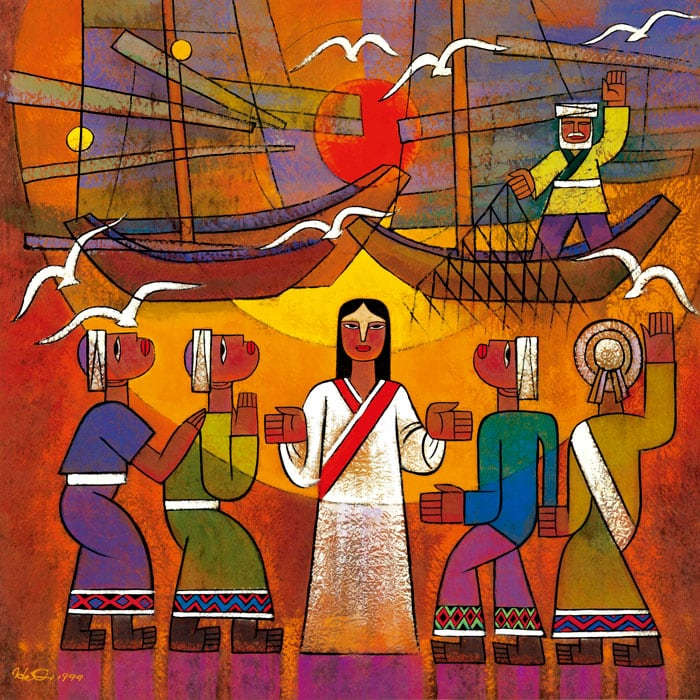
Jesus Calls His Disciples by He Qi

When Jesus heard that John had been put in prison, he withdrew to Galilee. Leaving Nazareth, he went and lived in Capernaum, which was by the lake in the area of Zebulun and Naphtali—to fulfill what was said through the prophet Isaiah:

“Land of Zebulun and land of Naphtali,
    the Way of the Sea, beyond the Jordan,
    Galilee of the Gentiles—
the people living in darkness
    have seen a great light;
on those living in the land of the shadow of death
    a light has dawned.”

From that time on Jesus began to preach, “Repent, for the kingdom of heaven has come near.”

As Jesus was walking beside the Sea of Galilee, he saw two brothers, Simon called Peter and his brother Andrew. They were casting a net into the lake, for they were fishermen. “Come, follow me,” Jesus said, “and I will send you out to fish for people.” At once they left their nets and followed him.

Going on from there, he saw two other brothers, James son of Zebedee and his brother John. They were in a boat with their father Zebedee, preparing their nets. Jesus called them, and immediately they left the boat and their father and followed him.

Jesus went throughout Galilee, teaching in their synagogues, proclaiming the good news of the kingdom, and healing every disease and sickness among the people. (New International Version)

What is “ministry”? 

For some, ministry is only about the souls of people; it is seeing as many people respond to the message of salvation in Christ as possible. 

For others, ministry is meeting the tangible needs of people because there is such a breadth and depth of human social and physical problems. 

And, for others, ministry is defined in terms of what takes place within the four walls of a church building, led by pastors and church leaders.

“Ministry takes place when divine resources meet human needs through loving channels to the glory of God.”

Warren Wiersbe

Problems, however, arise whenever we:

  • Focus on one dimension of ministry. Because, in reality, ministry is multidimensional.
  • Fulfill the outward, administrative demands of ministry – without going after the relational heart of what ministry entails. 
  • Forget about whole groups of people who are different than us. Ministry is for everyone, not some.

We need to look at the ministry of Jesus – what he did and why he did it. Christ’s purpose is to be our purpose: Minister to the total life of all people.

Jesus Preaching

Before there were newspapers, CNN, and 24 hour news cycles, ancient people heard what was happening from heralds or preachers who loudly announced in the streets the important news of the day.

Jesus had a ministry to both Jew and Gentile. Although his ministry was chiefly directed toward his fellow Jews, Christ went out of his way to engage Gentiles, as well, with a message of repentance.

Repentance is turning the whole person – body, soul, mind, will, and emotions – from sin and disobedience to God in obedience to the message of Christ. It involves humility, sorrow for sin, and a commitment to following Jesus.

To repent doesn’t mean to manage sin or clean up parts of my life; it’s a radical conversion from an old way of life to a new way of life. Repentance is not simply adding Jesus to our schedule but is a complete change of how we live.

Christianity is a life, not just an event. Following Jesus is a journey, a life-long process of inner transformation; a complete forsaking of anything that does not please God; and a desire to reorient my life around what’s important to God. 

To illustrate this in a contemporary context, I ask, “What does it mean to follow the Green Bay Packers football team?” A fan not only watches all the games from start to finish, but cheers loudly for the Packers; talks about the Packers with everyone, even strangers; and doesn’t cheer for the Chicago Bears! Fans are committed to their team.

The difference, however, between football and Christianity, is that followers of a team are fans, whereas followers of Jesus are not fans in the stands or watching the television. Instead, Christ followers are on the field of play as teammates with Jesus.

So, when it comes to repentance, we turn from being fans of Jesus to followers of Jesus, doing what he did and saying what he said. We are active participants in the kingdom of God – embracing and embodying a message of repentance to new life in Christ.

Jesus Calling

Jesus calling the first disciples illustrates the kingdom message: a radical break with the old life. Each disciple walked away from a good life and embraced of a new life following Jesus.

Some understanding of Jewish culture in the time of Jesus is helpful here. Central to the life of any Jew was the Torah, the Law. Around age 6, Jewish boys would begin to go to the synagogue for schooling in the Torah by the local rabbi. 

This first level of education was called Beth Sefer (“House of the Book”) and would last until about age 10. In those four years, the first five books of the Old Testament, the Pentateuch, were thoroughly memorized.

By age 10, some of the boys would distinguish themselves as good students and able to handle Torah. So, they would continue on in the second level of schooling called Beth Talmud (“House of Learning”). Those that did not continue with school would then learn the family trade and become an apprentice. Those that went on with school would then memorize the rest of the Old Testament.

At about age 14, only the best of the best were studying Torah. At the completion of their studies, they would apply to a well-known rabbi in order to become his disciple. The goal of this third level was to become just like the rabbi. This was called Beth Midrash (“House of Study”). The rabbi essentially interviews the teenager to find out if he has the stuff to become like the rabbi. 

If the rabbi believes the kid doesn’t have it in him, he tells him to go back to the family business. If, however, the rabbi grills the kid and finds he has what it takes, then he will say to him, “Come, follow me.” It was considered a great privilege and opportunity, and the teenager would leave everything to literally follow the rabbi everywhere he went.

Now, let’s return to Christ’s disciples. Jesus calls Andrew, Peter, James, and John. At the time, they were fishing because they were fishermen. That meant somewhere along the line they didn’t have what it took to further their education, or to follow a rabbi. 

Let’s, then, not miss the import and impact of Jesus saying to them, “Come, follow me!”  Jesus is expressing a belief that these men can become just like him. Well, of course you drop your nets and follow him! Jesus believes I can be like him! Jesus took a group of young men who couldn’t make the grade and used them to change human history. 

Jesus also says the same thing to you and me: I choose you. Come, follow me. 

Christ believed in us before we believed in him. Yes, Jesus believes you can do all the work of embodying the very words of God and becoming like him.

The attitude here is not, “Oh, geez, I have to go do ministry,” as if I were a teenager who was just asked to do the dishes. Rather, the attitude is of privilege and opportunity. If we fail to view ministry in this way, then we must come back to the message of repentance and have an attitude adjustment. People who follow Jesus do so because they get to, not because they have to.

Jesus Healing

            Envision yourself walking with Jesus and following him. You observe several things about his ministry of healing:

  • Jesus heals every problem. Christ has the power and authority to do so.
  • Jesus heals the whole person – not just the physical, or just the spiritual.
  • Jesus heals people whether they repent or not. Christ never made repentance a prerequisite for healing. He heals simply because he wants to.
  • Jesus heals to defeat the devil. Christ continually looks to reverse the hold that sin has on people.
  • Jesus chose to focus on healing the destitute, the poor, and the disadvantaged – rather than directing ministry to the higher classes and royalty to mediate his wishes to the people.

Who are the people – the least, the lonely, the lost – in need of healing in your family, neighborhood, and community?

  1. Those who are ill with various diseases
  2. Those suffering severe pain – of body, mind, emotion, and spirit
  3. The demon possessed or demonically influenced
  4. Prisoners and ex-convicts
  5. The working poor, and the elderly poor
  6. Those in the hospital with no one to visit them
  7. Those who grieve alone
  8. Those with addictions and behavioral issues
  9. Victims of verbal or physical abuse
  10. And many, many more….

Jesus had a ministry of both word and deed. To follow Christ is to become like him and pass on what we have learned to reliable people who will do the same.

A Parable about Faithfulness (Luke 19:11-27)

Parable of the Ten Minas, by Dutch painter Willem de Poorter (1608-1668)

The crowd was listening to everything Jesus said. And because he was nearing Jerusalem, he told them a story to correct the impression that the Kingdom of God would begin right away. 

He said, “A nobleman was called away to a distant empire to be crowned king and then return. Before he left, he called together ten of his servants and divided among them ten pounds of silver, saying, ‘Invest this for me while I am gone.’ But his people hated him and sent a delegation after him to say, ‘We do not want him to be our king.’

“After he was crowned king, he returned and called in the servants to whom he had given the money. He wanted to find out what their profits were. The first servant reported, ‘Master, I invested your money and made ten times the original amount!’

“‘Well done!’ the king exclaimed. ‘You are a good servant. You have been faithful with the little I entrusted to you, so you will be governor of ten cities as your reward.’

“The next servant reported, ‘Master, I invested your money and made five times the original amount.’

“‘Well done!’ the king said. ‘You will be governor over five cities.’

“But the third servant brought back only the original amount of money and said, ‘Master, I hid your money and kept it safe. I was afraid because you are a hard man to deal with, taking what isn’t yours and harvesting crops you didn’t plant.’

“‘You wicked servant!’ the king roared. ‘Your own words condemn you. If you knew that I’m a hard man who takes what isn’t mine and harvests crops I didn’t plant, why didn’t you deposit my money in the bank? At least I could have gotten some interest on it.’

“Then, turning to the others standing nearby, the king ordered, ‘Take the money from this servant, and give it to the one who has ten pounds.’

“‘But, master,’ they said, ‘he already has ten pounds!’

“‘Yes,’ the king replied, ‘and to those who use well what they are given, even more will be given. But from those who do nothing, even what little they have will be taken away. And as for these enemies of mine who didn’t want me to be their king—bring them in and execute them right here in front of me.’” (New Living Translation)

The great humanitarian issues of this world are not only individual concerns but are also systemic problems.

And the majority of those troubles are us climbing the wrong ladder. It’s a booger to get to the top and find out all that energy was expended for a worthless chamber pot full of $%&!.

So, whenever we examine Holy Scripture, especially the words of Jesus, it’s necessary to pay attention and hear both the responsibility of individuals and the accountability which human culture has to ensure a just society and equitable structural systems.

In other words, evil resides in both the individual human heart and in the world’s operating system. Corporations, communities, and churches not only have sinful persons within them; sin also resides in the very ways we about business, interactions, even worship.

Westerners tend to read a story, like today’s Gospel parable from Jesus, with individualist eyes. Yes, it is about individual servants; and it’s also about community and culture – and ultimately about the kingdom of God.

The cost of Christian discipleship is high, demanding both personal and communal faithfulness to Jesus Christ.

Christianity is concerned for all of life – not just the religious parts but all the parts – both body and soul, personal and communal, church and workplace, individual minds and institutional education, healthy emotional selves and healthy public discourse. It all matters to God.

Whoever’s in charge makes a big difference as to whether right and just systems are followed, or whether corrupt and oppressive operations are the chief mode of ruling.

To illustrate the contrast, Jesus told a parable about systemic evil and whether one will be faithful to that or some other way of operating.

In the parable, the nobleman becoming the king is a reference to an earthly ruler, not Jesus. Before this worldly prince takes off to obtain more authority, he summons ten of his servants and gives them each ten pounds, or coins.

As the sort of person who rules in standard worldly ways, the nobleman fully expects the servants to operate just as he himself would: collect unfair taxes, squeeze the poor of what little they have, and generally do whatever it takes to make a profit. This, of course, is why the story tells us that the general populace hate the guy in charge.

Parable of the Ten Minas, by Unknown 16th century artist

This is not a parable about rejecting the Messiah or God; it is about authority and government, economics and politics, systemic oppression and structural evil. It’s about where our faith and commitment is truly placed.

The ruler is quite pleased when the first and second servants faithfully invest in the politics and economics of his worldly kingdom. So, the servants are rewarded for abiding by the system.

However, if you buck the system, like the third servant did, you’ll get condemned. That servant knew the sort of ruler he was dealing with and the kind of cutthroat system which was in place. And he wanted nothing to do with it.

The third servant in the parable is unfaithful to the unjust ruler and oppressive system because he is faithful to another lord with a different kind of system. This servant was prepared to accept the consequences of his convictions and his inaction. In a way, he was practicing civil disobedience.

As servants under God’s rule and reign, we are not to play along with worldly systems of injustice and oppression. If we want to be faithful Christian disciples, then we must live into the words and ways of Jesus; we must be prepared to pay the price for our commitment to an alternative kingdom.

Everyone has faith. It’s just a matter of whom and what we place that faith in.

Perhaps Jesus had the words of his mother, Mary, in his mind when he told the story. She was willing to accept whatever happens in a complete commitment and faith in God:

“Here am I, the servant of the Lord; let it be with me according to your word.” (Luke 1:38, NRSV)

Jesus was unlike any earthly ruler. Christ operated very differently than any worldly government. He and his teaching were in stark contrast to others:

God will bless you people
who are poor.
    His kingdom belongs to you!

God will bless
    you hungry people.
You will have plenty
    to eat!
God will bless you people
who are now crying.
    You will laugh!

God will bless you when others hate you and won’t have anything to do with you. God will bless you when people insult you and say cruel things about you, all because you are a follower of the Son of Man…. So when this happens to you, be happy and jump for joy! You will have a great reward in heaven.

But you rich people
    are in for trouble.
You have already had
    an easy life!

You well-fed people
are in for trouble.
    You will go hungry!
You people
who are laughing now
    are in for trouble.
You are going to cry
    and weep!

You are in for trouble when everyone says good things about you. (Luke 6:20-26, CEV)

In order to embrace Christian ethics, worldly practices have got to be jettisoned. To make room for the good, the just, and the right, we must let go of any and all ways contrary to our Christian commitment of following Jesus.

Are you willing to be the third servant?

Gracious and sovereign Lord God of all, in your mercy, hear our prayers:

Help us to be understanding and forgiving of all those we encounter.

Show us how to serve one another, to offer love, care and support.

Guide all those who are called to lead and advocate in the world.

Inspire our leaders, teachers, doctors, social workers and counsellors to be bringers of hope in all situations.

Protect all those who carry peace to other nations. Bless the food, care and shelter they provide.

Comfort those who live with grief. Help them see the light of heaven.

Heal all the broken-hearted and those with broken bodies and spirits.

Embrace those in pain and physical suffering. May they feel your abiding and close presence.

Watch over all who feel isolated and alone. Calm their fears and lead them into peace and freedom.

Strengthen and encourage all those who seek to serve and protect the vulnerable.

Lead us to be generous with our time, possessions and money.

Lord, in your mercy, hear our prayers, and answer them according to your good grace and in your good time. Amen.