Dealing with Spiritual Blindness (John 9:1-41)

Coptic Church depiction of Jesus healing the man born blind

As he went along, he saw a man blind from birth. His disciples asked him, “Rabbi, who sinned, this man or his parents, that he was born blind?”

“Neither this man nor his parents sinned,” said Jesus, “but this happened so that the works of God might be displayed in him. As long as it is day, we must do the works of him who sent me. Night is coming when no one can work. While I am in the world, I am the light of the world.”

After saying this, he spit on the ground, made some mud with the saliva, and put it on the man’s eyes. “Go,” he told him, “wash in the Pool of Siloam” (this word means “Sent”). So the man went and washed, and came home seeing.

His neighbors and those who had formerly seen him begging asked, “Isn’t this the same man who used to sit and beg?” Some claimed that he was.

Others said, “No, he only looks like him.”

But he himself insisted, “I am the man.”

“How then were your eyes opened?” they asked.

He replied, “The man they call Jesus made some mud and put it on my eyes. He told me to go to Siloam and wash. So I went and washed, and then I could see.”

“Where is this man?” they asked him.

“I don’t know,” he said.

They brought to the Pharisees the man who had been blind. Now the day on which Jesus had made the mud and opened the man’s eyes was a Sabbath. Therefore the Pharisees also asked him how he had received his sight. “He put mud on my eyes,” the man replied, “and I washed, and now I see.”

Some of the Pharisees said, “This man is not from God, for he does not keep the Sabbath.”

But others asked, “How can a sinner perform such signs?” So they were divided.

Then they turned again to the blind man, “What have you to say about him? It was your eyes he opened.”

The man replied, “He is a prophet.”

They still did not believe that he had been blind and had received his sight until they sent for the man’s parents. “Is this your son?” they asked. “Is this the one you say was born blind? How is it that now he can see?”

“We know he is our son,” the parents answered, “and we know he was born blind. But how he can see now, or who opened his eyes, we don’t know. Ask him. He is of age; he will speak for himself.” His parents said this because they were afraid of the Jewish leaders, who already had decided that anyone who acknowledged that Jesus was the Messiah would be put out of the synagogue. That was why his parents said, “He is of age; ask him.”

A second time they summoned the man who had been blind. “Give glory to God by telling the truth,” they said. “We know this man is a sinner.”

He replied, “Whether he is a sinner or not, I don’t know. One thing I do know. I was blind but now I see!”

Then they asked him, “What did he do to you? How did he open your eyes?”

He answered, “I have told you already and you did not listen. Why do you want to hear it again? Do you want to become his disciples too?”

Then they hurled insults at him and said, “You are this fellow’s disciple! We are disciples of Moses! We know that God spoke to Moses, but as for this fellow, we don’t even know where he comes from.”

The man answered, “Now that is remarkable! You don’t know where he comes from, yet he opened my eyes. We know that God does not listen to sinners. He listens to the godly person who does his will. Nobody has ever heard of opening the eyes of a man born blind. If this man were not from God, he could do nothing.”

To this they replied, “You were steeped in sin at birth; how dare you lecture us!” And they threw him out.

Jesus heard that they had thrown him out, and when he found him, he said, “Do you believe in the Son of Man?”

“Who is he, sir?” the man asked. “Tell me so that I may believe in him.”

Jesus said, “You have now seen him; in fact, he is the one speaking with you.”

Then the man said, “Lord, I believe,” and he worshiped him.

Jesus said] “For judgment I have come into this world, so that the blind will see and those who see will become blind.”

Some Pharisees, who were with him, heard him say this and asked, “What? Are we blind too?”

Jesus said, “If you were blind, you would not be guilty of sin; but now that you claim you can see, your guilt remains. (New International Version)
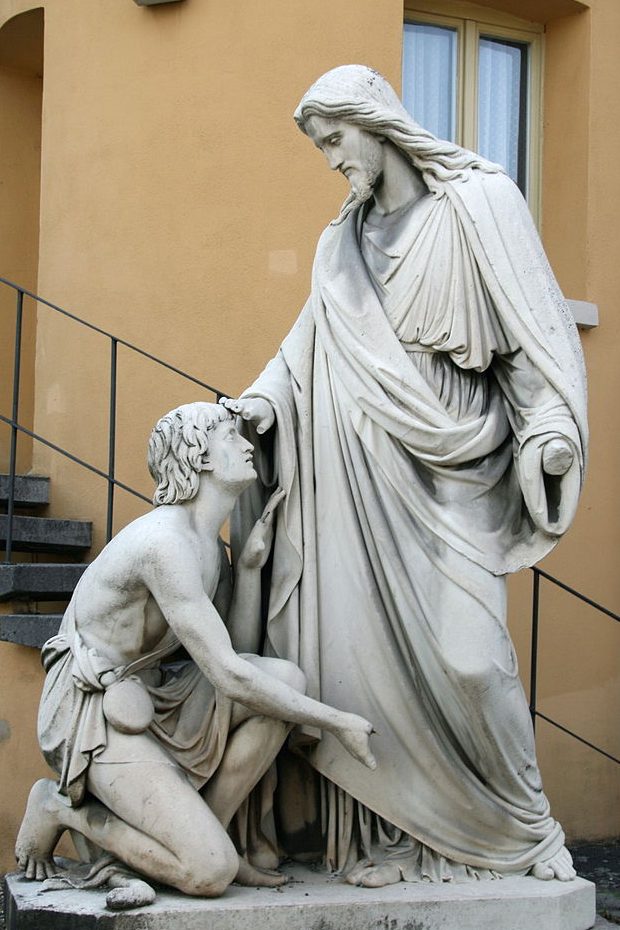
Jesus healing blind Bartimaeus by Johann Heinrich Stöver, 1861. St John’s Church, Hesse, Germany

Assuming Blindness

Behind everything we believe and talk about, there are pre-suppositions or assumptions. The disciples had an assumption about blindness: its sin – not just a result of living in a fallen world, but personal sin. That is, an individual sinner whom we can point the finger to. The disciples demonstrated they were just as blind as the physically blind man.

Jesus had a clear and concise response to that assumption: nobody is at fault here, nobody. Which, to me, begs the question:

Have you considered that your thoughts are subjective, not objective?

Too many people treat their thoughts, ideas, and beliefs as if they were pure gospel truth (which is probably why they feel justified in assuming they are always right and are arbiters of truth!). Reality check: You, nor I, have the corner on truth. Jesus is the truth, not anybody else.

Healing Blindness

Since Jesus is the way, the truth, and the life, he has the power and authority to heal, making the blind to see. Sin wasn’t the issue; the true issue was an opportunity to showcase the gracious work of God. So, Jesus healed the man’s eyes so that he could see again. Healing is not a one-size-fits-all, which is why Jesus did something unique with the blind man, and then gave specific instructions on what to do.

Therefore, we must not assume that we know how a healing is supposed to happen. There’s no codifying a particular process or prayer in order to leverage God into performing one.

Investigating Blindness

The religious leaders always seem to have a problem about something. They, like the disciples, assumed sin was at the core of the man’s blindness. The leaders were befuddled that a sinner like Jesus (who doesn’t keep the Sabbath properly) could ever heal another sinner (a blind man). That’s a conundrum they couldn’t live with, and so, the questions kept getting heaped on the poor guy who was healed.

The religious leaders were trying to make sense out of what they thought was a nonsensical situation. It’s only nonsensical to them because they didn’t have any good sense to begin with. Their interaction with the healed man, and then with Jesus, only demonstrated their profound lack of awareness resulting in spiritual blindness.

Remaining in Blindness 

Many of the religious leaders, heretics in the early church, and spiritual phonies of today are not deliberately trying to deceive or lead others astray; they think they are doing the right thing when they are actually not. 

An eye-opening reality I discovered when I first studied church history is that the early heresies, condemned at church councils, were doctrines promoted by men who were not evil – they were just sincerely misguided. The heretics believed they were helping the church better understand the nature of God and Christ. However, they were unaware and blind to the actual nature of their teachings. 

Back when I wrote my master’s thesis in nineteenth century American Religious History, I read hundreds of sermons from southern preachers before the American Civil War. They had a “biblical” defense of Black chattel slavery. Many of them were influential pastors of large churches who led many people to Christ, that is, white people. Yet, at the same time, they were blind to how they slammed the door of God’s kingdom in the faces of Black folk, were complicit in slaveholder abuse, and fueled antagonisms between North and South.

Churches and Christians may be unaware and blind to how they keep people out of God’s kingdom by saying God’s grace is for all, and then avoid certain people; by having explicit written statements or rules that exclude people from service; or by binding people to human traditions and practices instead of Holy Scripture.

Our Eyes

“The eye is the lamp of the body. If your eyes are healthy, your whole body will be full of light. But if your eyes are unhealthy, your whole body will be full of darkness. If then the light within you is darkness, how great is that darkness! (Matthew 6:22-23, NIV)

In the ancient world, the eye represented what you fixed your gaze on, or what your focus was. In our culture, we could replace the word “eye” with the word “goal.” The word “body” represents the entirety of one’s life.  So, we might interpret Christ’s words in this way: 

A goal is the focus of a life. If your goals are good, your whole life will be full of proper focus. But if your goals are bad, your whole life will be full of blindness. If then, the focus within you is only really blindness, how great is that darkness!

If goals and dreams are toward earthly treasure, one will blindly move in that direction and have misplaced values. Today’s Gospel story portrays the need to be self-aware as individual Christians and as a church. We can choose to:

  1. Be open to new information
  2. Entertain the notion that you might be wrong
  3. Embrace a full range of knowing (head, heart, and gut)
  4. Allow the light of Christ to shine on every person and each situation
  5. Stick to your experience of others and events
  6. Consider how your words and actions affect others
  7. Keep accountable to others and ask for feedback

Monitoring ourselves and our own emotional landscape will help us to become aware of what’s happening inside us. And then, in turn, having our eyes opened enables us to truly see others and be aware of their needs.

Who Are We Listening To? (Jeremiah 23:9-22)

My head is reeling,
    my limbs are limp,
I’m staggering like a drunk,
    seeing double from too much wine—
And all because of God,
    because of his holy words.

Now for what God says regarding the lying prophets:

“Can you believe it? A country teeming with adulterers!
    faithless, promiscuous idolater-adulterers!
They’re a curse on the land.
    The land’s a wasteland.
Their unfaithfulness
    is turning the country into a cesspool,
Prophets and priests devoted to desecration.
    They have nothing to do with me as their God.
My very own Temple, mind you—
    mud-spattered with their crimes.” God’s Decree.
“But they won’t get by with it.
    They’ll find themselves on a slippery slope,
Careening into the darkness,
    somersaulting into the pitch-black dark.
I’ll make them pay for their crimes.
    It will be the Year of Doom.” God’s Decree.

“Over in Samaria I saw prophets
    acting like silly fools—shocking!
They preached using that no-god Baal for a text,
    messing with the minds of my people.
And the Jerusalem prophets are even worse—horrible!—
    sex-driven, living a lie,
Subsidizing a culture of wickedness,
    and never giving it a second thought.
They’re as bad as those wretches in old Sodom,
    the degenerates of old Gomorrah.”

So, here’s the Message to the prophets from God-of-the-Angel-Armies:

“I’ll cook them a supper of maggoty meat
    with after-dinner drinks of strychnine.
The Jerusalem prophets are behind all this.
    They’re the cause of the godlessness polluting this country.”

A Message from God-of-the-Angel-Armies:

“Don’t listen to the sermons of the prophets.
    It’s all hot air. Lies, lies, and more lies.
They make it all up.
    Not a word they speak comes from me.
They preach their ‘Everything Will Turn Out Fine’ sermon
    to congregations with no taste for God,
Their ‘Nothing Bad Will Ever Happen to You’ sermon
    to people who are set in their own ways.

“Have any of these prophets bothered to meet with me, the true God?
    bothered to take in what I have to say?
    listened to and then lived out my Word?
Look out! God’s hurricane will be let loose—
    my hurricane blast,
Spinning the heads of the wicked like tops!
    God’s raging anger won’t let up
Until I’ve made a clean sweep,
    completing the job I began.
When the job’s done,
    you’ll see that it’s been well done.

“I never sent these prophets,
    but they ran anyway.
I never spoke to them,
    but they preached away.
If they’d have bothered to sit down and meet with me,
    they’d have preached my Message to my people.
They’d have gotten them back on the right track,
    gotten them out of their evil ruts. (The Message)

Jeremiah had a hard gig as a prophet of the Lord. And what made it especially difficult was the continual stream of false prophets, preaching their “everything will turn out just fine” sermons in the face of economic injustice, social unrighteousness, emotional denial, and spiritual adultery.

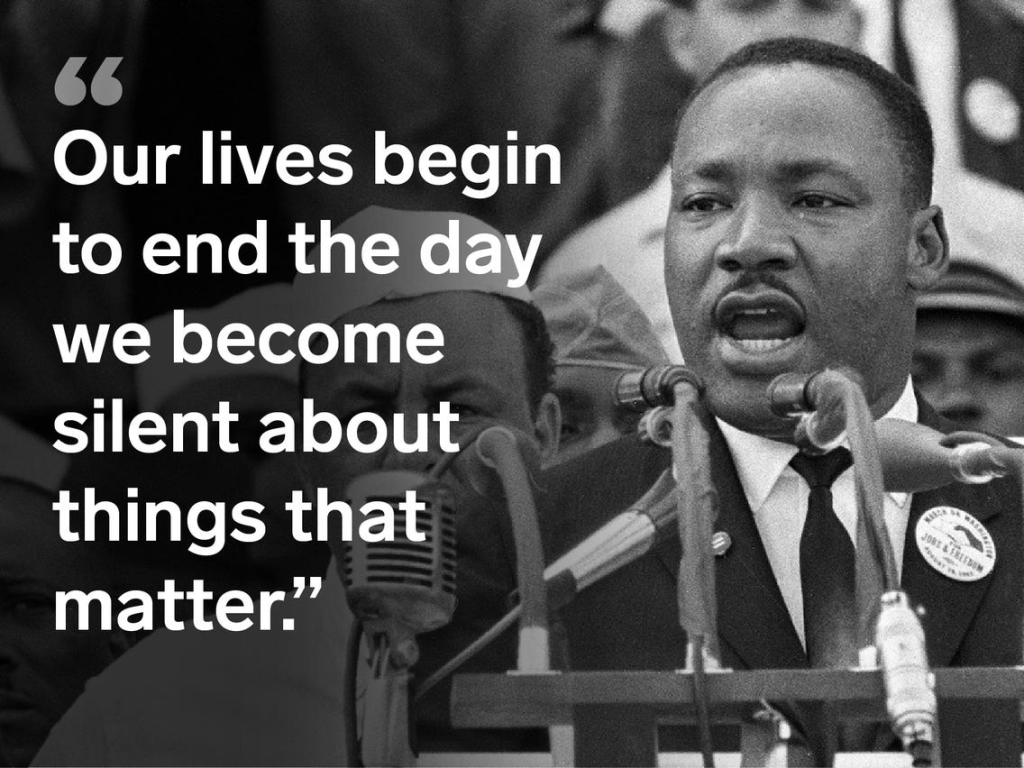
Methinks that Martin Luther King, Jr. must have felt a kinship with the prophet Jeremiah. After all, he was much like a modern-day prophet. In word and deed, he kept asking people to close the distance between the values they espoused and their actual behavior. 

The terrible treatment King and his allies received during the civil rights movement through non-violent marches and demonstrations, brought-out the awful gap between espoused American values of freedom, fairness, and tolerance, and the reality that Blacks really did not possess these in any manner close to the white population. 

Every prophetic ministry compels people to come face-to-face with the disparity between beliefs and behaviors.

Jeremiah knew all about the gulf between expressed values and actual conduct. And he faced a very large chasm between the two. 

Like Reverend King, Jeremiah was imprisoned, had rocks thrown at him, and was jeered for his message of calling people to live up to God’s agenda for humanity. 

White supremacy, or at least white privilege, was taken for granted in much of America before King. In the same way, Israelite privilege was taken for granted in Jerusalem, in Jeremiah’s day. Unfaithful prophets kept proclaiming Jewish supremacy and insisted that the Lord would be on their side of things. 

But the Lord insisted that these supposed prophets have neither attended a meeting of any divine council in heaven nor ever heard God speak to them.

I urge you, brothers and sisters, to keep an eye on those who create dissensions and hindrances, in opposition to the teaching that you have learned; avoid them. For such people do not serve our Lord Christ but their own appetites, and by smooth talk and flattery they deceive the hearts of the simple-minded. (Romans 16:17-18, NRSV)

The spirit of the age simply accepted power, privilege, and pedigree as the norm that ought to always endure. But God thinks differently about it. And so, the Lord sends prophets to call people back to justice, righteousness, and peace for the benefit of all persons.  

The zeitgeist of our own age is one of turmoil, uncertainty – and even chaos, violence, and death. We have our own contemporary self-appointed prophets who proclaim peace where there is no peace; safety, at the expense of others’ protection; militant forms of xenophobia; and an American exceptionalism which places a thin veneer of respectability over the graves of dead people’s bones.

The Lord will not contend with this forever.

An exercise in healthy introspection would be to consider these questions:

  • What are our most cherished values?
  • Where did we get them? Who are we listening to?
  • Are they God’s values? 
  • Who is really in control as the arbiter of values?
  • How might godly values of justice, righteousness, and peace be expressed in our everyday actions and behaviors?
  • Will we seek to engraft such values into our organizations, systems, faith communities, neighborhoods, and governments?
  • Can we work together in humility?
  • Do we have the courage to change, to share power, and to seek the common good of all persons?

Lord, have mercy, and grant us your peace.

All-Seeing God, you know the true state of every heart and every people group. Do your work of making me holy in all I do and say so that your values, and the words and ways of Jesus, might be expressed through me in the power of the Holy Spirit. Amen.

1 John 2:12-17 – Where Is Your Love Aimed?

I am writing to you, dear children,
    because your sins have been forgiven on account of his name.
I am writing to you, fathers,
    because you know him who is from the beginning.
I am writing to you, young men,
    because you have overcome the evil one.

I write to you, dear children,
    because you know the Father.
I write to you, fathers,
    because you know him who is from the beginning.
I write to you, young men,
    because you are strong,
    and the word of God lives in you,
    and you have overcome the evil one.

Do not love the world or anything in the world. If anyone loves the world, love for the Father is not in them. For everything in the world—the lust of the flesh, the lust of the eyes, and the pride of life—comes not from the Father but from the world. The world and its desires pass away, but whoever does the will of God lives forever. (New International Version)

The true measure of one’s Christian belief and commitment is the direction of their love.

We all love. Its part of being a human. Where our love is oriented is the real issue. The trajectory of love is the best measurement of faith and belief.

To love our fellow humanity, our brothers and sisters in Christ, and the neighbors around us, is to live in the light. It is the distinguishing mark of following Jesus. To hate humanity, to downplay love and dismiss it amongst believers, and to ignore the neighbors God placed us around, is to live in darkness.

A Christian is one who has received the love of God in Christ. Because of Divine Love, they know they are forgiven and have eternal life. They know, experience, and feel the permanence of godly love flowing powerfully in and through them to the glory of God.

Christians trust their gut, informed by the conscience testifying to the importance of love, and the Spirit sanctifying them with the primary tool of love.

So, when some folks come along and place a heavy emphasis on cognitive belief, eschewing the heart and the gut, it ought to raise some saved and sanctified eyebrows. To merely affirm a doctrinal statement, then turn around and aim love in the wrong direction, is to affirm a wrong belief. To hate people and love the world is just plain heretical.

The term “world” in the New Testament has differing meanings according to the context. Jesus stated that God so loved the “world” that he gave his only Son. That’s a reference to people, the entire mass of humanity on this planet. John, however, typically uses “world” as the antonym to the church, as if it were an evil opposite.

In our New Testament lesson for today, the term “world” are the patterns, systems, and operations of the world which are in direct contrast to how God operates and how the church ought to function. To love humanity is to hate the world and do God’s will. To love the world is to hate others and adopt a devilish agenda. For example:

  • The world engages in revenge and payback when wronged, whereas the Christian learns to believe God as the Judge, loves the person who has offended them through prayer for their enemy, and obeys God through good works that seeks the welfare of the other. 
  • The world uses other people as either objects of their pleasure or to get ahead in life, whereas the Christian believes God will take care of their needs, will seek to love the other person instead of use them, and would rather obey God than be selfish. 
  • The world thinks nothing of lying, cheating, and stealing, if they can get away with it, whereas the Christian believes Jesus is the way, the truth, and the life, loves being a person of integrity, and obeys God even when it hurts.

Love in the Bible always begins with God’s love for people. This is the fundamental starting point for love because without God’s love, our love doesn’t get very far.

The world hates. God loves. Many people in this cruel and calloused world are unloving and unkind because they lack knowing that God loves them. If we do not believe or know that God infinitely loves us, then our words and our actions will reflect more hate than love.

The Lord your God is with you, he is mighty to save. He will take great delight in you, he will quiet you with his love, he will rejoice over you with singing.”  (Zephaniah 3:17, NIV)

Christianity does not come into existence by knowing some belief statements about Jesus. Rather, Christianity exists when individuals experience the white-hot burning love of God in Jesus Christ. Jesus came not only for those who skip church and only occasionally read their Bibles, but also came for the hard-hearted prick, the immoral adulterer, the strung-out addict, the terrorist, the murderer, and for all those caught up in bad choices and failed relationships. 

God’s love is not based on our performance, how good we look to others, nor conditioned by our moods. The love of God only looks longingly at you and me with the potential of what we can become in Christ and cares for us as we are.

God demonstrates his own love for us in this: While we were still sinners, Christ died for us. (Romans 5:8, NIV)

Christianity never begins with what we do for God to make ourselves lovely for him. Instead, Christianity always starts with what God has done for us, the great and wonderful love that exists for us in Christ Jesus.

But when the kindness and love of God our Savior appeared, he saved us, not because of righteous things we had done, but because of his mercy. (Titus 3:4, NIV)

All the wrong turns in the past, the mistakes and the moral lapses, everything that is ugly or painful all melts in the light of God’s acceptance and love for us. It makes loving the world seem distasteful, like trying to eat sand. Love for God and neighbor is the true source of doing God’s will and the true measure of Christian belief.

In what direction is your love aimed today?

O Lord, you have taught us that without love, whatever we do is worth nothing. Send your Holy Spirit and pour into my heart your greatest gift, which is love, the true bond of peace and of all virtue, without which whoever lives is accounted dead before you. Grant this for the sake of your only Son Jesus Christ, who lives and reigns with you and the Holy Spirit, one God, now and forever. Amen.

Psalm 101 – The Ethics of King David

I will sing to you, Lord!
    I will celebrate your kindness
    and your justice.
Please help me learn
    to do the right thing,
    and I will be honest and fair
    in my own kingdom.

I refuse to be corrupt
or to take part
    in anything crooked,
    and I won’t be dishonest
    or deceitful.

Anyone who spreads gossip
    will be silenced,
    and no one who is conceited
    will be my friend.

I will find trustworthy people
    to serve as my advisors,
    and only an honest person
    will serve as an official.

No one who cheats or lies
    will have a position
    in my royal court.
Each morning I will silence
    any lawbreakers I find
    in the countryside
    or in the city of the Lord. (Contemporary English Version)

King David was one serious dude when it came to dealing with wickedness and injustice. He had a zero tolerance policy toward people who were deceitful and proud. David was determined to deal with slanderous and arrogant people. He sought to establish a rule and reign based in his own personal integrity and practice of being a king who seeks after what is right and just.

And so, David refused to take a second look at corrupt people and things which degraded and debased others. He gathered around himself officials who genuinely care about kindness and justice.

David was not about to put up with anyone in his court who had personal agendas of power and privilege at the expense of the powerless.

For David, a diligent and conscientious application of God’s just and right law was absolutely necessary to a benevolent reign in which everyone felt secure and were able to enjoy the Promised Land. Corrupt officials had no place in the kingdom and would be summarily dealt with.

Unfortunately, there are far too many leaders in our world today who create cultures of fear, insecurity, and walking on eggshells. They are crafty and deceitful, actually using organizational codes of morality and ethics to hide their damaging and destructive effect on people.

We may not be kings like David, yet we can share his stance of not avoiding the evil in front of us and dealing with corruption, dishonesty, and disingenuous behavior from others, especially those in positions of power and authority. Toxic authority figures actively isolate us, making us feel stupid and incompetent and afraid to share our struggles with others, so that they can maintain all of the power. 

How, pray tell, might us lowly persons take on those with leverage and power over us, whether they be job bosses, church pastors, local politicians, or family members?

  • Do everything from a place of integrity. Seek the Lord in doing the right thing. Ultimate power belongs to God, not some puny person who is master of a small world.

Whoever walks in integrity walks securely, but whoever takes crooked paths will be found out. (Proverbs 10:9, NIV)

  • Refuse to play their game. Don’t resort to gossip, backbiting, or displays of your own supposed power. Be just, kind, wise, and, most of all, humble. Virtue will serve you well. Vice will not.

Gossip is spread by wicked people; they stir up trouble and break up friendships. (Proverbs 16:28, GNT)

  • Keep in mind that niceness is often used by corrupt leaders to keep others under their thumb. Dishonest and deceitful people are not necessarily bullying. They’ll use whatever means they can to get their way.

Flattery is nothing less than setting a trap. (Proverbs 29:5, CEV)

  • It is always our place to love, not judge. King Jesus is the Judge, not me, not you. Loving an unlovable person can only happen if we have a love for God which is able to see God’s image in every person we encounter, including that difficult leader. In the end, they will be held accountable – whether in this life, or in the one to come. Jesus said:

“You have heard that it was said, You must love your neighbor and hate your enemy. But I say to you, love your enemies and pray for those who harass you.” (Matthew 5:43-44, CEB)

  • Watch your back. Yes, we are to trust in the Lord. That doesn’t mean we implicitly trust everyone and/or every organization. Jesus said:

“Listen! I am sending you, and you will be like sheep among wolves. So be smart like snakes. But also, be like doves and don’t hurt anyone. Be careful!” (Matthew 10:16-17a, ERV)

We all, like King David of old, need an unequivocal commitment to a zero tolerance policy toward evil. It is simply unacceptable to flirt with it. Whatever we must do to remind ourselves of righteousness, and whatever boundaries we need to set, is most necessary, because no one who practices deceit will dwell in the Lord’s house.

Holy God of justice, I will make a covenant with my eyes to set before them no vile thing. Help me to be strong in your mighty power so that my daily walk of faith in Jesus is righteous, free of guilt, and enjoyable.  Amen.