Welcome, friends! In the New Testament Gospel of Luke 24:1-12, we find an account of women approaching the grave of Jesus, only to find an empty tomb. Today, people search for reality in all kinds of empty places. There is, however, hope, because Christ is risen! He is risen, indeed! Click the videos below and let us enjoy and be in awe that Jesus is alive!
Pastor Tim Ehrhardt, Luke 24:1-12
May the glory and the promise of this joyous time of year bring peace and happiness to you and those you hold most dear.
And may Christ, Our Risen Savior, always be there by your side to bless you most abundantly and be your loving guide. Amen.
At daybreak, Jesus went out to a solitary place. The people were looking for him and when they came to where he was, they tried to keep him from leaving them. But he said, “I must proclaim the good news of the kingdom of God to the other towns also, because that is why I was sent.” And he kept on preaching in the synagogues of Judea. (New International Version)
A domesticated Jesus is nothing more than a fictional character, part of the panoply of old classic literature, and just another person in the Christian writings of the New Testament.
Many so called Christians want to control Jesus, to have him serve their purposes. Like some magical entertainer, they want to hold onto him, keep him around, trotting him out occasionally to impress friends and family.
Such persons have not yet come to terms with the spiritual reality that Jesus belongs to others, to everyone, not just me or people I like.
Whenever we grab hold of Jesus to keep him from going to others, we play the role of Mary Magdalene, who did not recognize her Lord when he was standing in front of her face. Then, when realizing who he was, did not want Jesus going anywhere. Yet, the Lord responded:
“Do not hold on to me, because I have not yet ascended to the Father. But go to my brothers and say to them, ‘I am ascending to my Father and your Father, to my God and your God.’” (John 20:17, NRSV)
Mosaic of Jesus and Mary Magdalene, Washington National Cathedral
Jesus did more than proclaim good news; he was the good news itself, embodied, for the life of the world – and not only for the life of a particular race or ethnicity or gender, or even religion. As the Lord of Life, there is enough Jesus for everyone.
Maybe the true mark of a Christian is not having bumper sticker messages or a bobblehead Christ or an impressive Bible on the living room coffee table or erudite theological ideas. Maybe its in telling others about Jesus from our own mouth, from a heart that overflows with the gospel of grace.
We must let God be God. Yes, there is a very important place for us to ask, seek, and knock on the door of heaven. And there is also an equal necessity for solitude, silence, and patience, in waiting for the Lord to say, “Come here to me.”
The wisdom to know when to practice solitude, and when to actively seek, arises by purposely engaging in both. We must have an action/reflection model in which we seek to do the will of God, then step back and reflect upon the experience and learn from it. And, at the same time, we are to practice a contemplation/response model that communes in solitude with God, then responds with active involvement of just and merciful acts toward others.
Our Gospel lesson today highlights the need for solitude as a Christian spiritual practice because our Lord practiced it. The solitude, however, is not to be unending. At some point, we must descend from the mountain peak and enter the valley, just as we ascended it from the activity below.
Good news needs proclamation. And for that to happen, it must be proclaimed from both the top of the mountain, as well as the lowest valley. The gospel cannot be chained so that it is tethered for only my group of cronies. No, Jesus is for all, and so, good news is meant to spread to every corner of the earth.
Perhaps we need to sit still long enough, without allowing our inner anxiety to rule the day, to let Jesus call to us and invite us to come. Then, maybe we will be able to hear the gracious words of the Lord:
“Come to me, all you who are struggling hard and carrying heavy loads, and I will give you rest. Put on my yoke and learn from me. I’m gentle and humble. And you will find rest for yourselves. My yoke is easy to bear, and my burden is light.” (Matthew 11:28-30, CEB)
Come Unto Me by Wayne Pascall
There’s no need to break down doors, trying to squeeze ourselves into the kingdom of God. We need only respond to the gracious invitation of Jesus and let him invite others. Truly receiving amazing grace changes us, and we then do not seek to keep Jesus from leaving.
“How amazing, amazing that the one who has help to bring is the one who says: Come here! What love! It is already loving, when one is able to help, to help the one who asks for help, but to offer the help oneself! And to offer it to all! Yes, and to the very ones who are unable to help in return! To offer it, no, to shout it out, as if the helper himself were the one who needed help, as if he who can and wants to help everyone were nevertheless in one respect himself a needy one, that he feels need, and thus needs to help, needs those who suffer in order to help them!”
Søren Kierkegaard, Practice in Christianity
Coming and going, silencing and proclaiming, holding and letting go. We allow Jesus to do it all. And we simply follow in his footsteps.
Lord Jesus Christ, Son of God, Son of Humanity, your presence here on earth never becomes a thing of the past – thus never becoming distant. Our faith and experience of you is very present and very much real in the here and now.
Might all people see you in your true form and in the way you walked this earth – not in an empty or meaningless way of mere thoughts or distortions. May all people see you as you are, a lowly man, yet the Savior and Redeemer of humanity – who out of love came to earth to seek the lost, to suffer and die, to call the straying soul, and to absorb the opposition of others without raising a hand in defense.
Would that we might see you in this way, and not be offended at you and your gracious gathering of all kinds of people into your glorious kingdom. Amen.
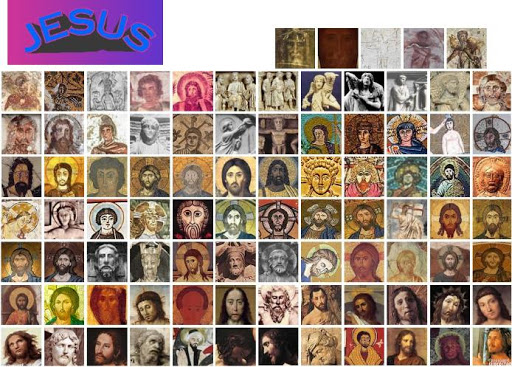
Cultural depictions of Jesus throughout the world.
Yes, we have many troubles in this old fallen world and in our various families and individual lives. And, yes, there a lot of things we need right now such as wiping the terrible COVID-19 virus off the face of the planet; healing from the ravages of disease and of our damaged emotions; economic stability to make ends meet; and, solutions to the awful human ailments and conditions that beset the world. We need relief, guidance, and wisdom.
So, I declare with conviction that out of all the great needs which surround us, the greatest need is for Jesus. I do not just need his teaching. I do not just need Christ’s instruction. I do not only need to imitate his model of loving service. I need Jesus himself!
Jesus was speaking with his disciples in the Upper Room on the night before his crucifixion. He told them he was leaving (dying) and that it must be this way. The disciples were understandably troubled. Thomas was worried about what was going to happen and how he and the others were going to deal with an uncertain future. (John 14:1-14)
I will tell you how millions of people have dealt with their past difficulties, their present troubles and their worries about the future: Jesus.
Jesus is the Way
Jesus is the way to deal with our current concerns and anticipated anxieties. He himself is the way. The way is not through a program of self-improvement. The way is not through a fake-it-till-you-make-it approach. The way is not through an ability to articulate well-crafted words or through being able to answer with certainty every question of faith. The way is not through finding just the right plan or system.
Jesus is our way – he is the way of rescue, the road to a life of harmonious peace and settled rest even when the world is going to hell around us, as well as the connection with God. To trust Jesus is to give up the personal delusion of control and to walk with him on his terms.
Jesus is the way for the church everywhere – fellowship, encouragement, acts of loving service, teaching, and strengthening of faith all center around Jesus because he is love incarnate.
Jesus is the way for the world – serving neighbors and nations, advocating for those who are mistreated and victims of injustice, tackling the dozens of world problems which oppress humanity come through the continuing presence of Jesus here on this earth (the Holy Spirit indwelling God’s people).
Jesus is the Truth
Jesus does not only speak truth; he is truth incarnate. Truth is more than abstract ideas and personal perspectives. What is true about God has its ultimate expression and demonstration in the person of Jesus.
“True worshipers will worship the Father in spirit and in truth… God is spirit, and his worshipers must worship in spirit and in truth.” (John 4:23-24, NIV)
“If you hold to my teaching, you are really my disciples. Then you will know the truth, and the truth will set you free.” (John 8:31-32, NIV)
To see the face of Jesus is to see the reality of Truth. God’s character and attributes expressed through creating, loving, sustaining, healing, and providing all have their highest expression in Jesus.
Jesus is our truth. When troubles abound, Jesus is the ballast of truth we can rely upon, the rock of our salvation, and the anchor of our soul.
Jesus is the truth in the church. All teaching, mentoring, and instruction points to the person and work of Jesus. Guidance and direction, whether in marriage, family, work, school, relationships or interpersonal communication flows from Jesus. To merely dispense homespun advice falls short if there is no Jesus.
“Since we have a great high priest who has gone through the heavens, Jesus the Son of God, let us hold firmly to the faith we profess. For we do not have a high priest who is unable to sympathize with our weaknesses, but we have one who has been tempted in every way, just as we are – yet was without sin. Let us then approach the throne of grace with confidence, so that we may receive mercy and find grace to help us in our time of need.” (Hebrews 4:14-16, NIV)
Jesus is the truth for the world. Proclaiming Jesus is more than mere words; it is an embodying of truth. At the beginning of his earthly ministry:
Jesus “went to Nazareth, where he had been brought up, and on the Sabbath day he went into the synagogue, as was his custom. And he stood up to read. The scroll of the prophet Isaiah was handed to him. Unrolling it, he found the place where it is written [Isaiah 61:1-2] “The Spirit of the Lord is on me, because he has anointed me to preach [to embody] good news to the poor. He has sent me to proclaim freedom for the prisoners and recovery of sight for the blind, to release the oppressed, to proclaim the year of the Lord’s favor.” (Luke 4:16-19, NIV)
Followers of Jesus embody him, the Truth, through looking for ways to be Jesus to the lost, the least, and the lonely in acts of basic human compassion and advocating for their social justice.
Jesus is the Life
“Life” and “death” in Scripture are relational terms, not just physical references. When Adam and Eve fell into disobedience, they spiritually died without being physically dead. They originally enjoyed the connection of life with God; then, after the Fall, experienced a separation from God by being cast out of the Garden.
Jesus is our life. He is the person in whom Christians have their identity. Instead of connecting myself to a narrowly expected outcome, I tether myself to Jesus because he is my connection, my life.
Jesus is the life of the church. Christians experience life as their prayers and their praise are directed toward Jesus as both the subject and the object of worship.
Jesus is the life of the world. The good news of Christ’s redemptive events of incarnation, earthly ministry of teaching and healing, death, resurrection, ascension and glorification is good news for everyone. There is forgiveness of sins and deliverance from the hell of separation through Jesus.
“I am the way, the truth, and the life.” –Jesus
Our problems, concerns, and troubles on this earth are not be sufficiently addressed by simply acknowledging Jesus and his teaching. I need Jesus himself. For he has the power to give life.
“Salvation can be found in no one else. Throughout the whole world, no other name has been given among humans through which we must be saved.” (Acts 4:12, CEB)
“I need Jesus!” is my affirmation and my declaration, my proclamation and my preaching. I need Jesus as the way to live my life instead of trusting in my own power and ability. Jesus is the truth I choose to bank my life upon. Jesus is the life graciously given for which I can say with boldness that I belong to God.
Jesus is the midpoint of history to which all events point; the center of my life upon which all my devotion is directed; and, the subject and object of Holy Scripture:
In the Gospel of Matthew, Jesus is the King of Kings with authority to back it up.
In the Gospel of Mark, Jesus is both the Servant of humanity and all of creation’s Authority.
In the Gospel of Luke, Jesus is the Son of Man who relates to us and is attentive to humanity.
In the Gospel of John, Jesus is the Word become flesh, the Good Shepherd, the Bread of Life, and the Light of the World.
In the Acts of the Apostles, Jesus is the risen and ascended Lord who will come again.
In Romans, Jesus secures our union with God and justifies us according to his mercy and grace.
In 1 Corinthians, Jesus is the Wisdom and Power of God, despite the foolishness of the cross.
In 2 Corinthians, Jesus is the One who has brought forgiveness and reconciliation to the world.
In the book of Galatians, Jesus is our Substitute for sin.
In Ephesians, Jesus is the One who has subdued all the dark forces of this world.
In Philippians, Jesus humbled himself and submitted to death on a cross for our deliverance.
In Colossians, Jesus is the Creator and Sustainer of the universe.
In the First letter to the Thessalonians, the coming of Jesus is near and will soon be here!
In the Second letter to the Thessalonians, we are partakers in God’s glory through Jesus.
In the book of First Timothy, Jesus saves sinners of whom I am chief.
In Second Timothy, Jesus is the Righteous One who will come to Judge the living and the dead.
In Titus, Jesus is the Redeemer, snatching us from the realm of wickedness and godlessness.
In the little book of Philemon, every good thing we have comes from Jesus.
In Hebrews, Jesus is our faithful High Priest, the Pioneer of our salvation and our Champion.
In James, Jesus is the Wise Teacher.
In First Peter, Jesus is the Lamb of God who takes away the sin of the world.
In Second Peter, Jesus is the Divine Power that allows me to live a godly life.
In the Epistles of John, the God of Love is Jesus, who demonstrated love through the cross.
In Jude, it is Jesus who keeps us from falling and presents us faultless before God.
Finally, in Revelation, Jesus is the Alpha and Omega, the First and the Last, the Beginning and the End.
I need Jesus, the Son of God and Son of Man; the Lord and Judge of all, the Redeemer and Savior of humanity, my Healer and my Friend. It’s all about him.






 Rev. Tim Ehrhardt