Philippians 3:17-20 – Follow a Good Example

Join together in following my example, brothers and sisters, and just as you have us as a model, keep your eyes on those who live as we do. For, as I have often told you before and now tell you again even with tears, many live as enemies of the cross of Christ. Their destiny is destruction, their god is their stomach, and their glory is in their shame. Their mind is set on earthly things. But our citizenship is in heaven. And we eagerly await a Savior from there, the Lord Jesus Christ. (New International Version)

Who do you imitate? What examples do you follow? How are you influenced by others?

Good Examples Are Virtuous

Because we are social creatures, we mimic and then pass on things we learn from others. So, it’s imperative we learn from people who demonstrate the values and ideals we aspire to possess ourselves.

In the people we listen to, either virtually or in person, as well as the authors we read, we are to live according to an example of virtue, sacrifice, and commitment.

We must imitate those Christian leaders who have a proven character in persevering in faith in the face of pain and suffering and have done it with great humility.

This does not necessarily mean we emulate those who eruditely speak the Word of God, have superior gifts and abilities, and enjoy success in ministry. It does mean, however, we ought to imitate, and have as mentors, those persons who imitate Christ.

We can leave behind and ignore those who are self-promoting peacocks, concerned with pursuing admiration and praise. Let’s, instead, mimic those who have proved themselves in hardship.

A Christian leader who has not undergone fiery trials and been purged of sinful pride are more easily seduced by their own importance. However, leaders who have seen their share of hard circumstances, pain, and suffering, and have come through it loving God and serving others out of grace and humility, are leaders worth imitating. They will likely serve well as good models of faith and ministry.

Good Examples Are In Community

Please notice there is more in today’s New Testament lesson than individually following a good example; we are to join with others in doing so. Community is needed for proper spiritual mimicking to take place.

Watch what God does, and then you do it, like children who learn proper behavior from their parents. Mostly what God does is love you. Keep company with him and learn a life of love. Observe how Christ loved us. His love was not cautious but extravagant. He didn’t love in order to get something from us but to give everything of himself to us. Love like that.

Ephesians 5:1-2, MSG

This is why the Apostle Paul wrote a letter telling Titus to ensure that he was being an example within the church community – and why he gave detailed instructions on virtue to make sure the older saints of God were teaching and mentoring the younger generations with a good example to show them. (Titus 1:5, 2:1-4, 3:1-2)

Following an example doesn’t take place in isolation. Like a duckling, we need to be with other ducklings following Mama Duck. Otherwise, we are at risk of getting lost and losing our faith, maybe even our lives.

Be a Good Example

It is also good to consider the kind of example we ourselves are displaying for others. In all our words and behaviors, whether we recognize it or not, we are modeling what is genuinely important to us. And sometimes what we do not say, or choose not to do, says as much or more about our character, beliefs, and ethics.

Our character is revealed in the way we treat people. How we treat those who cannot give something back to us tells more about our character than how we treat people we think are important.

People who are honest, kind, and fair – only when there’s something to gain – shouldn’t be confused with people of real character who demonstrate virtuous qualities habitually, under every circumstance. Individuals and groups of people are never to be handled as things or mechanisms to get what we want and achieve our goals.

Character is also revealed in the way we deal with the pressures and temptations which come our way. If we are one way whenever situations are going well, and then another way when things go sideways, it reveals something of our inner self.

Doing the right thing, whether someone is watching, or not, is always a hallmark of a good example.

It takes a lot of confidence in our way of life to say to another, like the Apostle Paul did, “follow my example.” If we have learned with humility and curiosity the words and ways of Jesus, and lovingly put them into practice, then we can be emboldened to mentor others in the faith and demonstrate for them what laboring for justice, righteousness, holiness, and godliness looks like in this fallen world.

Good Examples Together

More than ever, we need a cadre of solidly committed folks who have been mentored well in the ways of grace to serve as a beacon of light in the darkness of this world’s besetting sins of structural racism, hedonistic consumerism, discriminatory ageism, oppressive patriarchalism, biased hierarchism, disparity classism, religious anarchism, and a hundred other “isms” which keep people from flourishing in this life as God intended.

It is vital we learn from and emulate others who have a proven track record of promoting the common good of all persons. And it is equally important we become part of the ranks of those who are good examples of citizens in God’s benevolent and ethical kingdom.

Lord God, help me as your disciple to follow you in every thought, word, and deed. Give me a heart of faith and obedience so that I will live with confidence in the example and in the way of Jesus. Enable me to recognize your good and perfect will, even when it may seem nonsensical to me. I want to follow you all the days of my life. Please give me the strength to do so in the strength of your Holy Spirit. Amen.

2 Samuel 10:1-5 – Misunderstood

Sometime later, King Nahash of Ammon died, and his son Hanun became king. David said, “Nahash was kind to me, and I will be kind to his son.” So, he sent some officials to the country of Ammon to tell Hanun how sorry he was that his father had died.

But Hanun’s officials told him, “Do you really believe David is honoring your father by sending these people to comfort you? He probably sent them to spy on our city, so he can destroy it.” Hanun arrested David’s officials and had their beards shaved off on one side of their faces. He had their robes cut off just below the waist, and then he sent them away. They were terribly ashamed.

When David found out what had happened to his officials, he sent a message and told them, “Stay in Jericho until your beards grow back. Then you can come home.” (Contemporary English Version)

Showing mercy, grace, and good faith doesn’t always have a happy ending.

Sometimes people get burned for their genuine gracious overtures. Not only do some folks not return or reciprocate with grace. There are times when someone refuses it and even responds with criticism and judgment.

King David was at the pinnacle of his rule. All Israel and Judah were under his gracious authority. David acted as a godly sovereign when he sought to use his power to show kindness and grace to those in his kingdom, even to those who were related to his former enemy, Saul. (2 Samuel 9:1-12)

Yet when David kept up his gracious ways and sent a delegation to the Ammonites in order to bring compassion to a grieving nation, they not only spurned the kindness but attributed evil intent to it.

Why in the world would they do such a thing? Why did Hanun, the new ruler of Ammon, reject David’s kindness? Because he severely misinterpreted David’s motives, and completely misjudged David’s intentions.

It is important to make wise assessments of others, and not quick judgments about people or their situations.

Being misunderstood is downright difficult to swallow. Yet we can avoid sinful reactions and respond with grace, even if grace isn’t being shown to us:

  • We can be gracious by not always needing to have the last word. Any fool can get easily get sucked into an argument. Know when to stop talking.

Too much talk leads to sin. Be sensible and keep your mouth shut. (Proverbs 10:19, NLT)

Even fools may be thought wise and intelligent if they stay quiet and keep their mouths shut. (Proverbs 17:28, GNT)

  • We can be gracious through cultivating a humble spirit. Pride assumes that another can be silenced with the power of words. What’s more, wounded pride typically manifests itself by gossiping to others about our hurt.

Destructive people produce conflict; gossips alienate close friends. (Proverbs 16:28, CEB)

Pride leads to destruction; humility leads to honor. (Proverbs 18:12, CEV)

God opposes arrogant people, but he is kind to humble people. (James 4:6, GW)

  • We can be gracious by developing our capacity for civility and empathy. Often when someone spews their off-base judgments and criticisms upon us, they have a world of their own past personal hurt behind the angry diatribe. We can choose to be gently curious about this, discovering why there is such a visceral reaction to our kindness.

“I tell you, love your enemies and pray for those who persecute you, that you may be children of your Father in heaven. He causes his sun to rise on the evil and the good and sends rain on the righteous and the unrighteous.” (Matthew 5:44-45, NIV)

Show respect for all people. Love your brothers and sisters in God’s family. Respect God and honor the king. (1 Peter 2:17, ERV)

  • We can be gracious through tapping into an inner storehouse of wisdom. Knowledge puffs up. Love builds up. Wisdom is insight into reality. For the believer, it is the ability to take God’s Word and lovingly apply it to the lived experience we are enduring.

Hold on to wisdom, and it will take care of you. Love it, and it will keep you safe. Wisdom is the most important thing; so, get wisdom. If it costs everything you have, get understanding. (Proverbs 4:6-7, NCV)

It is true, of course, that “all of us have knowledge,” as they say. Such knowledge, however, puffs a person up with pride; but love builds up. (1 Corinthians, 8:1, GNT)

One of life’s hard lessons is that bestowing grace and mercy to others does not necessarily mean they will receive it and respond in kind. 

In fact, there are some individuals who refuse grace and give back only scorn and derision. Even the Lord Jesus experienced this like no other before or after him. Christ endured all the foulness and degradation of a cruel cross because there were people who refused to see that he was extending God’s grace to them. He turned scorn on its head by despising shame and enduring pain so that we would be spared of such ignominy. (Hebrews 12:2-3)

In those times when we, at best, scratch our heads, and, at worst, weep uncontrollably over having our genuine love paid back with harsh misunderstanding, it is a good reminder that we are imitating the life of our precious Lord Jesus who knows exactly what shame is and what a profound lack of mercy can do. 

It is in the seasons and events of life which produce frustration that we understand this: Perfect peace will not be found in this life. So, we more fully attach ourselves to Jesus and find genuine grace and the solidarity of faith and love.

Consider what Christ went through; how he put up with so much hatred from those misinterpreting and misjudging him. Do not let yourselves become discouraged and give up from gross misunderstanding.

Loving God, I give you thanks for sending your Son, the Lord Jesus. Christ is the pioneer of my faith. Just as he endured the cross, scorning its shame, and sat down at your right hand, so help me to live into the grace you offer through Christ’s redemptive events so that I might persevere with grace through all the unmerciful acts of this world. Amen.

2 Samuel 3:1-12 – Which One Would You Follow?

The war between the house of Saul and the house of David lasted a long time. David grew stronger and stronger, while the house of Saul grew weaker and weaker.

Sons were born to David in Hebron: His firstborn was Amnon the son of Ahinoam of Jezreel; his second, Kileab the son of Abigail the widow of Nabal of Carmel; the third, Absalom the son of Maakah daughter of Talmai king of Geshur; the fourth, Adonijah the son of Haggith; the fifth, Shephatiah the son of Abital; and the sixth, Ithream the son of David’s wife Eglah. These were born to David in Hebron.

During the war between the house of Saul and the house of David, Abner had been strengthening his own position in the house of Saul. Now Saul had had a concubine named Rizpah daughter of Aiah. And Ish-Bosheth said to Abner, “Why did you sleep with my father’s concubine?”

Abner was incredibly angry because of what Ish-Bosheth said. So, he answered, “Am I a dog’s head—on Judah’s side? This very day I am loyal to the house of your father Saul and to his family and friends. I haven’t handed you over to David. Yet now you accuse me of an offense involving this woman! May God deal with Abner, be it ever so severely, if I do not do for David what the Lord promised him on oathand transfer the kingdom from the house of Saul and establish David’s throne over Israel and Judah from Dan to Beersheba.” Ish-Bosheth did not dare to say another word to Abner, because he was afraid of him.

Then Abner sent messengers on his behalf to say to David, “Whose land, is it? Make an agreement with me, and I will help you bring all Israel over to you.” (New International Version)

“Leadership is the capacity and will to rally men and women to a common purpose and the character which inspires confidence.”

World War II British Field Marshall Bernard Montgomery (1887-1976)

Our inner character is a combination of what we do, why we do it, and how we go about it. Personal character is seen in the reactions and responses of life events and situations. And Holy Scripture is concerned and attentive to all our attitudes and actions in the world.

Stories in the Old Testament are largely designed to help us, as readers and listeners, to compare and contrast the mindsets, motivations, and morals of the principal actors in those narratives. We are meant to understand the difference between godly and ungodly people through how the story shakes out.

Three leaders are paraded before us in today’s Old Testament lesson. The story is arranged so that we will take a look at their manner of life. The lesson begs us to implicitly ask: Which of the three characters would you follow?

David

King David was a true leader, having G-d’s calling, inquiring to G-d continually, and using his ruling authority to extend kindness, like G-d does. Because of David’s character, his reign became stronger and stronger. David neither planned to annihilate all of Saul’s heirs as rivals to this throne, nor did he set out to make their lives miserable – despite the fact that most people of the time would actually expect him to do that.

Ish-Bosheth

Whereas David was initially ruling only Judah, Ish-Bosheth was a son of Saul and king of Israel. He was a mere figurehead. Abner, the army’s general, was really calling the political shots in Israel. Ish-Bosheth was too fearful to challenge Abner, and so, never exerted a significant influence. Instructive for us as readers is the absence of this king’s prayers or efforts to do anything helpful or constructive for his people.

Ish-Bosheth’s name essentially means “Master,” a dignified word which is meant to communicate respect. The incongruence between Ish-Bosheth’s ascribed name, and his actual attitudes and lack of action, betrays a double-minded person, divided in decision-making, not knowing quite what to do, so doing nothing of substance which helps anyone.

Contrasting Ish-Bosheth with David, we clearly see that David is no figurehead but the leader of his people. Unlike Ish-Bosheth, David is no washrag and is no one’s puppet but takes charge of situations by inquiring of G-d, then acting.

Confidence comes from knowing the Lord and stepping out in faith, which is precisely what David’s pattern of kingship was like.

“God grant that men of principle shall be our principal men.”

Thomas Jefferson, 3rd President of the United States of America (1743-1826)

Abner

Israel’s general, Abner, was neither like David nor Ish-Bosheth. Although Abner had the qualities of confidence and taking charge, unlike David, he was a self-serving leader.

Abner used his position to gain for himself power and prestige. He was willing to quickly switch his loyalties when it was no longer helpful for him, personally. Although Abner did right by working toward uniting the kingdoms of Israel and Judah (a good thing) he did it for all the wrong reasons (a bad thing).

Compared to David, Abner has only self-interest, not the common interest of all citizens. He acts for what he can personally get out of it – which is just the opposite of David, who has an eye which scans the horizon to do what is best for the common good of all the kingdom’s subjects.

Conclusion

When we read today’s story, the guided narrative wants us to arrive at the conclusion of saying, “I don’t want to become or follow somebody like Ish-Bosheth or Abner. I want to become and follow someone like King David.”

David listened to G-d, prayed to G-d, and acted with justice and kindness because of G-d. There’s likely no better approach to the spiritual life than that.

Grant us, Lord G-d, a vision of our world as your love would make it: a world where the weak are protected, and none go hungry or poor; a world where the benefits of abundant life are shared, and everyone can enjoy them; a world where different races and cultures live in tolerance and mutual respect; a world where peace is built with justice, and justice is guided by love. And give us the inspiration and courage to build it, through Jesus Christ our Lord. Amen.

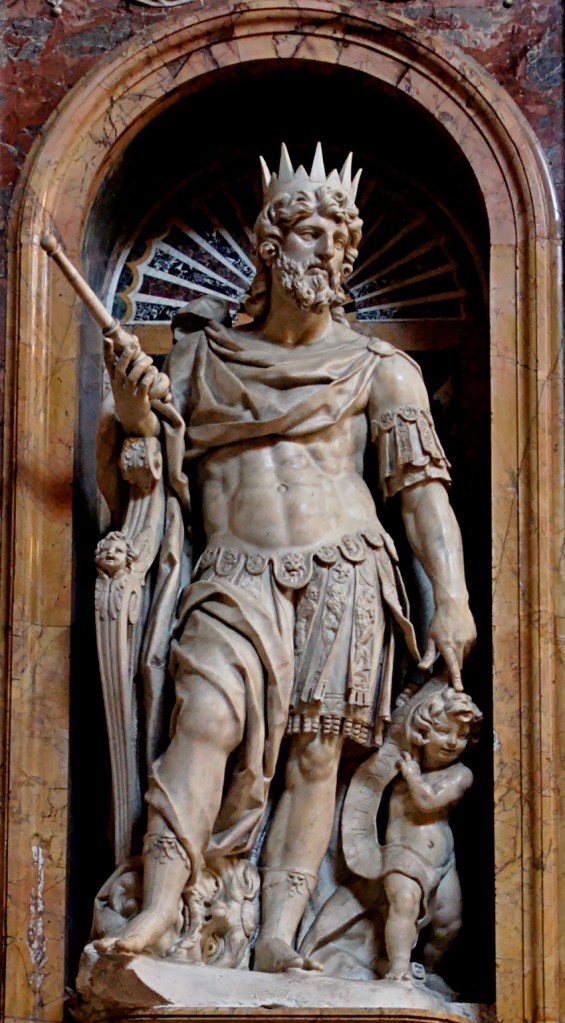
*Above statue of King David by French artist Nicolas Cordier, c.1610

Titus 1:1-9 – Effective Spiritual Leaders

From Paul, a slave of God and an apostle of Jesus Christ. I’m sent to bring about the faith of God’s chosen people and a knowledge of the truth that agrees with godliness.

Their faith and this knowledge are based on the hope of eternal life that God, who doesn’t lie, promised before time began. God revealed his message at the appropriate time through preaching, and I was trusted with preaching this message by the command of God our savior.

To Titus, my true child in a common faith.

Grace and peace from God the Father and Christ Jesus our savior.

The reason I left you behind in Crete was to organize whatever needs to be done and to appoint elders in each city, as I told you. Elders should be without fault. They should be faithful to their spouse and have faithful children who can’t be accused of self-indulgence or rebelliousness. This is because supervisors should be without fault as God’s managers: they shouldn’t be stubborn, irritable, addicted to alcohol, a bully, or greedy. Instead, they should show hospitality, love what is good, and be reasonable, ethical, godly, and self-controlled. They must pay attention to the reliable message as it has been taught to them so that they can encourage people with healthy instruction and refute those who speak against it. (Common English Bible)

Paul wrote his letter to Titus so that spiritually solid competent virtuous leaders might be appointed to guide the church on the island of Crete (located in the Mediterranean Sea, south of Greece). 

There was no ambiguity with Paul about the importance of leadership. The Apostle clearly laid out his expectations that church officials must have a good reputation – not bossy, quick-tempered, heavy drinkers, bullies, or dishonest in business. Instead, they must be friendly to strangers and enjoy doing good things. They must also be sensible, fair, pure, and self-controlled.  They must stick to the true message they were taught, so that their good teaching can help others and correct everyone who opposes it.

I find it interesting that very few biblical scholars view this teaching as an ideal to aspire – while many churches and believers think this is the case. There is neither any indication nor reason within the biblical text to think that Paul presented his expectations for the ideal leader, as if no one could really be this way. 

Furthermore, Paul did not provide his instruction as a strategy for getting apathetic people off their butts and into some form of service. No, it’s best to understand that Paul meant what he said. He knew that compromising on the character of leadership would erode and destroy the church.

“True leadership is found in giving yourself in service to others, not in coaxing or inducing others to serve you.”

J. Oswald Sanders

The selection of church leaders is important because just one bad belly-aching non-virtuous apple can upset the entire apple cart. Good people provide good teaching and good wisdom. Selfish people with a self-centered agenda find ways to subvert or manipulate sound instruction to get what they want. 

Everyone in the Body of Christ is to grow in the wisdom and knowledge of God. They are to be wise to all the shenanigans of myopic persons through understanding the commands and instruction of Holy Scripture. This is yet another reason to immerse ourselves in the Bible so that we will lead with confidence.

If a church or faith community feels the need to overlook character defects to fill empty leadership seats, then Houston, we have a problem. Any short order cook worth his salt would never crack open a rotten egg and mix it in with the rest to make an omelet. And any group of people who throw a bad egg into their leadership team had better be ready to get sick and vomit when meetings are called to order.

It is imperative that spiritual leaders possess the following:

  • A good reputation
  • Faithfulness and fidelity to their families.
  • A clear-mind and consistent good behavior.
  • Self-control
  • The moral courage to speak truth with grace.
  • A spirit and practice of hospitality.
  • An ability to communicate well so that people are built up in their faith.
  • Sobriety
  • Humility
  • Respectability
  • Gentleness
  • Patience
  • Generosity
  • Compassion
  • Maturity
  • Sincerity
  • Honesty
  • Empathy
  • Purity

All these traits are needed for effective and godly spiritual leadership. Compromising on virtue will never end well. Upholding moral character brings blessing.

“The authority by which the Christian leader leads is not power but love, not force but example, not coercion but reasoned persuasion. Leaders have power, but power is safe only in the hands of those who humble themselves to serve.” 

John R.W. Stott

God calls and sets apart individuals for service. The Lord desires to reveal and manifest the divine presence among people through leaders who reflect God’s good attributes. Jesus Christ wants his church to be built up through faithful service. The Spirit seeks to sanctify and empower for effective ministry.

Nowhere do we find in Scripture that a leader’s main job is listening to complaints. That’s because God has a zero tolerance policy toward murmuring, grumbling, and ingratitude. In fact, the New Testament clearly says to do everything without complaining or arguing. (Philippians 2:14)

Neither will you find the church is supposed to operate just like an American form of democracy. Spiritual leaders are not representatives of the people to do their will. Instead, they are representatives of God to the people so that God’s will is done in all things. 

That all means prayer to God and outreach to the world is the major work for spiritual leaders. And it takes virtuous and ethical persons leading to realize love to all kinds of people. So, feel free to exercise leadership. Just make sure that leadership is grounded in the God of integrity and the Word of grace and truth.

Almighty God, the One who gives good gifts to people, may every grace of ministry rest on divinely appointed leaders. Keep them strong and faithful so that your church may prosper in peace. Grant leaders wisdom, courage, discretion, and benevolence so that they may fulfill their charge to the glory of Jesus Christ and in the power of your Holy Spirit. Amen.