A Mountain of Good News (Isaiah 25:6-9)

On this mountain the Lord of hosts will make for all peoples
    a feast of rich food, a feast of well-aged wines,
    of rich food filled with marrow, of well-aged wines strained clear.
And he will destroy on this mountain
    the shroud that is cast over all peoples,
    the covering that is spread over all nations;
    he will swallow up death forever.
Then the Lord God will wipe away the tears from all faces,
    and the disgrace of his people he will take away from all the earth,
    for the Lord has spoken.
It will be said on that day,
    “See, this is our God; we have waited for him, so that he might save us.
    This is the Lord for whom we have waited;
    let us be glad and rejoice in his salvation.” (New Revised Standard Version)

Mountains are a prominent and symbolic part of Holy Scripture.

Abraham sojourned to a mountain where he exhibited the pinnacle of faith in radical obedience to God’s command to sacrifice his son Isaac. (Genesis 22:1-19)

The Law was given to Moses on a mountain. (Exodus 19:1-20:17)

Elijah traveled 40 days and nights to meet God on a mountain. (1 Kings 19:11-18)

Jesus preached the most famous sermon ever on a mountain. (Matthew 5-7)

Because of such references, we routinely refer to extraordinary events as “mountaintop experiences.”

Your steadfast love, O Lord, extends to the heavens,
    your faithfulness to the clouds.
Your righteousness is like the mighty mountains;
    your judgments are like the great deep;
    you save humans and animals alike, O Lord. (Psalm 36:5-6, NRSV)

The mountain is a contrast and antithesis to the valley of death below. It signifies God’s power and reign over all earthly rulers. On the mountain we enjoy a great feast of the soul, not to mention an actual meal full of celebration. After all, food and celebration always go together in God’s kingdom.

Whenever healing and/or emancipation happen, it’s time for a celebration. To celebrate significant events, and ritualize them so we remember them, is wise and much needed.

For the Christian, Jesus is the fulfillment of all God’s good promises. In Christ, we have deliverance from guilt, shame, death, and hell. Because Jesus Christ is risen from death and has conquered the grave, our salvation is assured and made possible. And so, along with the prophet Isaiah, we proclaim the good news of peace through the crucifixion and resurrection of Christ.

How beautiful upon the mountains
    are the feet of the messenger who announces peace,
who brings good news,
    who announces salvation,
    who says to Zion, “Your God reigns.” (Isaiah 52:7, NRSV)

Celebration of the good news keeps any sort of spiritual amnesia at bay; and when future difficulties arise, because of our joy in salvation, we are able to recall the mighty acts of God and embrace hope for the future.

If we consistently practice celebration, the redemption experienced in the past is constantly fresh, like a sumptuous meal before us in an endless buffet of goodness. We can eat anytime we want.

Banquets are rightly associated with hospitality, generosity, and fellowship. Meals in the ancient Near East culture were much more than utilitarian; eating together was (and, frankly, still is in most parts of the world) a deeply spiritual event which communicates acceptance, encouragement, and love to one another.

God is the ultimate host. He throws the best parties. God ensures that there is plenty of food, fellowship, and fun. God’s joy knows no bounds. In the middle of a world beset with sadness, loss, and grief, God’s boundless generosity swallows up people’s disgrace and mourning.

At God’s Table, no one cries alone; everyone is comforted; nobody walks away hungry; and, every person is waited upon, no matter who they are or where they have come from. Indeed, there is always room at the Table.

Through Christ’s resurrection, death has been swallowed up in victory. (1 Corinthians 15:54)

Death no longer has any power to control, humiliate, or shame us into submission. Death’s threats are empty.

The Grim Reaper’s teeth have been pulled and his scythe has been broken. He is the party-pooper who is barred from entry.

There is life and abundance for all who ascend the mountain and feast with God at his Table. The invitation has gone out. The Table is spread. We need only to come.

In the joy of your Son, Jesus Christ, through his mighty resurrection and in expectation of his coming again, we offer ourselves to you, Almighty God, as holy and living sacrifices. Together with all your people everywhere and in every age, we proclaim the mystery of the faith:

Christ has died!

Christ is risen!

Christ will come again!

Send your Holy Spirit upon us, we pray, that the bread which we break and the cup which we bless may be to us a sacred communion, a holy celebration of Christ’s body, blood, and victory over death. We declare:

God has spoken!

God has acted!

God has provided!

May you gather all into your hospitable and abundant kingdom; through Jesus Christ, your Son, our Lord, who lives and reigns with you and the Holy Spirit, One benevolent God, now and forever. Amen.

Victory Celebration (Exodus 15:1-18)

The Songs of Moses and Miriam, by Laura James

Then Moses and the Israelites sang this song to the Lord:

“I will sing to the Lord, for he has triumphed gloriously;
    horse and rider he has thrown into the sea.
The Lord is my strength and my might,
    and he has become my salvation;
this is my God, and I will praise him;
    my father’s God, and I will exalt him.
The Lord is a warrior;
    the Lord is his name.

Pharaoh’s chariots and his army he cast into the sea;
    his elite officers were sunk in the Red Sea.
The floods covered them;
    they went down into the depths like a stone.
Your right hand, O Lord, glorious in power—
    your right hand, O Lord, shattered the enemy.
In the greatness of your majesty you overthrew your adversaries;
    you sent out your fury; it consumed them like stubble.
At the blast of your nostrils the waters piled up;
    the floods stood up in a heap;
    the deeps congealed in the heart of the sea.
The enemy said, ‘I will pursue; I will overtake;
    I will divide the spoil; my desire shall have its fill of them.
    I will draw my sword; my hand shall destroy them.’
You blew with your wind; the sea covered them;
    they sank like lead in the mighty waters.

Who is like you, O Lord, among the gods?
    Who is like you, majestic in holiness,
    awesome in splendor, doing wonders?
You stretched out your right hand;
    the earth swallowed them.

In your steadfast love you led the people whom you redeemed;
    you guided them by your strength to your holy abode.
The peoples heard; they trembled;
    pangs seized the inhabitants of Philistia.
Then the chiefs of Edom were dismayed;
    trembling seized the leaders of Moab;
    all the inhabitants of Canaan melted away.
Terror and dread fell upon them;
    by the might of your arm, they became still as a stone
until your people, O Lord, passed by,
    until the people whom you acquired passed by.
You brought them in and planted them on the mountain of your own possession,
    the place, O Lord, that you made your abode,
    the sanctuary, O Lord, that your hands have established.
The Lord will reign forever and ever.” (New Revised Standard Version)

The ancient Israelites were freed from four hundred years of Egyptian bondage through the miraculous work of God. Then, as they were leaving Egypt, Pharaoh had a change of heart and decided to take his army and pursue the Israelites.

Literally sandwiched between the army and the sea, yet another miracle happened: God parted the Red Sea, allowing the Israelites to pass through on dry ground; and then God closed the sea up on the pursuing army. Today’s Old Testament lesson is the people’s victory chant of deliverance.

Portrayed here is Yahweh’s incomparable power over the mighty Egyptians, and protective presence with the Israelites. God was fulfilling the divine promise to bring the people out from bondage and into the Promised Land. Nothing can stand in the way of the Lord’s purpose.

By Stushie Art

God Rescues

Throughout the Bible, deliverance and celebration go hand in hand. For the Christian, this time of year is full of celebrating the resurrection of Christ from death. Because our redemption is secured, we rejoice in the once for all sacrifice of Jesus.

God rescued us from dead-end alleys and dark dungeons. He’s set us up in the kingdom of the Son he loves so much; the Son who got us out of the pit we were in, got rid of the sins we were doomed to keep repeating. (Colossians 1:13-14, MSG)

God Protects

The Lord showed up and wondrously delivered the Israelites from certain annihilation. And God has also entered into humanity’s world and brought emancipation from sin, death, and hell through Christ’s redemptive events of cross and resurrection. We are shielded by God’s glorious grace and goodness.

Praise be to the God and Father of our Lord Jesus Christ! In his great mercy he has given us new birth into a living hope through the resurrection of Jesus Christ from the dead, and into an inheritance that can never perish, spoil or fade. This inheritance is kept in heaven for you, who through faith are shielded by God’s power until the coming of the salvation that is ready to be revealed in the last time. (1 Peter 1:3-5, NIV)

God Establishes

Deliverance is provided, and then the divine presence is with us throughout life. God doesn’t expect us to be on our own after we are saved from a calamitous situation. Grace is given for all things, not just some things. So, the Lord helps to establish us in faith and perseverance for a lifetime.

His divine power has given us everything needed for life and godliness, through the knowledge of him who called us by his own glory and excellence. Thus he has given us, through these things, his precious and very great promises, so that through them you may escape from the corruption that is in the world because of lust and may become participants of the divine nature…. Therefore I intend to keep on reminding you of these things, though you know them already and are established in the truth that has come to you. (2 Peter 1:3-4, 12, NRSV)

Our victory chant comes from God’s redemptive events. For the Christian, we are rescued from our precarious spiritual plight, protected and established by divine power, through the person and work of Jesus Christ.

“Victory in Jesus” by E.M. Bartlett, 1939

I heard an old, old story
How a Savior came from glory
How He gave His life on Calvary
To save a wretch like me
I heard about His groaning
Of His precious blood’s atoning
Then I repented of my sins
And won the victory

Oh, victory in Jesus, my Savior forever
He sought me and bought me with His redeeming blood
He loved me ‘ere I knew Him and all my love is due Him
He plunged me to victory beneath the cleansing flood

I heard about His healing
Of His cleansing power revealing
How He made the lame to walk again
And caused the blind to see
And then I cried, “Dear Jesus, come and heal my broken spirit”
And somehow Jesus came and brought to me the victory

Victory in Jesus, my Savior forever
He sought me, and He bought me with His redeeming blood
He loved me ‘ere I knew Him and all my love is due Him
He plunged me to victory beneath the cleansing flood

Give Thanks and Praise (Luke 17:11-19)

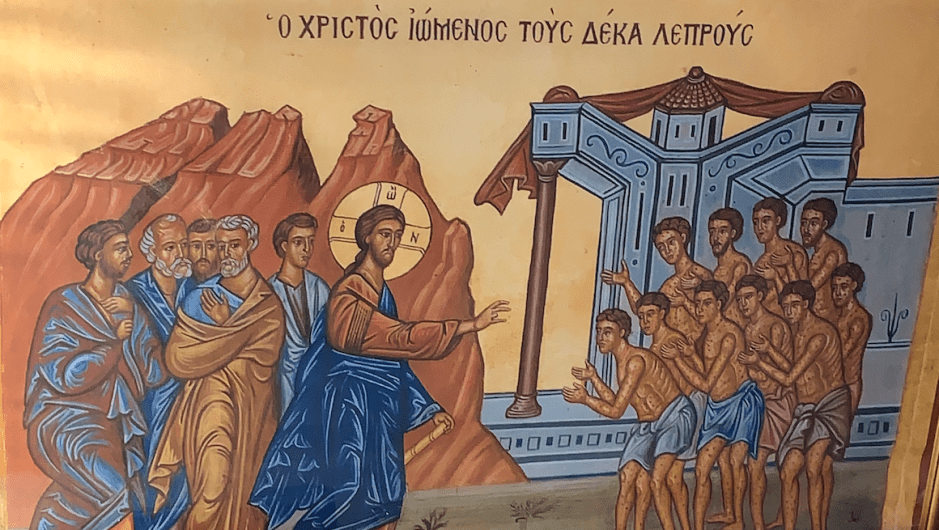
Eastern Orthodox depiction of Jesus Christ healing the ten lepers

Now on his way to Jerusalem, Jesus traveled along the border between Samaria and Galilee. As he was going into a village, ten men who had leprosy met him. They stood at a distance and called out in a loud voice, “Jesus, Master, have pity on us!”

When he saw them, he said, “Go, show yourselves to the priests.” And as they went, they were cleansed.

One of them, when he saw he was healed, came back, praising God in a loud voice. He threw himself at Jesus’ feet and thanked him—and he was a Samaritan.

 Jesus asked, “Were not all ten cleansed? Where are the other nine? Has no one returned to give praise to God except this foreigner?” Then he said to him, “Rise and go; your faith has made you well.” (New International Version)

Today’s Gospel story is both joyous and sad. The healing of ten lepers is astonishing and elicits praise and thanks… from only one. Maybe it’s because they stood at a distance. After all, it’s a close connection to God which causes praise and gratitude to arise within us – and not some appreciation from afar. Therefore, methinks we ought to consider what the nature of our own connection is. 

“Thanksgiving” to most Americans is Thanksgiving Day – a holiday filled with food, football, and family, the trifecta of American celebration. I myself admit to liberally indulging in all three. Although Thanksgiving has become a form of secular liturgical worship, I believe that underneath all the gravy, naps at halftime, and the occasional obnoxious relative, we know why we celebrate: To praise God and give thanks for our abundant blessings. 

It seems that even those who do not readily acknowledge the Divine intuitively know there is a power and source of blessing well beyond themselves which makes all good things occur.

Celebrations are a spiritual activity. God invented parties. When Israel was preparing for a new national life in the Promised Land, God told them to celebrate the Feast of Harvest with the first fruits of the crops (Exodus 23:16). The Levitical law prescribed how to go about giving thanksgiving offerings and offering praise (Leviticus 7:11-34).

Gratitude and praise was commanded, expected, and an important dimension of Old Testament worship. King David established a group of 288 full-time musicians to do nothing but praise and give thanks before God day and night (1 Chronicles 25).

Let us come into his presence with thanksgiving; let us make a joyful noise to him with songs of praise!

Psalm 95:2, NRSV

Enter his gates with thanksgiving
    and his courts with praise.
    Give thanks to him; bless his name.

For the Lord is good;
    his steadfast love endures forever
    and his faithfulness to all generations. (Psalm 100:4-5, NRSV)

It ought to have been reflexive for all ten lepers healed by Jesus to offer their worship to Jesus. A Samaritan, considered by many of the time as the lowliest of the low, a “half-breed,” was the lone person who came and fell at Christ’s feet with effusive praise and heartfelt gratitude. While the other nine went about their lives, free from disease and glad for it, only one guy took the time to thank Jesus and give glory to God. 

The Samaritan leper alone gives thanks to Christ, by Unknown artist

Sometimes we need to be reminded that celebration is a spiritual practice. It’s important to celebrate Jesus and for the ways God has provided and blessed us. In Holy Scripture, it is often the homeless, the sick, the lowly, and the outsiders who lead the way and demonstrate what genuine praise and honest thanksgiving looks like.

We, the Church, who belong to God and possess the Spirit, are to always remember and be mindful of what we truly have in Jesus Christ:

So then, just as you received Christ Jesus as Lord, continue to live your lives in him, rooted and built up in him, strengthened in the faith as you were taught, and overflowing with thankfulness. (Colossians 2:6-7, NIV)

We, like King David of old, are to establish continual worship of God:

Rejoice always, pray continually, give thanks in all circumstances; for this is God’s will for you in Christ Jesus.

1 Thessalonians 5:16-18, NIV

Our sacrifice as Christians is not with the blood of animals but with our lips and our lives:

Through Jesus, therefore, let us continually offer to God a sacrifice of praise—the fruit of lips that openly profess his name. (Hebrews 13:15, NIV)

And the worship service is eternal; it will never end:

And the twenty-four elders, who were seated on their thrones before God, fell on their faces and worshiped God, saying:

“We give thanks to you, Lord God Almighty,
    the One who is and who was,
because you have taken your great power
    and have begun to reign.” (Revelation 11:16-17, NIV)

Praising God and giving thanks to the Lord go together like mashed potatoes and gravy. Since God created everything, and since Jesus has brought healing to us through the cross, every juicy morsel of goodness we have is to be received with the full cognizance that God is behind it all.

Our lives need to be punctuated with times of celebration, praise, gratitude, and even blowout parties. Otherwise, we become dull, boring, lifeless, and bereft of Christ’s lifeblood coursing through our spiritual veins. A joyous and raucous group of healed believers jabbering incessantly with thanksgiving of God’s goodness are winsome and peculiar (in a good way and not in the strange way of your weird uncle who wants the turkey neck to gnaw on at the Thanksgiving meal).

Seems to me that Christians really ought to be at the forefront of having maximum fun because we are forgiven people; we know and experience the presence of God; our lives are hidden with God in Christ; we are confident and can approach the throne of God with boldness; and we possess the power of the Spirit and the shepherding ministry of Jesus.

Remember to give thanks. Plan to praise – out loud and with others – for the God who stands behind every good gift of creation. Let thanksgiving (not complaint) shape your life. Be the person who comes back to Jesus and offers praise and gratitude – and see how such gratefulness and glory can change the world.

Gracious God, Father of all mercies, we your unworthy servants give you humble thanks for all your goodness and steadfast love to us and to all whom you have made. We bless you for our creation, preservation, and all the blessings of this life; but above all praise you for your immeasurable love in the redemption of the world by our Lord Jesus Christ; for the means of grace, and for the hope of glory.

Give us such an awareness of your mercies, that with truly thankful hearts we may show forth your praise, not only with our lips, but in our lives, by giving up ourselves to your service, and by walking before you in holiness and righteousness all the days of our lives, through Jesus Christ our Lord, who with you and the Holy Spirit, be honor and glory throughout all ages and forevermore. Hallelujah! Amen!

Psalm 6 – Independence Day Celebration or Mourning?

O Lord, do not rebuke me in your anger
    or discipline me in your wrath.
Be gracious to me, O Lord, for I am languishing;
    O Lord, heal me, for my bones are shaking with terror.
My soul also is struck with terror,
    while you, O Lord—how long?

Turn, O Lord, save my life;
    deliver me for the sake of your steadfast love.
For in death there is no remembrance of you;
    in Sheol who can give you praise?

I am weary with my moaning;
    every night I flood my bed with tears;
    I drench my couch with my weeping.
My eyes waste away because of grief;
    they grow weak because of all my foes.

Depart from me, all you workers of evil,
    for the Lord has heard the sound of my weeping.
The Lord has heard my supplication;
    the Lord accepts my prayer.
All my enemies shall be ashamed and struck with terror;
    they shall turn back and in a moment be put to shame. (New Revised Standard Version)

Methinks we Americans, especially on this our national Independence Day, must remember that this has not always been, nor currently is, a day of celebration for a sizable chunk of people in the United States.

Now before you begin offering some mental pushback that I am pouring cold water on a time-honored holiday, or begin believing I’m not a true patriot, I will simply point out that not only is today’s psalm lesson in the Revised Common Lectionary a lament, but also that I’m a guy with two academic degrees in American history.

If we only look at Independence Day from the perspective of white Northern European heritage persons, then it will seem that, speaking like this, I am not grateful for the blessings of being in this incredible country of my birth and the place I’ve lived my entire life.

But I am not looking from that angle today. I choose to acknowledge that on this day, every year for the past 246 years, today’s psalm has been the lived experience and expression of others who looked to the heavens and asked, “How long, O Lord!?”

A true people of compassion are able to suffer with those who suffer. The people of God really ought to be at the forefront of exhibiting empathy and standing in solidarity with suffering folk.

A patriot is one who acknowledges and affirms all it’s citizens, and not only the ones who look like me, talk like me, and act like me. After all, the original documents of the United States made room for this to be so. Empathy, compassion, and solidarity are intentionally built into our nation’s grand experiment of democracy and government.

“We the people of the Unites States, in order to form a more perfect union, establish justice, insure domestic tranquility, provide for the common defense, promote the general welfare, and secure the blessings of liberty to ourselves and our posterity, do ordain and establish this Constitution for the United States of America.”

Preamble of the United States Constitution

The very fact that the previous quotation is true for some, and not for everyone, is a telling testament to the reality that we need to keep striving to live into our heritage as Americans and ensure that welfare for the common good of all citizens is continually sought, even if done so imperfectly.

Grieving, tears, and lament was the response of the former slave Frederick Douglass.

“The rich inheritance of justice, liberty, prosperity and independence, bequeathed by your [white] fathers, is shared by you, not by me. The sunlight that brought light and healing to you, has brought stripes and death to me [a black man]. This Fourth July is yours, not mine. You may rejoice, I must mourn.”

Frederick Douglass, “What to the Slave is the 4th of July?” (An oration on July 4, 1852)

Mourning and weeping was and continues to be the experience of many Native American peoples.

“While the United States and its settlers claimed its independence from Great Britain, this came at a cost of others, including this land’s Indigenous Peoples that were stolen from their own homelands. This patriotic holiday is nothing to celebrate because freedom cannot come at the cost of another’s freedom. America’s Independence Day is a celebration of imperialism, genocide, and American exceptionalism, and there is no pride in genocide.”

Daisee Francour (Oneida Nation of Wisconsin)

We cannot change history, but we can work towards a better future where all of our rights are respected and we all experience freedom and independence equally. Those with non-European ancestry who today in our nation experience racism and anti-ethnic aggression need to be acknowledged and affirmed as Americans with equal standing and an equal voice alongside the white population.

So, I would argue that both celebration and weeping ought to occur on this day. We should weep for the dreams and lives of indigenous peoples who were destroyed through westward expansion, and even today experience the ongoing effects of cultural genocide.

We ought to acknowledge not only our nation’s blessings, but also our curses which are still seen in exploiting others through envy, greed, sloth, pride, lust, and gluttony.

We, the people of the United States of America, ought to actively seek to live in more simple and less harmful ways. We should offer our voices, not in violent speech and language, but with creative and healing words.

On this American Independence Day, the Church should reaffirm her allegiance and citizenship to Christ and God’s Kingdom and renounce any nationalistic, economic, ethnic, and political divisions which are contrary to the words and ways of Jesus.

All of the citizens of the earth should seek to embrace non-violent, self-sacrificial love on behalf of everyone. Today is an opportunity to affirm that Christ is the Friend of all people, not just some.

No one ought to be wasting away in their grief and languishing in their tears when we have the means to acknowledge their suffering and to do something about it.

Our Father who is in heaven,

uphold the holiness of your name.

Bring in your kingdom

so that your will is done on earth as it’s done in heaven.

Give us the bread we need for today.

Forgive us for the ways we have wronged you,

just as we also forgive those who have wronged us.

And don’t lead us into temptation,

but rescue us from the evil one. (Matthew 6:9-13, CEB)