Remember Passover (Deuteronomy 16:1-8)

Exodus, by Yoram Raanan

Observe the month of Aviv and celebrate the Passover of the Lord your God, because in the month of Aviv he brought you out of Egypt by night. Sacrifice as the Passover to the Lord your God an animal from your flock or herd at the place the Lord will choose as a dwelling for his Name. Do not eat it with bread made with yeast, but for seven days eat unleavened bread, the bread of affliction, because you left Egypt in haste—so that all the days of your life you may remember the time of your departure from Egypt. Let no yeast be found in your possession in all your land for seven days. Do not let any of the meat you sacrifice on the evening of the first day remain until morning.

You must not sacrifice the Passover in any town the Lord your God gives you except in the place he will choose as a dwelling for his Name. There you must sacrifice the Passover in the evening, when the sun goes down, on the anniversary of your departure from Egypt. Roast it and eat it at the place the Lord your God will choose. Then in the morning return to your tents. For six days eat unleavened bread and on the seventh day hold an assembly to the Lord your God and do no work. (New International Version)

The first five books of the Old Testament are known by Christians as the Pentateuch. These same books are the Torah in Judaism. Deuteronomy is the fifth and final book; it is a restatement of God’s Law for the Israelites about to enter the Promised Land.

Several prominent theological themes are highlighted in the book of Deuteronomy. It vigorously advocates for exclusive loyalty to the monotheistic God, Yahweh. Yahweh is characterized as a transcendent Being, full of steadfast love and transformative justice.

Deuteronomy places significant emphasis upon the covenant relationship between God and Israel. The covenant was established with the patriarchs – Abraham, Isaac, and Jacob – and affirmed at Mount Sinai after the exodus from Egypt, at the giving of the Law. This Law was graciously provided by God for the people; it is encapsulated in the Ten Commandments, and is to be reaffirmed as soon as Israel enters the land.
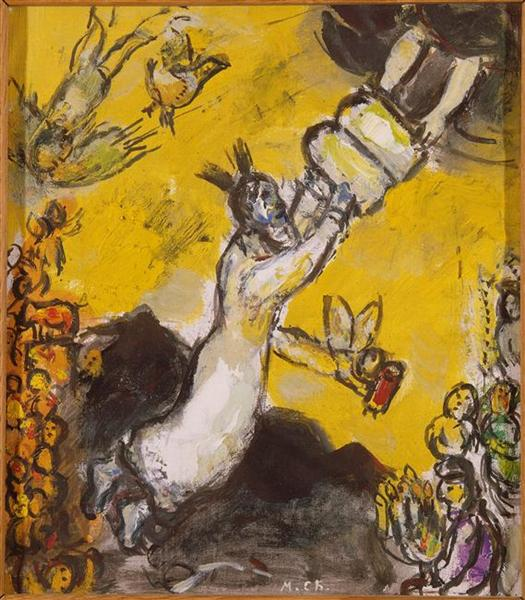
Moses receiving the Tablets of Law, by Marc Chagall, 1963

Therefore, the entire book of Deuteronomy looks forward toward a new existence in the Promised Land. This new society is to pursue justice and be devoted to righteousness. All Israel is to live in harmony with God and one another, enjoying the land and the covenant relationship.

The welfare of Israel depends upon upholding and maintaining the social and religious laws given by Yahweh. God’s commands are a divine gift, and if closely followed, will be the best humanitarian way of caring for the poor and disadvantaged, as well as bringing the people close to Yahweh.

The sacrificial system will revolve around a singular sanctuary in the religious capital. By locating sacrifices in a particular place, this has the effect of Jewish faith not becoming dependent on offerings, but instead on mercy, love, learning the law, and rituals that uphold reverence for God.

Perhaps the greatest of all the rituals is Passover. Israel’s experience of deliverance at the Red Sea and the centralization of worship in Jerusalem is remembered and celebrated at the festival of Passover every year.

In the original Passover, at the time of the exodus, the blood of a sacrificed lamb was smeared on the doorposts of each Jewish home. In doing this, it let the angel of death know to “pass over” that house, thereby only entering Egyptian homes that did not revere nor recognize God. This act was also the final miraculous act of ten plagues leveled on Egypt.

And There Was a Great Cry in Egypt, by Arthur Hacker, 1897

As the households of Egypt were grieving their dead, Israel was urged by the Egyptians to get out. Egypt feared what would happen if the Israelites remained. Therefore, Israel left post haste. They didn’t have any time for their bread to rise. The people ate unleavened bread so they could immediately leave Egypt.

So, from then on, every year in early Spring, Israel commemorates and remembers God’s deliverance of the people from slavery. God, through Moses, instructed the Israelites to mark Aviv as the first month; it is then that the Passover festival is to occur.

I believe that what we can takeaway from this Scripture, is that perhaps, we ought to stop trying to always have takeaways for everything – as if the Bible can be boiled down to some neat personal application for my life.

Aside from admitting I’ve had a bit of a cynical streak lately, we really must contend with seasons like Passover and Lent, and matters such as social justice and religious worship. These religious seasons are important enough to warrant what the late Eugene Peterson called “a long obedience in the same direction.”

By that phrase, Peterson meant that there are some spiritual practices that we must commit ourselves to year after year, even day after day, for the rest of our lives. Generations before did, and generations after us will need to, as well.

Spiritual growth and maturity take time; and we must patiently and consistently cultivate a sense of justice and a practice of righteousness over and over again.

Passover Seder, by Melita Kraus

One must fight for what they believe, each and every day. Spiritual growth takes a lot of time, grit, tenacity, and resilience. It requires patience and grace, perseverance and a good nature. And it is very much a skill which demands daily practice.

Contemporary society is obsessed with quick fixes and easy solutions. But the time-tested practices of Lent, rooted in the remembrances of Passover, are a Christian discipleship that is long on obedience in the same well-worn ancient directions.

We need to keep moving in the directions of deepening a life of prayer, learning the joy of service, growing in the worship of God, and discovering the virtues of humility and a concern for the welfare of everyone in the community.

In other words, to truly observe something, we need to do it, over and over, year after year. In observing the significant events and dates and seasons of the Christian Year, we can find the sort of spiritual support that will fortify our soul, and bless others.

Almighty and everlasting God, you hate nothing you have made and forgive the sins of all who are penitent: Create and make within us new and contrite hearts, so that we may acknowledge our guilt and lament our shame. Let us obtain from you, O merciful God, reconciliation through the Cross, and empowerment through the Spirit, to do justice, love mercy, and walk humbly with you. Amen.


Let Me Tell You What God Has Done For Me (Psalm 66:8-20)

Praise our God, all peoples,
    let the sound of his praise be heard;
he has preserved our lives
    and kept our feet from slipping.
For you, God, tested us;
    you refined us like silver.
You brought us into prison
    and laid burdens on our backs.
You let people ride over our heads;
    we went through fire and water,
    but you brought us to a place of abundance.

I will come to your temple with burnt offerings
    and fulfill my vows to you—
vows my lips promised and my mouth spoke
    when I was in trouble.
I will sacrifice fat animals to you
    and an offering of rams;
    I will offer bulls and goats.

Come and hear, all you who fear God;
    let me tell you what he has done for me.
I cried out to him with my mouth;
    his praise was on my tongue.
If I had cherished sin in my heart,
    the Lord would not have listened;
but God has surely listened
    and has heard my prayer.
Praise be to God,
    who has not rejected my prayer
    or withheld his love from me! (New International Version)

“God made humans because God loves stories.”

Elie Wiesel

The Church’s Prayer Book

Those of us who utilize the Revised Common Lectionary Daily Readings are familiar with having a psalm each day. In addition, the same psalm is repeated three consecutive days, following the pattern of Thursday, Friday, and Saturday readings preparing for Sunday – and Monday, Tuesday, and Wednesday readings reflecting on Sunday. The Psalter has such a prominent place in the readings because it is viewed as the Church’s Prayer Book.

Within the book of Psalms, we have the full range of human experience and emotion. Much like athletes in weight training, putting in their reps (repetitions), so the Christian is to use the weighty Psalms with repeated use for spiritual growth and development. Prayer and praise, lament and celebration, are necessary equipment for the strengthening of faith and a healthy Christian life.

Psalms of Praise and Thanksgiving

Today’s psalm is a song of thanksgiving for the community of worshipers approaching the temple and offering their sacrifices to God. Together, as the people of God, they proclaim what God has done for them. Through hardship and difficulty, they have realized abundance and joy. Personal witness and testimony are given to the congregation for answered prayer so that all may rejoice together in God’s steadfast and unfailing love.

Expressing celebration is important. Without it, our spirits are famished and find it difficult to be patient and persevere. With celebration, our spiritual muscles flex with joy and are in shape for the trials and tribulations which lie ahead. Corporate affirmation and personal appreciation are meant to work together in a grand profession of faith in God’s good guidance and help.

“Come and listen and I will tell you what God did for me,” benefits both the individual and the group. If all we ever hear and experience is hardship, our faith muscle will be overused and give out. We need stories to celebrate. We need to hear testimonies of God’s enduring love.

So, what has God done for you? What celebrations do we have today? Are you willing to share your story?

Ritual Celebration

Celebrations are necessary because they highlight the things most important to us. And it is okay to make them regular rituals – which is why I care about attending to the Christian Year with it’s centrality of Jesus and the movements of Advent, Christmas, Epiphany, Lent, Easter(tide), Ascension, Pentecost, and “Ordinary” Time.

Ritual celebration is, of course, not unique to Christianity. Rituals are part of being human. At it’s heart, ritual is a form of celebration, of remembering to observe significant events, special seasons, and daily routines. Each ritual observance is a re-telling of meaningful stories for an individual, family, or group of people.

Observing ritual celebrations:

  • Re-enforces our values.
  • Gives us a sense of belonging.
  • Marks time for us in meaningful ways.
  • Forms daily habits in us.
  • Reminds of us of who we are and what our purpose in this world is.
  • Helps us express our emotions in a healthy way.
  • Adds new stories to our lives.
  • Connects us to our spiritual ancestors and bonds us to one another.
  • Builds close relationships and trust.
  • Heals us from traumatic events.

Not observing ritual celebrations:

  • Causes a lack of identity and purpose.
  • Creates loneliness and confusion.
  • Hollows out our lives and sucks our souls of joy.

Sharing stories, and paying attention to rituals, are a primary connection between the individual and the community, a place where our identities and our values are reinforced and transformed into a force for good in the world.

Both the smallest and biggest of celebrations are appropriate, along with everything in between. While writing at my desk, a majestic male red wing blackbird perched himself on the bush in front of the window. Being only a few feet from him, I could see his feathers in detail and his glorious preening for the benefit of the females.

You are wonderful, Lord,
    and you deserve all praise,
because you are much greater
    than anyone can understand.

Each generation will announce
to the next your wonderful
    and powerful deeds.
I will keep thinking about
your marvelous glory
    and your mighty miracles.
Everyone will talk about
    your fearsome deeds,
and I will tell all nations
    how great you are.
They will celebrate and sing
about your matchless mercy
    and your power to save. (Psalm 145:3-7, CEV)

On a much grander scale, today I gathered with a family at the bedside of their loved one to grieve his death, and to also remember and celebrate his life for the gift he had been to so many. Together we were able to say, “Let the whole world bless our God and loudly sing his praises.”

We pray. God answers. We rejoice. If we don’t rejoice in the company of others, then we eventually forget – which then makes the next hardship even harder.

The practice of telling our story is the means by which we come to understand our faith. Testimony not only declares what we believe, but is also the vehicle that shapes our belief. The psalmist issues an invitation for people to come and hear, and he will tell what God has done. The story, the psalmist’s testimony of faith, is a simple one, essentially saying: I prayed to God. God listened. God answered. Praise be to God! And I will now tell you about God.

Tell a Story

When the Bible speaks about God, it most often does so by telling a story of what God has done. The Bible, as a whole, follows the pattern of a story: creation, fall, redemption, and new creation.

Beginning in the Old Testament, we get stories of God’s creative activity, humanity’s fall into sin, and God’s response of covenant and promise. The Lord calls Abraham and Sarah and their ancestors to a special relationship with a special purpose to reclaim all the world to it’s intended design.

The story continues with the Exodus from Egypt, the giving of God’s divine commandments, the wandering in the wilderness, the conquest of the land, the monarchy and finally the exile.

The New Testament picks up the story, telling about Jesus as the fulfillment of the Old Testament promises and spelling out the meaning of his death and resurrection.

The book of Acts continues the grand story of redemption and of what God has done, climaxing in the life, death and resurrection of Jesus. The apostles further the story by spreading good news of great joy: in Jesus Christ, there is grace, forgiveness, purpose, faith, hope, and love for all people everywhere.

In all the storytelling, remember to celebrate the mighty acts of God and declare what the Lord has done for you.

Creator God, because of your abundant love, you chose to bring light and order into the formless void, to create a world of unsurpassed beauty; and you saw that it was good. We ask that you continue to recreate the world with that same attentive love, to bring light into today’s ever increasing chaos and darkness. Replenish our hearts so that we too can renew the face of the earth, through Christ our Lord. Amen.

A Mountain of Good News (Isaiah 25:6-9)

On this mountain the Lord of hosts will make for all peoples
    a feast of rich food, a feast of well-aged wines,
    of rich food filled with marrow, of well-aged wines strained clear.
And he will destroy on this mountain
    the shroud that is cast over all peoples,
    the covering that is spread over all nations;
    he will swallow up death forever.
Then the Lord God will wipe away the tears from all faces,
    and the disgrace of his people he will take away from all the earth,
    for the Lord has spoken.
It will be said on that day,
    “See, this is our God; we have waited for him, so that he might save us.
    This is the Lord for whom we have waited;
    let us be glad and rejoice in his salvation.” (New Revised Standard Version)

Mountains are a prominent and symbolic part of Holy Scripture.

Abraham sojourned to a mountain where he exhibited the pinnacle of faith in radical obedience to God’s command to sacrifice his son Isaac. (Genesis 22:1-19)

The Law was given to Moses on a mountain. (Exodus 19:1-20:17)

Elijah traveled 40 days and nights to meet God on a mountain. (1 Kings 19:11-18)

Jesus preached the most famous sermon ever on a mountain. (Matthew 5-7)

Because of such references, we routinely refer to extraordinary events as “mountaintop experiences.”

Your steadfast love, O Lord, extends to the heavens,
    your faithfulness to the clouds.
Your righteousness is like the mighty mountains;
    your judgments are like the great deep;
    you save humans and animals alike, O Lord. (Psalm 36:5-6, NRSV)

The mountain is a contrast and antithesis to the valley of death below. It signifies God’s power and reign over all earthly rulers. On the mountain we enjoy a great feast of the soul, not to mention an actual meal full of celebration. After all, food and celebration always go together in God’s kingdom.

Whenever healing and/or emancipation happen, it’s time for a celebration. To celebrate significant events, and ritualize them so we remember them, is wise and much needed.

For the Christian, Jesus is the fulfillment of all God’s good promises. In Christ, we have deliverance from guilt, shame, death, and hell. Because Jesus Christ is risen from death and has conquered the grave, our salvation is assured and made possible. And so, along with the prophet Isaiah, we proclaim the good news of peace through the crucifixion and resurrection of Christ.

How beautiful upon the mountains
    are the feet of the messenger who announces peace,
who brings good news,
    who announces salvation,
    who says to Zion, “Your God reigns.” (Isaiah 52:7, NRSV)

Celebration of the good news keeps any sort of spiritual amnesia at bay; and when future difficulties arise, because of our joy in salvation, we are able to recall the mighty acts of God and embrace hope for the future.

If we consistently practice celebration, the redemption experienced in the past is constantly fresh, like a sumptuous meal before us in an endless buffet of goodness. We can eat anytime we want.

Banquets are rightly associated with hospitality, generosity, and fellowship. Meals in the ancient Near East culture were much more than utilitarian; eating together was (and, frankly, still is in most parts of the world) a deeply spiritual event which communicates acceptance, encouragement, and love to one another.

God is the ultimate host. He throws the best parties. God ensures that there is plenty of food, fellowship, and fun. God’s joy knows no bounds. In the middle of a world beset with sadness, loss, and grief, God’s boundless generosity swallows up people’s disgrace and mourning.

At God’s Table, no one cries alone; everyone is comforted; nobody walks away hungry; and, every person is waited upon, no matter who they are or where they have come from. Indeed, there is always room at the Table.

Through Christ’s resurrection, death has been swallowed up in victory. (1 Corinthians 15:54)

Death no longer has any power to control, humiliate, or shame us into submission. Death’s threats are empty.

The Grim Reaper’s teeth have been pulled and his scythe has been broken. He is the party-pooper who is barred from entry.

There is life and abundance for all who ascend the mountain and feast with God at his Table. The invitation has gone out. The Table is spread. We need only to come.

In the joy of your Son, Jesus Christ, through his mighty resurrection and in expectation of his coming again, we offer ourselves to you, Almighty God, as holy and living sacrifices. Together with all your people everywhere and in every age, we proclaim the mystery of the faith:

Christ has died!

Christ is risen!

Christ will come again!

Send your Holy Spirit upon us, we pray, that the bread which we break and the cup which we bless may be to us a sacred communion, a holy celebration of Christ’s body, blood, and victory over death. We declare:

God has spoken!

God has acted!

God has provided!

May you gather all into your hospitable and abundant kingdom; through Jesus Christ, your Son, our Lord, who lives and reigns with you and the Holy Spirit, One benevolent God, now and forever. Amen.

Give Thanks and Praise (Luke 17:11-19)

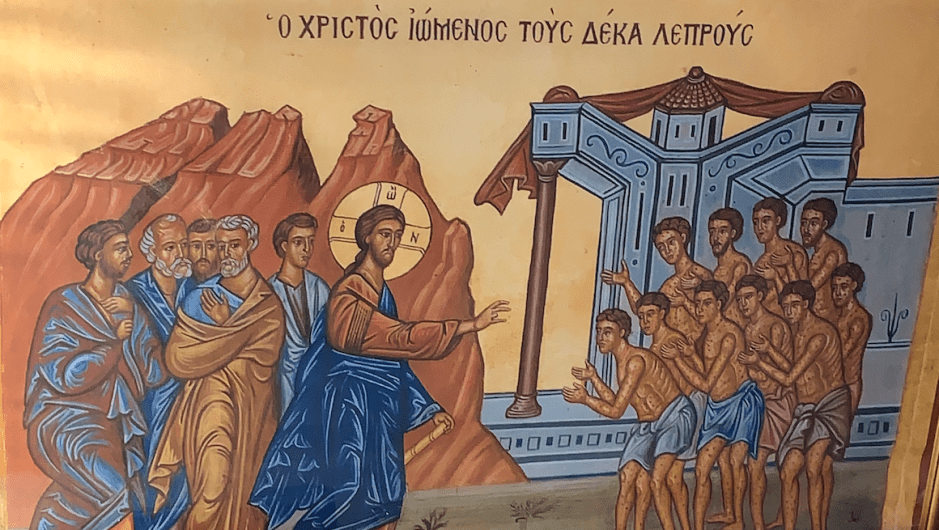
Eastern Orthodox depiction of Jesus Christ healing the ten lepers

Now on his way to Jerusalem, Jesus traveled along the border between Samaria and Galilee. As he was going into a village, ten men who had leprosy met him. They stood at a distance and called out in a loud voice, “Jesus, Master, have pity on us!”

When he saw them, he said, “Go, show yourselves to the priests.” And as they went, they were cleansed.

One of them, when he saw he was healed, came back, praising God in a loud voice. He threw himself at Jesus’ feet and thanked him—and he was a Samaritan.

 Jesus asked, “Were not all ten cleansed? Where are the other nine? Has no one returned to give praise to God except this foreigner?” Then he said to him, “Rise and go; your faith has made you well.” (New International Version)

Today’s Gospel story is both joyous and sad. The healing of ten lepers is astonishing and elicits praise and thanks… from only one. Maybe it’s because they stood at a distance. After all, it’s a close connection to God which causes praise and gratitude to arise within us – and not some appreciation from afar. Therefore, methinks we ought to consider what the nature of our own connection is. 

“Thanksgiving” to most Americans is Thanksgiving Day – a holiday filled with food, football, and family, the trifecta of American celebration. I myself admit to liberally indulging in all three. Although Thanksgiving has become a form of secular liturgical worship, I believe that underneath all the gravy, naps at halftime, and the occasional obnoxious relative, we know why we celebrate: To praise God and give thanks for our abundant blessings. 

It seems that even those who do not readily acknowledge the Divine intuitively know there is a power and source of blessing well beyond themselves which makes all good things occur.

Celebrations are a spiritual activity. God invented parties. When Israel was preparing for a new national life in the Promised Land, God told them to celebrate the Feast of Harvest with the first fruits of the crops (Exodus 23:16). The Levitical law prescribed how to go about giving thanksgiving offerings and offering praise (Leviticus 7:11-34).

Gratitude and praise was commanded, expected, and an important dimension of Old Testament worship. King David established a group of 288 full-time musicians to do nothing but praise and give thanks before God day and night (1 Chronicles 25).

Let us come into his presence with thanksgiving; let us make a joyful noise to him with songs of praise!

Psalm 95:2, NRSV

Enter his gates with thanksgiving
    and his courts with praise.
    Give thanks to him; bless his name.

For the Lord is good;
    his steadfast love endures forever
    and his faithfulness to all generations. (Psalm 100:4-5, NRSV)

It ought to have been reflexive for all ten lepers healed by Jesus to offer their worship to Jesus. A Samaritan, considered by many of the time as the lowliest of the low, a “half-breed,” was the lone person who came and fell at Christ’s feet with effusive praise and heartfelt gratitude. While the other nine went about their lives, free from disease and glad for it, only one guy took the time to thank Jesus and give glory to God. 

The Samaritan leper alone gives thanks to Christ, by Unknown artist

Sometimes we need to be reminded that celebration is a spiritual practice. It’s important to celebrate Jesus and for the ways God has provided and blessed us. In Holy Scripture, it is often the homeless, the sick, the lowly, and the outsiders who lead the way and demonstrate what genuine praise and honest thanksgiving looks like.

We, the Church, who belong to God and possess the Spirit, are to always remember and be mindful of what we truly have in Jesus Christ:

So then, just as you received Christ Jesus as Lord, continue to live your lives in him, rooted and built up in him, strengthened in the faith as you were taught, and overflowing with thankfulness. (Colossians 2:6-7, NIV)

We, like King David of old, are to establish continual worship of God:

Rejoice always, pray continually, give thanks in all circumstances; for this is God’s will for you in Christ Jesus.

1 Thessalonians 5:16-18, NIV

Our sacrifice as Christians is not with the blood of animals but with our lips and our lives:

Through Jesus, therefore, let us continually offer to God a sacrifice of praise—the fruit of lips that openly profess his name. (Hebrews 13:15, NIV)

And the worship service is eternal; it will never end:

And the twenty-four elders, who were seated on their thrones before God, fell on their faces and worshiped God, saying:

“We give thanks to you, Lord God Almighty,
    the One who is and who was,
because you have taken your great power
    and have begun to reign.” (Revelation 11:16-17, NIV)

Praising God and giving thanks to the Lord go together like mashed potatoes and gravy. Since God created everything, and since Jesus has brought healing to us through the cross, every juicy morsel of goodness we have is to be received with the full cognizance that God is behind it all.

Our lives need to be punctuated with times of celebration, praise, gratitude, and even blowout parties. Otherwise, we become dull, boring, lifeless, and bereft of Christ’s lifeblood coursing through our spiritual veins. A joyous and raucous group of healed believers jabbering incessantly with thanksgiving of God’s goodness are winsome and peculiar (in a good way and not in the strange way of your weird uncle who wants the turkey neck to gnaw on at the Thanksgiving meal).

Seems to me that Christians really ought to be at the forefront of having maximum fun because we are forgiven people; we know and experience the presence of God; our lives are hidden with God in Christ; we are confident and can approach the throne of God with boldness; and we possess the power of the Spirit and the shepherding ministry of Jesus.

Remember to give thanks. Plan to praise – out loud and with others – for the God who stands behind every good gift of creation. Let thanksgiving (not complaint) shape your life. Be the person who comes back to Jesus and offers praise and gratitude – and see how such gratefulness and glory can change the world.

Gracious God, Father of all mercies, we your unworthy servants give you humble thanks for all your goodness and steadfast love to us and to all whom you have made. We bless you for our creation, preservation, and all the blessings of this life; but above all praise you for your immeasurable love in the redemption of the world by our Lord Jesus Christ; for the means of grace, and for the hope of glory.

Give us such an awareness of your mercies, that with truly thankful hearts we may show forth your praise, not only with our lips, but in our lives, by giving up ourselves to your service, and by walking before you in holiness and righteousness all the days of our lives, through Jesus Christ our Lord, who with you and the Holy Spirit, be honor and glory throughout all ages and forevermore. Hallelujah! Amen!