
Luke 4:38-44 – Every One of Them

“Healing” by Ivan Filichev, 2014

After leaving the synagogue he entered Simon’s house. Now Simon’s mother-in-law was suffering from a high fever, and they asked him about her. Then he stood over her and rebuked the fever, and it left her. Immediately she got up and began to serve them.

As the sun was setting, all those who had any who were sick with various kinds of diseases brought them to him; and he laid his hands on each of them and cured them. Demons also came out of many, shouting, “You are the Son of God!” But he rebuked them and would not allow them to speak, because they knew that he was the Messiah.

At daybreak he departed and went into a deserted place. And the crowds were looking for him; and when they reached him, they wanted to prevent him from leaving them. But he said to them, “I must proclaim the good news of the kingdom of God to the other cities also; for I was sent for this purpose.” So, he continued proclaiming the message in the synagogues of Judea. (New Revised Standard Version)

One of the most fundamental truths about the person of Jesus is that he heals all kinds of people. 

Even people who know very little about the historical Jesus know that he was a guy who brought healing to people while he was here on this earth.  For many Christians, the fact that Christ healed people is almost a “ho-hum” moment because we are so familiar with the Gospel stories about him doing the supernatural. 

Observation: Christ Healed Every One of Them

Yet, as with most Scripture stories we encounter, we really need to slow down a bit and let the story sink in. Then, we are likely to make simple but profound observations of the text. One of those observations is this: When people brought the sick and infirmed to Jesus, he healed every one of them. Christ laid his hands on each and every one of them and cured them.

Every one of them, Jesus healed. There is apparently no disease, no infirmity, no sickness, no malady, and no situation too much for Jesus to heal. Without exception, no matter the problem, every individual who came to Jesus was healed by Jesus. 

Observation: Every One of Them Were Healed Through Others

Here’s another simple but profound observation of the story: All those who had any who were sick brought them to Jesus. In other words, those needy folks didn’t come to Jesus on their own. It was their family, friends, and neighbors of the sick persons who brought them to Jesus for healing.

It is good to care for the sick. It is also good to encourage them to look to Jesus for their help and healing. Yet, it is also very good when we bring them to Jesus ourselves. 

Perhaps one of the main reasons we are not seeing more healing and new life in the Western church is because we are not bringing the needy to Jesus. Maybe it is our lack of faith and action, and not the sick person’s, that prevents healing from being realized. 

Methinks that a profound dearth and lack of prayer for others might be at the core of all the physical, mental, and spiritual sickness that abounds in this world. So, let us bring people to Jesus so that he will heal and cure every one of them.
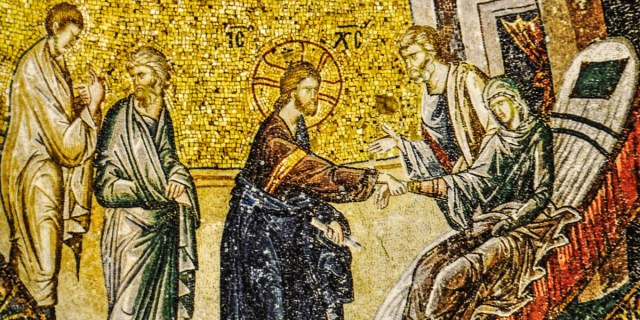
A mosaic of Jesus healing Peter’s mother-in-law, from a Byzantine Church, c.1100 C.E.

Observation: Christ Cares about Every One of Them

Jesus accepts, heals, and cures those at the margins of society. The sick, infirmed, and demon-possessed were the most marginalized people in the ancient world. They were at the mercy of a caring relative, that is, if they had one. If not, the only way of making it was to beg and rely on public charity. Yet, that was difficult because, in many cases, depending upon the illness, they were considered impure. No one would get near them. They couldn’t participate in the community.

But Jesus welcomed them. He took the time and attention to place his hands on each one of them. Their divine healing was much more than physical; being cured meant they no longer needed to be at the margins, unaccepted and unwanted. Jesus was giving them full inclusion to society.

The good news of Jesus Christ consists of meeting the holistic needs of people for health and community. Our Lord desires to integrate excluded people into society. If that takes the miraculous healing of sickness to do it, then Jesus will make it happen.

Observation: Christ Looks to Heal and Care for Every One of Them, Besides Just Us

It can be a real temptation to believe that our little group has the corner on Jesus. We don’t. Jesus was given for the life of the world – not just a few people who look, think, and act like you and me. In today’s story, the people didn’t want Jesus to go. That’s understandable. Yet, Christ left them because there were others in need of healing of both body and soul.

Christ’s mission is so much broader than we sometimes see or expect. Evangelical Christians camp on saving the soul. Progressive Christians hang their hat on social justice and the real physical needs of people. In reality, the gospel involves both body and soul. To only focus on one aspect is to truncate the gospel as only okay news, not good news.

I would argue there is far too much proclaiming of okay news today. Christianity needs a full-orbed gospel that addresses the holistic needs of people, just like Jesus did. It needs a robust Trinitarian theology with the love of God the Father, the grace of Jesus Christ, and the empowerment of the Holy Spirit delivering souls from spiritual death and saving bodies from worldly injustice.

Anything less is simply picking and choosing what we want and trying to keep Jesus to ourselves. Let’s not do that. Instead, let’s preach the gospel, a kingdom message in which the power of God comes upon people – transforming them from the inside-out and bringing them from the outside-in.

Healing God, we bring to you all those who are discouraged, depressed, diseased, disordered, and damaged in some way by the sin of this world. Cure them by your mighty power so that they will be included into our communities, as well as your heavenly kingdom. Amen.


1 Timothy 5:9-16 – A Ministry of Giving and Receiving

No widow may be put on the list of widows unless she is over sixty, has been faithful to her husband, and is well known for her good deeds, such as bringing up children, showing hospitality, washing the feet of the Lord’s people, helping those in trouble and devoting herself to all kinds of good deeds.

As for younger widows, do not put them on such a list. For when their sensual desires overcome their dedication to Christ, they want to marry. Thus, they bring judgment on themselves because they have broken their first pledge. Besides, they get into the habit of being idle and going about from house to house. And not only do they become idlers, but also busybodies who talk nonsense, saying things they ought not to. So, I counsel younger widows to marry, to have children, to manage their homes and to give the enemy no opportunity for slander. Some have in fact already turned away to follow Satan.

If any woman who is a believer has widows in her care, she should continue to help them and not let the church be burdened with them, so that the church can help those widows who are really in need. (New International Version)

The subject of widows is throughout all of Holy Scripture. Since well over half of all women in the ancient world above age 60 were widows, there were continual and ongoing needs to be addressed.

Women were mostly dependent upon men in the biblical world. So, whenever a husband died, this put the widow immediately at risk. The children and other extended family needed to step up and care for her. And, if this didn’t happen for whatever reasons, then the church would fill the void of caring for them.

Because of their vulnerable situation, God especially cares about widows. This is made evident by the many instructions and exhortations of the Lord to Israel:

The Lord your God is the God of all gods and Lord of all lords, the great, mighty, and awesome God who doesn’t play favorites and doesn’t take bribes. He enacts justice for orphans and widows, and he loves immigrants, giving them food and clothing. (Deuteronomy 10:17-18, CEB)

A father to the fatherless, a defender of widows,
    is God in his holy dwelling.
God sets the lonely in families. (Psalm 68:5-6b, NIV)

Jesus maintained the stance of care and concern for widows in the Gospels:

 Soon afterward, Jesus went to a city called Nain. His disciples and a large crowd went with him. As he came near the entrance to the city, he met a funeral procession. The dead man was a widow’s only child. A large crowd from the city was with her.

When the Lord saw her, he felt sorry for her. He said to her, “Don’t cry.”

 He went up to the open coffin, took hold of it, and the men who were carrying it stopped. He said, “Young man, I’m telling you to come back to life!” The dead man sat up and began to talk, and Jesus gave him back to his mother. (Luke 7:11-15, GW)

So, it is no wonder that the Apostle Paul gave his young protégé Timothy some detailed instructions on how to handle ministry to widows in his church at Ephesus. The gist of that instruction is to encourage younger widows to remarry so that they would be properly cared for and enrolling older widows on a church list for support.

These widows within the church were expected to have a ministry of prayer and good works. This is truly wise counsel from Paul. Good relations and lifestyles require a healthy rhythm of giving and receiving. Widows are honored by having their needs met, as well as providing opportunities for them to give in ways they are able.

Religion that God accepts as pure and without fault is this: caring for orphans or widows who need help, and keeping yourself free from the world’s evil influence.

James 1:27, NCV

Whenever widows are only on the receiving end, they tend to become busybodies and gossips. And whenever they only give, then widows can be overlooked, and their daily needs neglected. All this is to say that there really needs to be thoughtful and intentional ministry to the widows among us.

Although in today’s modern society the status and station of many widows is different from the ancient world, there are still widows who need a life-giving ministry of both giving and receiving.

For this important dynamic to be successful, it’s necessary that adult children care for their elderly parents. I can testify firsthand as a hospital chaplain that there are many sons and daughters who fall woefully short of providing basic help to their aging mothers through a failure of consistent relational interactions, following through on needed paperwork, and answering calls in a timely manner.

Also, far too many aging widows are lonely with little to no resources and support in the form of both relationships and basic necessities. A truly Christian community is aware of the widows in their parish and seeks to honor them through establishing a ministry of giving and receiving.

Learn to do good.
 Seek justice.
Help the oppressed.
    Defend the cause of orphans.
    Fight for the rights of widows.

Isaiah 1:17, NLT

Families and churches have a responsibility to the elderly in giving sufficient financial help, practical assistance with driving to appointments, and consistent companionship. They also have a responsibility to arrange opportunities for widows to give their time in prayer and helping out others through good works and good wisdom.

If we ourselves who are not widows have healthy rhythms of giving and receiving in our own lives, then we are in a position to help the elderly establish healthy rhythms, as well. Perhaps it is telling that any lack of attention to widows reflects our own personal neglect of spiritual and emotional health.

May God be in my head and in my understanding. May God be in my eyes and in my looking. May God be in my mouth and in my speaking. May God be in my heart and in my thinking. May God be at my end and at my departing. May God be with us, in all things and in every way. Amen.

A Damaged People

Legacy Museum in Montgomery Alabama
This verse of a Maya Angelou poem is on the outside of the Legacy Museum: From Enslavement to Mass Incarceration in Montgomery, Alabama

I am an aging white male Protestant minister. From the inception of colonial America through the first one-hundred years of the United States, my kind ruled the roost.[i] We established schools and universities, advised governors and presidents, and held the reins of power. We were at the vanguard of the nation’s spiritual and moral development.[ii] Even after much of American society became increasingly secularized and more pluralistic, we white men of the cloth wielded a great deal of influence. We still hold respect (albeit less respected than earlier times in American history) and are typically given the benefit of the doubt in most situations.

For all the good we have done throughout American history, we also turned a blind eye to the slave trade and even championed slavery as a good for black Africans throughout most of the United States. Even in the North, where abolitionists could be found, far too many of us preached against slavery not for the inherent evil it is but because of fear that blacks might integrate with the more enlightened white society. Using their influence, ministers got behind efforts to send blacks back to Africa. Hence, the modern-day country of Liberia.[iii] Although today’s white male ministers are more diverse than ever in their theology and practice, there yet remains for us all a collective wound, a putrid abscess of a racialized society.

Something else to know about me: I have two academic degrees in history and did my graduate thesis on slaveholder religion in the antebellum South. I continue to keep abreast of historical research pertaining to my own expertise.[iv] I am both a church pastor and a hospital chaplain. Spiritual and pastoral care of parishioners, patients, and their families are the stuff of my workaday world. I exist in the lived world of people’s struggles, joys, hopes, and desires – bearing witness to all their myriad experiences of heartbreak, miracle, and everything in between.[v]

As both an historian and ordained minister, I agree with religion and social history professor, D.G. Hart, when he said, “There is a long history going all the way back to slavery, of white Americans not trusting black perspectives as truthful.”[vi] Indeed, this has been my own experience in discussing racism. I have come to expect that if I am in a room full of white male ministers, the subject of racism will not be broached – unless I bring it up. I am usually met with defensiveness and an insistence about not being racist; and, a rebuke of bringing up politics in the august clerical group. The assumptions in the room are that we, ministers, are color-blind (“I don’t see a person’s color when I preach.”); and, that racism means a specific political agenda (“All lives matter, not only black ones….”).[vii]

It would be untenable and unethical if I entered a patient room as a chaplain and spent my time providing for the nurse’s emotional and spiritual well-being. Yes, she has needs, too, and a good chunk of my job involves care of staff. Yet, in this scenario, it is the sick person we are both attending to. It will not do for me to argue, “I don’t see a person’s health when I look at them – I am health-blind.” And it would be ludicrous for me to insist that “all lives matter, not just sick ones,” and nonsense to say, “healthy lives matter.”

Yet, this is happening every day. It is as if a person is struck by a car and lies bleeding in the street while the ambulance and first responders rush to the driver who hit the person saying, “Are you okay? That must have been traumatic running over a person!” Yes, the driver is in shock and will likely need therapy to deal with what happened. However, this is not the primary need and focus of the moment.

Black men die in our streets and we focus on the unruly aspects of demonstrations and riots. Black women disproportionately lose their lives in maternity wards, along with an infant mortality rate more than twice that of whites.[viii] Black families on average have ten times less the annual income than white families, with little to no inherited property or wealth (due in large degree to widespread twentieth century zoning laws which excluded blacks from certain geographic areas and neighborhoods).[ix]

We need not look to other nations of the world for human rights violations. “Physician, heal thyself,” comes from the Gospel of Luke. Immediately after Jesus proclaimed that the poor, the prisoner, the blind, and the oppressed matter, he received pushback from the establishment to maintain the status quo. The good news of freedom and recovery is still subversive and scandalous today as it was all those centuries ago. The gospel still elicits anger from the privileged when resources are focused toward the underprivileged.[x]

I once had a fellow old white Protestant minister throw up his hands in exasperation after speaking with him about race saying, “Well, what do you want me to do about it!?” Indeed, what shall you do? How then shall we live?

The short answer: care. The following are a potpourri of practices I have personally engaged over the past few decades. Perhaps and hopefully you will find some ways to put a voice and some hands and feet to the caring:

  • Seek first to understand rather than be understood. Be informed. Read. Listen to another, without mentally arming yourself with a response. If you cannot state to a person you disagree with their position in a way they would say, “Yep, that’s it, that’s my position,” then you have not done your due diligence in listening well. The bibliography below are just a few books I have found helpful for me as a white person seeking to understand.
  • Engage in self-awareness. Explore what implicit bias and microaggressions are and take a fierce moral inventory of your own life regarding them.
  • Find out what the needs are in your local community. Projecting what you think the needs are of a place or a people is not the same as discovering what the needs really are. Many of my fellow whites cannot see past the demonstrations of black folk on the streets to the needs behind those demonstrations. People demonstrate because they have legitimate needs which are not being fulfilled and they possess little power to change the system which keeps those needs unfulfilled.
  • Exercise humility and repentance. Have a teachable spirit. Be willing to say when you are wrong without beating up yourself. True repentance is not shame – it is changing course when you see your previous path was down a damaging road. More than once I have stuck my foot in my mouth and said something racist that, at the time, I did not realize.
  • Embrace your power, position, or privilege. Use what you have for the benefit of those without. And, more difficult to do for most of my white brothers and sisters, share your power. If a round table discussion of all nice old white male Protestant ministers talk about what to do about race, we will only get a nice old white male Protestant minister answer about how to deal with it. Furthermore, token procedures and policies, as well as token representation will do diddly squat.
  • Keep the main thing the main thing. There are many things which require our (white) attention, including talking to our kids about race, common decency, etc. Yet, when black lynching continues in more modern and sophisticated forms, this requires our immediate attention. The white lady in the car is not bleeding in the street, so keep focused on the main thing.
  • Dedicate effort and resources to dismantling systemic and structural racism. We white folk built it. We can destroy it. The only assumptions we ought to be making is that racism exists everywhere and in every institution in some way, shape, or form. I define racism as vastly more than overt individual discriminatory words or actions – racism primarily exists as covert inequities which maintain white control of institutional power and decision-making, thus, making it more difficult for people of color to have access and opportunity to quality education, jobs, housing, healthcare, and equal treatment in the criminal justice system.

When one of us is wounded, we are all wounded. It is unacceptable we would ever refuse to weep with our brothers and sisters of color who weep. Until we, whites, can individually and collectively find it within ourselves to grieve and lament the loss of human life beside people of color, then we shall continue to be damaged together as one people. Pastors and faith leaders can play a special role in healing our wounds if we find within ourselves a commitment to such a worthy task.

Bibliography of Selected Works

Brown, Austin Channing I’m Still Here: Black Dignity in a World Made for Whiteness, Colorado Springs, CO: Convergent Books, 2018.

Carter, J. Kameron Race: A Theological Account, New York: Oxford University Press, 2008.

Coates, Ta-Nehesi Between the World and Me, New York: One World Press, 2015.

Cone, James H. The Cross and the Lynching Tree, New York: Orbis Press, 2013.

DiAngelo, Robin White Fragility: Why It’s So Hard for White People to Talk About Racism, Boston: Beacon Press, 2018.

Douglass, Frederick The Complete Works of Frederick Douglass, Madison & Adams Press, 2018.

DuBois, W.E.B. The Souls of Black Folk, CreateSpace Independent Publishing Platform, 2014.

Glaude, Eddie S. Democracy in Black: How Race Still Enslaves the American Soul, New York: Broadway Books, 2017.

Guelzo, Allen C. Lincoln’s Emancipation Proclamation: The End of Slavery in America, New York: Simon & Schuster, 2006.

Kendi, Ibram X. How to Be an Antiracist, New York: One World Books, 2019.

Rah, Soong-Chan Many Colors: Cultural Intelligence for a Changing Church, Chicago: Moody Publishers, 2010.

Swanson, David W. Rediscipling the White Church: From Cheap Diversity to True Solidarity, Downers Grove, IL: InterVarsity Press, 2020.

Tisby, Jemar The Color of Compromise: The Truth about the American Church’s Complicity in Racism, Grand Rapids, MI: Zondervan Publishing, 2019.

Endnotes

[i] E. Brooks Holifield, Theology in America: Christian Thought from the Age of the Puritans to the Civil War (New Haven, CT: Yale University Press, 2003): 1-4.

[ii] Sydney Ahlstrom, A Religious History of the American People (New Haven, CT: Yale University Press, 1972): xiii-xvi.

[iii] Edwin S. Gaustad, ed. A Documentary History of Religion in America to the Civil War (Grand Rapids, MI: William B. Eerdmans Publishing, 1982): 485-490.

[iv] I have a B.A. in history from the University of Northern Iowa and an M.A. in 19th Century American Religious History from Western Michigan University – as well as an M.Div. from Grand Rapids Theological Seminary.  For a survey of recent historical research approaches, see Jay D. Green, Christian Historiography: Five Rival Trends (Waco, TX: Baylor University Press, 2015).

[v] I am the Staff Chaplain at Aurora St. Luke’s South Shore Medical Center and the Pastor of the New Life Community Church, both in Milwaukee, Wisconsin.

[vi] D.G. Hart, The Trouble I’ve Seen: Changing the Way the Church Views Racism (Harrisonburg, VA: Herald Press, 2016): 46.

[vii] These statements have been said to me by several white ministers in the past ten years from various denominations, theological traditions, and geographical locales – enough for me to form anecdotal evidence regarding common presuppositions of race.

[viii] Cigna Health and Life Insurance Co., Report on African American Health Disparities, 2016.

[ix] Kriston McIntosh, Emily Moss, Ryan Nunn, and Jay Shambaugh, Examining the Black-White Wealth Gap (The Brookings Institute, 2020).

[x] Luke 4:14-30 in The Holy Bible.

Psalm 8 – Our Place in the World

Milky Way

Lord, our Lord,
how majestic is your name in all the earth!

You have set your glory
in the heavens.
Through the praise of children and infants
you have established a stronghold against your enemies,
to silence the foe and the avenger.
When I consider your heavens,
the work of your fingers,
the moon and the stars,
which you have set in place,
what is mankind that you are mindful of them,
human beings that you care for them?

You have made them a little lower than the angels
and crowned them with glory and honor.
You made them rulers over the works of your hands;
you put everything under their feet:
all flocks and herds,
and the animals of the wild,
the birds in the sky,
and the fish in the sea,
all that swim the paths of the seas.

Lord, our Lord,
how majestic is your name in all the earth! (NIV)

I adore the psalms. Many years ago, it was the biblical Book of Psalms which helped me come to faith. This little psalm for today is illustrative of why I was moved toward embracing a life with God. Psalm 8 grounds us through dealing with the ultimate questions of human existence:

Who am I? Why do I exist? What is the purpose of life?

The answers to those questions are supremely important because people throughout history and now across the world are asking what meaning their lives really have. For example, depression is ubiquitous in the world as well as the church. It is a large issue. Peeling back the layers of a person’s life, many have a deep sense of not truly belonging, and of being profoundly misunderstood by others. Many depressed persons are very aware of their own mortality and have a disconnected sense of their personal role in the world. In other words, some people have lost their original purpose of being a person and that they belong to the human family in a way that makes a significant contribution to the world.

Living on such a big planet causes some people to feel quite small and wonder how they fit in. With such a large universe, which may at times seem cold and capricious, we may ask along with psalmist:

“What is humanity that you are mindful of them?”

This question forms the center of the psalm. Hebrew poetry is typically set up to have the front and the end of the poem point to the middle where the chief focus is found. So, then, the psalmist purposely wrote this psalm so we would consider this great question of what God thinks of humanity within the scope of this immense universe.

And it is a staggeringly huge universe! To put it in perspective, if our galaxy, the Milky Way, were the size of the entire continent of North America, our solar system would fit in a coffee cup. Even now, two Voyager spacecraft are hurtling toward the edge of the solar system at a rate of 100,000 miles per hour. For decades they have been speeding away from Earth, having now traveled billions of miles. When engineers beam a command to the spacecraft at the speed of light, it takes over half a day to arrive. Yet this vast neighborhood of our sun—in truth, the size of a coffee cup—fits along with several hundred billion other stars and their planets in the Milky Way, one of perhaps 100 billion such galaxies in the universe. To send a light-speed message to the edge of that universe would take 15 billion years.

Out of the billions of galaxies in the universe, what is the planet Earth that God should care about it?  Even on our planet there are billions of creatures. Yet, of all those bugs, animals, fish, and birds, God has a special relationship with us, humanity, and cares for us deeply. We know that God cares for us, according to this psalm, because he has entrusted us with the responsibility to care for creation. We are the only creatures who have the charge to steward all that God has created. To put it another way, we, as people created in the image of God, have a job that is befitting of a king. We as humans are God’s vice-regents in charge of tending and caring for all creation. This incredible job is both a duty and a delight.

creation care

God has us, his people, playing a crucial role in governing and caring for the world he created. Like a parent or grandparent patiently working with a child to teach them responsibility for all that is around them, God teaches us and has entrusted to us this large expansive world we live in. Literally everything in all creation is under our stewardship. Only we as people have the self-awareness and perspective of the world that is needed to govern the world.  So, then, we can only find our true purpose and belonging in the stewardship of creation.

Caring is at the heart of being a person.

The only glitch to all this, and why so many lose their way, is that the world is still living under a curse due to the original fall of humanity. When we allow other dominions to supersede God’s dominion, then we have issues. When the power of money or the significance of a position or job title or the ability to do certain tasks is our basic identity and place of belonging, then we will likely succumb to anxiety because other dominions cannot help us find our true God-given majesty as people created in God’s image.

Living in any other way than being a proper steward of the world is beneath us because we have inherent dignity as God’s vice-regents over creation.  Mother Teresa once said that there is no such thing as a small thing – only small things which are done with big love. Her sentiment perfectly captures the vision of the psalmist – that all people are crowned with glory and honor and rule with God to do all the small things of life with a love that comes from our Creator.

We continually have possibilities of engaging in good stewardship of all that God has given us. We have the chance to be attentive to all the little things of life, whether gardening, building a bird house, working with diligence and care at our jobs, or keeping our community clean and its citizens healthy and happy – it is all important and has a significant place. It brings meaning to our existence as human beings.

We as people, like all creation, are meant for growth. Putting effort into developing our skills and honing our craft, whatever that may be, is what helps us tap into our God-given purpose for being in this big world. So, may we, then, continually improve what we do, no matter what it is, so that it befits us as God’s people crowned with honor. May we realize joy and contentment – knowing the majesty we share with God in his wondrous world.

Lord God Almighty, Creator of the heavens and the earth, words are not enough to express your awesome majesty. My highest expressions of theology are but baby talk next to you. Grant me awareness through your Spirit that you are here with me. May this awareness lead me to approach life carefully. The words I speak, the tunes I sing, the thoughts I think, the joy and sadness I feel – may it all be pleasing to you, o Lord, my God. For, despite the inadequacy of my words and my actions, my life and my worship are addressed to you alone. May you make that life complete, whole, full to overflowing through Jesus Christ, your Son, my Lord, who with you and the Holy Spirit lives and reigns forever.  Amen.