A Calling Is a Sacred Responsibility (2 Kings 9:1-13)

King Jehu

The prophet Elisha called to a member of the group of prophets, “Get ready, take this jug of oil with you, and go to Ramoth-Gilead. When you arrive there, look for Jehu, Jehoshaphat’s son and Nimshi’s grandson. Go to him, then pull him away from his associates, taking him to a private room. Take the jug of oil and pour it on his head. Then say, ‘This is what the Lord has said: I anoint you king of Israel.’ Then open the door, and run out of there without stopping.”

So the young prophet went to Ramoth-Gilead. He came in, and the military commanders were sitting right there. He said, “Commander, I have a word for you.”

“For which one of us?” Jehu asked.

The young prophet said, “For you, Commander.”

So Jehu got up and went inside. The prophet then poured oil on his head and said to him, “This is what the Lord, Israel’s God, says: I anoint you king over the Lord’s people, over Israel. You will strike down your master Ahab’s family. In this way I will take revenge for the violence done by Jezebel to my servants the prophets and to all the Lord’s servants. Ahab’s whole family will die. I will eliminate from Ahab everyone who urinates on a wall, whether slave or free, in Israel. I will make Ahab’s dynasty like the dynasty of Jeroboam, Nebat’s son, and like the dynasty of Baasha, Ahijah’s son. And as for Jezebel: The dogs will devour her in the area of Jezreel. No one will bury her.” Then the young prophet opened the door and ran.

Jehu went out to his master’s officers. They said to him, “Is everything okay?

Why did this fanatic come to you?”

Jehu said to them, “You know the man and the nonsense he talks.”

“That’s a lie!” they said. “Come on, tell us!”

Jehu replied, “This is what he said to me: ‘This is what the Lord says: I anoint you king of Israel.’”

Then each man quickly took his cloak and put it beneath Jehu on the paved steps. They blew a trumpet and said, “Jehu has become king!” (Common English Bible)

The biblical books of 1 & 2 Kings (originally one book of Kings) tells of the kingdoms of Israel and Judah over a five-hundred year period from c.960-586 B.C.E. The dynasties of the house of Omri and the house of Jehu were the longest lasting in Israel.

The books of First and Second Kings are primarily concerned with an evaluation of the 20 kings of Judah and the 19 kings of Israel. Of greatest concern was whether the particular king was loyal to God, or not. If the king tolerated worship of other gods besides Yahweh, and established sacrifices outside of Jerusalem, then that king was evaluated as doing evil in the eyes of the Lord.

This judgment of the kings is consistent with Deuteronomic laws of sole loyalty to God, and the importance of a central location for all Jewish people to worship (in Jerusalem).

To understand why it was so important for Jehu to be anointed with a mission is to know something of the house of Omri, and in particular, the king Ahab and his queen Jezebel. They are both conveyed to us in the biblical text as a power couple who want what they want, without a lot of concern about the subjects of their kingdom.

Jezebel was a follower of Baal and Asherah, not Yahweh. She provided for hundreds of their prophets. Her husband the king was fine with this situation. Jezebel was a clear enemy of God’s prophets, and killed hundreds of them, so that there were only a few left, including Elijah and Elisha (1 Kings 18:13).

Ahab and Jezebel’s powerful misuse of authority is relayed in the story of Naboth (1 Kings 21). Ahab wanted to buy Naboth’s vineyard, which was adjacent to his own land. But Naboth refused to sell, mainly because the land was his family’s ancient generational inheritance.

Jezebel went to work and arranged false witnesses to claim that Naboth had cursed both God and King (which was the ultimate sign of treason in Israel). As a result, Naboth was wrongly stoned to death; and Ahab unjustly confiscated his property.

Elijah prophesied that Ahab’s descendants would die, his dynasty will perish, and that Jezebel would be eaten by dogs (1 Kings 21:17-24). In our story for today, this is alluded to in the reference of God eliminating all that belong to Ahab who “urinate on a wall,” that is, unjustly marking the territory of another as their own property.

Indeed, it all shook-out according to prophecy. Ahab died in battle. Then, Ahab and Jezebel’s son Ahaziah succeeded him as king. Young Ahaziah died two years into his reign, and his brother Jehoram became king. Jehoram was then killed by Jehu. After this, some of Jezebel’s own palace officials tossed her out a window to her death, and dogs descended on her carcass – all to Elijah’s earlier prophecy.

Injustice, unrighteousness, abuse of power, and selfish concerns are ugly nasty business. These sorts of attitudes and behaviors ruin people, and keep others locked into patterns of poverty and powerlessness. God is not okay with any of it.

Whenever we are in the middle of oppression and/or authoritative people abusing their power for their own benefit, its hard to maintain our sense of rightness and goodness. Yet, we must. In such times, patience and perseverance is needed without resorting to attempts of paying back evil with evil.

What’s more, we can find ways of tapping into the spiritual power of God within us, in order to resist and subvert unjust authority with righteousness. To some degree, everyone can do something by employing nonviolent resistance tactics like networking, protest, persuasion, non-cooperation, and speaking out through either speech or writing.

Only those who possess nothing can be entrusted with everything. Systemic evil isn’t changed from the top, because those at the top benefit from the system. Rather, structural evil is transformed through grass roots efforts from the bottom up. What’s more, individuals rarely change from the outside-in, but rather from the inside-out.

A ruling establishment is not always necessarily wrong. Yet, it takes a lot of willing accountability and plenty of intentional soul searching for administrations to remain on the straight and narrow.

Such realities characterized Jehu. He was a non-descript military man. There was nothing, in particular, which distinguished him as having a special calling from God.

Yet, although Jehu fulfilled his calling, he added to the call; the Lord was not pleased with Jehu’s form of violent bloodshed, and so, put an end to Jehu’s house, just as Omri’s house had been purged from Israel.

Power and authority will do that to a person – which is why leaders must be continuously vigilant to guard against developing a thick ego and following their pride.

And so do we. Anyone who receives a call from God has a sacred responsibility and trust to fulfill that calling with competence, care, and conscientiousness.

Almighty God, direct me in all my activity with Your grace, wisdom, and help, so that in all I do and say may glorify Your holy Name; through Jesus Christ our Lord, in the power of the Holy Spirit. Amen.

The Church that Makes a Difference (Matthew 16:13-20)

Photo by Felix Mittermeier on Pexels.com

When Jesus came to the region of Caesarea Philippi, he asked his disciples, “Who do people say the Son of Man is?”

They replied, “Some say John the Baptist; others say Elijah; and still others, Jeremiah or one of the prophets.”

“But what about you?” he asked. “Who do you say I am?”

Simon Peter answered, “You are the Messiah, the Son of the living God.”

Jesus replied, “Blessed are you, Simon son of Jonah, for this was not revealed to you by flesh and blood, but by my Father in heaven. And I tell you that you are Peter, and on this rock I will build my church, and the gates of Hades will not overcome it. I will give you the keys of the kingdom of heaven; whatever you bind on earth will be bound in heaven, and whatever you loose on earth will be loosed in heaven.” Then he ordered his disciples not to tell anyone that he was the Messiah. (New International Version)

A lot of research studies have come out in the past 20 years demonstrating that legions of adults, especially between the ages of 18-29, are leaving the Church in droves. This confirms my own anecdotal evidence over the years that about 80% of twenty-somethings drop out of church altogether. So, why are people leaving? Can anything be done about it?

Most of the studies can be boiled down to three major reasons: 

  1. The Church is irrelevant to my life and doesn’t talk about things important to me
  2. The Church is judgmental toward others not like themselves
  3. The Church is hypocritical by saying one thing and yet living another way

A good, right, and real confession of Jesus will speak a relevant word into the culture and into various generations, will proclaim the gospel of grace (not judgment), and will live what it believes.

In today’s Gospel lesson, Jesus and his disciples are in the Gentile (non-Jewish) territory of Caesarea Philippi, a city 25 miles north of the Sea of Galilee. Up to this point, the disciples encountered a lot of people and heard a lot of things said. So, Jesus asked them two questions: 

Who do people say the Son of Man is?

The disciples gave a variety of answers, which is to be expected, with some of them being a bit esoteric. John the Baptist raised from the dead is a stretch. Elijah was a man who never died, but was just taken to heaven; maybe he’s back. Maybe Jeremiah or one of the other prophets got sent back. 

When asking this question to folks today, you will also get a variety of answers as to whom Jesus is – a good teacher, a model humanitarian, a myth or a legend who didn’t really exist. A few times I have been told that Jesus was an alien from another planet. My personal favorite when I asked who Jesus, a guy answered that he was a nudist, and that if we all just took off our clothes, there would be peace in the world.

Who do you say I am?

Peter acted as the spokesperson for the group. Given the disciples’ track record of scratching their heads over nearly everything Jesus said or did, one might expect to hear another crazy answer. But Peter got it right by confessing, “You are the Christ, the Son of the Living God.” 

“Christ” is another way of saying “Messiah,” or “Savior.” It literally means, in the Greek language, “Answer.”  Peter confessed Jesus as being The Answer, the person for whom everything comes down to. Peter may not have fully understood what he was saying, but he said it.

The reason that craziness didn’t come out of Peter’s mouth is that “The Answer” was divinely revealed to him.  Faith in Jesus Christ is a gift given to us by God. 

“All things have been committed to me by my Father. No one knows the Son except the Father, and no one knows the Father except the Son and those to whom the Son chooses to reveal him.” Jesus (Matthew 11:27, NIV)

Peter was blessed – not necessarily because of sincerity, openness, or deserving it – but because of God’s grace which revealed to him that Jesus is the “Answer.”

The Apostle Peter put himself in a position to know by obeying the voice of Jesus to follow him. It took him and the other disciples a while to “get it,” but eventually they did. And if it took years of being with Jesus for the disciples to make a right and good confession of faith, then it’s important that we have a great deal of patience for our friends and relatives.

Jesus proclaimed Peter (which means “rock”) the immovable object from which the Church would be built.  The Apostle Paul framed it this way:

You are no longer foreigners and strangers, but fellow citizens with God’s people and also members of his household, built on the foundation of the apostles and prophets, with Christ Jesus himself as the chief cornerstone. In him the whole building is joined together and rises to become a holy temple in the Lord. (Ephesians 2:19-21, NIV)

Christ is the one who builds the Church – and not me,  nor you. This reality is encouraging and comforting to me. If it was up to me to build the Church, I would screw it up so badly that it would actually be overcome by hell. But I can’t screw it up, because it’s Christ’s Church, not mine. 

So, we can move forward and storm the gates of hell, we can move and work and act and call others to confess, all with the confidence and security of knowing that Jesus is building his Church. There’s no need to worry whether we’re getting it right, or not, because we aren’t the ones in control of the project.

However, I admit what Jesus says next isn’t very comforting to me. Christ told Peter that he will give him the “keys of the kingdom of heaven,” and that whatever he binds on earth will be bound in heaven, and whatever he lets loose on earth will be loosed in heaven.

Giving Peter the keys of the kingdom seems akin to giving an 8 year old the keys to the car and saying, “Go ahead, take it for a spin, you can drive it!” 

What are the keys of the kingdom? 

The preaching of the holy gospel and Christian discipline toward repentance. Both preaching and discipline open the kingdom of heaven to believers and close it to unbelievers. 

How does the preaching of the gospel open and close the kingdom of heaven? 

The kingdom of heaven is opened by proclaiming and publicly declaring to all believers, each and every one, that, as often as they accept the gospel promise in true faith, God, because of what Christ has done, truly forgives all their sins. The kingdom of heaven is closed, however, by proclaiming and publicly declaring to unbelievers and hypocrites that, as long as they do not repent, the anger of God and eternal condemnation rest on them. (The Heidelberg Catechism, Q&A 83, 84 )

The Church is true to its mission when it proclaims the good news of God’s grace in Christ. We possess the keys of the kingdom. Jesus knew exactly what he was doing, that is, the risks and the problems of letting people do the task of proclaiming the gospel. Yet, Christ still tossed us the keys to his Mercedes.

Conclusion

A Church that makes a difference is made up of people who confess Jesus, are called by God, and call others to confess Jesus, too. The de-churched and the disaffected want to see a Church that seeks to understand the world, to provide relevant ministry to others, and to tackle the injustice that exists everywhere.

We must use the power given us with the keys of the kingdom to bestow mercy to the weak, the oppressed, and the lost. We need to live what we believe with a passionate heart and an unashamed faith.

Together, as God’s people, we can extend the hospitality and the kindness to make a difference in the church and the world. 

May our confession of Christ shape our words and our actions. And may it give us the confidence and boldness to live as Jesus did, and to enjoy him forever. Amen.

How Jesus Prayed (John 17:1-11)

After Jesus said this, he looked toward heaven and prayed:

“Father, the hour has come. Glorify your Son, that your Son may glorify you. For you granted him authority over all people that he might give eternal life to all those you have given him. Now this is eternal life: that they know you, the only true God, and Jesus Christ, whom you have sent. I have brought you glory on earth by finishing the work you gave me to do. And now, Father, glorify me in your presence with the glory I had with you before the world began.

“I have revealed you to those whom you gave me out of the world. They were yours; you gave them to me and they have obeyed your word. Now they know that everything you have given me comes from you. For I gave them the words you gave me and they accepted them. They knew with certainty that I came from you, and they believed that you sent me. I pray for them. I am not praying for the world, but for those you have given me, for they are yours. 

All I have is yours, and all you have is mine. And glory has come to me through them. I will remain in the world no longer, but they are still in the world, and I am coming to you. Holy Father, protect them by the power of your name, the name you gave me, so that they may be one as we are one.” (New International Version)

Prayer can be described in many ways. Yet, at it’s heart, prayer is simply talking to God. Jesus had taught his disciples early in his ministry about how to pray (The Lord’s Prayer). Now he demonstrates the way to pray, also revealing the heart of God in the process. Our prayers reflect our values and what is truly in our hearts. As Jesus offers his petitions to the Father, let’s notice what they are, and so, align our own hearts with the heart of God.

First Petition: Glorify God

Jesus prayed that he himself would be glorified, so that then he might turn right around and glorify the Father in heaven. This is a great lesson for all who pray – that we seek to receive in order to give.

All of life is dependent upon rhythms of receiving and giving. We breathe in and breathe out in a consistent flow. If that doesn’t happen, we have major health issues. Jesus promised that he would send the Spirit of God to help us breathe spiritually.

And so, it’s important that we routinely inhale the Holy Spirit so that we may exhale the virtues of love, joy, peace, patience, kindness, goodness, faithfulness, gentleness, and self-control for the benefit of the church and the blessing of the world.

Please never forget that we are stewards of the grace given to us by God. That means our purpose is not for avarice (to hoard the spiritual resources so generously given to us) but to receive, so that we can give. And God’s grace is inexhaustible; we shall never run out of offering peace and reconciliation to the world. That, my friends, is how we glorify God and show God’s Name as holy. (Matthew 6:9)

Two Groups and Three Givings

            Jesus mentions two groups: The Father and Son; and the World and Church. And he prays that the Father will give in three distinct ways:

  1. The Father gave the Son authority over all humanity. Jesus truly has the whole world in his hands. And when the Son has a hold of people, there’s no snatching them out. Jesus is not a hired hand; he is the hand of God. Since Jesus is in charge, we can be fully confident that every single member of the human race will be treated with respect in this life and with fairness on Judgment Day.
  2. The Father has given Jesus a second group of people out of the whole of humanity: the Church. Both the World and the Church are in Christ’s hands. Jesus has other sheep who are not yet in the fold. He is presently, by means of the Holy Spirit, gathering them into his divine sheep pen. There are two groups and three givings; but there is only One Shepherd and one Flock. And this one Flock of Christ is to be a kingdom of priests to serve the interests of the entire world. (1 Peter 2:9-10)
  3. The Church has been given the gift of Jesus by the Father. The Flock has received life – abundant and everlasting life. This by no means implies that we are in some sort of holding pattern until Christ returns to take us to be with him. Rather, now we are to be busy giving the world the gift of grace we ourselves have received. Life – real life, true life – is to know the Father and the Son.

God is glorified when we take up the mission given to us by Jesus:

  • We are called by God for a reason: to do justice, to love mercy, and to walk humbly with our God (Micah 6:8)
  • We are given a purpose of bearing witness to what God has done for us in Christ Jesus (Acts 1:8)
  • We are commissioned to make disciples from all nations, all ethnicities, and every sort of people (Matthew 28:19)
  • We are commanded to do it all through love of God and neighbor (Mark 12:28-31)

Second Petition: Protect the Church

Why does Jesus pray for our protection? So that we might be one as the Father and Son are one – and will not fragment and be scattered without any relation to each other.

Here are a couple of simple observations: this prayer of Jesus is not yet answered; and if Jesus can have unanswered prayer for two thousand years, maybe we ought to cut ourselves (and others!) a bit of slack on not getting our own prayers answered.

When we consider the Church throughout the world, we see that various Christian traditions just plain don’t like each other, and even accuse one another of not being Christians at all! And, what’s more, a chunk of the Church seems to be abusive.

Whether it’s Roman Catholicism and the sad story of the priest sexual abuse, or the steady stream of stories about Protestant Evangelical pastors who do the same and use their authority for personal and selfish advantage, there is plenty of awful crud out there.

And what the world sees, far too often, is a profound lack of grace – which brings us back to what we need to be doing to begin with: receiving grace so that we can give it to others. If this is not at the heart of our prayers (and apparently isn’t for many Christians) then we ought not be surprised whenever the world wants nothing to do with Christianity.

Unity is important to Jesus; it ought to be important to us. We need to work at it and work toward it. As God is One, so are God’s people to be one.

Unity does not mean:

  • one cultural expression (i.e. American)
  • the same personality (i.e. extroverted)
  • Christendom (i.e. the Church holding political power)

Unity does involve:

  1. being one in our basic mindset (humble, merciful, holy, peaceful)
  2. being one in purpose (glorifying God)

Therefore if you have any encouragement from being united with Christ, if any comfort from his love, if any common sharing in the Spirit, if any tenderness and compassion, then make my joy complete by being like-minded, having the same love, being one in spirit and of one mind. Do nothing out of selfish ambition or vain conceit. Rather, in humility value others above yourselves, not looking to your own interests but each of you to the interests of the others. In your relationships with one another, have the same mindset as Christ Jesus. (Philippians 2:1-5, NIV)

The Church, the people of God, are to be protected and kept safe from fragmenting into mere special interest groups who only care about their particular pet convictions or projects. Instead, we are to take a step back and see the big forest of Christianity and appreciate all the various trees within it. The Gospel of Jesus Christ is preserved and secured whenever we keep this unity of Christ in the middle of everything, and let go of everything else as being a test of Christian unity (e.g. personal convictions, church dogma and confessional statements).

Conclusion

So, what does this all mean for us? Pray. Talk to God. And talk to God about the same things that Jesus prayed about while he was here on this earth. We might discover that many of the issues we care about will resolve themselves if we simply pray as Jesus has modeled for us.

O God, the Father of our Lord Jesus Christ, our only Savior, the Prince of Peace: Give us grace to set aside and let go of all dissension and division in Christ’s Church. Take away all hatred and prejudice, and everything that hinders us from unity and harmony.

As there is but one Body, and one Spirit, and one hope of our calling, one Lord, one faith, one baptism, one God and Father of us all; so may all your people be of one heart, and of one soul, united in one holy bond of truth and peace, and of faith and love, with one mind and one mouth glorifying you, through Jesus Christ our Lord. Amen.

The Ministry of Jesus (Matthew 4:12-23)

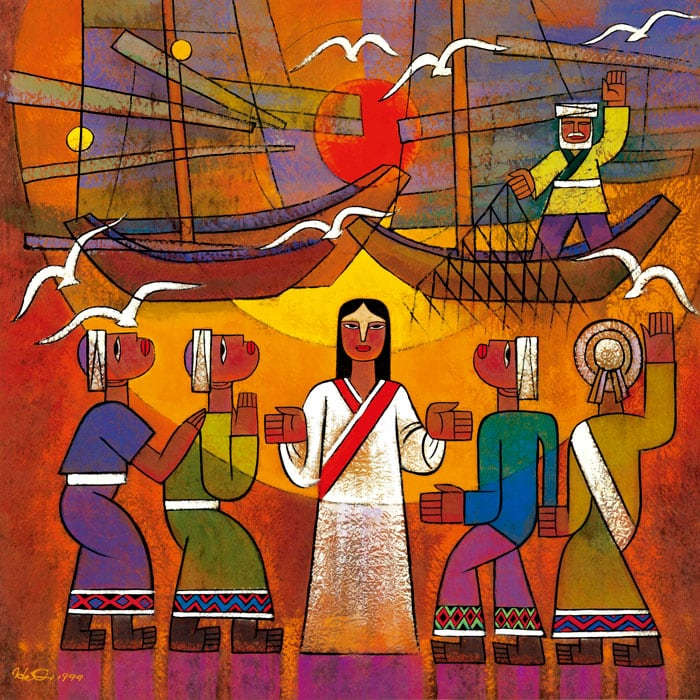
Jesus Calls His Disciples by He Qi

When Jesus heard that John had been put in prison, he withdrew to Galilee. Leaving Nazareth, he went and lived in Capernaum, which was by the lake in the area of Zebulun and Naphtali—to fulfill what was said through the prophet Isaiah:

“Land of Zebulun and land of Naphtali,
    the Way of the Sea, beyond the Jordan,
    Galilee of the Gentiles—
the people living in darkness
    have seen a great light;
on those living in the land of the shadow of death
    a light has dawned.”

From that time on Jesus began to preach, “Repent, for the kingdom of heaven has come near.”

As Jesus was walking beside the Sea of Galilee, he saw two brothers, Simon called Peter and his brother Andrew. They were casting a net into the lake, for they were fishermen. “Come, follow me,” Jesus said, “and I will send you out to fish for people.” At once they left their nets and followed him.

Going on from there, he saw two other brothers, James son of Zebedee and his brother John. They were in a boat with their father Zebedee, preparing their nets. Jesus called them, and immediately they left the boat and their father and followed him.

Jesus went throughout Galilee, teaching in their synagogues, proclaiming the good news of the kingdom, and healing every disease and sickness among the people. (New International Version)

What is “ministry”? 

For some, ministry is only about the souls of people; it is seeing as many people respond to the message of salvation in Christ as possible. 

For others, ministry is meeting the tangible needs of people because there is such a breadth and depth of human social and physical problems. 

And, for others, ministry is defined in terms of what takes place within the four walls of a church building, led by pastors and church leaders.

“Ministry takes place when divine resources meet human needs through loving channels to the glory of God.”

Warren Wiersbe

Problems, however, arise whenever we:

  • Focus on one dimension of ministry. Because, in reality, ministry is multidimensional.
  • Fulfill the outward, administrative demands of ministry – without going after the relational heart of what ministry entails. 
  • Forget about whole groups of people who are different than us. Ministry is for everyone, not some.

We need to look at the ministry of Jesus – what he did and why he did it. Christ’s purpose is to be our purpose: Minister to the total life of all people.

Jesus Preaching

Before there were newspapers, CNN, and 24 hour news cycles, ancient people heard what was happening from heralds or preachers who loudly announced in the streets the important news of the day.

Jesus had a ministry to both Jew and Gentile. Although his ministry was chiefly directed toward his fellow Jews, Christ went out of his way to engage Gentiles, as well, with a message of repentance.

Repentance is turning the whole person – body, soul, mind, will, and emotions – from sin and disobedience to God in obedience to the message of Christ. It involves humility, sorrow for sin, and a commitment to following Jesus.

To repent doesn’t mean to manage sin or clean up parts of my life; it’s a radical conversion from an old way of life to a new way of life. Repentance is not simply adding Jesus to our schedule but is a complete change of how we live.

Christianity is a life, not just an event. Following Jesus is a journey, a life-long process of inner transformation; a complete forsaking of anything that does not please God; and a desire to reorient my life around what’s important to God. 

To illustrate this in a contemporary context, I ask, “What does it mean to follow the Green Bay Packers football team?” A fan not only watches all the games from start to finish, but cheers loudly for the Packers; talks about the Packers with everyone, even strangers; and doesn’t cheer for the Chicago Bears! Fans are committed to their team.

The difference, however, between football and Christianity, is that followers of a team are fans, whereas followers of Jesus are not fans in the stands or watching the television. Instead, Christ followers are on the field of play as teammates with Jesus.

So, when it comes to repentance, we turn from being fans of Jesus to followers of Jesus, doing what he did and saying what he said. We are active participants in the kingdom of God – embracing and embodying a message of repentance to new life in Christ.

Jesus Calling

Jesus calling the first disciples illustrates the kingdom message: a radical break with the old life. Each disciple walked away from a good life and embraced of a new life following Jesus.

Some understanding of Jewish culture in the time of Jesus is helpful here. Central to the life of any Jew was the Torah, the Law. Around age 6, Jewish boys would begin to go to the synagogue for schooling in the Torah by the local rabbi. 

This first level of education was called Beth Sefer (“House of the Book”) and would last until about age 10. In those four years, the first five books of the Old Testament, the Pentateuch, were thoroughly memorized.

By age 10, some of the boys would distinguish themselves as good students and able to handle Torah. So, they would continue on in the second level of schooling called Beth Talmud (“House of Learning”). Those that did not continue with school would then learn the family trade and become an apprentice. Those that went on with school would then memorize the rest of the Old Testament.

At about age 14, only the best of the best were studying Torah. At the completion of their studies, they would apply to a well-known rabbi in order to become his disciple. The goal of this third level was to become just like the rabbi. This was called Beth Midrash (“House of Study”). The rabbi essentially interviews the teenager to find out if he has the stuff to become like the rabbi. 

If the rabbi believes the kid doesn’t have it in him, he tells him to go back to the family business. If, however, the rabbi grills the kid and finds he has what it takes, then he will say to him, “Come, follow me.” It was considered a great privilege and opportunity, and the teenager would leave everything to literally follow the rabbi everywhere he went.

Now, let’s return to Christ’s disciples. Jesus calls Andrew, Peter, James, and John. At the time, they were fishing because they were fishermen. That meant somewhere along the line they didn’t have what it took to further their education, or to follow a rabbi. 

Let’s, then, not miss the import and impact of Jesus saying to them, “Come, follow me!”  Jesus is expressing a belief that these men can become just like him. Well, of course you drop your nets and follow him! Jesus believes I can be like him! Jesus took a group of young men who couldn’t make the grade and used them to change human history. 

Jesus also says the same thing to you and me: I choose you. Come, follow me. 

Christ believed in us before we believed in him. Yes, Jesus believes you can do all the work of embodying the very words of God and becoming like him.

The attitude here is not, “Oh, geez, I have to go do ministry,” as if I were a teenager who was just asked to do the dishes. Rather, the attitude is of privilege and opportunity. If we fail to view ministry in this way, then we must come back to the message of repentance and have an attitude adjustment. People who follow Jesus do so because they get to, not because they have to.

Jesus Healing

            Envision yourself walking with Jesus and following him. You observe several things about his ministry of healing:

  • Jesus heals every problem. Christ has the power and authority to do so.
  • Jesus heals the whole person – not just the physical, or just the spiritual.
  • Jesus heals people whether they repent or not. Christ never made repentance a prerequisite for healing. He heals simply because he wants to.
  • Jesus heals to defeat the devil. Christ continually looks to reverse the hold that sin has on people.
  • Jesus chose to focus on healing the destitute, the poor, and the disadvantaged – rather than directing ministry to the higher classes and royalty to mediate his wishes to the people.

Who are the people – the least, the lonely, the lost – in need of healing in your family, neighborhood, and community?

  1. Those who are ill with various diseases
  2. Those suffering severe pain – of body, mind, emotion, and spirit
  3. The demon possessed or demonically influenced
  4. Prisoners and ex-convicts
  5. The working poor, and the elderly poor
  6. Those in the hospital with no one to visit them
  7. Those who grieve alone
  8. Those with addictions and behavioral issues
  9. Victims of verbal or physical abuse
  10. And many, many more….

Jesus had a ministry of both word and deed. To follow Christ is to become like him and pass on what we have learned to reliable people who will do the same.