The Kingdom of God Is Here (Matthew 10:5-15)

Jesus sent his twelve harvest hands out with this charge:

“Don’t begin by traveling to some far-off place to convert unbelievers. And don’t try to be dramatic by tackling some public enemy. Go to the lost, confused people right here in the neighborhood. Tell them that the kingdom is here. Bring health to the sick. Raise the dead. Touch the untouchables. Kick out the demons. You have been treated generously, so live generously.

“Don’t think you have to put on a fund-raising campaign before you start. You don’t need a lot of equipment. You are the equipment, and all you need to keep that going is three meals a day. Travel light.

“When you enter a town or village, don’t insist on staying in a luxury inn. Get a modest place with some modest people and be content there until you leave.

“When you knock on a door, be courteous in your greeting. If they welcome you, be gentle in your conversation. If they don’t welcome you, quietly withdraw. Don’t make a scene. Shrug your shoulders and be on your way. You can be sure that on Judgment Day they’ll be mighty sorry—but it’s no concern of yours now. (The Message)

“People can’t observe the coming of God’s kingdom. They can’t say, ‘Here it is!’ or ‘There it is!’ You see, God’s kingdom is within  you.” Jesus, from Luke 17:20-21, GW

When Jesus told his followers that the kingdom of God is here, he didn’t simply mean that it all of a sudden showed up. No, it’s already here. It always has been. We just haven’t paid attention. And we haven’t noticed because we keep looking for a location, somewhere outside of ourselves. But, as it turns out, we already have what we’ve been searching for.

Christianity, at its core, is about following Christ. And that journey with Jesus is first and foremost a journey into oneself. This is why the Lord tells the disciples not to go first to outsiders. There’ll be a time for that. But now, the journey to their fellow Jews was to be an internal walk into the very depths of their own souls and the soul of a nation.

The singular message of this particular mission was to proclaim that the kingdom of God is near. It is here. In fact, it is so near and here that it is actually within you. But the disciples needed to discover this for themselves by going out and removing all obstacles to awareness of God’s light.

Jesus sent the disciples out and told them not to take anything with them because they already had what they needed. The kingdom of God is already within them.
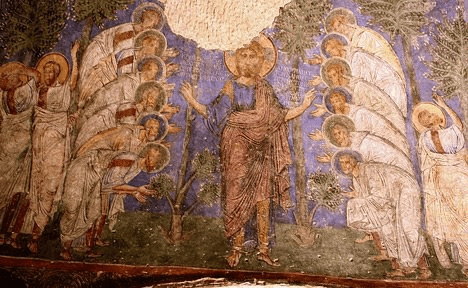
A Byzantine fresco of Jesus sending the disciples, 12th century

So, they were to leave all their baggage and their stuff behind. The disciples were to be stripped of all their trusted outer resources so that they had the ability to see themselves, to others, and human need – and then to be moved in their hearts with compassion, just as Jesus is. 

Whenever we take all our pre-packaged stuff with us into relationships and the doing of Christ’s mission, we already assume we know what other people need. If we have nothing with us, then we are able to see people for who they actually are; we can genuinely listen to what they are saying. 

You have freely received compassion from God, so freely give it away. Not everyone will respond, but that’s not your business; they will have to deal with God on that later.

Compassion is to be our response to human need. Yet, we don’t always respond with compassion because of the obstacles within our own hearts and lives prevent us from seeing others and their needs.

The following are a few of obstructions which hinder us from compassion and perceiving the kingdom of God within us, and how to deal with them:

  1. Contempt. Contempt breeds contempt. Unacknowledged and unresolved anger produces bitterness. Hatred feeds more hatred. Our environment makes a difference. For example, if you find you have to check your heart at the workplace in order to do your job, then you need to either you quit your, or bring forth the kingdom of God by tirelessly advocating for compassionate treatment of people.
  2. Busyness. I’m referring to an unhealthy pace of life. Many of us work too much and do too many things. We cannot have compassionate hearts by moving so fast that we fail to see other people’s needs. Slow down. No one is going to come to the end of their life and wished they had been workaholics. Make a thoughtful plan to slow down enough so you can tune into the needs of others and have emotional energy for them.
  3. Resentment. It’s possible to become coldhearted by excessive and unrelenting caregiving. This is the same sort of problem as an unhealthy pace of life; you give so much that you actually begin to resent the people you care for. Caregiving has to be meticulously balanced with self-care. There’s a time for everything, including rest and recuperation.
  4. Inaction. Only receiving and not giving is what I call “spiritual constipation.” It’s when a person listens to hundreds and thousands of sermons and podcasts but doesn’t listen to their neighbor. They have no intention of putting anything they hear into practice.

However, with nothing restricting or obstructing God’s kingdom within us, we can see the divine image within each person and within ourselves. We can begin to radiate that divine presence and be transformed by it’s inner light.

Like Jesus, transfigured before the disciples on Mount Tabor, we too, become transfigured by God’s energy of love touching our hidden divine energy as image-bearers. That energy now comes forth because we have left everything behind to follow Christ and experience the generosity which, ironically, only comes from having nothing.

This is a spiritual walk we cannot take alone. The road we travel is the way of community. Just as God is community – Father, Son, and Spirit – always in a unity of love, so we, as God’s image-bearers with the divine light within us, must strip ourselves of everything that hinders and the sin that so easily entangles and run with perseverance the race marked out for us.

We are to fix our eyes on Jesus and see him, the pioneer of our faith, the Light of the World, the Living Water, and Bread for the world, who endured all things for the redemption of humanity and all creation.

Almighty God, you sent your Son Jesus Christ to reconcile the world to yourself: We praise and bless you for those whom you have sent in the power of the Spirit to proclaim that the kingdom of God is near. We thank you that in all parts of the earth a community of love has been gathered together by their prayers and labors, and that in every place your servants call upon your Name; for the kingdom and the power and the glory are yours forever. Amen.

Leviticus 25:1-19 – Your Well-Being Is a Priority to God

And the Lord spoke to Moses on Mount Sinai, saying, “Speak to the children of Israel, and say to them: ‘When you come into the land which I give you, then the land shall keep a sabbath to the Lord. Six years you shall sow your field, and six years you shall prune your vineyard, and gather its fruit; but in the seventh year there shall be a sabbath of solemn rest for the land, a sabbath to the Lord. You shall neither sow your field nor prune your vineyard. What grows of its own accord of your harvest you shall not reap, nor gather the grapes of your untended vine, for it is a year of rest for the land. And the sabbath produce of the land shall be food for you: for you, your male and female servants, your hired man, and the stranger who dwells with you, for your livestock and the beasts that are in your land—all its produce shall be for food.

‘And you shall count seven sabbaths of years for yourself, seven times seven years; and the time of the seven sabbaths of years shall be to you forty-nine years. Then you shall cause the trumpet of the Jubilee to sound on the tenth day of the seventh month; on the Day of Atonement, you shall make the trumpet to sound throughout all your land. And you shall consecrate the fiftieth year and proclaim liberty throughout all the land to all its inhabitants. It shall be a Jubilee for you; and each of you shall return to his possession, and each of you shall return to his family. That fiftieth year shall be a Jubilee to you; in it you shall neither sow nor reap what grows of its own accord, nor gather the grapes of your untended vine. For it is the Jubilee; it shall be holy to you; you shall eat its produce from the field.

‘In this Year of Jubilee, each of you shall return to his possession. And if you sell anything to your neighbor or buy from your neighbor’s hand, you shall not oppress one another. According to the number of years after the Jubilee you shall buy from your neighbor, and according to the number of years of crops he shall sell to you. According to the multitude of years you shall increase its price, and according to the fewer number of years you shall diminish its price; for he sells to you according to the number of the years of the crops. Therefore, you shall not oppress one another, but you shall fear your God; for I am the Lord your God.

‘So, you shall observe My statutes, keep My judgments, and perform them; and you will dwell in the land in safety. Then the land will yield its fruit, and you will eat your fill, and dwell there in safety. (New King James Version)

Our continual well-being and rest are not optional; it is absolutely essential.

If a car is driven day-after-day and never gets an oil change, the engine will eventually seize and die. And if a person insists on driving their life every day with continual work, and never practices a Sabbath rest, that person will inevitably burn-out and die an early death. 

In this busy world, far too many persons are putting the pedal-to-the-metal with no thought to the consequences, and no plan for any kind of Sabbath rest. Many people throughout the modern world are slowly draining their souls, causing themselves physical harm, and are on the precipice of emotional and spiritual death.

Perhaps you raise a Mr. Spock eyebrow and wonder if I am being too dramatic. Yet, if we are to take today’s Old Testament lesson seriously, we will see that all of life is to be governed by a healthy rhythm of life which benefits both the individual and the community.

Yes, I fully understand that neither the contemporary person nor the Christian is currently living under ancient Israelite law. However, every single law in the Old Testament is grounded in the character of God. 

This means that, although we may not be obliged to hold the detailed specifics of the seven years system and a year of Jubilee, we are still beholden to observe a Sabbath rhythm of rest because God rested. And we ignore this built-in rhythm to our own peril.

Sometimes I watch the news, see all the upset people at one another and think, “Dude, you really need to sit down, relax, and have a sandwich. Just take a breath, man!” I sometimes wonder if God looks down from heaven at all the world’s conflicts and sees the people involved as a bunch of toddlers who simply need a snack and a nap.

Just as God loves, we are to love. As God is holy, so we are to be holy. And the same holds true for a Sabbath rest. Just as God rested from all the work of creating the world, so we, too, are to rest from our work. Laboring 24/7 will only give us regrets, not results.

If I haven’t been explicit enough, I will say it plainly: We are commanded by God to rest.

It is high time we begin building into our weekly planners, smartphone calendars, and long-range goals, a deliberate and purposeful inclusion of Sabbath rest. 

That means not just doing this biblical rest thing once-in-a-while, that is, if I can fit it in somewhere. A complete Sabbath rest entails making it a real actual event on a regular basis in our life, on our calendars. No excuses, no fudging of appointments, and no lame *sigh* about how busy we are. 

Set aside time today to build a Sabbath into your schedule for the rest of the year, and maybe beyond. I’m not saying this is at all easy; in fact, it is terribly hard for me to get this practice into my own life. 

Because I am a church pastor, hospital chaplain, husband, father, and grandfather, my times of scheduling meetings, events, and visits looks more like a Sudoku puzzle than a calendar. Engrafting some serious biblical rest into my life sometimes feels like hacking through a jungle, looking frenetically for some time.

But, without that rest, I am much less the person I need to be for all the people and responsibilities I care for. The people in my life deserve better than that. They don’t need my leftovers. And I suspect the people in your life want you to rest, too, because you matter to them.

Creator God, you formed the earth in six days and then rested on the seventh. Help me not to put Sabbath on some wish list of things to do someday but enable me to practice it with courage and without apology, through the name of Jesus, I live and pray. Amen.

Sitting at Jesus’ Feet

We are barely into the New Year but already many of us are feeling guilty about our broken resolutions and/or are despondent about the lack of change in our lives.  We feel guilty because we have not let up on the gas pedal of our lives enough to accommodate any of those new pledges to live differently.
 
            But, you might reason, things will eventually settle down – but somewhere on the inside you really know that is not true.  Things probably won’t settle down because we are like Martha in the Gospel of Luke – busy doing things we believe are necessary, as if we are living on the belief that constant busy-ness and activity is what really pleases God (Luke 10:38-42).  The gospel story about Mary and Martha is a monkey wrench in our plans.  So, what we often do when exposed to a story about Jesus setting priorities for us is that we simply feel guilty, then just move on with our all our hard work without ever doing the even harder work of stopping long enough to sit at the Lord Jesus’ feet.


            We don’t sit down because, like Martha, we are distracted.  After all, there are too many plans and preparations to be made.  But the one reality that we must come to grips with is this:  Jesus is here, and since he is here, what will we do?
 
            I’m not going to give you some sage advice about how to plan your life, or some nifty tips concerning how to fix your schedule.  Instead, I can tell you that, based on the Word of God, the one thing that we must do is be with Jesus and sit at his feet.
 
            For that to happen we really need to see that we identify more with Martha than we do with Mary.  We may not say it out loud, but Mary just seems weirdly irresponsible and maybe even a bit lazy to us.  She has, we might think, her head in the clouds to the point of being no earthly good.  And Jesus seems like he is not being very realistic or understanding of what a real life in today’s world is like, and what a hectic schedule we keep.  For Jesus to identify with Mary sitting at his feet listening to him, and gently rebuke Martha for being pre-occupied with supper seems strange to our American Protestant work ethic.  After all, there are things to do, people to see, family responsibilities, work projects and deadlines, school papers, plans and preparations.  Martha isn’t a bad person, we rightly recognize.  She was doing important work, hard work, and that is good.  It’s not like she was idly sitting at her computer watching kittens breakdance on YouTube; she wasn’t wasting time surfing the web on her smartphone; she wasn’t next door gossiping to the neighbor, or being a busybody.  We need people like Martha, people who will roll up their sleeves and get lots of work done, people like me, we reason.  That’s what Martha was feeling, anyway.  But we still must deal with this inescapable truth:  Jesus didn’t feel that way.
 
            Many of us go day after day, month after month, anxious, upset, troubled and even frantic over every dirty dish, each upcoming project or event, and every responsibility whether it is big or small.  Truth be told, we are slaves to our schedules rather than being masters of our time and commitments.  What ends up happening is the thing that matters most is squeezed out and pushed to the margins of our lives.  We walk around and are quick to spout to anyone who will listen to us moan about how busy we are and how we don’t have time to read our Bibles, engage in focused prayer, let alone serve the church.
 
            Being busy is not bad.  But the point here is that the best practice we can engage in each and every day is to sit at Jesus’ feet and listen to him.  This is a reminder to keep first things first.  Martha wasn’t doing anything wrong; she was just distracted and was missing out on learning from Jesus and making him priority.  We all know what we have to do; but are we doing the one thing that is necessary?
 
            If you are sick and tired and being sick and tired because of your ridiculously sinful schedule, then do this one thing:  devote yourself to the Word of God and prayer every day.  For that to happen we must not approach this in a legalistic way and end up rushing through reading the Bible and praying in a few minutes because we have to get to work.  That only misses the important picture of unhurried time with Jesus.
 
            We also need to avoid coming to the Scriptures as something to master or conquer or control because that misses the picture of simple humility and obedience at Christ’s feet.  We really have to believe that sitting at Jesus’ feet is important enough to rearrange our lives without making excuses about it.
 
            Most people are really not looking to be lazy.  Most Christians I know have a high sense of responsibility and obligation – and that is good.  We do not like letting people down or leaving things undone.  We do not like running late or being idle.  It is not wrong or bad to go through seasons of being overwhelmed with things that must be done.  Every family is busy.  But we must not wear that busy schedule as a badge of spirituality, as if we are trying to earn God’s good favor.  There was a time in my life when I worked fifty hours a week, went to graduate school, and either preached or taught nearly every Sunday – all when my girls were still young and I was trying to be a good Dad and husband.  I was up by 4:30 every morning and went to bed at 10:00 or later every night, and every minute of my days were filled to the full.  There were no Sabbath days off; no vacations; nothing idle; I was constantly doing and going.


            I only mention this because I learned something very important once I got through that crazy busy season of my life – something that I could not see while I was in the middle of it:  my busy-ness actually caused everyone else around me to be as crazy busy as I was, especially my gracious wife.  When there are no margins in your life, then every problem or change in schedule becomes a Martha-like experience of having to have other people step up in order to make your busy schedule possible.  You then become the center of time, not God.  People don’t do less when you are crazy busy – they do more, and the person who suffers the most is Jesus.
 
            If we are so busy that we cannot hear the Word of God; if we are so upset and frustrated to the degree that we cannot listen to Holy Scripture; if we are preoccupied with thinking about Monday morning; if we are distracted making speeches in our heads and mumbling to ourselves about other people and how they should be here and do this and that; if that is us, then we have an issue, and that issue is not with the Mary’s of this world, but with our own Martha mentality.  There is a difference between living a full life, and being obsessed with doing more and expecting others to do the same.
 
            Christianity is a life.  It is primarily a relationship, and relationships must be cultivated and given attention.  Jesus loves you, and he wants you to be with him.  Kevin DeYoung in his book Crazy Busy rightly says it’s not wrong to be tired and it’s not bad to feel overwhelmed.  It’s only normal to go through seasons of a chaotic schedule.  But what is both wrong and foolish, not to mention heartbreaking, DeYoung insists, is to live with more craziness than we should and have less Jesus than we need. 


So, instead, may we live unhurried lives, yet accomplishing more, because we have been with Jesus, sitting at his feet learning from him.

Observing the Sabbath


             At a conference many years ago I heard the late Dr. Howard Hendricks, who was a professor at Dallas Seminary, tell a story of being picked up from the airport for a speaking engagement by a local pastor.  This pastor, in the course of conversation in the car, droned on about how he worked hard for the Lord.  He bragged about laboring seven days a week because, as he put it, “the devil never takes a day off.”  Dr. Hendricks’ was known for his pithy comebacks, and so he calmly replied to the over-functioning pastor:  “Gee, I didn’t know Satan was your model for ministry!”
            Somehow pastors and committed church leaders and servants have gotten the wrong-headed idea that working long hours and doing ministry every day of the week with no break is godly.  Needless to say, burn-out among church leaders is common.  Every day pastors walk away from their churches never to enter vocational ministry again.  Loyal church members might put so much effort into their ministries that eventually they quit, unable to do any more due to sheer overwork.  The pressure of responsibility, fear of failure, perfectionist impulses, and the just plain stress of dealing with people and conflict can all contribute to crack-ups and breakdowns, both emotionally and physically.  Those in leadership find the shame of failure too unbearable to let up on the gas pedal, and so keep going day after day worried that they might be letting someone down.  But the irony is that the constant movement only leads to an eventual and abrupt stop. 
            There is, however, a very biblical answer:  observe the Sabbath.  And there is a clear theological reason for it:  God himself rested from all his work.  It sounds easy.  It is anything but easy.  Our society prizes hard work and self-sufficient behavior.  To need a day, an entire day of Sabbath rest is counter-intuitive to our current Western cultural sensibilities.  Some months back I asked my church to help me in keeping a Sabbath each and every week by contacting me and calling me, if at all possible, on the six days of the week that I am working.  To be honest, it wasn’t easy for me to say.  Furthermore, some of my parishioners didn’t like what I said.  They mistakenly thought I must not like my job.  People who don’t like their jobs have no problem staying away from work.  But most pastors, including me, love what they do and enjoy being ministers of the Word.  It is hard to stay away.  Yet, if we are to take the Scriptures seriously, all of us, whether preacher or parishioner, pastor or pew-sitter, will avoid loading up our Sabbath day with all kinds of work.  Instead, we will rest – really rest!  We will use the time to restfully connect with and worship God, take leisurely walks with family, enjoy good friends over a meal, and, of course, delight in a well-deserved nap.
            It is time to stop making excuses, engaging in ridiculous hermeneutical gymnastics, and offering crazy rationalizations for neglecting a very clear scriptural command:  obey the Sabbath.  For many a church leader, finding hope in the midst of darkness and seeing a light at the end of the tunnel begins with putting in the planner a weekly Sabbath to the Lord.  The fear of the Lord is the beginning of wisdom.  Wise and rightly ordered priorities come from well-rested Christians.  The Sabbath affords an opportunity to know God in ways that we cannot on the other six days.  So, may you rest well and know God better.