On Divorce (Matthew 19:1-12)

When Jesus had finished saying these things, he left Galilee and went into the region of Judea to the other side of the Jordan. Large crowds followed him, and he healed them there.

Some Pharisees came to him to test him. They asked, “Is it lawful for a man to divorce his wife for any and every reason?”

“Haven’t you read,” he replied, “that at the beginning the Creator ‘made them male and female,’and said, ‘For this reason a man will leave his father and mother and be united to his wife, and the two will become one flesh’? So they are no longer two, but one flesh. Therefore what God has joined together, let no one separate.”

“Why then,” they asked, “did Moses command that a man give his wife a certificate of divorce and send her away?”

Jesus replied, “Moses permitted you to divorce your wives because your hearts were hard. But it was not this way from the beginning. I tell you that anyone who divorces his wife, except for sexual immorality, and marries another woman commits adultery.”

The disciples said to him, “If this is the situation between a husband and wife, it is better not to marry.”

Jesus replied, “Not everyone can accept this word, but only those to whom it has been given. For there are eunuchs who were born that way, and there are eunuchs who have been made eunuchs by others—and there are those who choose to live like eunuchs for the sake of the kingdom of heaven. The one who can accept this should accept it.” (New International Version)

It’s interesting that the compilers of the Revised Common Lectionary chose this Gospel lesson the day after Valentine’s Day. Not sure I would do that, but here we are, so let’s deal with it….

I grew up in an era in which not many couples divorced. Frankly, that probably was a bad thing, because there was plenty of hanky-panky going on, and far too much domestic violence that didn’t get dealt with. Women, mostly, tended to put up with an awful lot from abusive men.

Today, of course, divorce is common. And that’s probably a bad thing, too. A whole lot of couples aren’t working through their communication issues – and that’s because many individual persons have done precious little in addressing their own background experiences of trauma and/or abuse.

In short, divorce is not the ideal – but it’s necessary. And Jesus understood this more than most people of his day. It isn’t supposed to be this way, all this interpersonal crud, heartache, and pain. Yet here we are, having to navigate broken relationships, busted marriages, and bewildered children.

No married couple, on their wedding day, anticipates a divorce in their future. Nobody anticipates having a debilitating illness or to be locked into poverty. Instead, we are optimistic, believing that we’ll fall more on the side of better than worse, richer than poorer, healthier than sick, and cherishing the other more than irked by them.

As of this writing, my dear wife and I have been married nearly 38 years. A lot of blood, sweat, and tears have gone into being together for all that time. We have weathered many experiences with one another. Yet, I’m under no illusions; there’s nothing particularly special about me or my spouse. There are plenty of couples who have put in as much work as we have, and their marriages still dissolved in an ocean of disappointment.

I’d like to think I am not speaking as one above others, but as a fellow guy just trying to do his best with what he currently knows – and grateful that I have a partner and friend who sticks with me and lives life alongside me.

The last thing any divorced folks need is a bunch of condescending gobbledygook from a pious simpleton who likely doesn’t have a clue about what’s going on.

God heals the brokenhearted
    and bandages their wounds.

Psalm 147:3, CEB

The truth is that we all need to continually come back to what Jesus encouraged us to do: Avoid hardness of heart, embrace humility, and seek oneness and unity above all else. A marriage that has two people living under the same roof like roommates, isn’t really a marriage, at all; they may have the legal document to prove it, but they don’t have the relational practices to back it up.

Divorce is a major change of life. Put that together with the reality that life is always progressing and never stays the same, we all undergo many new beginnings throughout the course of our lives. 

Thankfully, there is another reality that will forever stay the same: You were created in the image of God, both male and female, and that divine likeness can never be taken from you. Wherever you go, whatever you do, God is with us. One is never outside the Lord’s reach.

The self-righteous person who belittles any and all divorcees is unaware that even God has experienced divorce and knows precisely what it feels like:

I [God] gave faithless Israel her certificate of divorce and sent her away because of all her adulteries. Yet I saw that her unfaithful sister Judah had no fear; she also went out and committed adultery. Because Israel’s immorality mattered so little to her, she defiled the land and committed adultery with stone and wood. (Jeremiah 3:8-9, NIV)

Perhaps your frame of mind right now is that you can barely see beyond today and cannot even imagine what will happen tomorrow. No matter the circumstance, regardless of who you are, where you have been, or where you are going, there is a God who exists on heaven and earth who completely knows and understands your situation. 

And the Lord stands ready to help you begin again and start something new.

Where hearts are broken, grant your healing.
Where trust is eroded, restore good faith.
Where bitterness has taken root, plant seeds of forgiveness.
Do not let anger destroy us, O God,
but teach us to love as Christ loved us. Amen.


Genesis 33:1-17 – Reconciled

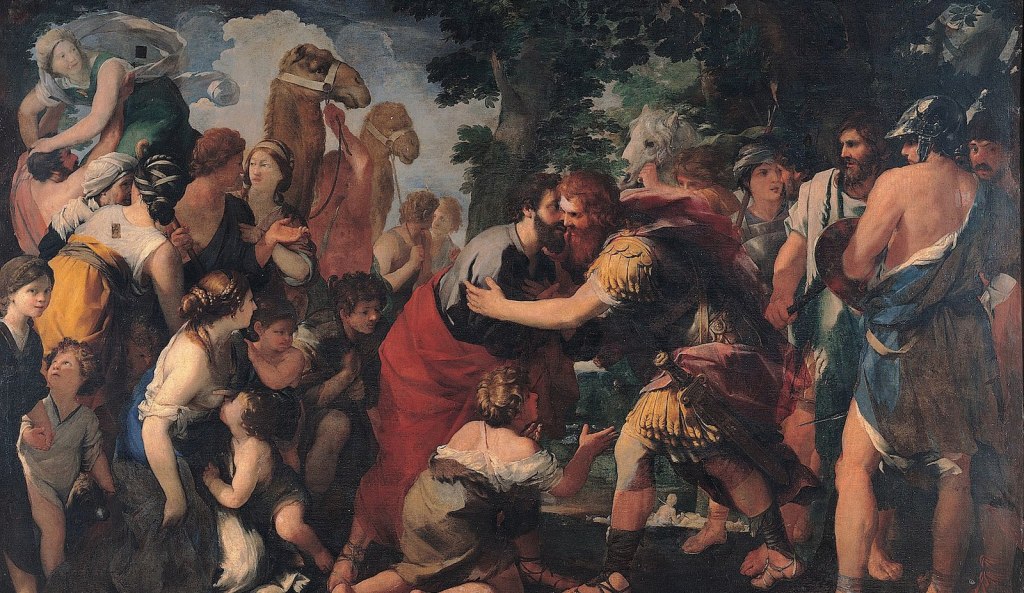
Meeting Between Jacob and Esau by Italian painter Bottalla Raffaellino (1613-1644)

Later that day Jacob met Esau coming with his four hundred men. So, Jacob had his children walk with their mothers. The two servant women, Zilpah and Bilhah, together with their children went first, followed by Leah and her children, then by Rachel and Joseph. Jacob himself walked in front of them all, bowing to the ground seven times as he came near his brother.

But Esau ran toward Jacob and hugged and kissed him. Then the two brothers started crying.

When Esau noticed the women and children he asked, “Whose children are these?”

Jacob answered, “These are the ones the Lord has been kind enough to give to me, your servant.”

Then the two servant women and their children came and bowed down to Esau. Next, Leah and her children came and bowed down; finally, Joseph and Rachel also came and bowed down.

Esau asked Jacob, “What did you mean by these herds I met along the road?”

“Master,” Jacob answered, “I sent them so that you would be friendly to me.”

“But, brother, I already have plenty,” Esau replied. “Keep them for yourself.”

“No!” Jacob said. “Please accept these gifts as a sign of your friendship for me. When you welcomed me and I saw your face, it was like seeing the face of God. Please accept these gifts I brought to you. God has been good to me, and I have everything I need.” Jacob kept insisting until Esau accepted the gifts.

“Let’s get ready to travel,” Esau said. “I’ll go along with you.”

But Jacob answered, “Master, you know traveling is hard on children, and I have to look after the sheep and goats that are nursing their young. If my animals travel too much in one day, they will all die. Why don’t you go on ahead and let me travel along slowly with the children, the herds, and the flocks. We can meet again in the country of Edom.”

Esau replied, “Let me leave some of my men with you.”

“You don’t have to do that,” Jacob answered. “I am happy, simply knowing that you are friendly to me.”

So, Esau left for Edom. But Jacob went to Succoth, where he built a house for himself and set up shelters for his animals. That’s why the place is called Succoth. (Contemporary English Version)

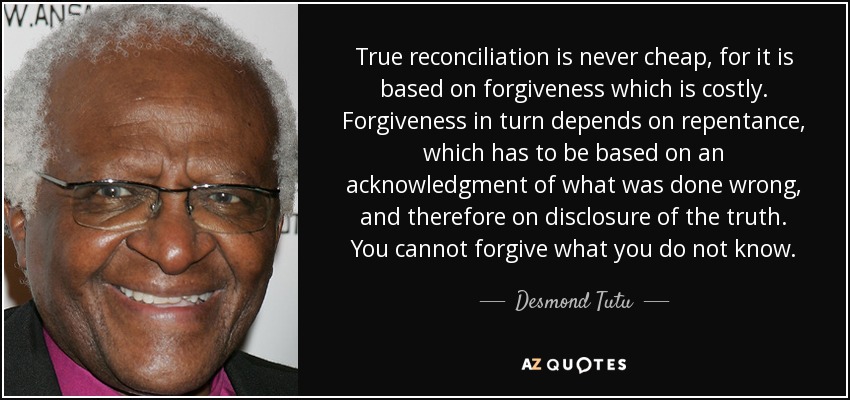
Repentance includes more than saying sorry. It also involves admitting wrong and making things right. Turning from erroneous thinking and forsaking past hurtful actions, lays the groundwork for an earnest attempt at reconciliation. 

For example, the Christian does more than a simple acceptance and acquiescence of Jesus, as if merely adding a bit of Christ to life will dash it up and make it better. Rather, we are invited into the very life of Christ. This life turns us upside-down and inside-out in a new and radical allegiance.

Repentance and reconciliation are a way of life. They are necessary skills requiring development through continual practice and use.

Broken relationships are the stuff of life. So, we need gracious approaches to deal with them so that bitterness does not take root in our souls. Connection and peace between two people are a beautiful thing. They bring emotional health, spiritual wholeness, and life enrichment.

From the get-go, twin brothers Jacob and Esau in the Old Testament book of Genesis had a contentious relationship. Their relations became so bad that Esau had homicidal ideation toward his brother. Neither Esau nor Jacob handled things well. Jacob ended up leaving, finding a wife, growing a family, and becoming wealthy.

Twenty years passed before they came together again.

Jacob, knowing he was about to meet his brother, had an encounter with God. It changed his identity from the old deceiver to the new Israel (Genesis 32:22-31).  In a demonstration of his new identity as Israel, Jacob worked at making amends for his old cheating ways. He sought to give the blessing he had stolen from his brother.

Jacob understandably had some dread in meeting Esau. He had connived and manipulated to take the family birthright and blessing from his brother. Fresh from wrestling with God, Jacob demonstrated a newfound courage and humility. He offered Esau respect, gifts, and honor – reversing his past pattern of disrespect, stealing, and dishonor.

True repentance is making things right. Merely having feelings of remorse is not repentance. To repent involves genuine sorrow; an earnestness to make restitution and reconciliation; an indignation over what happened; and, perhaps most importantly, a deep concern for the person(s) harmed by our wrongdoing (2 Corinthians 7:8-11).

The reconciliation between the brothers was a surprise. Jacob was not expecting Esau’s response. It seems Jacob was bracing for the worse, which explains his high anxiety before the encounter.

Esau’s gracious response was an answer to Jacob’s prayer.  For Jacob, seeing Esau’s face was like seeing the face of God. In fact, he saw both faces and lived! Jacob likely would not have seen his brother’s face until he had first seen God’s. His divine experience prepared the way for the human encounter.

We all experience times when relationships unravel and need to be mended. Jacob procrastinated for twenty years before working at reconciliation with his brother. What made the difference for Jacob was trusting God, who always works out divine promises, despite our human foibles. 

May you know and experience the God who reconciles and restores, and in so doing, extend that same earnestness to others.

Merciful God, I confess that I have sinned against you and against others through my own fault by thought, word and deed in things done and left undone. Especially I confess that I have _____.  I therefore repent; for these and all my sins I am terribly sorry and pray for forgiveness. I firmly intend to make amends and seek for help. I ask for strength to serve you in newness of life through Jesus Christ, my Lord, in the power of your Holy Spirit. Amen.

Genesis 33:1-17 – Brothers Reconciled

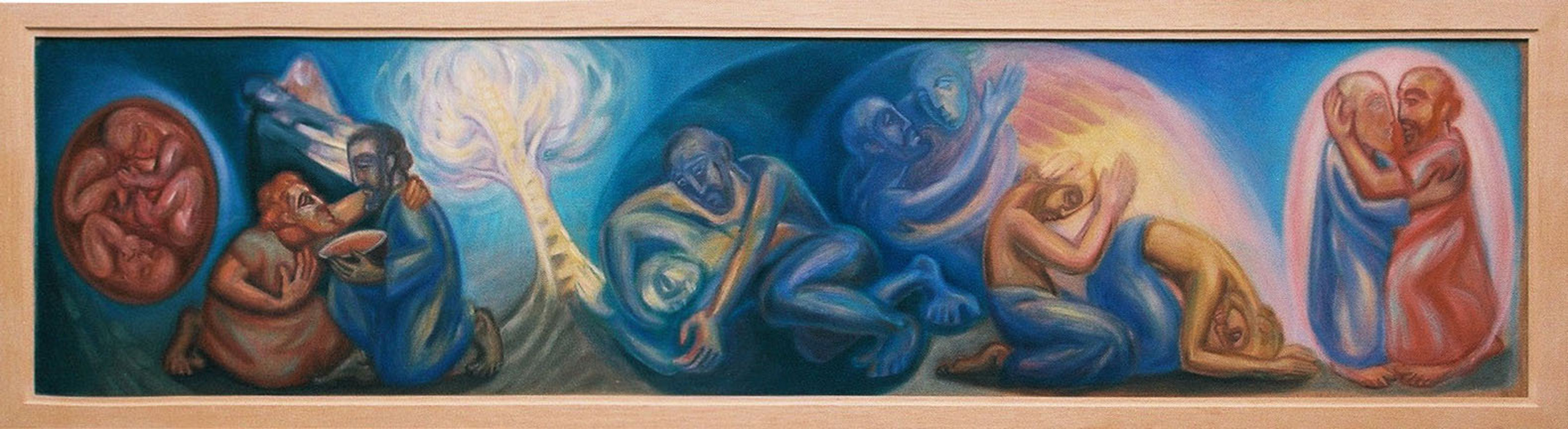
Jacob and Esau by Willow Winston
Jacob and Esau by British artist Willow Winston

Jacob looked up and saw Esau coming with his four hundred men. He divided the children between Leah and Rachel and the two maidservants. He put the maidservants out in front, Leah, and her children next, and Rachel and Joseph last. He led the way and, as he approached his brother, bowed seven times, honoring his brother. But Esau ran up and embraced him, held him tight and kissed him. And they both wept. 

Then Esau looked around and saw the women and children: “And who are these with you?” 

Jacob said, “The children that God saw fit to bless me with.” 

Then the maidservants came up with their children and bowed; then Leah and her children, also bowing; and finally, Joseph and Rachel came up and bowed to Esau. 

Esau then asked, “And what was the meaning of all those herds that I met?” 

“I was hoping that they would pave the way for my master to welcome me.” 

Esau said, “Oh, brother. I have plenty of everything—keep what is yours for yourself.” 

Jacob said, “Please. If you can find it in your heart to welcome me, accept these gifts. When I saw your face, it was as the face of God smiling on me. Accept the gifts I have brought for you. God has been good to me and I have more than enough.” Jacob urged the gifts on him, and Esau accepted. 

Then Esau said, “Let’s start out on our way; I’ll take the lead.” 

But Jacob said, “My master can see that the children are frail. And the flocks and herds are nursing, making for slow going. If I push them too hard, even for a day, I’d lose them all. So, master, you go on ahead of your servant, while I take it easy at the pace of my flocks and children. I’ll catch up with you in Seir.” 

Esau said, “Let me at least lend you some of my men.” 

“There’s no need,” said Jacob. “Your generous welcome is all I need or want.” 

So, Esau set out that day and made his way back to Seir. 

And Jacob left for Succoth. He built a shelter for himself and sheds for his livestock. That’s how the place came to be called Succoth (Sheds). (MSG) 

Repentance includes more than saying sorry. It also involves admitting wrong and making things right. This, then, lays the groundwork for an earnest attempt at reconciliation.  For example, the Christian does more than a simple acceptance and acquiescence of Jesus, if merely adding a bit of Christ to life will dash it up a bit and make it better. Rather, we are invited into the very life of Christ. This life turns us upside-down and inside-out in a new and radical allegiance.

Repentance and reconciliation are a way of life, as well as a necessary skill requiring development through continual practice and use. Broken relationships are the stuff of life, and we need gracious approaches to deal with them so that bitterness does not take root in our souls. Connection and peace between two people are a beautiful thing; it brings emotional health, spiritual wholeness, and life enrichment.

From the get-go, twin brothers Jacob and Esau in the Old Testament book of Genesis had a contentious relationship. At one point their relations were so bad that Esau was having some homicidal ideation toward his brother. Neither Esau nor Jacob handled things well between each other with Jacob leaving, finding a wife, and growing a family, and becoming wealthy. Twenty years passed before they came together again.

Jacob wrestling with God
Jacob Wrestling with the Angel of God by Jack Baumgartner, 2009

Jacob, knowing he was about to meet his brother, had an encounter with God that changed his identity from the old deceiver to the new Israel (Genesis 32:22-31).  In a demonstration of his new identity as Israel, Jacob worked at making amends for his old cheating ways by turning around the blessing he had stolen from his brother and then giving one back to him.

Jacob understandably had some dread in meeting Esau, considering what he had done to his brother in deceitfully taking both his birthright and blessing. Fresh from wrestling with God, Jacob demonstrated a newfound courage and humility through respect, gift-giving, and showing honor – reversing his past pattern of disrespect, stealing, and dishonor.

True turning away from what we have done wrong is by making things right. Merely having the feeling of being sorry is not repentance. Genuine repentance involves true sorrow; an earnestness to make restitution and reconciliation; an indignation over what happened; and, perhaps most importantly, a deep concern for the person(s) harmed by our wrongdoing (2 Corinthians 7:8-11).

The reconciliation between the brothers was a surprise because Jacob was not expecting Esau’s response. It seems Jacob was bracing for the worse, which would explain his high anxiety before the encounter. Esau’s gracious response was an answer to Jacob’s prayer.  For Jacob, seeing Esau’s face was like seeing the face of God – in fact, he saw both faces and lived!  Jacob likely would not have seen his brother’s face until he had first seen God’s. His divine experience prepared the way for the human encounter.

We all experience times when relationships unravel and need to be mended. Jacob procrastinated for twenty years before working at reconciliation with his brother. What made the difference for Jacob was trusting God, who always works out his promises, despite our human foibles.

May you know and experience the God who reconciles and restores, and in so doing extend that same earnestness to others.

Merciful God, I confess that I have sinned against you and against others through my own fault by thought, word and deed in things done and left undone. Especially I confess that I have _____.  therefore repent; for these and all my sins I am terribly sorry and pray for forgiveness. I firmly intend to make amends and seek for help. I ask for strength to serve you in newness of life through Jesus Christ, my Lord, in the power of your Holy Spirit. Amen.