The Example of John the Baptist (Matthew 14:1-12)

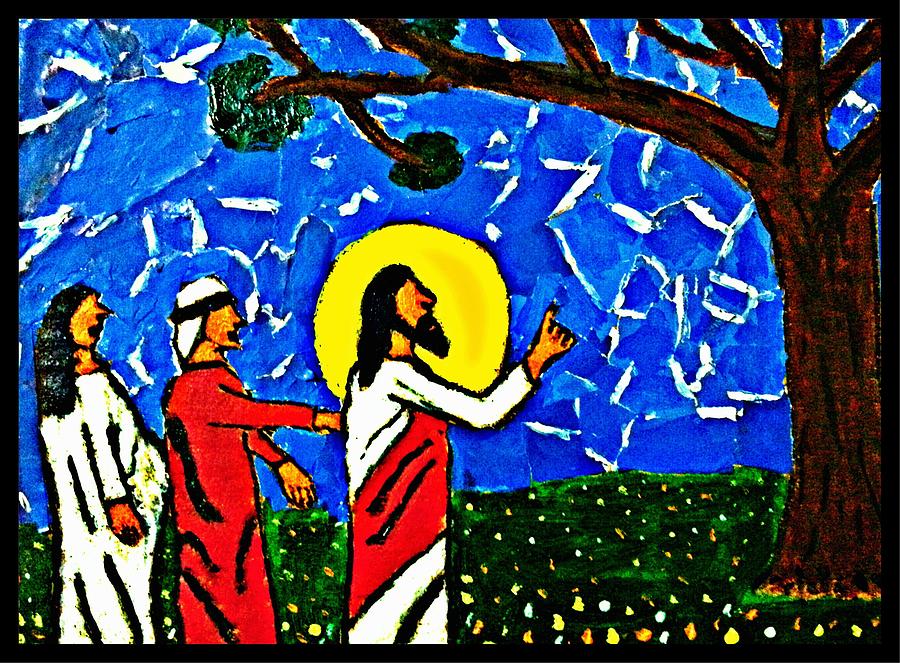
John the Baptist preaching, by George Maurice Cloud (1909-1973)

At that time Herod the ruler heard the news about Jesus. He said to his servants, “This is John the Baptist. He’s been raised from the dead. This is why these miraculous powers are at work through him.” Herod had arrested John, bound him, and put him in prison because of Herodias, the wife of Herod’s brother Philip.

That’s because John told Herod, “It’s against the law for you to marry her.”

Although Herod wanted to kill him, he feared the crowd because they thought John was a prophet. But at Herod’s birthday party Herodias’ daughter danced in front of the guests and thrilled Herod. Then he swore to give her anything she asked.

At her mother’s urging, the girl said, “Give me the head of John the Baptist here on a plate.” Although the king was upset, because of his solemn pledge and his guests he commanded that they give it to her. Then he had John beheaded in prison. They brought his head on a plate and gave it to the young woman, and she brought it to her mother. But John’s disciples came and took his body and buried it. Then they went and told Jesus what had happened. (Common English Bible)

John the Baptist’s murder is not only an ancient story; it’s also a story about our contemporary world – a world of power, sex, and intrigue. Times may change, but people across the ages do not. Humanity is fundamentally the same in every century. And the world is still the world, no matter the historical time. 

The contrast between King Herod and John the Baptist supply us with two types of people who exist throughout every age of humankind, offering us the choice of which way we will go with our lives. The story illustrates for us the reality of living in a fallen world as a devout person.

The Herod in today’s Gospel lesson was a son of Herod the Great, the one who killed all the male babies when Jesus was born in order to try and get rid of any rival king (Matthew 2:1-18). King Herod is displayed in the narrative as a tragic and pathetic figure who is ruled by his own lusts. He seems too proud and wimpy to admit he made a rash promise. He killed a man just to save face with his guests at a party.

This a Jerry Springer worthy family drama: The Herod family was rich, proud, and downright violent. They tended to marry within their own clan to hold their power and possessions for themselves. Herodias married her uncle Herod Philip; Salome was their daughter.

Later, Salome married Philip the tetrarch, half-brother to Herod Philip. Through marriage, Salome became both aunt and sister-in-law to her mother. Then the Herod in our story married Herodias, who had been married to Herod’s half-brother, Herod Philip. Having fallen in love with Herod Antipas, Herodias divorced Herod Philip to marry Herod Antipas.

Sheesh, nothing quite like complicated family drama.
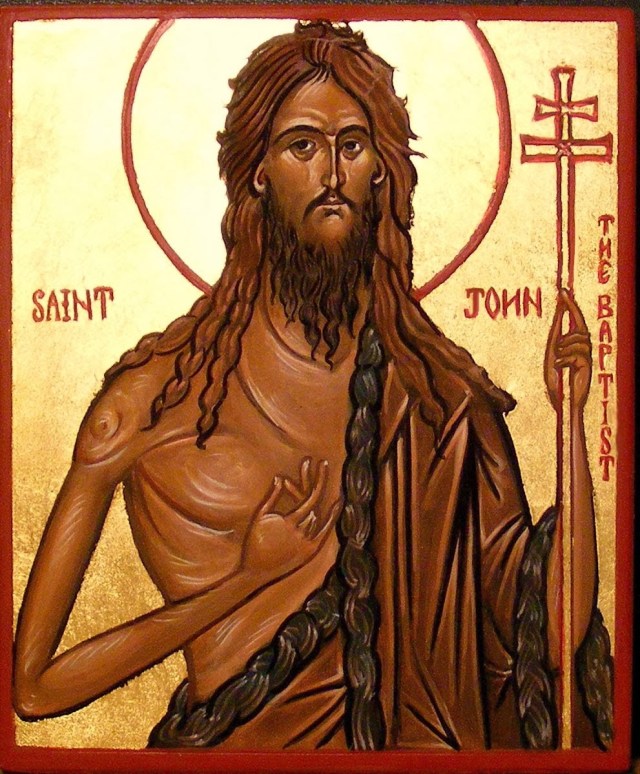
Orthodox icon of John the Baptist

Into this violation of Old Testament marriage laws (the Herod’s were Jewish) came John who made no bones about the fact this was not right (Leviticus 18:16, 20:21). Herodias nursed a grudge against John for speaking out against her and Herod’s choices.

Hell, hath no fury like a woman’s scorn, and when Herodias found an opportunity to get rid of John, she coached her daughter into asking for John the Baptist’s head on a platter. Herod, too insecure to take back his ridiculous promise and look like a fool, consented to the execution of John.

In contrast to all this tragic theater is John the Baptist. John was a messenger of God and a preacher of repentance. As one who was preparing the way for Jesus, his message was simple and to the point: Repent, for the kingdom of God is near.

John got into trouble and lost his life because he spoke truth to power by meddling in the life of King Herod and his family. The Herod’s were the political establishment of the day, and John did not temper his words when dealing with them.

There is a refreshing integrity about John. He was always the same, no matter where he was, and no matter who the people were around him. In contrast to Herod, John was bold, courageous, confident, unafraid, and secure enough in his relationship with God to engage in ministry without thought to the consequences. 

John was unconcerned for what others might think of him, if he proclaimed truth in the public square, and it ended up costing him his life.

John the Baptist Rebuking Herod, by Giovanni Fattori (1825-1908)

The story of John the Baptist’s death speaks about the hostility of this world. And it prefigured and foreshadowed the death of Jesus:

  • Like John, Jesus was executed by the civil authorities.
  • Herod, like Pilate after him, hesitated to execute and was swayed by the crowd.
  • Herodias, like the chief priests toward Jesus, finally got her way through scheming and manipulation.
  • John’s disciples came and took his body and buried it, just like Joseph of Arimathea and Nicodemus did for Jesus.

These stories, on the surface, appear to be only gloom and doom. Yet, there is a message of hope and joy. The absurd is working out itself in deliverance from sin, death, and hell. Through death, Jesus conquered death. We now have no fear of death; its sting has been taken away. Without fear of death, we have no reason to fear life with its troubles and tribulations.

The fork in the road is between the way of John or Herod. It’s a values-based decision. If worth is derived from what we do, what we have, and/or other’s opinion of us, we will likely identify more with Herod and his choices. If there is a preoccupation with hoarding power and control, this is the path of Herod. 

Conversely, if the ultimate value is in knowing Christ crucified and the power of his resurrection, then we identify with John as our spiritual ancestor. If security and worth is derived from being in Christ, then there is boldness to speak truth to power and give grace to the powerless.

Herod saw no further than his immediate needs and safety; he failed to discern his own heart. Because of his spiritual blindness, Herod did not look away from himself and look to God. Faith in Jesus comes when persons look away from themselves and look to Christ who holds the power to free all from spiritual bondage.

Consider the example of John the Baptist. He consistently sought to do the will of God as best as he understood it. Together with all God’s people past and present, we declare that God is with us, the kingdom of God is near, and the love of Christ brings faith and hope.

Almighty God, through your providence John the Baptist was wonderfully born and was sent to prepare the way of your Son, our Savior, by the preaching of repentance. Lead us to repent according to his preaching and, after his example, constantly to speak the truth, boldly to rebuke vice, and patiently to suffer for truth’s sake; through Jesus Christ your Son, our Lord, who is alive and reigns with you, in the unity of the Holy Spirit, one God, now and forever. Amen.

Ezekiel 2:8-3:11 – Use the Head-Butt

Rufus R. Jones (1933-1993)

Son of man, listen to what I say to you. Do not join them in their rebellion. Open your mouth and eat what I give you.”

Then I looked and saw a hand reaching out to me. It held a scroll, which he unrolled. And I saw that both sides were covered with funeral songs, words of sorrow, and pronouncements of doom.

The voice said to me, “Son of man, eat what I am giving you—eat this scroll! Then go and give its message to the people of Israel.” So, I opened my mouth, and he fed me the scroll. “Fill your stomach with this,” he said. And when I ate it, it tasted as sweet as honey in my mouth.

Then he said, “Son of man, go to the people of Israel and give them my messages. I am not sending you to a foreign people whose language you cannot understand. No, I am not sending you to people with strange and difficult speech. If I did, they would listen! But the people of Israel won’t listen to you any more than they listen to me! For the whole lot of them are hard-hearted and stubborn. But look, I have made you as obstinate and hard-hearted as they are. I have made your forehead as hard as the hardest rock! So don’t be afraid of them or fear their angry looks, even though they are rebels.”

Then he added, “Son of man, let all my words sink deep into your own heart first. Listen to them carefully for yourself. Then go to your people in exile and say to them, ‘This is what the Sovereign Lord says!’ Do this whether they listen to you or not.” (New Living Translation)

When I was a kid, my brother and I watched “All-Star Wrestling” on television every Saturday. One of our favorite wrestlers was Rufus R. Jones. Like all wrestlers, he had a signature move, a lights-out-nobody-is-getting-up maneuver that always ended the match. 

Rufus’ move was the head-butt. Slamming his hard forehead into the head of his opponent always brought raucous behavior from me and my brother. Then, as the boys we were, we acted out the head-butt scene over and over. The hardest head always won…. I usually lost…. That probably explains a lot.

God gave a message to the prophet Ezekiel concerning the stubborn hearts and hard heads of the Israelites. The Lord was looking for repentance, for the people to turn their hearts and minds back to true worship and an authentic humble relationship with their God. 

The prospect of facing such a task, such an opponent, seemed daunting to Ezekiel. So, the Lord assured the prophet that his forehead would be harder than that of Rufus R. Jones. So, there is no need to be afraid of the opponent. They may be hard, but they’re no match for the rock-hard head of the prophet.

In essence, God told Ezekiel to pull-out the signature wrestling move and do the lights-out head-butt maneuver. And the promise from God that backed up Ezekiel was this: There’s absolutely no way you’re going to lose the match with the kind of head I’m giving you.

Like Ezekiel, we are to speak the Word of God with the promise of not losing. Prideful ungodly stubbornness will get us knocked-out. But conversely, gracious bold stubbornness, which determines to do the will of God, shall always win the day.

The only catch is: The Word needs to sink down deeply into our own hearts through listening well – before we can effectively speak to others.

God provides us with spiritual giftedness. Yet, that doesn’t mean we never need to develop that gift or engage in any spiritual practices to make it better. We are to use that which God gives us, no matter the response from others.

There is often a fine line between sinful obstinate stubbornness and godly persevering tenacity. We are never to use our abilities to slam people, obnoxiously and persistently, upside the head with an oversized King James Version of the Bible – in the wrongheaded notion that the Word doesn’t come back without effect.

That kind of effect, however, is harmful spiritual bruising that is devoid of grace. It’s really nothing more than an individual working out their own anger and frustration on somebody else.

Rather, we are to carefully, deliberately, consistently, and daily internalize God’s Word so that what comes out of us is helpful, not harmful. Only by a constant use of solitude and silence, in truly listening well for the voice of God, can we effect the sort of positive ministry which is needed for the present moment.

Put another way, whenever we head-butt an opponent, the grace and mercy ought to be uncompromising. It’s not our job to be the judge; our task is to communicate effectively and humbly without giving in or giving up. The message may be hard, but it should always be sweet.

Almighty and ever-living God, we pray that you would give us the Spirit of wisdom and discernment so that we may know you better and love you more. Give us an understanding heart so that we may be open in hearing your voice of grace and guidance.

Use us, your people, not to be unthinking and unfeeling tools of bludgeoning others, but to be your hands and feet – your voice and heart so that we may be a channel through which you pour out your grace to help others – may we decrease to nothing so that only Christ is seen in our lives – we ask this in the power of the Spirit and in the name of Jesus. Amen.

Acts 2:14-24 – From Flaky to Faithful

Preaching of the Apostles (crayon on paper) by Peter Gorban, 1990

Peter stood up with the Eleven, raised his voice and addressed the crowd: “Fellow Jews and all of you who live in Jerusalem, let me explain this to you; listen carefully to what I say. These people are not drunk, as you suppose. It’s only nine in the morning! No, this is what was spoken by the prophet Joel:

“‘In the last days, God says,
    I will pour out my Spirit on all people.
Your sons and daughters will prophesy,
    your young men will see visions,
    your old men will dream dreams.
Even on my servants, both men and women,
    I will pour out my Spirit in those days,
    and they will prophesy.
I will show wonders in the heavens above
    and signs on the earth below,
    blood and fire and billows of smoke.
The sun will be turned to darkness
    and the moon to blood
    before the coming of the great and glorious day of the Lord.
And everyone who calls
    on the name of the Lord will be saved.’

“Fellow Israelites listen to this: Jesus of Nazareth was a man accredited by God to you by miracles, wonders and signs, which God did among you through him, as you yourselves know. This man was handed over to you by God’s deliberate plan and foreknowledge; and you, with the help of wicked men, put him to death by nailing him to the cross. But God raised him from the dead, freeing him from the agony of death, because it was impossible for death to keep its hold on him. (NIV)

In the New Testament Gospels of the Holy Bible, the Apostle Peter was a flake. He sometimes got it, and sometimes didn’t. Peter could discern Jesus was Messiah, but then would turn around and refuse that Christ had to die on a cross. He would get bold and walk on water, then, end up falling short and needing help from drowning. Peter stood tall for Jesus, and then denied him three times.

However, following the Gospels in the Acts of the Apostles, Peter is a completely changed man. He now gets it. He is brave. He confesses Christ with confidence and boldness. And, while the reader might be waiting for the other shoe to drop yet again, all the while Peter does not falter, flinch, or back down. Alright, Peter, way to go!

So, what is the difference between the Gospels and Acts with Peter? Why is there such a turnaround from flaky to faithful? The Scriptures make it plain: The Holy Spirit comes upon Peter. And he is never the same again. Everything falls into place for Peter. He proclaimed the life and death of Jesus in such a way that thousands changed their way of thinking, as well as their way of life, and placed their faith and hope in Christ as Savior and Lord. Not a bad day’s work for a former fisherman.

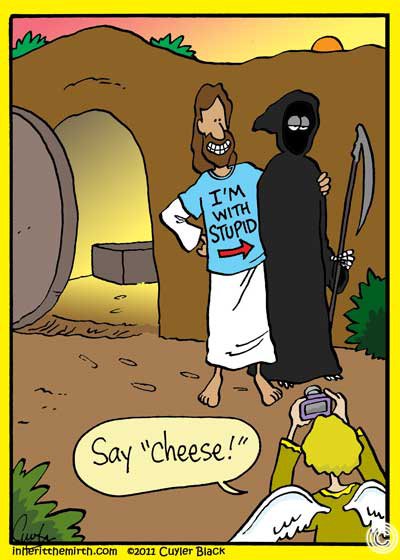
Peter’s message was pointed and straightforward: God raised Jesus up, forever changing the nature of death. Peter was dogmatic about stating that it wasn’t even possible for death to get a grip on Jesus. Oh, death thought it had him, the Grim Reaper believed he had Christ nailed to death for certain. Not so. The grave could not contain the immense and incredible power of divine love for humanity.

Inherit the Mirth

If it was impossible for death to keep its grip on Jesus, then there is absolutely nothing that can deter Jesus or hold him back from accomplishing what he wants to accomplish. Flaky believers are not going to frustrate Jesus or upset his plans; he’ll just send the Holy Spirit. 

We too often imprison ourselves in self-made spiritual jail cells, flaking-out in the Christian life, sometimes getting it right and once-in-a-while hitting upon some right combination we can’t explain, like a golfer who hits an amazing shot but can’t reproduce it no matter how hard he tries. The truth is: Jesus has conquered sin, death, and hell. By faith, we have forgiveness of sins in Christ and have the way opened to a new life in the Spirit. It isn’t a secret; it is a new reality.

The season of Lent is a time of remembering those things which hinder us in our walk with Jesus and repenting of our sins so that we can live anew. As we quickly approach Holy Week, the golf clubs of vulnerability, confession and prayer will keep us in God’s fairway and allow us to shoot par.

Gracious God, who raised Jesus from the dead, may the same power reside in me so that I can do your will in every situation through the power and presence of your Holy Spirit.  Amen.

Matthew 21:18-22 – Faith and Prayer

Jesus Cursing the Fig Tree
Jesus Cursing the Fig Tree by Ganosh Kelagina Beedu Shenay, 2016

Early in the morning, as Jesus was on his way back to the city, he was hungry. Seeing a fig tree by the road, he went up to it but found nothing on it except leaves. Then he said to it, “May you never bear fruit again!” Immediately the tree withered.

When the disciples saw this, they were amazed. “How did the fig tree wither so quickly?” they asked.

Jesus replied, “Truly I tell you, if you have faith and do not doubt, not only can you do what was done to the fig tree, but also you can say to this mountain, ‘Go, throw yourself into the sea,’ and it will be done. If you believe, you will receive whatever you ask for in prayer.” (NIV)

God wants us to pray! Prayer happens from a place of faith because to pray, one must believe that God is good and answers prayer. Conversely, prayerlessness is faithlessness.  A person of little faith prays only a little. A person full of faith cannot stop praying.

God’s world revolves more around promise than command – which means that Jesus merely exhorting the disciples to pray would fall flat; they needed a deep change of heart. God calls us all to transformation. Lasting change takes place at the roots of our lives. When there is a drought, pouring lots of water on our backyard trees at the first sign of withering leaves is too late. The tree may look fine on the outside, but on the inside, it is dying from lack of water. Real change comes from the inside-out.  It is the root of a person’s life, below the surface where others do not see, that needs change, and not merely the outward behavior.  Prayer must be directed to the root, to the heart of the issue.

In today’s Gospel story, Jesus was up early and going to Jerusalem. He was hungry and wanted some breakfast, so he approached a fig tree. Figs were known back in Christ’s day as the poor man’s food. Fig trees were everywhere. Approaching a certain fig tree, Jesus found one that looked fine, but no figs. He chose to use the tree as a teachable moment for his disciples. Christ cursed the tree and immediately the entire tree withered.  So, why did Jesus curse the tree?

Jesus cursed the fig tree because it looked good on the outside, but it was already dead on the inside. The tree had everything a tree needed: branches, leaves, and a trunk – except fruit.  The tree served as an illustration for the disciples of believing prayer. The tree looked fine, and had the promise of fruit, yet, none was found.  The point of the tree illustration is this: Jesus is looking for faith in his followers.

In the prophet Jeremiah’s day, the nation of Judah had enjoyed a long stretch of prosperity and good circumstances. By all outward appearances they were doing fine. Temple attendance was at its peak and everyone was offering their sacrifices. But something was wrong….

I will put an end to them,
declares the Lord;
there are no grapes on the vine,
no figs on the tree,
only withered leaves.
They have squandered what I have given them!
(Jeremiah 8:13, CEB)

Although fine on the outside, the people of Judah trusted in themselves, their ability to produce a harvest, and their outward show of how many cattle and sheep they brought to the temple. But what God was looking for was fruit, not nice leaves. He was watching for offerings of believing prayer, born of a faith that is confident in the goodness of God. And the Lord is still looking for people’s faith in God alone – rather than in religiously outward forms of success.

Jesus wants his followers to understand and believe that our words and prayers can have the immediate effect of changing the world.  We can even speak to a mountain and it will have to move if we tell it to. We probably do not go around talking to mountains, but all of us go around talking to ourselves about mountain-like problems. The power that levels mountains is prayer that speaks confidence and boldness.  If you believe, you will receive whatever you ask for in prayer.

Doubt sometimes stands in the way of prayer – not doubt in ourselves because we do not answer our own prayers. The Apostle James said:

“If any of you needs wisdom, you should ask God for it. He is generous to everyone and will give you wisdom without criticizing you. But when you ask God, you must believe and not doubt. Anyone who doubts is like a wave in the sea, blown up and down by the wind. Such doubters are thinking two different things at the same time, and they cannot decide about anything they do. They should not think they will receive anything from the Lord.” (James 1:5-8, NCV)

Both James and his brother Jesus refer to an unshakable faith in the goodness of God. This is faith in the person of God, and not faith in faith itself. If we are honest, every one of us who has made a difficult prayer request, mustering-up all the faith we can, and then being disappointed when it did not happen, has been hurt. The unstable person vacillates when this happens, doubting whether God is good (playing the he-loves-me, he-loves-me-not game). The person of faith believes God answers prayers according to his will, and that if the prayer is not answered, God knows what he is doing and will answer it in his own good timing and purposes.

Maybe you have even indulged your inner-critic, a Job-like friend, telling you that you have a failure of faith, or not enough faith, and that is why your prayer was not answered. Yet, positive thinking is not the same as Christian faith.  It is neither a matter of being optimistic, nor of sending $19.95 to some hack preacher who promises to give you the secret of answered prayer, along with a free gold cross.

God’s will for our lives is sometimes, maybe even oftentimes, a mystery. However, we do know what God’s will is for a lot of things. For example, God is not willing that any should perish but all be brought to eternal life.  So, we can pray with confidence for a person’s deliverance from sin.  We can be bold about trusting in God’s promises – he will do what he says he will do.  Boldness is only as good as the truth it is based upon.

Imposing Mountain View and Lake Glacier National Park
Imposing Mountain View and Lake Glacier National Park. Many Glacier Area. Swiftcurrent Lake.

We have every right, based in our union with Jesus Christ and our redemption in him, to ask God confidently and boldly for the removal of mountains.  We have the authority in Christ to do so.  Therefore, we do not need to offer tepid, milquetoast, mumbling prayers with sighs and hunched shoulders (i.e. “Well, God, if it is your will, could you help me?”).

It is time for men to step out and give God some healthy hairy-chested prayers.  And, this is not the time for women to be worried about what the men do, or not do. Everyone is to be bold in prayer.

“God desires of us nothing more ardently than that we ask many and great things of him, and he is displeased if we do not confidently ask and entreat.” –Martin Luther

Jesus wants faithful and fruitful prayer. He still scans the horizon of our spiritual lives looking for believing prayer. Christ desires from those who follow him bold prayers which curse and wither fruitless and feckless places. When my children were small there was an adult store in our neighborhood. It disturbed my spirit. Each time I passed it I confidently prayed that the pornography and exploitation of women would dry up and cease in Jesus’ name, and that those who worked in that establishment would find more gainful and ethical employment. And that is exactly what happened.

Aggressive prayer against the enemy of our souls is needed, prayer that claims the authority which has been given us in Christ, prayer that is based in solid biblical truth and robust theology. So, let us pray in faith and confidence….

Heavenly Father, we praise you for the grace we possess through the Lord Jesus Christ.  We rejoice in Christ’s teaching and the victory you have provided for us to live above sin and failure.  We come before you in confession and to plead your mercy over our sins, the sins of other believers, and the sins of our world.  We confess the sin of prayerlessness, faithlessness, apathy, complacency, and indifference to those who are lost.  We also acknowledge before you the wickedness of our world through the evil machinations of injustice, oppression, and exploitation of others.

We praise your holy name, O God, that there is plenty of grace through the person and work of the Lord Jesus.  We plead the blood of the cross and the power of the resurrection against the sins and rebellion of people against you.  We pray and wait for you, Holy Spirit, to bring us all to new life in Jesus Christ. 

We recognize that Satan and the kingdom of darkness have plotted and laid strategies against new spiritual life, keeping your people from believing prayer.  So, in the name of the Lord Jesus Christ, we claim our place as children of God. We smash and pull down all the strongholds which Satan has erected against humanity – and pray that the power of Christ’s resurrection would hinder and frustrate the plans formed against us. 

We pull down demonic strongholds of prayerlessness and carelessness with the Word of God. We claim back for the Lord Jesus Christ the ground Satan is claiming as a means of hindering faith, hope, and love; and, we affirm that Satan’s plans were fully defeated through the cross and resurrection of Jesus. We pull down all of Satan’s plans to divert fresh faith when it comes. Blessed Holy Spirit, may you send a renewal to the hearts and souls of all people. May it bring a wondrous season of peace and joy.

We, your people, accept the role of standing in the gap for others in prayer.  You yourself, God, said that we, in Christ, are mighty through God to the pulling down of strongholds.  So, we bring all the work of the Lord Jesus Christ to focus directly against the powers of darkness that blind people and keep them in bondage.  We pray the victory of Christ’s incarnation, crucifixion, resurrection, ascension, and glorification directly against all of Satan’s power in their lives.  We now bind all powers of darkness set to destroying them, and we unbind those demonic bonds and blinders from them in the mighty name of Jesus. 

By faith we claim humanity for fruitful lives of spiritual abundance, social justice, and sanctified relationships in the name of Jesus Christ our Lord, who defeated all powers and principalities of this world.  Amen.