Receiving Blessings or Woes? (Luke 6:17-26)

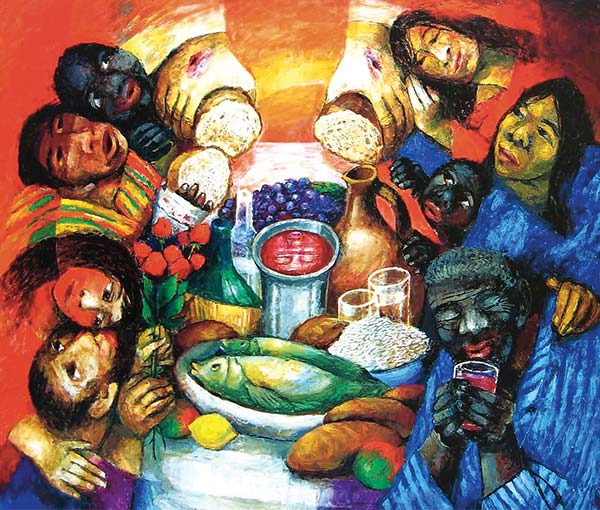
Ethiopian artist depiction of Jesus teaching

He went down with them and stood on a level place. A large crowd of his disciples was there and a great number of people from all over Judea, from Jerusalem, and from the coastal region around Tyre and Sidon, who had come to hear him and to be healed of their diseases. Those troubled by impure spirits were cured, and the people all tried to touch him, because power was coming from him and healing them all.

Looking at his disciples, he said:

“Blessed are you who are poor,
    for yours is the kingdom of God.
Blessed are you who hunger now,
    for you will be satisfied.
Blessed are you who weep now,
    for you will laugh.
Blessed are you when people hate you,
    when they exclude you and insult you
    and reject your name as evil,
        because of the Son of Man.

“Rejoice in that day and leap for joy, because great is your reward in heaven. For that is how their ancestors treated the prophets.

“But woe to you who are rich,
    for you have already received your comfort.
Woe to you who are well fed now,
    for you will go hungry.
Woe to you who laugh now,
    for you will mourn and weep.
Woe to you when everyone speaks well of you,
    for that is how their ancestors treated the false prophets. (New International Version)

There are double meanings throughout these words of Christ for us today; the expressions used by Jesus are specifically meant to be understood in two ways.

In order to speak to the people, Jesus went down with them and stood on a level place. In other words, the actual act of doing this is also to be understood as a means of identifying with others and getting on their level. The Lord intends not to speak down to people but to relate with folks alongside them.

The blessing of God is provided, up close and personal, not from afar. The word “blessed” is much more than a reference to physical health and wealth; it also refers to enjoying God’s stamp of approval on the whole of your life – body, mind, emotions, and spirit. And that is also what healing does for us; it effects the entirety of our being and not just one dimension of it.

To be “blessed” does not mean an absence of struggle. Indeed, blessings can and do rest upon us, even though we may be on the unfortunate end of someone’s hatred, exclusion, and defamation. It is to live through opposition, aware that our struggles are temporary and that our reward is great in heaven.

To have a “woe” pronounced means the opposite of blessing – to have God’s disapproval. It is to experience a curse – body, mind, emotions, and spirit – in the holistic sense.

The woeful may not experience apparent discomfort during this life. They mistake their wealth, their stuff, and their high connections as approval from God. However, they will find a fiery existence awaiting them. Apart from repentance and faith in becoming poor in spirit, their end is sure.

We are being led and guided to choose the way of blessing – and to avoid the path of woe.

Poverty, hunger, and weeping, on one level, are broad social categories. At another level, they are spiritual categories which describe the true follower of Jesus.

Christ’s church includes people who are poor, hungry, and weeping – in the full sense of the term. They, therefore, rely upon the community of the redeemed sharing all things in common as their means of provision. (Acts 2:44-45; 4:34)

We really need to avoid the temptation to make complex situations simple. To look upon those who now have wealth, eat well, laugh, and enjoy high standing, as under a curse from God, makes us simpletons who likely don’t understand what’s going on.

Others may make direct associations with wealth as blessing, which it may or may not be. And the same can be said for poverty and hunger – the presence of it doesn’t necessarily mean either blessing or woe.

The watershed issue is what we do with the life we have been given. Do the rich rely upon wealth or on God? Do the poor seek the Lord or just try to look for patrons who will help them? And do we all accept where we are right now and look to use whatever we have, and whoever we are, to benefit the benevolent and gracious kingdom of God?

We all may come from different places, have differing experiences, and be at various points along the continuum of poverty and wealth. Yet, we are all human and we are all in this life together.

So, we need to make the best of it with each other – instead of continually being at cross purposes with one another through simple stereotypes and hackneyed approaches based in little research or rational thought.

Jesus is leading us to a place of abundance, peace, and blessing – if we have ears to hear and minds receptive to his leading. It’s a place of healing; and not a place of woe. It is the realm of God, in which morality, ethics, kindness, and joy abound forever and ever.

Help us, O God, to heal those who are broken in body or spirit, and to turn their sorrow into joy. Grant this, Father, for the love of your Son, who for our sake became poor, Jesus Christ our Lord, who with you and the Holy Spirit are one God, now and forever. Amen.

Covenant Promises (2 Samuel 7:1-17)

Jerusalem. Photo by Anton Petrus

After the king was settled in his palace and the Lord had given him rest from all his enemies around him, he said to Nathan the prophet, “Here I am, living in a house of cedar, while the ark of God remains in a tent.”

Nathan replied to the king, “Whatever you have in mind, go ahead and do it, for the Lord is with you.”

But that night the word of the Lord came to Nathan, saying:

“Go and tell my servant David, ‘This is what the Lord says: Are you the one to build me a house to dwell in? I have not dwelt in a house from the day I brought the Israelites up out of Egypt to this day. I have been moving from place to place with a tent as my dwelling. Wherever I have moved with all the Israelites, did I ever say to any of their rulers whom I commanded to shepherd my people Israel, “Why have you not built me a house of cedar?”’

“Now then, tell my servant David, ‘This is what the Lord Almighty says: I took you from the pasture, from tending the flock, and appointed you ruler over my people Israel. I have been with you wherever you have gone, and I have cut off all your enemies from before you. Now I will make your name great, like the names of the greatest men on earth. And I will provide a place for my people Israel and will plant them so that they can have a home of their own and no longer be disturbed. Wicked people will not oppress them anymore, as they did at the beginning and have done ever since the time I appointed leaders over my people Israel. I will also give you rest from all your enemies.

“‘The Lord declares to you that the Lord himself will establish a house for you: When your days are over and you rest with your ancestors, I will raise up your offspring to succeed you, your own flesh and blood, and I will establish his kingdom. He is the one who will build a house for my Name, and I will establish the throne of his kingdom forever. I will be his father, and he will be my son. When he does wrong, I will punish him with a rod wielded by men, with floggings inflicted by human hands. But my love will never be taken away from him, as I took it away from Saul, whom I removed from before you. Your house and your kingdom will endure forever before me; your throne will be established forever.’”

Nathan reported to David all the words of this entire revelation. (New International Version)

What is a covenant?

A covenant is simply a contract or agreement between two or more parties. The Bible is a covenant document. The Old and New Testaments are really Old and New Covenants. The word “testament” is Latin for “covenant.” When God makes a covenant with people, it means they receive divine promises of what God will do; and, in response, the people have moral expectations or ethical responsibilities to follow. 

The ancient world operated on a covenant system. A nation or empire would conquer a city or territory and set up a covenant in which the conqueror promised protection, certain provisions, and left a military presence among them. In response, the conquered people were required to offer their allegiance and some of the goods and services of the land. 

God made a covenant with Abraham and promised that all the nations of the earth would be blessed through him. The only stipulation that God gave to Abraham was to leave and begin a new life in the land he would show him. (Genesis 12:1-3)

The Lord continued to work through Abraham’s descendants, the Israelites. They would be a kingdom of priests, testifying to the nations through a lifestyle of having God at the center of all they do. The people were expected to embody the Ten Commandments and be holy, thus reflecting the holiness of God.

The difference between earthly covenants and God’s covenant is that God saturates the divine covenant in love and grace – because the Lord cares about the divine/human relationship.

What do we learn about God through a covenant?

First and foremost: God never forgets nor reneges on divine promises. God was faithful to David by establishing a covenant, yet also spoke to him about his descendants. The Lord promised David a dynasty, a kingdom that would never end, a temple, and a father/son relationship with his progeny. 

Furthermore, God promised that divine love would never be taken away. The Lord shows continuous love to people, even when they go astray. Unlike the nations of the earth, the fickle nature of people, and the inconsistent commitment of others, God is a Being whose very nature is love.

In a world of broken families and severed relationships; of selfishness and trying to impose one’s will on another; of taking advantage of others; and in a world that is messed up and depraved because of sin and unfaithfulness, God stands as the consistent, never-changing Sovereign of Love who graciously blesses people. 

What sort of covenant is this?

Short answer: a covenant of grace. It’s demonstrated in how the tables are turned on David with grace. David intended on doing something for God. But the Lord completely turned it around and blessed him abundantly beyond what David could even ask or think. David had it in his heart to build a house for God, but God comes back and says that an enduring house (household and dynasty) will be built for David.

How does this covenant apply to Christians?

All the good and gracious promises given to Abraham, Moses, and David are all fulfilled in the person of Jesus Christ.  

The New Testament Gospels are steeped in the language and explanation that Jesus is the Son of David, the Promised One, Savior, Lord, Teacher, and Healer. He will save the people from their sins and bring them to a spacious kingdom full of the grace and love. 

Through the cross and resurrection of Jesus Christ we are brought into union with God and participate fully in all the promises of the New Covenant of love. Love the Lord your God with all your heart, soul, mind, and strength. Love your neighbor as yourself. All this love is personified in Christ.

Where is the covenant?

The Davidic Covenant is not limited to a specific place or a building. God is present with people wherever they go. 

A common understanding in the ancient world was that there were local gods, not a universal God over all the earth. The Jews were unique in the belief that there is not one square inch of this entire earth where God is not present. The Lord does not need a permanent structure because God is everywhere. 

We, as New Covenant people, are God’s temple. The Lord takes up residence within our lives. We possess covenant loyalty and faithfulness, continually, in the person of the Holy Spirit.

What do we learn about ourselves?

Timing is important. David had a good idea and good motives for wanting to house the Ark of the Covenant in a temple. Yet, God let David know that the timing was off. So, David would need to be patient and let his vision of a temple come to fruition with his son. 

However, that didn’t mean David was idle. By the time he died, his son Solomon had most of the building materials already stockpiled and ready for the temple construction. Waiting does not necessarily mean passivity. 

A vision for life or for ministry rarely is implemented quickly. It needs to grow and mature before it will bear fruit. Two sage questions to ask, therefore, are:

  1. Is the future I am imagining, a future that God desires, or do I have my ladder leaning on the wrong building?
  2. If I am imagining a good and gracious future, is it the right time for it to happen? 

We also learn about ourselves that we must bank on the promises of God – and trust in the person and work of Jesus because all of God’s promises are fulfilled in Christ. In Christ we are taught how to live, and by his wounds we are healed. Jesus is the hope of the world. 

There is grace to be found; forgiveness to be had; and dreams to be realized, if we are attentive to the promises given to us in Holy Scripture. Do not let your sanctified dreams die, because they might not yet have come to full term.

God’s direction for our lives is needed. We have responsibilities as God’s covenant people to be faithful and uphold the ethics of the kingdom, as expressed by Jesus in his Sermon on the Mount. (Matthew 5-7)

Perhaps what we learn most about ourselves is to surrender our plans to God. My life is not all about me. Most of the Christian life is about weaning ourselves away from our own thoughts and ingenuity, learning to submit to God’s plans for our lives. We must pray and not make assumptions, because after a night of prayer, the prophet Nathan withdrew his building permit for David.

Unless the Lord builds the house, those who build it labor in vain.

Psalm 127:1, NIV

The Lord is gracious, loving, and loyal to covenant promises. We are to live into what God is building on this earth: an ethical kingdom with people characterized by mercy, purity, and peace-making. 

Soli Deo Gloria.

Luke 14:1, 7-14 – How Can I Be Blessed?

Jesus eating with “sinners.”

One Sabbath, when Jesus went to eat in the house of a prominent Pharisee, he was being carefully watched….

When he noticed how the guests picked the places of honor at the table, he told them this parable:“When someone invites you to a wedding feast, do not take the place of honor, for a person more distinguished than you may have been invited. If so, the host who invited both of you will come and say to you, ‘Give this person your seat.’ Then, humiliated, you will have to take the least important place. But when you are invited, take the lowest place, so that when your host comes, he will say to you, ‘Friend, move up to a better place.’ Then you will be honored in the presence of all the other guests. For all those who exalt themselves will be humbled, and those who humble themselves will be exalted.”

Then Jesus said to his host, “When you give a luncheon or dinner, do not invite your friends, your brothers or sisters, your relatives, or your rich neighbors; if you do, they may invite you back and so you will be repaid. But when you give a banquet, invite the poor, the crippled, the lame, the blind, and you will be blessed. Although they cannot repay you, you will be repaid at the resurrection of the righteous.” (New International Version)

A lot of people live by the old adage, “You scratch my back and I’ll scratch yours.” It’s a phrase referring to reciprocity. In other words, if you give me something I want, I will then respond by giving you something you want.

That old adage works fine, that is, unless you have no ability to give or give back to another. If we only operate by the principle of reciprocity, a large chunk of people automatically get left out. And this situation is untenable and unacceptable to Jesus.

Christ observed that the religious insiders of his day were keeping entire groups of people on the outside through their practice of scratching one another’s backs.

We need to get ahold of the reality that God loves us, as well as everyone else – even the people we may not give the time of day to. God so loved the world that he sent his Son. Jesus has come to feed us all, not just some.

Jesus eats with sinners by Sieger Köder (1925-2015)

The kingdom of God is about food. The food given by Jesus is to feed the hungry by staging a banquet. It is a feast of God’s abundance. Yet, many seem to hoard the resources they have, only thinking about their friends, family, and people just like them. They act as if there is no need to invite outsiders, consumed as they are with their own daily lives.

We have an incredible abundant feast contained in Scripture – in fact, Jesus said that his food and drink was to do the Father’s will, that Scripture was his bread. (Matthew 4:4; John 4:34) 

It’s much too easy to take our blessings of food for granted. After all, when we are well-fed, it’s easy to assume that everyone else is, too. Feeling healthy, it’s easy to forget that others are hurting. Making money, it’s easy to think there are not many poor people around. Living in a community with plenty of churches and more bibles than people, it’s natural to assume that everyone knows the gospel of Jesus – but they don’t!

Then, whenever we get around to acknowledging there are people who need Jesus, we keep devising ways to reach them without having to change or accommodate our own lives to do it.

Christ’s call to faithful discipleship requires people to change from having a narrow focus on our small circle of friends, to including those who have no means to pay us back.

Table fellowship by Sieger Köder 

The gospel of Jesus Christ is open to outcasts and failures, to problem people and unimpressive persons. People with needs and flaws are especially dear to Jesus. It’s the people who outwardly have it all together who are being replaced wholesale with those who admit their need. 

We must not be picky about who we invite to participate in the largess of abundance we possess. We are to avoid the spiritual snobbery of looking down our noses at the needy and less fortunate, who have nothing to offer us in return.

Those who give need to do so without prejudice or favoritism. Even the lazy, the fool, and the sinner still need basic resources to live. By opening our hearts in almsgiving, we open ourselves to Christ, who is present in the least of those among us.

Refusing mercy to people deemed as unworthy, givers then actually shut themselves off from the very mercy God desires for them. There is no reward from God when there is only reward from others.

“If we are going to examine lives, we will never have mercy upon any human being; rather, hindered by this inopportune meddlesomeness, we will remain fruitless and destitute of all help ourselves.”

St. John Chrysostom, On Repentance and Almsgiving

It’s not only the poor who suffer when the rich fail to give. In judging whether or not a particular person is worthy of love and aid, the wealthy person rejects the spiritual fruit that he would have received by giving with humility.

Giving to the poor, simply to relieve our own conscience, is not real charity; it doesn’t consider the other. We attend fully to the other by observing their spiritual and holistic needs for community, purpose, respect, and dignity. Dispassionate giving from a distance, without relationship, refuses to acknowledge the whole person. It exploits the poor for the mental comfort of the rich.

We need to be involved in people’s lives, and that takes a lot of blood, sweat, and tears. There are too many lost people who need Jesus – and, I may add, too many Christians who are the walking wounded and need the healing touch of Jesus – for us to pay scant attention to the call of Jesus to invite the needy into our lives. 

Seeing people come into God’s great banquet, and into a joyous and vital relationship with Christ, will likely take ten times more work than what you are thinking it does right now. Yet, this is the pathway of true blessing – to having God’s stamp of approval on our lives.

How can I be blessed? Not by posturing for the best place in the room but by being a blessing to the most vulnerable and needy amongst us.

Merciful God, thank you for the abundance of life, relationships, health, comfort, and wealth you have provided to so many. Thank you that, even in times of need, despair, and brokenness, you are there. Please, put your arms around children and families in  poverty and disability so that they feel your comfort and hope. Meet their needs both physically and spiritually. And guide me so I can be your hands and feet pursuing justice for the poor and upholding the cause of the needy, in the way of Jesus Christ our Lord. Amen.

Ephesians 3:14-21 – A Prayer for Every Believer

A mosaic of the Apostle Paul in St Isaac’s Cathedral, St. Petersburg, Russia

For this reason, I fall on my knees before the Father, from whom every family in heaven and on earth receives its true name. I ask God from the wealth of his glory to give you power through his Spirit to be strong in your inner selves, and I pray that Christ will make his home in your hearts through faith. I pray that you may have your roots and foundation in love, so that you, together with all God’s people, may have the power to understand how broad and long, how high and deep, is Christ’s love. Yes, may you come to know his love—although it can never be fully known—and so be completely filled with the very nature of God.

To him who by means of his power working in us is able to do so much more than we can ever ask for, or even think of: to God be the glory in the church and in Christ Jesus for all time, forever and ever! Amen. (Good News Translation)

In Jesus Christ, the believer has been given incredible blessings – adoption into God’s family and belonging with God, redemption through Christ’s cross and experiencing freedom from the power of sin, and intimacy and help by means of God’s own Spirit.

Today’s New Testament lesson is a prayer of the Apostle Paul for the Church. After three chapters of describing who we are and what we have in Christ as Christians, he goes to prayer, asking that the new life we have in Christ will be pressed firmly into our heads and our hearts so that this reality of spiritual blessings will be practically realized for the believer.

Here’s a quick remedial grammar lesson: a “verb” expresses an action between two things; a “participle” or “participial phrase” is a word or group of words which help describe the action of the verb.

There are two main verbs Paul uses: “I ask (pray)” for God “to give.” The participles all explain or modify the action of pray and give. In other words, the following actions are what Paul deeply desires that God will do for us as believers in Jesus….

To Become Mighty Through the Spirit

God grants us all the blessings of being in Christ. We are delivered from sin, death, and hell so that we will live into God’s purposes for this new life of freedom.

We live into the Christian life, on a practical level, as our faith is strengthened, and our inner person becomes powerful. This is the Spirit’s work in us – to strengthen our spiritual spine so that we can bear and carry our cross in this life, despite whatever the adversity or difficulty.

We are not alone. The Spirit is with us always. God is present. The believer is never promised that life will be a bowl of cherries and that being a Christian is all rainbows and unicorns. However, the believer is assured that God will be with us through the trouble – which is why we need a strong and robust faith.

You set a table for me
    right in front of my enemies. (Psalm 23:5, CEB)

To Dwell In Christ Through Faith

The “heart” in the New Testament is a reference not to the physical muscle in our chest but the seat or center of our inner person.

Paul’s prayer is that God gives or plants the seeds of the gospel in the hearts of people. Those good seeds then take root and become anchored firmly in the soul. They grow and mature, producing a harvest of love.

Not only do those roots grow down and deep, but they also grow out and connect with all other believers everywhere.

To Grasp God’s Love in Christ Through the Spirit

Enjoying this mystical union with Christ and connection with Christians, we come to experientially grasp together the vast dimensions of God’s love for us. God’s love is a multiverse of blessing. In fact, an eternity in heaven will never reach the bottom or top of the God who is Love itself.

When God our Savior made his kindness and love for humanity appear, he saved us, but not because of anything we had done to gain his approval. Instead, because of his mercy he saved us through the washing in which the Holy Spirit gives us new birth and renewal. God poured a generous amount of the Spirit on us through Jesus Christ our Savior. (Titus 3:4-6, GW)

To be filled with all the fullness of Love, is to be filled thoroughly with God – because God is Love.

My dear friends, we must love each other. Love comes from God, and when we love each other, it shows we have been given new life. We are now God’s children, and we know him. God is love, and anyone who doesn’t love others has never known him. (1 John 4:7-8, CEV)

Conclusion

Prayer is a gift. Like a little child bursting into her daddy’s office at work and crawling up on his lap, so we have the wondrous privilege of coming to God without hindrance and asking for whatever we need and want.

And what God wants and enjoys hearing, is us asking for spiritual strength, faith, and love. Because it is these things which create a thriving inner person who blesses others.

May it be so, to the glory of God, for the edification of the Church, and in the proclamation of the gospel. Amen.