Receiving Blessings or Woes? (Luke 6:17-26)

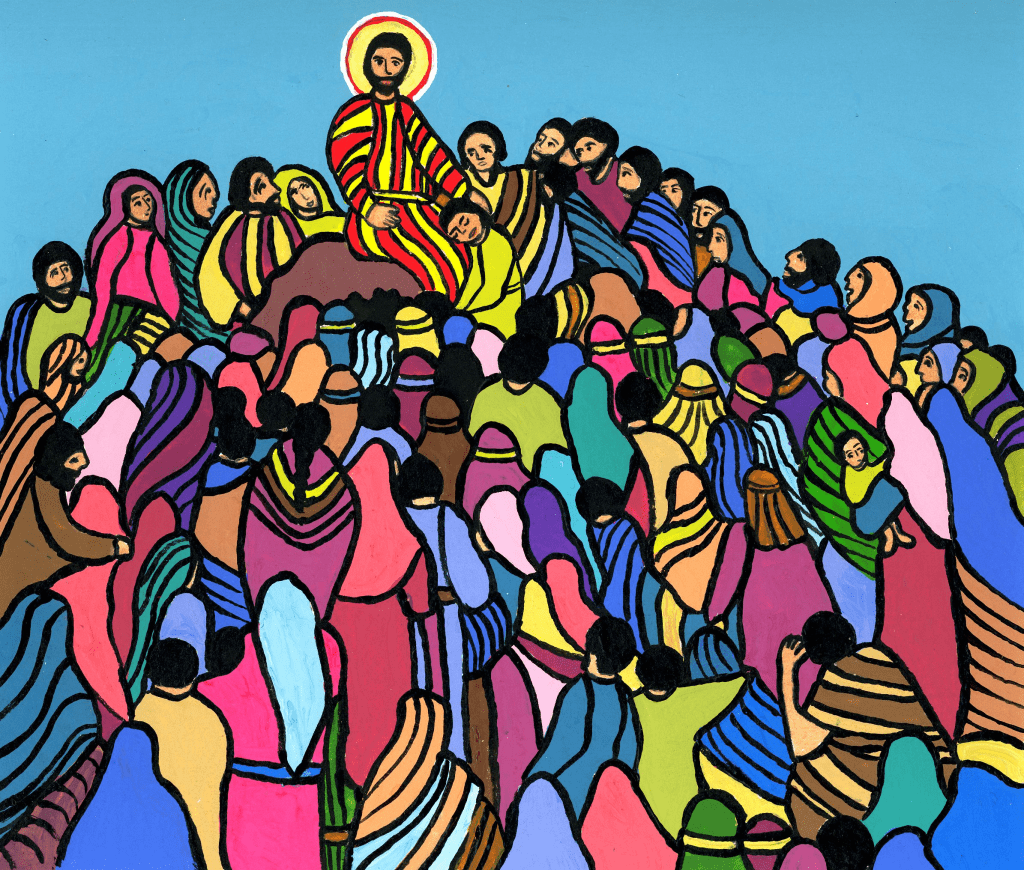
Ethiopian artist depiction of Jesus teaching

He went down with them and stood on a level place. A large crowd of his disciples was there and a great number of people from all over Judea, from Jerusalem, and from the coastal region around Tyre and Sidon, who had come to hear him and to be healed of their diseases. Those troubled by impure spirits were cured, and the people all tried to touch him, because power was coming from him and healing them all.

Looking at his disciples, he said:

“Blessed are you who are poor,
    for yours is the kingdom of God.
Blessed are you who hunger now,
    for you will be satisfied.
Blessed are you who weep now,
    for you will laugh.
Blessed are you when people hate you,
    when they exclude you and insult you
    and reject your name as evil,
        because of the Son of Man.

“Rejoice in that day and leap for joy, because great is your reward in heaven. For that is how their ancestors treated the prophets.

“But woe to you who are rich,
    for you have already received your comfort.
Woe to you who are well fed now,
    for you will go hungry.
Woe to you who laugh now,
    for you will mourn and weep.
Woe to you when everyone speaks well of you,
    for that is how their ancestors treated the false prophets. (New International Version)

There are double meanings throughout these words of Christ for us today; the expressions used by Jesus are specifically meant to be understood in two ways.

In order to speak to the people, Jesus went down with them and stood on a level place. In other words, the actual act of doing this is also to be understood as a means of identifying with others and getting on their level. The Lord intends not to speak down to people but to relate with folks alongside them.

The blessing of God is provided, up close and personal, not from afar. The word “blessed” is much more than a reference to physical health and wealth; it also refers to enjoying God’s stamp of approval on the whole of your life – body, mind, emotions, and spirit. And that is also what healing does for us; it effects the entirety of our being and not just one dimension of it.

To be “blessed” does not mean an absence of struggle. Indeed, blessings can and do rest upon us, even though we may be on the unfortunate end of someone’s hatred, exclusion, and defamation. It is to live through opposition, aware that our struggles are temporary and that our reward is great in heaven.

To have a “woe” pronounced means the opposite of blessing – to have God’s disapproval. It is to experience a curse – body, mind, emotions, and spirit – in the holistic sense.

The woeful may not experience apparent discomfort during this life. They mistake their wealth, their stuff, and their high connections as approval from God. However, they will find a fiery existence awaiting them. Apart from repentance and faith in becoming poor in spirit, their end is sure.

We are being led and guided to choose the way of blessing – and to avoid the path of woe.

Poverty, hunger, and weeping, on one level, are broad social categories. At another level, they are spiritual categories which describe the true follower of Jesus.

Christ’s church includes people who are poor, hungry, and weeping – in the full sense of the term. They, therefore, rely upon the community of the redeemed sharing all things in common as their means of provision. (Acts 2:44-45; 4:34)

We really need to avoid the temptation to make complex situations simple. To look upon those who now have wealth, eat well, laugh, and enjoy high standing, as under a curse from God, makes us simpletons who likely don’t understand what’s going on.

Others may make direct associations with wealth as blessing, which it may or may not be. And the same can be said for poverty and hunger – the presence of it doesn’t necessarily mean either blessing or woe.

The watershed issue is what we do with the life we have been given. Do the rich rely upon wealth or on God? Do the poor seek the Lord or just try to look for patrons who will help them? And do we all accept where we are right now and look to use whatever we have, and whoever we are, to benefit the benevolent and gracious kingdom of God?

We all may come from different places, have differing experiences, and be at various points along the continuum of poverty and wealth. Yet, we are all human and we are all in this life together.

So, we need to make the best of it with each other – instead of continually being at cross purposes with one another through simple stereotypes and hackneyed approaches based in little research or rational thought.

Jesus is leading us to a place of abundance, peace, and blessing – if we have ears to hear and minds receptive to his leading. It’s a place of healing; and not a place of woe. It is the realm of God, in which morality, ethics, kindness, and joy abound forever and ever.

Help us, O God, to heal those who are broken in body or spirit, and to turn their sorrow into joy. Grant this, Father, for the love of your Son, who for our sake became poor, Jesus Christ our Lord, who with you and the Holy Spirit are one God, now and forever. Amen.

Christ’s Beatitudes (Matthew 5:1-12)

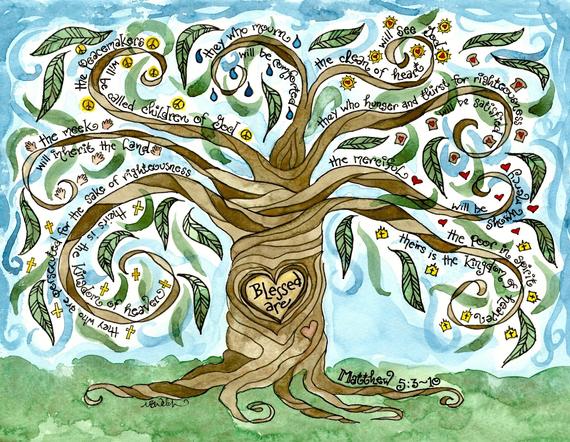
Sermon on the Mount by Gisele Bauche

When Jesus saw the crowds, he went up the mountain, and after he sat down, his disciples came to him. And he began to speak and taught them, saying:

“Blessed are the poor in spirit, for theirs is the kingdom of heaven.

“Blessed are those who mourn, for they will be comforted.

“Blessed are the meek, for they will inherit the earth.

“Blessed are those who hunger and thirst for righteousness, for they will be filled.

“Blessed are the merciful, for they will receive mercy.

“Blessed are the pure in heart, for they will see God.

“Blessed are the peacemakers, for they will be called children of God.

“Blessed are those who are persecuted for the sake of righteousness, for theirs is the kingdom of heaven.

“Blessed are you when people revile you and persecute you and utter all kinds of evil against you falsely on my account. Rejoice and be glad, for your reward is great in heaven, for in the same way they persecuted the prophets who were before you. (New Revised Standard Version)

God’s Law (The Ten Commandments) was given on a mountain. That Law was restated and reframed on a mountain by Jesus in his Sermon on the Mount.

I believe that arguably one of the most important and impactful portions of Holy Scripture are the Beatitudes of Jesus, which serve as the foundation to all of Christ’s teaching.

Christ’s Beatitudes are not simply a random collection of pithy phrases from Jesus on what constitutes approval and blessing from God. They intentionally build upon each other and describe the nature of true righteousness.

The Poor in Spirit

Spiritual poverty, not wealth, is the spiritual base to the Christian life. Most of the original crowd listening to Jesus thought they were on the outside of the kingdom, on the margins of true religion. But Jesus told them they have a place in God’s reign as poor and pitiable people.

To be “poor in spirit” is to be a spiritual beggar who recognizes they have nothing to offer God. It is seeing oneself, one’s sin, and one’s life as spiritually bankrupt apart from God.

Beggars have neither the leverage nor the ability to strike deals with anybody; and so, they do one thing: beg continually.

The proud person would never be caught begging for anything. Yet, the humble spiritual beggar constantly prays because they need God. They discern that without God there is no hope. The kingdom of heaven belongs to the penitent and not to the proud.

The Mourners 

Mourning is the emotional response of acknowledging one’s spiritual poverty. 

Grief and lament have a central place in Christian theology and life. To avoid it, work around it, or short-circuit its process is to refuse Christ; there is no righteousness apart from mourning over sin. Crying, weeping, and even intense tears are important and necessary.

To experience personal grief over one’s sins and the sins of the church and the world is a Beatitude of Jesus. You neither need position, power, privilege, nor pedigree to be a mourner. All can mourn. This is the door by which we enter the kingdom of God.

The Meek

A meek and gentle spirit is the result of realizing poverty of spirit and practicing lament.

At the heart of what it means to be meek is a spirit of non-retaliation. Whenever we are flat on our backs before God, there is no place to look but up. Thus, there is no ability to look down on others.

To be meek is to be broken and moldable before God. A meek person takes personal responsibility for their attitudes and actions. The meek have no need to retaliate, even when egregiously wronged, because they fully entrust themselves to God alone who judges the living and the dead.

Ironically, brokenness is the path to righteous wholeness.

The Hungry and Thirsty

Only those who know their poverty of spirit, personally grieve over sin, and are gentle, end up longing for righteousness.

The desire for righteousness is a recognition that without God I will not make it. I cannot be righteous without Jesus. Simply put, righteousness is a right relationship with God and others.

Those who hunger and thirst for God’s righteousness know they cannot make things right by themselves; they need God’s help.

If we think we can live most days of our lives without God, we do not yet know true righteousness. People who understand their great need for Jesus are easy to spot. They crave and devour God’s Word as their daily food; and they cannot stop blabbering on about Jesus.

There are three practices of living that arise from being filled with God’s righteousness: mercy, purity, and peacemaking. These Beatitudes cannot be conjured up by our own will; instead, they organically grow within us and are freely expressed because of what God is doing in our lives.

You cannot force them any more than you can force a stalk of corn to grow on your terms. Rather, you work with the unforced rhythms of God’s grace and allow righteousness to take root in you.

Down below in the soil, spiritual poverty, mourning, and humility germinate. Then, when the plant breaks the soil and flowers, it produces mercy, purity, and peace-making.

The Merciful 

Mercy begins with a heart that seeks to be generous; it is a loving response to someone or a group of people in misery. We accept them and help them because we ourselves have been there.

The merciful person looks for ways to come alongside others and help, rather than pile expectations and burdens on others without mentoring them in the ways of God.

The Pure In Heart

Purity also results from true righteousness. A stalk of corn might look good, but if you shuck it and it’s filled with worms, it’s not worth much. Legalistic righteousness is concerned to look good; it’s obsessed with performance, perfection, and possessions.

Conversely, the righteousness of God fills our hungry hearts and makes us pure and holy, set apart for good use.

The Peacemakers 

Those who make peace intentionally put themselves in the middle of trouble because they want to live righteously with the mercy and purity that God has provided for them.

Peace is realized through peacemakers. It seems we all desire peace, and yet, peacemakers are hard to come by. It’s a tough gig. To achieve peace, one must first be at peace with God and self – which is why we need the cross of Jesus Christ.

The Persecuted 

Living righteously, as presented by Jesus, tends to bring persecution; and the persecuted consider it a small price to pay for realizing God’s justice in the world.

Folks who are offended by even slight criticisms are usually the ones who are privileged and in power. They have not yet learned the ways of Jesus. Pettiness is nothing more than a sign of unrighteousness.

Yoking up with Jesus, following him, and living into his words and ways has always been risky and dangerous. The Beatitudes of Jesus are not characteristics that lead to power, prestige, or possessions, but likely just the opposite.

“The Beatitudes, spoken with the community of Jesus’ disciples in view, are paradoxes – the standards of the world are turned upside down as soon as things are seen in their right perspective, which is to say, in terms of God’s values, so different from those of the world. It is precisely those who are poor in worldly terms, those thought of as lost souls, who are truly fortunate ones, the blessed, who have every reason to rejoice and exult in their suffering. The Beatitudes are promises resplendent with the new image of the world and humanity inaugurated by Jesus.”

Pope Benedict XVI

Truly righteous persons become living Beatitudes; they are walking, talking blessings to the world. They abide with Christ and are witnesses to a subversive, yet wonderful, way of life, where the last are first and the greatest are the least.

O Lamb of God, that takes away the sins of the world, have mercy upon me.

O Lamb of God, that takes away the sins of the world, have mercy upon me.

O Lamb of God, that takes away the sins of the world, grant me your peace.

Obey with Integrity and Love (Psalm 15)

God, who gets invited
    to dinner at your place?
How do we get on your guest list?

 “Walk straight,
    act right,
        tell the truth.

“Don’t hurt your friend,
    don’t blame your neighbor;
        despise the despicable.

“Keep your word even when it costs you,
    make an honest living,
        never take a bribe.

“You’ll never get
blacklisted
if you live like this.” (The Message)

Nearly all of us had to work hard to get good grades in school. Each schoolyear began with a blank slate; then, what we did with learning the lessons determined the grade.

So, it’s unthinkable for many of us to consider that we all begin God’s school with A’s. We’re all 4.0 students. There’s only a lower grade if we neglect to do the things necessary as an A student. And, as it turns out, the most important things are a matter of basic human kindness and respect for others.

At the end-of-the-year banquet, awards are given. If we’ve done what’s expected, then the invitation to come to the front and receive the award is assured.

Yet, if anyone has gone out of their way to be deliberately stupid and ignore what’s right, then they aren’t going to show up at the banquet. They’ll dismiss it as a waste of their time and blabber about how they don’t be around a bunch do-gooder pricks and Abe Lincoln’s, blah-blah-blah.

Integrity, honesty, kindness, accountability, and commitment matter. Virtue shows itself through the practice of obedience.

We might get hung up on obedience for a few reasons:

  1. Many Westerners, especially Americans, have a strong anti-authoritarian strain; obedience smacks them as something negative. For some, they would rather stick-it-to-the-man than obey. Even Christians might sacralize their disobedience by linking obedience to law – as if gospel and obedience are antithetical.
  2. A lot of people have been personally hurt because they tried to do the right thing by obeying their authorities, but it ended badly. Now, they aren’t so sure about the whole obedience thing.
  3. We just plain don’t want anyone else telling us what to do and not do; and that includes not wanting to obey God. So, we focus on the freedom to do what we want, to the exclusion of obedience.

Yet, there’s no way to get around the pervasive reality of obedience to Torah, to Yahweh. Obedience is both the glue which holds a people together, as well as the major means of expressing love to God and others.

Jesus said, “If you love me, obey my commandments.” (John 14:15, NLT)

Love and obedience go together in Holy Scripture like a hand in a glove. Jesus insisted that upholding Torah and loving others is by obedience to divine commands.

When Jesus first began his teaching and healing ministry, he sat all the people down who were following him and gave them a summary of the Old Testament understanding of God’s righteousness. These are the things, Jesus explained, that characterize a person who loves God:

Blessed are the poor in spirit, for theirs is the kingdom of God. 

Blessed are those who mourn, for they shall be comforted. 

Blessed are the meek, for they will inherit the earth. 

Blessed are those who hunger and thirst for righteousness, for they will be filled. 

Blessed are the merciful, for they will be shown mercy. 

Blessed are the pure in heart, for they will see God.  Blessed are the peacemakers, for they will be called sons of God. 

Blessed are they who are persecuted for righteousness, for theirs is the kingdom of God (Matthew 5:12-17, NIV).

Obedient believers are characterized by their:

  • Authentic humility
  • Deep concern over sin, to the point of tears
  • Gentle and meek spirit toward others
  • Intense desire for personal righteousness and corporate justice
  • Daily life of mercy, purity, and peacemaking
  • Willingness to accept adversity as part of the spiritual life

“Love the Lord your God with all your heart and with all your soul and with all your mind. This is the first and greatest commandment. And the second is like it: Love your neighbor as yourself.”

Jesus (Matthew 22:36-40, NIV)

Humanity is meant for wholeness, integration, and alignment of head, heart, and gut – with the glue of obedient love. We are designed to have all of life in parity and balance – work, play, family, and faith – because God is Lord of it all, not just the spiritual parts.

Historic confessional Christianity acknowledges that obedience is both duty and delight – and they go together in perfect harmony.

Believers consider it a both a high charge and a wonderful privilege to love the Lord with a life devoted to obeying divine commands.

It’s just that sometimes we have our lives so planned and pre-determined that when God’s Spirit shows up to take us to a place of obedience, we struggle to realize what’s happening. And we miss what the Lord is doing in this world. 

At other times, we read scriptural commands and feel the gentle nudging of God’s Spirit, yet we either cannot or will not respond out of fear, busyness, or grief. 

Then there are times in which we are attentive to God’s Word and Spirit, seeking to obey – only to mess up and fail at it. It can leave us wondering if God could ever really do anything in or through us.

The truth is this: Love conquers all. Grace overcomes everything. Mercy never fails.

We are here on this earth because of how much the Lord is devoted to us. Even though we often walk the spiritual road in a three-steps-forward-two-steps-backward kind of way, God accommodates to our weakness. 

So, we keep learning the ways of the Lord under the tutelage of God’s Spirit – who patiently and powerfully works within us so that God’s kingdom breaks into this world and God’s will is done on earth as it is in heaven.

Blessed God, I seek not my own will but to fulfill your will in my everyday life. Enable me and strengthen me for this sacred duty and delight, in the power of your Spirit. Amen.

Luke 14:1, 7-14 – How Can I Be Blessed?

Jesus eating with “sinners.”

One Sabbath, when Jesus went to eat in the house of a prominent Pharisee, he was being carefully watched….

When he noticed how the guests picked the places of honor at the table, he told them this parable:“When someone invites you to a wedding feast, do not take the place of honor, for a person more distinguished than you may have been invited. If so, the host who invited both of you will come and say to you, ‘Give this person your seat.’ Then, humiliated, you will have to take the least important place. But when you are invited, take the lowest place, so that when your host comes, he will say to you, ‘Friend, move up to a better place.’ Then you will be honored in the presence of all the other guests. For all those who exalt themselves will be humbled, and those who humble themselves will be exalted.”

Then Jesus said to his host, “When you give a luncheon or dinner, do not invite your friends, your brothers or sisters, your relatives, or your rich neighbors; if you do, they may invite you back and so you will be repaid. But when you give a banquet, invite the poor, the crippled, the lame, the blind, and you will be blessed. Although they cannot repay you, you will be repaid at the resurrection of the righteous.” (New International Version)

A lot of people live by the old adage, “You scratch my back and I’ll scratch yours.” It’s a phrase referring to reciprocity. In other words, if you give me something I want, I will then respond by giving you something you want.

That old adage works fine, that is, unless you have no ability to give or give back to another. If we only operate by the principle of reciprocity, a large chunk of people automatically get left out. And this situation is untenable and unacceptable to Jesus.

Christ observed that the religious insiders of his day were keeping entire groups of people on the outside through their practice of scratching one another’s backs.

We need to get ahold of the reality that God loves us, as well as everyone else – even the people we may not give the time of day to. God so loved the world that he sent his Son. Jesus has come to feed us all, not just some.

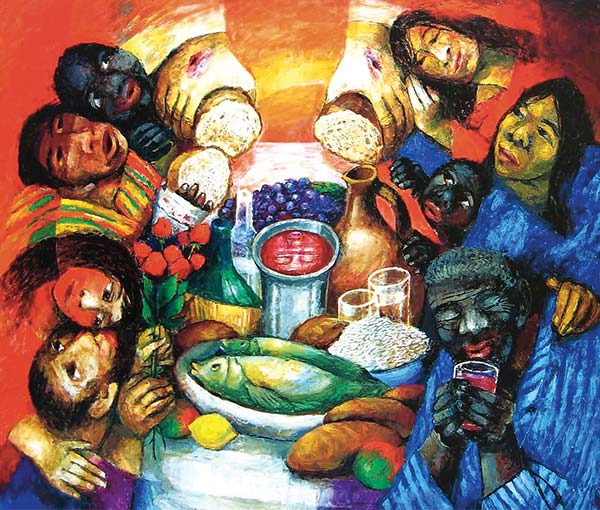
Jesus eats with sinners by Sieger Köder (1925-2015)

The kingdom of God is about food. The food given by Jesus is to feed the hungry by staging a banquet. It is a feast of God’s abundance. Yet, many seem to hoard the resources they have, only thinking about their friends, family, and people just like them. They act as if there is no need to invite outsiders, consumed as they are with their own daily lives.

We have an incredible abundant feast contained in Scripture – in fact, Jesus said that his food and drink was to do the Father’s will, that Scripture was his bread. (Matthew 4:4; John 4:34) 

It’s much too easy to take our blessings of food for granted. After all, when we are well-fed, it’s easy to assume that everyone else is, too. Feeling healthy, it’s easy to forget that others are hurting. Making money, it’s easy to think there are not many poor people around. Living in a community with plenty of churches and more bibles than people, it’s natural to assume that everyone knows the gospel of Jesus – but they don’t!

Then, whenever we get around to acknowledging there are people who need Jesus, we keep devising ways to reach them without having to change or accommodate our own lives to do it.

Christ’s call to faithful discipleship requires people to change from having a narrow focus on our small circle of friends, to including those who have no means to pay us back.

Table fellowship by Sieger Köder 

The gospel of Jesus Christ is open to outcasts and failures, to problem people and unimpressive persons. People with needs and flaws are especially dear to Jesus. It’s the people who outwardly have it all together who are being replaced wholesale with those who admit their need. 

We must not be picky about who we invite to participate in the largess of abundance we possess. We are to avoid the spiritual snobbery of looking down our noses at the needy and less fortunate, who have nothing to offer us in return.

Those who give need to do so without prejudice or favoritism. Even the lazy, the fool, and the sinner still need basic resources to live. By opening our hearts in almsgiving, we open ourselves to Christ, who is present in the least of those among us.

Refusing mercy to people deemed as unworthy, givers then actually shut themselves off from the very mercy God desires for them. There is no reward from God when there is only reward from others.

“If we are going to examine lives, we will never have mercy upon any human being; rather, hindered by this inopportune meddlesomeness, we will remain fruitless and destitute of all help ourselves.”

St. John Chrysostom, On Repentance and Almsgiving

It’s not only the poor who suffer when the rich fail to give. In judging whether or not a particular person is worthy of love and aid, the wealthy person rejects the spiritual fruit that he would have received by giving with humility.

Giving to the poor, simply to relieve our own conscience, is not real charity; it doesn’t consider the other. We attend fully to the other by observing their spiritual and holistic needs for community, purpose, respect, and dignity. Dispassionate giving from a distance, without relationship, refuses to acknowledge the whole person. It exploits the poor for the mental comfort of the rich.

We need to be involved in people’s lives, and that takes a lot of blood, sweat, and tears. There are too many lost people who need Jesus – and, I may add, too many Christians who are the walking wounded and need the healing touch of Jesus – for us to pay scant attention to the call of Jesus to invite the needy into our lives. 

Seeing people come into God’s great banquet, and into a joyous and vital relationship with Christ, will likely take ten times more work than what you are thinking it does right now. Yet, this is the pathway of true blessing – to having God’s stamp of approval on our lives.

How can I be blessed? Not by posturing for the best place in the room but by being a blessing to the most vulnerable and needy amongst us.

Merciful God, thank you for the abundance of life, relationships, health, comfort, and wealth you have provided to so many. Thank you that, even in times of need, despair, and brokenness, you are there. Please, put your arms around children and families in  poverty and disability so that they feel your comfort and hope. Meet their needs both physically and spiritually. And guide me so I can be your hands and feet pursuing justice for the poor and upholding the cause of the needy, in the way of Jesus Christ our Lord. Amen.