Out of the Slimy Pit (Psalm 40:1-11)

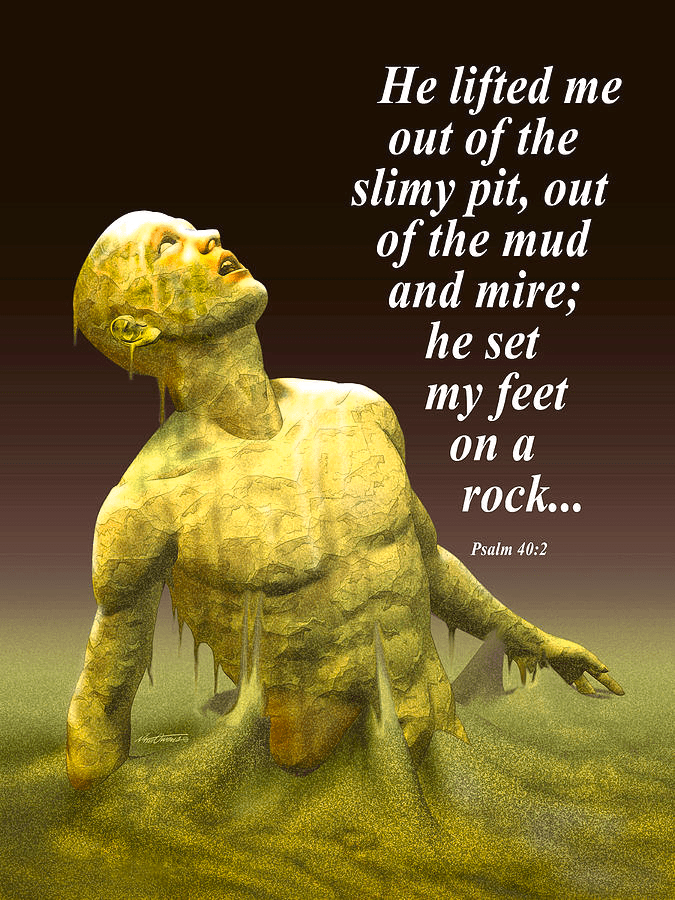
He Lifted Me by Nate Owens

I put all my hope in the Lord.
    He leaned down to me;
    he listened to my cry for help.
He lifted me out of the pit of death,
    out of the mud and filth,
    and set my feet on solid rock.
        He steadied my legs.
He put a new song in my mouth,
    a song of praise for our God.
Many people will learn of this and be amazed;
    they will trust the Lord.
Those who put their trust in the Lord,
    who pay no attention to the proud
    or to those who follow lies,
    are truly happy!

You, Lord my God!
    You’ve done so many things—
    your wonderful deeds and your plans for us—
        no one can compare with you!
    If I were to proclaim and talk about all of them,
        they would be too numerous to count!
You don’t relish sacrifices or offerings;
    you don’t require entirely burned offerings or compensation offerings—
    but you have given me ears!
So I said, “Here I come!
    I’m inscribed in the written scroll.
    I want to do your will, my God.
    Your Instruction is deep within me.”
I’ve told the good news of your righteousness
    in the great assembly.
    I didn’t hold anything back—
        as you well know, Lord!
I didn’t keep your righteousness only to myself.
    I declared your faithfulness and your salvation.
I didn’t hide your loyal love and trustworthiness
    from the great assembly.

So now you, Lord—
    don’t hold back any of your compassion from me.
Let your loyal love and faithfulness always protect me. (Common English Bible)

Every follower of the Lord has a powerful story of God’s grace in lifting them out of a slimy pit experience. 

We live in a profoundly broken world; and no one is exempt from its effects upon us. Whether physical problems, emotional trials, or relational hardships, there is always something going on in our lives – with the added pull toward trusting in things other than God. 

The temptation to say unjust words and do unjust actions is always over-promised and under-delivered. 

It’s easy to get sucked-in to poor decisions and be stuck in an empty hole with seemingly no way out. We often find ourselves slipping into a slimy pit because of our own bad decisions, as well as by no fault of our own. 

Living in a fallen world means that we inevitably experience troubles and hardships.

So, what do we do if we find ourselves in a slimy pit?

Look for Hope

David, the psalmist, waited patiently for the Lord. With great expectation, he fully anticipated God to act on his behalf. The sort of patience he practiced was an intense waiting – a waiting filled with longing and expectant hope, a patience that kept looking and praying and seeking.

The reason believers in Jesus keep hoping beyond hope is that we know that God is ultimately the One who delivers from the pit. 

But what if you have been looking for deliverance from the slimy pit experience and you have not seen it come to pass? 

Expectantly expect God to act. Wait patiently. Do not give up. Keep praying and watching. Like the father in the story of the prodigal son, keep looking out the window, waiting for the son to return, and picture the deliverance coming – because our waiting is not in vain.

flickr.com/photos/joshtinpowers

The psalmist, David, was eventually delivered. The Lord leaned down to him. God listened and lifted him. The Lord God set him on a firm place to stand and put a new song in his mouth. 

This was not only a personal matter for David; it was also an occasion that other people needed to know about.

Look for God

We all must finally come to the end of ourselves and look up. Whenever the deliverance doesn’t come quickly, we may look to other people or things to give us the freedom we long for. It’s easy to become impatient and begin searching for answers in everything else but God. 

Yet, if we will let patient hope have its way, we are blessed when we trust in the Lord.

In all my years of churchgoing as a kid, I had never read my Bible. But God was gracious to me. I remembered all those sermons I heard about Jesus. I gained a newfound sense of my own inner darkness, as well as the desire to read God’s Word. And God saved me. 

My circumstances did not change, but I did. My loneliness turned to joy; my aimlessness turned into purpose; and my selfishness became a deep concern for others. My heart had been black, and what God did to change it was nothing less than miraculous.

Look Within

The person who looks for hope and seeks God is also a person who looks into their own heart and there finds the attitude which God will bless. 

Blessing does not come from great sacrifice, but by syncing one’s heart with the heart of God. 

The Lord cares little about how much money or stuff you have, or how many sacrifices were made for God; that’s because God wants your heart, your mind, your will, and your emotions. In other words, God wants you! 

And God desires you because the Lord made you with a heart that beats for the same things God cares about: justice, mercy, and humility.

If you and I will but look within at the very spirit God has put within us, we shall find resources beyond what we can ask or think.

Look to Bless Others

We possess more than a personal faith which is to benefit ourselves; we also have an equal responsibility to bless the community with our experiences of what God has done in our lives. 

The telling of stories about what God has done for us is a necessary part of building up the church and helping others move forward in faith, hope, and love.

The psalmist proclaimed his testimony in the great assembly, that is, publicly. This isn’t about standing behind a microphone in front of lots of people; it’s about being so touched by God that we cannot keep our mouths shut about the Lord’s deliverance on our behalf.

So, let’s not shelve the idea of giving testimony to others as if it were only for pastors, missionaries, or other very religious people. 

When a person decides to play hockey in -20 degrees below zero weather, we might think that person is a little crazy;  but, hey, we reason, if they love hockey that much, more power to them. 

We must not think about Christianity in the same way, that if a person is passionate about Jesus and desires to tell others about what God has done for them, more power to them; just don’t expect me to go out in the cold and do that because it isn’t my thing. 

Christianity is a life, not a hobby; it’s about humble service, and not a means to look respectable; it cannot be reduced to a few practices, such as church attendance or putting money in an offering plate.

Christianity is a relationship with God through Jesus. Try looking at marriage as simply showing up for supper and paying the bills and see how far that gets you.

Look to Get Lost to Get Found

We may become obsessed with getting out of our slimy pit of illness, infirmity, pain, adversity, hardship, or discord. If that happens, we will likely lose our proper focus.

Instead, get lost in the wonder of God. The Lord does wondrous things when we are immersed in God’s wonders.

“Any of you who try to save the life you have will lose it. But you who give up your life for me will find true life.” Jesus (Matthew 16:25, ERV)

New life comes from a change of heart, not a change of circumstances. Wherever there is a firm reliance on God; a glad obedience to God; and a readiness to give testimony to God’s actions, then we are living into the spirit of today’s psalm.

Lamb of God, who takes away the sins of the world, have mercy on us.
Lamb of God, who takes away the sins of the world, grant us your peace. Amen.

Luke 14:1, 7-14 – How Can I Be Blessed?

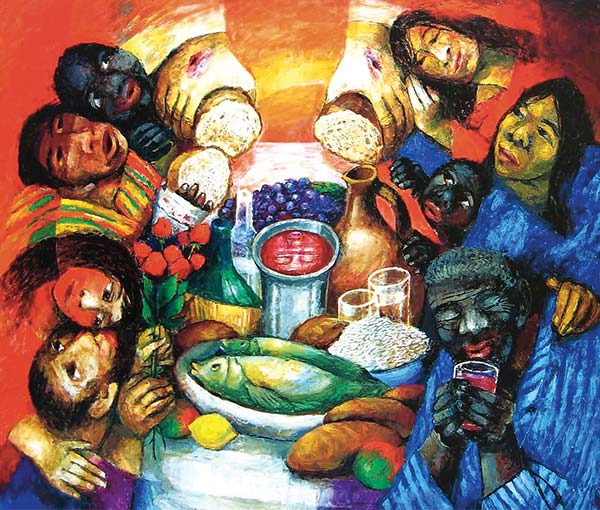
Jesus eating with “sinners.”

One Sabbath, when Jesus went to eat in the house of a prominent Pharisee, he was being carefully watched….

When he noticed how the guests picked the places of honor at the table, he told them this parable:“When someone invites you to a wedding feast, do not take the place of honor, for a person more distinguished than you may have been invited. If so, the host who invited both of you will come and say to you, ‘Give this person your seat.’ Then, humiliated, you will have to take the least important place. But when you are invited, take the lowest place, so that when your host comes, he will say to you, ‘Friend, move up to a better place.’ Then you will be honored in the presence of all the other guests. For all those who exalt themselves will be humbled, and those who humble themselves will be exalted.”

Then Jesus said to his host, “When you give a luncheon or dinner, do not invite your friends, your brothers or sisters, your relatives, or your rich neighbors; if you do, they may invite you back and so you will be repaid. But when you give a banquet, invite the poor, the crippled, the lame, the blind, and you will be blessed. Although they cannot repay you, you will be repaid at the resurrection of the righteous.” (New International Version)

A lot of people live by the old adage, “You scratch my back and I’ll scratch yours.” It’s a phrase referring to reciprocity. In other words, if you give me something I want, I will then respond by giving you something you want.

That old adage works fine, that is, unless you have no ability to give or give back to another. If we only operate by the principle of reciprocity, a large chunk of people automatically get left out. And this situation is untenable and unacceptable to Jesus.

Christ observed that the religious insiders of his day were keeping entire groups of people on the outside through their practice of scratching one another’s backs.

We need to get ahold of the reality that God loves us, as well as everyone else – even the people we may not give the time of day to. God so loved the world that he sent his Son. Jesus has come to feed us all, not just some.

Jesus eats with sinners by Sieger Köder (1925-2015)

The kingdom of God is about food. The food given by Jesus is to feed the hungry by staging a banquet. It is a feast of God’s abundance. Yet, many seem to hoard the resources they have, only thinking about their friends, family, and people just like them. They act as if there is no need to invite outsiders, consumed as they are with their own daily lives.

We have an incredible abundant feast contained in Scripture – in fact, Jesus said that his food and drink was to do the Father’s will, that Scripture was his bread. (Matthew 4:4; John 4:34) 

It’s much too easy to take our blessings of food for granted. After all, when we are well-fed, it’s easy to assume that everyone else is, too. Feeling healthy, it’s easy to forget that others are hurting. Making money, it’s easy to think there are not many poor people around. Living in a community with plenty of churches and more bibles than people, it’s natural to assume that everyone knows the gospel of Jesus – but they don’t!

Then, whenever we get around to acknowledging there are people who need Jesus, we keep devising ways to reach them without having to change or accommodate our own lives to do it.

Christ’s call to faithful discipleship requires people to change from having a narrow focus on our small circle of friends, to including those who have no means to pay us back.

Table fellowship by Sieger Köder 

The gospel of Jesus Christ is open to outcasts and failures, to problem people and unimpressive persons. People with needs and flaws are especially dear to Jesus. It’s the people who outwardly have it all together who are being replaced wholesale with those who admit their need. 

We must not be picky about who we invite to participate in the largess of abundance we possess. We are to avoid the spiritual snobbery of looking down our noses at the needy and less fortunate, who have nothing to offer us in return.

Those who give need to do so without prejudice or favoritism. Even the lazy, the fool, and the sinner still need basic resources to live. By opening our hearts in almsgiving, we open ourselves to Christ, who is present in the least of those among us.

Refusing mercy to people deemed as unworthy, givers then actually shut themselves off from the very mercy God desires for them. There is no reward from God when there is only reward from others.

“If we are going to examine lives, we will never have mercy upon any human being; rather, hindered by this inopportune meddlesomeness, we will remain fruitless and destitute of all help ourselves.”

St. John Chrysostom, On Repentance and Almsgiving

It’s not only the poor who suffer when the rich fail to give. In judging whether or not a particular person is worthy of love and aid, the wealthy person rejects the spiritual fruit that he would have received by giving with humility.

Giving to the poor, simply to relieve our own conscience, is not real charity; it doesn’t consider the other. We attend fully to the other by observing their spiritual and holistic needs for community, purpose, respect, and dignity. Dispassionate giving from a distance, without relationship, refuses to acknowledge the whole person. It exploits the poor for the mental comfort of the rich.

We need to be involved in people’s lives, and that takes a lot of blood, sweat, and tears. There are too many lost people who need Jesus – and, I may add, too many Christians who are the walking wounded and need the healing touch of Jesus – for us to pay scant attention to the call of Jesus to invite the needy into our lives. 

Seeing people come into God’s great banquet, and into a joyous and vital relationship with Christ, will likely take ten times more work than what you are thinking it does right now. Yet, this is the pathway of true blessing – to having God’s stamp of approval on our lives.

How can I be blessed? Not by posturing for the best place in the room but by being a blessing to the most vulnerable and needy amongst us.

Merciful God, thank you for the abundance of life, relationships, health, comfort, and wealth you have provided to so many. Thank you that, even in times of need, despair, and brokenness, you are there. Please, put your arms around children and families in  poverty and disability so that they feel your comfort and hope. Meet their needs both physically and spiritually. And guide me so I can be your hands and feet pursuing justice for the poor and upholding the cause of the needy, in the way of Jesus Christ our Lord. Amen.

1 Peter 3:8-12 – Bless and Do Not Curse

Ethiopian artist depiction of Jesus teaching on love

Finally, all of you be harmonious, sympathetic, affectionate, compassionate, and humble. Do not return evil for evil or insult for insult, but instead bless others because you were called to inherit a blessing. For

The one who wants to love life and see good days must keep his tongue from evil and his lips from uttering deceit.
And he must turn away from evil and do good;
he must seek peace and pursue it.
For the eyes of the Lord are upon the righteous and his ears are open to their prayer.
But the Lord’s face is against those who do evil.
(New English Version)

It’s one thing to bestow a blessing to folks when they seem worthy of it – but it’s quite another thing when you have stinkers in your life. Bless the very ones who are abusive toward me? Some might think the Apostle Peter was off his rocker to instruct believers to bless the insufferable persons in their lives.

Peter, however, was only passing on what he had learned from the Lord Jesus:

“You have heard that it was said: You must love your neighbor and hate your enemy. But I say to you, love your enemies and pray for those who harass you so that you will be acting as children of your Father who is in heaven. He makes the sun rise on both the evil and the good and sends rain on both the righteous and the unrighteous. 

If you love only those who love you, what reward do you have? Don’t even the tax collectors do the same? And if you greet only your brothers and sisters, what more are you doing? Don’t even the Gentiles do the same? Therefore, just as your heavenly Father is complete in showing love to everyone, so also you must be complete. (Matthew 5:43-48, CEB)

The instruction to bless the hateful ingrates in our lives only seems strange when the avoidance of suffering and experiencing a pain-free existence is the summum bonum of life.

I get it. We don’t like to suffer. I don’t like to suffer. It hurts! I’m not really into pain. I’m not a high tolerance pain kind of guy. I have no problem taking a pain pill at the first sign of discomfort. Even so, I know there will be times I am going to have pain – physical, mental, emotional, and spiritual – and there is going to be no way around it. 

To live in this broken world is to experience suffering. To suffer as a Christian, however, is different because we are following the way of our Lord Jesus Christ.

Just as Christ suffered, we can expect to suffer as his followers, as well. We are not above our Master. The real issue is whether we will suffer because of our own foolishness and selfishness, or because of our devotion to Christ in being kind, humble, and gracious. 

When insults come our way, we don’t need to respond in the same way with our own insults. Verbal cruelty is not the way of Christ. Anger, slander, gossip, lies, manipulative words, and belligerent bullying have absolutely no place in the kingdom of God for any reason. 

God takes a zero-tolerance policy toward hate speech, manipulation, and gaslighting.

The consistent witness of the New Testament is to bless and do not curse, to love and not to hate, to use our tongues for spreading words of encouragement and not of condemnation. Peter’s instruction and Christ’s teaching also totally jives with the Apostle Paul:

The Apostle Paul also learned from the Lord Jesus and upholds the need to bless and not curse:

Bless those who persecute you; bless and do not curse…. Live in harmony with one another…. Do not repay anyone evil for evil. Be careful to do what is right in the eyes of everyone. If it is possible, as far as it depends on you, live at peace with everyone. 

Do not take revenge, my dear friends, but leave room for God’s wrath, for it is written: “It is mine to avenge; I will repay,” says the Lord. On the contrary:

“If your enemy is hungry, feed him;
    if he is thirsty, give him something to drink.
In doing this, you will heap burning coals on his head.”

Do not be overcome by evil but overcome evil with good. (Romans 12:14-21, NIV)

Christians are to us their words for blessing, not cursing; for love, not hate; for truth, not lies; for building-up, not tearing-down; for proclaiming good news, not bad news laced with insults. 

If we suffer because of love, we shall receive blessing from God. If we suffer for giving-in to retaliation and our base desires for revenge, then we will suffer the consequences of our own stupidity.

God has called us to bless the world, not condemn it. 

Christians are to be on the front lines of spreading respect, civility, kindness, and the gospel. It is no problem showing love and respect to people we like. It’s a whole other ballgame to do the same for those who treat us with disrespect and hate.

Yet, God watches over all who obey him, and listens to their prayers. God will handle the hate-filled person; that’s not something we are to do.

Our task is to have a deep concern for humanity, both the ones we like, as well as the ones we don’t.

Loving Lord Jesus, you suffered and died on my behalf. It is a small thing for me to follow you and walk in the way of suffering. I know and have the confident expectation that blessing awaits. Keep me true to following you through all the adversity I face in this fallen broken world. Even so, come Lord Jesus, you who lives and reigns with the Father and the Spirit, one God, now and forever. Amen.

Psalm 128 – Blessed

The Lord will bless you 
    if you respect him 
    and obey his laws. 
Your fields will produce, 
    and you will be happy 
    and all will go well. 
Your wife will be as fruitful 
    as a grapevine, 
and just as an olive tree 
    is rich with olives, 
    your home will be rich 
    with healthy children. 
That is how the Lord will bless 
    everyone who respects him. 

I pray that the Lord 
    will bless you from Zion 
    and let Jerusalem prosper 
    as long as you live. 
May you live long enough 
    to see your grandchildren. 
    Let’s pray for peace in Israel! (CEV) 

There is a consistent connection between obedience and blessing. That is, in observing God’s ways, one will typically enjoy divine favor and approval.  

Keep in mind, however, this is not a math equation. Like 2+2=4 there are folks who expect a neat linear connection between their obedience and their blessing. In math theology, when a woman is unable to have children, or a child goes astray from their heritage, the parent concludes that they themselves must have been unfaithful to God’s law or are being punished. Conversely, with children who grow to be good citizens and respectful persons, the parents might conclude it was because of their superior observance to the spiritual life. 

In both cases, parents take too much credit, either for a child’s wandering or success. As for kids going astray, even God had prodigal children, so cut ourselves some slack. As for children who maintain faithfulness, a lot of factors went into who they are. I suppose it is only natural to quickly assume we have far more control of than we really do. 

This all cuts to the heart of biblical interpretation. If all Scripture is read literally, then we will likely see the Bible as a math equation where doing and saying the right things gets a predictable result of blessing. Yet, this mistakenly views promise and proverb as the same thing, and divine work with one person or group will be precisely the same for another. The wisdom literature of Scripture, which includes the psalms, were never designed as prescriptive decree but rather as the sage approach for work, worship, and family. 

Today’s psalm communicates the path of happiness coming through love and respect for God. It neither promises lots of kids, ensures money, nor guarantees smooth sailing. Rather, when one lives each day being cognizant and observant to center everything around the divine, then blessing and happiness will tend to follow. 

Blessings and benedictions are given to sustain us in hope and confidence. The best things in life usually come through faith and family. So, when we choose to walk with God and travel down the ethical road, then life becomes full of peace and prosperity – perhaps not always in the manner we expect, yet blessing, nonetheless. 

Humanity is hard-wired for blessing, for a steady diet of encouragement, acceptance, and approval from God and others. When this is withheld from us, unhappiness, even despair begins to settle. Giving and receiving blessing is at the heart of being fully human and alive. Our work and family life will likely be miserable if blessing is absent. Yet, with blessing, we have a sustainable form of happiness and enjoyment. 

Eternal God, by whose power we are created and by whose love we are redeemed, guide, strengthen, and bless us through your Spirit so that we may give ourselves to your service and live today in love to one another and to you, through Jesus Christ our Lord. Amen.