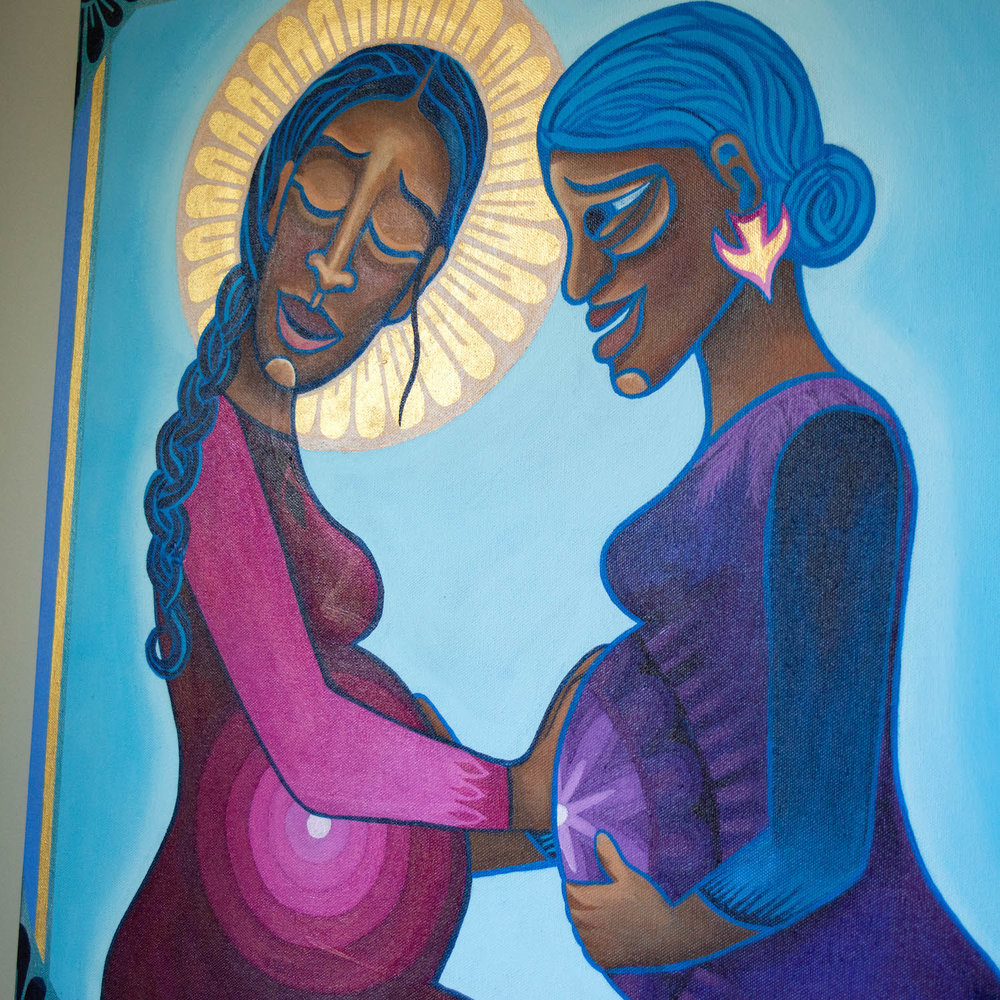
Fourth Sunday of Advent – Mary and Elizabeth (Luke 1:39-55)

Mary and Elizabeth, by Lauren Wright Pittman

In those days Mary set out and went with haste to a Judean town in the hill country, where she entered the house of Zechariah and greeted Elizabeth. When Elizabeth heard Mary’s greeting, the child leaped in her womb. And Elizabeth was filled with the Holy Spirit and exclaimed with a loud cry, “Blessed are you among women, and blessed is the fruit of your womb. And why has this happened to me that the mother of my Lord comes to me? For as soon as I heard the sound of your greeting, the child in my womb leaped for joy. And blessed is she who believed that there would be a fulfillment of what was spoken to her by the Lord.”

And Mary said,

“My soul magnifies the Lord,
    and my spirit rejoices in God my Savior,
for he has looked with favor on the lowly state of his servant.
    Surely from now on all generations will call me blessed,
for the Mighty One has done great things for me,
    and holy is his name;
indeed, his mercy is for those who fear him
    from generation to generation.
He has shown strength with his arm;
    he has scattered the proud in the imagination of their hearts.
He has brought down the powerful from their thrones
    and lifted up the lowly;
he has filled the hungry with good things
    and sent the rich away empty.
He has come to the aid of his child Israel,
    in remembrance of his mercy,
according to the promise he made to our ancestors,
    to Abraham and to his descendants forever.” (New Revised Standard Version)

Mary had a visitation by an angel, informing her that she would give birth to the Son of God. She immediately hurried to visit her relative Elizabeth, who was pregnant with the forerunner to the Son of God.

In the two women’s encounter, the baby within Mary is portrayed as of greater significance than the one within Elizabeth. And that was not because of the adults, but because of the babies themselves.

Something amazing and spectacular was about to occur in history. It would be so cataclysmic that these two babies, especially the one within Mary, would change the world in profound ways.

There was nothing particularly special about either Mary or Elizabeth – which is probably why they were perfect for the jobs of raising the Messiah and the Prophet.

The lowly non-descript persons are usually favored by God, even though the world knows nothing about them. After all, the kingdom of God knows nothing of billionaires and those in high places, even though the world knows nearly everything about them.

Throughout the history of the world, women have often been overlooked and underrated. Even in today’s Western world, even though it’s better than it was, women are still viewed not as qualified like men are. But that’s a topic for another time.

The Visitation, by Sadao Watanabe (1913-1996)

The most obvious observation from today’s Gospel story is that we wouldn’t have babies born without women. There were two in utero babies that had responses, because of two women.

Inside of Elizabeth’s womb, John leaped at the voice of Mary carrying his new cousin. Indeed, even before birth, John was filled with the Holy Spirit and began pointing to Jesus. (Luke 1:15)

John, although getting his prophetic leap from the Spirit, also got some significant prophetic oomph from his mother. Elizabeth spoke the prophetic word about Mary, who is “the mother of my Lord.”

Good people bestow blessing on others. And that is what Elizabeth did for Mary. This then, enabled Mary to express her own inspired blessing to God. To bless and be blessed means, on the practical level, that spiritual eyes are opened to see what is truly there.

Mary is a blessed person, not only because she is the Lord’s mother, but more fundamentally because she is faithful, and trusted in the promise of God to her.

To be blessed is to have God’s stamp of approval on your life. It has little to do with wealth or abundant resources. But it does have a lot to do with living a life of godly virtue and values.

So, again, it only makes sense that God used Mary and Elizabeth, two women who embodied being poor in spirit (humble) as the divine conduits for blessing the world.

Both Mary and Elizabeth believed. Elizabeth believed the words of the angel to her husband Zechariah. And Mary believed the angel’s direct words to her when she heard them. Without hesitation or any ambiguity.

Faith accepts what it cannot see; and when faith does see with actual eyes, it can see what is underneath the physical appearance.

Let’s also make sure to observe that this sort of faith, this particular way of seeing, has its consequences. Elizabeth and Mary both knew quite well that one of them was an unmarried pregnant woman.

They understood the social judgments to come, along with the shaming, and perhaps even the ostracism that would likely occur – even though all of this is divine through and through.

But grace can always use the eyes of faith to see beyond social status and convention in order to do what is right, just, and good. Mercy can always see what is truly honorable.

Elizabeth was perfectly comfortable extending hospitality to a person for whom others were likely to whisper, judge, and reject. Which is why I like Elizabeth. Every generation needs more women like her.

The welcome and love of Elizabeth is of the same sort that Jesus would show to prostitutes, tax collectors, and sinners. Like Elizabeth, Jesus could see beyond any societal shame to what was divinely happening in front of him.

Mary magnified the Lord with immortal words infused from the blessing bestowed upon her by Elizabeth. To bless another person is to open them to the possibilities of God’s actions in them and through them to the world.

That is the real gift that keeps on giving. And it is the most appropriate and valuable gift that we can give to another this season.

O God of Elizabeth and Mary, you visited your servants with news of the world’s redemption in the coming of the Savior. Make our hearts leap with joy, and fill our mouths with songs of praise, so that we may announce glad tidings of peace, and welcome Christ in our midst. Open our souls to receive the One who came to love your flock. Amen.

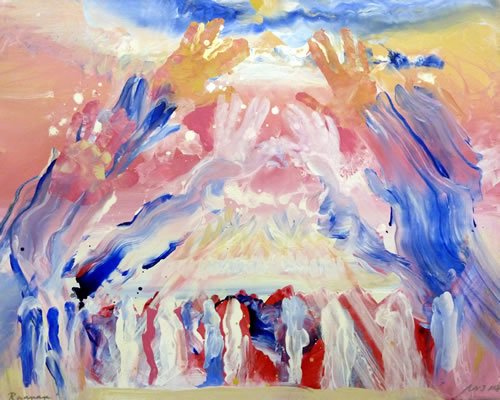
A New Year’s Blessing (Numbers 6:22-27)

The Priestly Blessing, by Yoram Raanan

The Lord spoke to Moses, saying, “Speak to Aaron and his sons, saying: Thus you shall bless the Israelites: You shall say to them:

The Lord bless you and keep you;
the Lord make his face to shine upon you and be gracious to you;
the Lord lift up his countenance upon you and give you peace.

“So they shall put my name on the Israelites, and I will bless them.” (New Revised Standard Version)

Perhaps we are living in a famine of blessing. Maybe so many people are short-tempered, rude, drive their cars recklessly, ignore others’ needs, swear like sailors, and speak enough sarcasm to bury the earth six feet deep in cynicism, because they are not being blessed; and it could be they haven’t been blessed for a very long time, even never.

At the beginning of this New Year, we are reminded of deep longings and hopes for fresh starts. I invite you to consider the value and significance of giving and receiving a blessing.

Life operates by blessing, not cursing.

The world cannot stand up under the curse. The new earth will endure forever with a blessing.

People wither without a blessing. They die when cursed. Not necessarily in body. Most definitely in spirit.

Something must be said about the word “blessing.” It gets used (and misused) a lot, especially by Christians.

As with most words in the Old Testament, “blessing” is a relational word. It means to have God’s stamp of approval on your life. It’s meant to convey that the Lord’s presence is with us.

To be blessed by God is a multi-dimensional experience – receiving promises, enjoying peace, having right relationships with both God and other people, and knowing divine comfort and security.

A blessing isn’t simply having lots of money, plenty of family, or a good job. One could have none of those and still be blessed by God. And being blessed is not getting everything you want. Some people continually get what they want and are cursed, not blessed.

Blessing is tied not to human activity but to divine initiative.

We can’t finagle a blessing out of God. Plenty of folks try to do that, and, like Jacob, they might get away with it in their family – but it will not work with God. The grace of blessing is freely bestowed by a benevolent and merciful Lord.

Everything comes down to God. The Lord is not stingy but generous – not subject to the whimsy of human cajoling but deeply influenced by the unending unity, harmony, and love within the divine godhead.

In other words, divine blessing is a gift – not something earned or cleverly received through trickery or manipulation.

Blessing one another is also a gift. In fact, God clearly communicated to Moses and Aaron how they were to bless the people with powerful words.

I believe we all intuitively know that words and language have the power of life and of death, of blessing and cursing. And withholding words of blessing and keeping silent is to withhold goodness and love from another.

Speaking words of blessing and backing up those words with an active commitment, is vital to humanity’s spiritual and emotional health.

Fathers and mothers everywhere across the world stand in a unique and special position as those who have the power of bestowing a blessing on their children – a blessing of being with them, approving of them, affirming their gifts and abilities, envisioning for them a special future of how God can use them.

Those words of blessing have the power to help children navigate the world with assurance and confidence. Armed with blessing, they can filter-out the choices in front of them and walk in the way of God.

Notice in the New Testament Gospels how the God the Father blessed the Son:

And when Jesus had been baptized, just as he came up from the water, suddenly the heavens were opened to him and he saw the Spirit of God descending like a dove and alighting on him. And a voice from heaven said, “This is my Son, the Beloved, with whom I am well pleased.” (Matthew 3:16-17, NRSV)

God provided a constant presence and an active commitment through the Spirit; God spoke words of approval and affirmation; God the Father had a special future for Jesus the Son, which helped Jesus to repel the words of Satan. Since Jesus needed and received a blessing from his Father, how much more do we?

Jesus passed the blessing to his disciples with a promise of presence and commitment:

Jesus came near and spoke to them, “I’ve received all authority in heaven and on earth. Therefore, go and make disciples of all nations, baptizing them in the name of the Father and of the Son and of the Holy Spirit, teaching them to obey everything that I’ve commanded you. Look, I myself will be with you every day until the end of this present age.” (Matthew 28:18-20, CEB)

Jesus informed the disciples his presence would be with them; communicated an active commitment to give them authority to do the job of disciple-making; pictured for them a special future of reaching the nations; affirmed and approved them. “The Great Commission” is really a statement of God’s blessing.

One reality needs to be recognized and affirmed with all confidence: You and I already possess God’s blessing; there is no need to try and earn it. The words of blessing state what is, in fact, already true.

We have the privilege and the ability to reverse the world’s curse and turn it into blessing.

Those blessed with money can be a blessing by giving it away.

Those blessed by growing up in a loving family can provide love to others who are unloved and need a special blessing.

Those blessed with wisdom can mentor and instruct those who need wisdom.

Those blessed with the mercy of God can be merciful to others.

Those blessed with a wonderful relationship with God can pray people into the kingdom of God.

Parents, it is never too late to bless your children, even if they are adults. Children, it is never too late to bless your parents and your siblings, even if they are prickly and hard. To not bless is to curse.

Bless your family through words that build up, and do not tear down. Use those words to picture a special future of what God can do. Follow through with those words by demonstrating an active commitment to embodying blessing.

I leave you with this blessing for the New Year:

May God answer you when you are in distress; may the name of Jesus protect you. 

May the Lord send help when you need it and give you support when you cry out to him. 

May the God of heaven remember your good deeds done in faith and accept you just as you are. 

May the Lord give you the desire of your heart and make all your plans succeed.

When the Almighty goes out of the way to answer your prayers, then I will be the first to shout with joy!

I know the Lord is God. There is a special future for you beyond what you can even ask or think. And I will be there on the sidelines, encouraging you all the way.

Some people trust in the political process, others trust in the strength of the economy; but we trust in the name of the Lord our God. 

May God answer when you call.

May God bless you with an everlasting love. 

May you know Christ, and him crucified, risen, and coming again. 

May God’s presence and power be with you now and forever. Amen.

The Power of a Blessing (Genesis 27:30-46)

Isaac Blesses Jacob, by Yoram Raanan

After Isaac had finished blessing Jacob, and just as Jacob left his father Isaac, his brother Esau came back from his hunt. He too made some delicious food, brought it to his father, and said, “Let my father sit up and eat from his son’s game so that you may bless me.”

His father Isaac said to him, “Who are you?”

And he said, “I’m your son, your oldest son, Esau.”

Isaac was so shocked that he trembled violently. He said, “Who was the hunter just here with game? He brought me food, and I ate all of it before you came. I blessed him, and he will stay blessed!”

When Esau heard what his father said, he let out a loud agonizing cry and wept bitterly. He said to his father, “Bless me! Me too, my father!”

Isaac said, “Your brother has already come deceitfully and has taken your blessing.”

Esau said, “Isn’t this why he’s called Jacob? He’s taken me twice now: he took my birthright, and now he’s taken my blessing.” He continued, “Haven’t you saved a blessing for me?”

Isaac replied to Esau, “I’ve already made him more powerful than you, and I’ve made all of his brothers his servants. I’ve made him strong with grain and wine. What can I do for you, my son?”

Esau said to his father, “Do you really have only one blessing, Father? Bless me too, my father!” And Esau wept loudly.

His father Isaac responded and said to him,

“Now, you will make a home
    far away from the olive groves of the earth,
        far away from the showers of the sky above.
You will live by your sword;
        you will serve your brother.
But when you grow restless,
        you will tear away his harness
        from your neck.”

Esau was furious at Jacob because his father had blessed him, and Esau said to himself, When the period of mourning for the death of my father is over, I will kill my brother.

Rebekah was told what her older son Esau was planning, so she summoned her younger son Jacob and said to him, “Esau your brother is planning revenge. He plans to kill you. So now, my son, listen to me: Get up and escape to my brother Laban in Haran. Live with him for a short while until your brother’s rage subsides, until your brother’s anger at you goes away and he forgets what you did to him. Then I will send for you and bring you back from there. Why should I suffer the loss of both of you on one day?”

Rebekah then said to Isaac, “I really loathe these Hittite women. If Jacob marries one of the Hittite women, like the women of this land, why should I go on living?” (Common English Bible)

Jacob and Esau

The twins Esau and Jacob are the very definition of sibling rivalry. Even at their birth, they jostled and positioned for their entry into the world. Although brothers, they were different from one another in every way. As their aged father, Isaac, was near the end of his days, he was looking to pass on a family blessing to Esau, the firstborn. And that’s where things got dicey.

Jacob, always the trickster, was still playing out the rivalry. When his brother Esau was out hunting and preparing to receive his father’s blessing, Jacob posed as his brother and deceitfully gained the blessing of Isaac.

Both Isaac and Esau were shocked to discover what happened. Esau’s response was one of grief, disappointment, bitterness, with tears and weeping. Despite Esau not being known for his sensitivity to God or family before this event, we can certainly feel his cry: “Do you have only one blessing, my father? Bless me too, my father!”

The Blessing

As a Pastor and a Chaplain who works with a variety of people, I have heard many times over the lament of individuals without a blessing from their father. As people created in the image and likeness of God, we were meant to be blessed – to have a loving and enduring stamp of approval from both our heavenly Father and our earthly fathers.

And when an earthly father, or father figure, either cannot or will not extend a vital blessing to children, it is a terrible wound – like an invisible open putrid abscess which continually leaves the person emotionally and spiritually sick.

Blessing is needed. Without blessing we flounder in the world, struggling to see hope, wondering if we are loved, and lacking confidence in our faith. To be blessed is to receive a beautiful gift.

The term “blessing” in Scripture is a powerful communication of God’s presence and approval.

So, when humans bless one another, we offer commitments of love and connection. We provide powerful words of encouragement and picture a special future for those we are close to.

None of this is optional. To bless others is the way of building up one another and fortifying each other for the rigors of this world. When blessing is withheld, and even worse, when it is replaced with cursing, then individuals are left untethered, bereft of support to face stressful situations. Like a ship adrift without any power or wind, so the person trying to live in this world without blessing is dead in the water.

Jesus Blesses

Where there is no blessing, like Esau, revenge fills our hearts. But Jesus clearly understood the need and the power of blessing, and he was not deterred in deliberately offering it:

People were bringing little children to Jesus for him to place his hands on them, but the disciples rebuked them. When Jesus saw this, he was indignant. He said to them, “Let the little children come to me, and do not hinder them, for the kingdom of God belongs to such as these. Truly I tell you, anyone who will not receive the kingdom of God like a little child will never enter it.” And he took the children in his arms, placed his hands on them and blessed them. (Mark 10:13-16, NIV)

I wonder how this simple encounter affected the lives of those children on that day in which Jesus blessed them. I am curious in what ways they grew-up and how Christ’s blessing shaped their lives. Because that is what blessing does: it forms us into the kind of people we were meant to be.

So, receive today this blessing from Holy Scripture:

The Lord bless you and keep you;
the Lord make his face to shine upon you, and be gracious to you;
the Lord lift up his countenance upon you, and give you peace. Amen. (Numbers 6:24-26)

Pastoral Care (Ezekiel 34:17-23)

“Now then, my flock, I, the Sovereign Lord, tell you that I will judge each of you and separate the good from the bad, the sheep from the goats. Some of you are not satisfied with eating the best grass; you even trample down what you don’t eat! You drink the clear water and muddy what you don’t drink! My other sheep have to eat the grass you trample down and drink the water you muddy.

“So now, I, the Sovereign Lord, tell you that I will judge between you strong sheep and the weak sheep. You pushed the sick ones aside and butted them away from the flock. But I will rescue my sheep and not let them be mistreated any more. I will judge each of my sheep and separate the good from the bad. I will give them a king like my servant David to be their one shepherd, and he will take care of them. (Good News Translation)

“Only through love can we obtain communion with God.”

Albert Schweitzer

I have a zero tolerance for bullying. And, I believe, this is a conviction which must be shared together with everyone. If not, we will continue to see spiritual abuse in the news, so-called Christians and churches throwing their weight around, and a world enveloped in the darkness of mean-spirited persons who only care about themselves and getting their way.

It is most necessary that spiritual folk let compassionate pastoral care have its way in the world.

Pastoral care, for me, is rooted in the compassion of Jesus Christ. It is my connection and relationship with this living Savior, Teacher, Healer, and Lord which enables me to extend genuine care to others. 

I believe that it is the grace and mercy of God in Christ through the enablement of the Holy Spirit which brings comfort, hope, and encouragement to people in need. My philosophy of pastoral care addresses three significant factors, in this order:

  1. Being in a safe environment is paramount. Building trust and connection is important. The caring relationship needs confidence so that the pastor can compassionately encourage and help the person to pursue being in a secure place – whether that is a physical moving away or out, or finding a safe and sacred place within one’s own soul from which healing and holistic health can begin. Bullying can be physical, verbal, emotional, mental, or personal in talking abusively to oneself; and it must be stood up to and stopped.
  2. Grieving is necessary. Mourning and lamenting a significant change or loss must occur to learn to thrive and flourish again in a new situation. This requires being open about one’s feelings, communing freely with God, and being vulnerable with a pastor, therapist, church group, or some other secure human connection. It is common to get “stuck” in grief and believe our situation can never change. But it can, so we must not remain there. 
  3. Reconnecting with the world is vital. Bullying and belligerent people can take a lot out of us and from us. Therefore, we need to find joy in the simple pleasures of life again; to reach out and relate to others who have gone through similar experiences; and, to regain ordinary rhythms and routines of life are all crucial to being alive. The compassionate pastor gently assists, encourages, exhorts, and walks with others toward relating well with the world once again.

Recovery is not an event, and not even a process; it is a way of life. 

All of us are vulnerable to the brokenness of this fallen world. We must learn to navigate troubled times with someone who cares, and not by ourselves. 

We all struggle to live out our faith commitments in a complex web of various family, work, social, and neighborhood relationships.

“If I were to wish for anything, I should not wish for wealth and power, but for the passionate sense of the potential, for the eye which, ever young and ardent, sees the possible. Pleasure disappoints, possibility never. And what wine is so sparkling, what so fragrant, what so intoxicating as possibility!”

Søren Kierkegaard

I am passionate about a biblical understanding of living in the world for its betterment and blessing as a pastoral minister. The following is a kind of manifesto of what I feel called to be and to do….

With God as my help, and with the Old and New Testaments of the Bible as my guide for grateful living, I seek with all my heart, soul, mind, and strength:

  • To foster, support, and realize spiritual healing in the world
  • To cultivate the human spirit and do the work of soul-craft deliberately, carefully, and patiently
  • To consult and collaborate with others who share a spiritual vision for blessing the world
  • To engage in spiritual practices which strengthen faith, enlarge a compassionate heart, and expand the soul’s capacity for growth
  • To walk in the way of Jesus through engrafting silence, solitude, fasting, giving, and prayer into regular and habitual rhythms of life
  • To wed integration of learning with an alignment of head, heart, and gut.
  • To embrace suffering and adversity as sacred Teachers of the soul
  • To continually pursue self-awareness and utilize that awareness for the common good of all persons
  • To liberally use the spiritual tools of faith, hope, and love; and, to sharpen those implements with great care
  • To weep with those who weep
  • To keep vigilant presence with the dying
  • To extend mercy, respect, and hospitality to those considered by society as the least, the last, and the lost
  • To eradicate loneliness in all its forms
  • To extend basic human dignity and divine grace to all with mental illness, cognitive disorders, soul-sucking addictions, and suicidal ideation
  • To embody the Beatitudes of Jesus and live by Christ’s Sermon on the Mount (Matthew 5-7)
  • To embrace humble service as demonstrated and taught by Jesus in his Upper Room Discourse (John 13-17)
  • To picture a world without poverty, racism, patriarchy, gender bigotry, verbal and physical violence, religious wars, and emotional immaturity
  • To imagine a future with an abundance of the Fruit of the Spirit, clean water, creativity, beauty, and equity of resources
  • To promote an egalitarian spirit and social justice, especially for those without power and/or privilege in the world
  • To see the image of God in persons very different from me
  • To grieve and lament my unwanted changes and losses
  • To express daily affirmations of faith
  • To exercise gratitude in all circumstances
  • To live in a healthy rhythm of receiving and giving
  • To encourage the telling and listening of stories
  • To champion women everywhere and alleviate all barriers to their voice in the world
  • To reform and keep reforming
  • To choose vulnerability and courage in life and leadership
  • To perpetuate, in both word and deed, the ancient Scriptures and ecumenical Creeds, paying attention to the worldwide church’s contribution to scriptural understanding
  • To use Holy Scripture for the encouragement of others and the strengthening of faith, and not as a weapon to damage others and create divisions
  • To observe the Christian Year and conform to its liturgical rhythms.
  • To die well, with no regrets and with a legacy of faith