The Issue of Holy War (Deuteronomy 7:1-11)

Joshua’s military campaign against the five Amorite kings, by Gilliam van der Gouwen, 1728

When the Lord your God brings you into the land you are entering to possess and drives out before you many nations—the Hittites, Girgashites, Amorites, Canaanites, Perizzites, Hivites and Jebusites, seven nations larger and stronger than you—and when the Lord your God has delivered them over to you and you have defeated them, then you must destroy them totally. 

Make no treaty with them, and show them no mercy. Do not intermarry with them. Do not give your daughters to their sons or take their daughters for your sons, for they will turn your children away from following me to serve other gods, and the Lord’s anger will burn against you and will quickly destroy you. 

This is what you are to do to them: Break down their altars, smash their sacred stones, cut down their Asherah poles and burn their idols in the fire. For you are a people holy to the Lord your God. The Lord your God has chosen you out of all the peoples on the face of the earth to be his people, his treasured possession.

The Lord did not set his affection on you and choose you because you were more numerous than other peoples, for you were the fewest of all peoples. But it was because the Lord loved you and kept the oath he swore to your ancestors that he brought you out with a mighty hand and redeemed you from the land of slavery, from the power of Pharaoh king of Egypt. 

Know therefore that the Lord your God is God; he is the faithful God, keeping his covenant of love to a thousand generations of those who love him and keep his commandments. But

those who hate him he will repay to their face by destruction;
    he will not be slow to repay to their face those who hate him.

Therefore, take care to follow the commands, decrees and laws I give you today. (New International  Version)

You may likely identify today’s Scripture as a difficult passage in the Bible. And rightly so. It doesn’t quite square with many people’s concept of a gracious and loving God. Yet, here it is. So, what do we do with this supposed loving God, commanding the new nation of Israel to completely wipe out the Canaanites?

Here are a couple of approaches I believe are completely unhelpful as we consider the text in front of us: 1) Ignore this text and relegate it as some antiquated piece of ancient literature which has nothing to do with us today; or 2) Reinterpret the text so that the killing doesn’t seem so bad, e.g. it’s not murder but a just war that was necessary to do.

However we choose to approach this text of Scripture, there’s no getting around the reality that it is talking about God commanding the Israelites to engage in a holy war of killing Canaanites – even though it was God who commanded, “Thou shalt not kill.” (Exodus 20:13, KJV)

Indeed, let’s face the reality that this is a moral and ethical conundrum for us. Let’s neither ignore it, nor do some interpretive gymnastics to make it say something it isn’t saying. In practical and objective terms, this is about God giving the Promised Land to the Israelites, of occupying and settling the land without any sort of residual contamination from the Canaanite way of life.

The taking of the land involved the exclusive worship of Yahweh. In order for that to effectively happen, the elimination of Canaanite gods needed to occur, according to God. And it was taken to the extreme limit of also eliminating those who worship the other gods.

An explanation is given for the method of holy war: To leave anything Canaanite in the land would end up being a snare to the Israelites because they would be led astray to serve those other gods.

For Israel to make it as a nation, they were to be holy and set apart exclusively for the worship of Yahweh. To have the Canaanites alongside them would be something like leaving a box of donuts on the desk next to you when you’re trying to work and attempting to lose weight.

Gathering, by Yoram Raanan, 2015

Covenant loyalty was highly important to both God and the Israelites. If the people would faithfully follow God’s will, as revealed in God’s Law, they could confidently go into battle against their enemies. Then, the Israelites will know that the Lord is going before them to give them success and victory.

However we try to understand holy war in the Old Testament, this was not really an issue for ancient cultures. Such an approach to taking land and occupying it was almost taken for granted. And in light of the Israelites having just lost an entire generation of people because of disobedience and complaining, they wanted nothing to do with that again – or with being under the slavery of an empire like Egypt.

Yet, here we are, trying to still make sense of the text of Scripture for today. And, it seems to me, every generation of Bible readers will continually grapple with this. There is something, however, that is important to consider: The nature of the ancient pagan worship.

There was a huge difference between the worship of Yahweh and the worship of the seven distinct gods in Canaan such as Molech and Chemosh. The abuse of both women and men in cult prostitution, as well as the practice of child sacrifice, were characteristics of that pagan worship.

Canaanite worship was so offensive to the Lord, that God as the rightful and just Judge, made the judgment to do away with them – not because Israel was so holy, but because Canaan was that immoral. In those circumstances of immoral and unethical ways of worship and life, the danger of Israel becoming morally and religiously corrupt was particularly acute.

So, this is why the Lord demanded that the Canaanite implements of worship be completely destroyed. And this situation was deemed of such high risk, that God commanded everything of the Canaanites – including the Canaanites themselves – be done away with. It was a war not just against people, but against their gods.

None of this necessarily makes a holy war justifiable from a contemporary perspective; but it does bring a needed context and understanding as to the extreme nature of ensuring the Canaanites were snuffed out altogether.

All of us are influenced by others. Bad relationships corrupt good character. No individual, group of people, or even an entire nation, can keep itself on a right, just, and good path if they are continually around others who harm people either verbally and/or physically.

It behooves us to be vigilant as to our relationships and to who we choose to listen to. One of the most significant issues for people today, in my opinion, is how we hear, and who we listen to. The poor choices that so many persons make as to the sort of people and ideas they hear every day significantly impacts our culture and society.

It is my ardent desire to be an agent of healthy religion, sound ethics, personal morality, cultural good, and societal justice. I neither need to be an obnoxious jerk in doing so, nor need to go on a holy war – namely because only God can call for such a thing. And if any person (especially a politician or a pastor) tries to tell you or me that it’s okay to destroy others and harm them, then that person is not speaking from a place of understanding or rationality.

In the end, we can choose to listen or not listen to whomever; yet we will eventually have to listen to the greatest force which exists in the universe.

Almighty God, the Sovereign of the universe who dispenses both judgment and grace: Deliver us from any sort of coldness and hardness of heart, or any kind of unhealthy and deluded thinking, so that we may have thoughts of steadfast love and affections of that which is just and true. Amen.

The Way of Love (Song of Songs 3:1-11)

Song of Songs III, by Marc Chagall, 1960

Night after night on my bed
I looked for the one I love.
I looked for him but did not find him.
I will get up now and roam around the city,
in the streets, and in the squares.
I will look for the one I love.
I looked for him but did not find him.
The watchmen making their rounds in the city found me.
I asked,
“Have you seen the one I love?”
I had just left them when I found the one I love.
I held on to him and would not let him go
until I had brought him into my mother’s house,
into the bedroom of the one who conceived me.

Young women of Jerusalem, swear to me
by the gazelles
or by the does in the field,
that you will not awaken love
or arouse love before its proper time.

Who is this young woman coming up from the wilderness
like clouds of smoke?
She is perfumed with myrrh and incense
made from the merchants’ scented powders.
Look! Solomon’s sedan chair!
Sixty soldiers from the army of Israel surround it.
All of them are skilled in using swords,
experienced in combat.
Each one has his sword at his side
and guards against the terrors of the night.
King Solomon had a carriage made for himself
from the wood of Lebanon.
He had its posts made out of silver,
its top out of gold,
its seat out of purple fabric.
Its inside—with inlaid scenes of love—
was made by the young women of Jerusalem.
Young women of Zion, come out and look at King Solomon!
Look at his crown,
the crown his mother placed on him on his wedding day,
his day of joyful delight. (God’s Word Translation)

Song of Songs III, by Marc Chagall, 1960

Eastertide is a celebration of new life through exploring the implications of living a resurrected life. A significant dimension to that life is a new awakening and awareness of love. Being raised to a new life of love means that we can dispense with old ways of looking at love that were unhealthy for us.

King Solomon’s Song of Songs has been viewed throughout the history of biblical interpretation in various ways. It’s been seen as a celebration of sexual love between a man and a woman. Others view the Song as a description of the mutual love between God and Israel or Christ and the Church.

With whatever approach we examine this unique book of Holy Scripture, I believe it’s helpful for us to avoid looking at it too literally, as if it were a sex manual for spiritually minded newlyweds.

For most of church history, the book has been viewed allegorically and metaphorically, not literally. So, it seems to me, this warrants the interpreter to walk mindfully and wisely through its wonderful prose, and not like some arrogant and supposed Romeo who believes they are God’s gift to scripture interpretation.

The Song of Songs, at its heart, is really an ode to Love itself. Love is the force that binds us together as humans, and comes from the One who is pure Love. As such, Love is perhaps the most potent strength in the universe. Thus, Love needs to be respected. Love must be handled with care, because its power can harm us if we are careless with it.

Longing for love is a universally understood feeling. The need for love is so great that the woman in today’s Old Testament lesson will put herself at considerable risk in order to seek and find her beloved in the middle of the night on the city streets.

“You have to keep breaking your heart until it opens.”

Rumi, 13th century Persian poet

Love, however, is not to be awakened before its proper time. Certainly, to love is to risk, for we choose to put ourselves out there for the sake of giving and receiving love. Yet, there are to be limits on that pursuit. Seeking love can put one in a hazardous situation. It’s best, therefore, to allow some patience with love, to not rouse love with blind desire.

Love will have its way; we need not force it before its true readiness.

The woman longs for her beloved. The pain of separation is almost too much for her to bear. Love hurts. There is, however, good pain and bad pain. The pain of waiting and wondering has a purpose which we need to submit to, and follow. It is an opportunity for careful reflection, mindful contemplation, and healthy introspection.

Without these spiritual disciplines, the problem of fear arises – not love – and begins to gnaw at us, that perhaps we are unloved. Thoughts and feelings of insecurity can creep in and dog us with incessant and obnoxious barking.

But we must trust in Love. Love cannot be domesticated, nor fully defined, and that is a good thing – because Love is much bigger than any of us. And it’s also good that we cannot precisely interpret nor explain all of the contents within the Song of Songs. The book is a good reminder that Holy Scripture stands above us, and not the other way around.

God is Love. And Love is God. True human love serves as a symbol of divine love. We not so much come to understand the ways of God and Love, as we discover it, describe it, and then determine to live it.

People never fully connect to God, at least this side of heaven, in much the same way as the desired rendezvous of the lovers in the Song never explicitly occurs. The God we seek is the God who corresponds to our needs and desires, our loves and our fears.

And yet, God is also wholly other than us; God is revealed to humanity by means of Scripture. God issues decrees and commands that may not seem as if they sync with our perceived needs. From this perspective, people must obey, regardless of any feeling.

God is, therefore, both approachable to us and completely apart from us, at the same time, all the time. God engages with us in intimate personal spiritual experiences; and God also reaches out through Scripture in human/divine encounters. Both ways are approaches of love, initiated by the One who loves us.

No matter what the question is, Love is always the answer. This is the way.

Creator God, by the mercies of your son, our Lord, Jesus, compel us to turn our hearts to the way of Love, so that we may follow Christ as your faithful people. Guide us, we pray, to Love. Amen.

Put To Death (Acts 7:55-60)

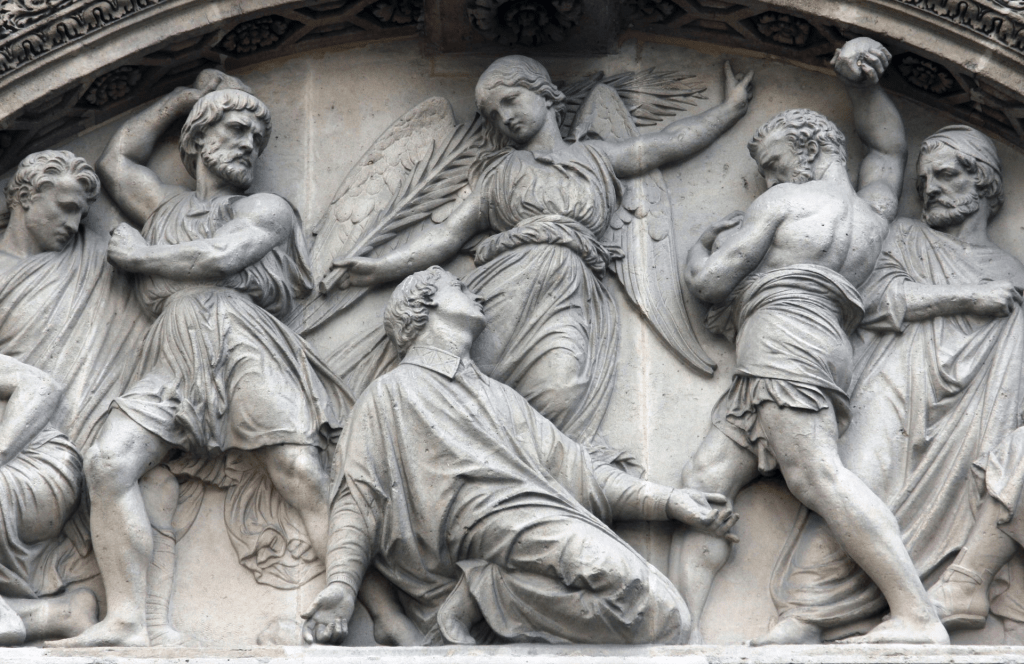
The Martyrdom of Stephen, by sculptor Gabriel-Jules Thomas (1824-1905)

But Stephen, full of the Holy Spirit, looked up to heaven and saw the glory of God, and Jesus standing at the right hand of God. “Look,” he said, “I see heaven open and the Son of Man standing at the right hand of God.”

At this they covered their ears and, yelling at the top of their voices, they all rushed at him, dragged him out of the city and began to stone him. Meanwhile, the witnesses laid their coats at the feet of a young man named Saul.

While they were stoning him, Stephen prayed, “Lord Jesus, receive my spirit.” Then he fell on his knees and cried out, “Lord, do not hold this sin against them.” When he had said this, he fell asleep. (New International Version)

Although I am a trained in biblical exegesis and hermeneutics (interpreting Scripture) I believe that most insights come from making simple observations about the text. So, I want to point out: Stephen was not martyred by the Romans, a religiously pagan group, nor Gentile people; he was martyred by those of his own ethnicity, by “God’s people.”

The religious authorities were more than just unhappy with Stephen. The Sanhedrin (the Jewish ruling council) were incensed with him, so mad that they were grinding their teeth at him. The council sincerely believed Stephen was a blasphemer of God, that what he was saying was so subversive and religiously radical, they could stone him to death with a clear conscience, as if this act were upholding God’s honor and God’s Law.

The result was not only the death of a humble man; it also sparked an intense persecution against the church which caused a new Christian diaspora (Acts 8:1-3). Many believers in Jesus found themselves as Christian refugees trying to eke out a living and worshiping Christ in foreign places.

I wish I could say the greatest opposition I’ve ever experienced as a Christian came from non-Christians who simply misunderstood and misinterpreted me. However, my most hurtful wounds have come from the hands of church folk, believing they were acting on God’s behalf by exacting an emotional martyrdom upon me with the stones of gossip, slander, backbiting, blame-shifting, and outright lying (and a few threats of violence).

Whenever I encounter persons who no longer attend church and have no intention of ever returning to any local congregation, I get it. I understand. Yet, although the church is sometimes like a woman of disrepute, I still love her, and will do whatever I can to edify her and not repay evil with evil.

Stoning a believer, either actually with physical rocks or virtually with verbal stones, is akin to persecuting Jesus himself. That’s because Christ so closely identifies with his people that it is as if he is a head, and his followers are a body – joined together in a vital union.

So, when Christ’s Body is subjected to what I call, “hermeneutical hubris,” in which one group of people insists there is only one way to interpret Scripture, and then uses their authority and structures of power to force compliance on another group, the result is persecution.

And that is precisely why Christians can abuse other Christians.

Rather than discerning that all Christians belong to God, one narrow-minded and small-hearted group excludes all other groups who disagree with them as blaspheming the name of Christ.

For example, insisting that a literal interpretation in the only means of understanding the Bible’s authority is to ignore and abuse the actual and real authority which exists with the Bible. I am in no way encouraging an “anything goes” type of approach to Holy Scripture that lets it say whatever you want it to say. 

What I am saying is that the biblical writers themselves employed different methods of interpretation, as well as the early church fathers (which is one reason I hold to the interpretive guides of the ancient Christian creeds, i.e. The Apostles’ Creed and Nicene Creed).

Far too often, churches stick to a particular interpretation because they believe they are keeping biblical fidelity. This is many times born of a fear that Christendom will be lost, and society will sink into an abyss of egregious sin. The irony is that many churches are sinking into forms of abusive and ungracious behavior by fighting battles that Scripture does not call them to fight.

The binary thinking of “I’m right and you’re wrong” is not an approach you’ll find in God’s Holy Word.

Even if the Sanhedrin in Stephen’s day intended on upholding the holiness of their God and the rightness of their cause, the impact it had on the church was martyrdom, death, and diaspora.

Unfortunately, throughout Christian history, the tables have too often turned with Christians persecuting Jews. I myself would like to avoid being the persecutor. If I kill anything, may it be putting to death my own sin – because that is what the Bible calls me to do.

Dear brothers and sisters, you have no obligation to do what your sinful nature urges you to do. For if you live by its dictates, you will die. But if through the power of the Spirit you put to death the deeds of your sinful nature, you will live.

The Apostle Paul (Romans 8:12-13, NLT)

Since, then, you have been raised with Christ, set your hearts on things above, where Christ is, seated at the right hand of God. Set your minds on things above, not on earthly things. For you died, and your life is now hidden with Christ in God. When Christ, who is your life, appears, then you also will appear with him in glory.

Put to death, therefore, whatever belongs to your earthly nature: sexual immorality, impurity, lust, evil desires and greed, which is idolatry. Because of these, the wrath of God is coming.You used to walk in these ways, in the life you once lived. But now you must also rid yourselves of all such things as these: anger, rage, malice, slander, and filthy language from your lips. 

Do not lie to each other, since you have taken off your old self with its practices and have put on the new self, which is being renewed in knowledge in the image of its Creator. Here there is no Gentile or Jew, circumcised or uncircumcised, barbarian, Scythian, slave or free, but Christ is all, and is in all.

Therefore, as God’s chosen people, holy and dearly loved, clothe yourselves with compassion, kindness, humility, gentleness and patience. Bear with each other and forgive one another if any of you has a grievance against someone. Forgive as the Lord forgave you. And over all these virtues put on love, which binds them all together in perfect unity.

Let the peace of Christ rule in your hearts, since as members of one body you were called to peace. And be thankful. Let the message of Christ dwell among you richly as you teach and admonish one another with all wisdom through psalms, hymns, and songs from the Spirit, singing to God with gratitude in your hearts. And whatever you do, whether in word or deed, do it all in the name of the Lord Jesus, giving thanks to God the Father through him. (Colossians 3:1-17, NIV)

Gracious God, as your Son humbled himself on this earth, so may your church walk continually in such humility that believers everywhere work together in unity for the sake of gospel of grace as a blessing to the world in the power of your Holy Spirit. Amen.

Slave or Free? (Galatians 4:21-5:1)

Tell me, you who want to be under the law, are you not aware of what the law says? For it is written that Abraham had two sons, one by the slave woman and the other by the free woman. His son by the slave woman was born according to the flesh, but his son by the free woman was born as the result of a divine promise.

These things are being taken figuratively: The women represent two covenants. One covenant is from Mount Sinai and bears children who are to be slaves: This is Hagar. Now Hagar stands for Mount Sinai in Arabia and corresponds to the present city of Jerusalem, because she is in slavery with her children. But the Jerusalem that is above is free, and she is our mother. For it is written:

“Be glad, barren woman,
    you who never bore a child;
shout for joy and cry aloud,
    you who were never in labor;
because more are the children of the desolate woman
    than of her who has a husband.”

Now you, brothers and sisters, like Isaac, are children of promise. At that time the son born according to the flesh persecuted the son born by the power of the Spirit. It is the same now. But what does Scripture say? “Get rid of the slave woman and her son, for the slave woman’s son will never share in the inheritance with the free woman’s son.” Therefore, brothers and sisters, we are not children of the slave woman, but of the free woman.

It is for freedom that Christ has set us free. Stand firm, then, and do not let yourselves be burdened again by a yoke of slavery. (New International Version)

Get your hermeneutics together, man

First of all, I want to say that I have little tolerance for Bible readers who insist on an exclusive literal interpretation of Scripture – because it’s downright nonsensical.

Today’s New Testament lesson is one of many biblical passages which really ought to put a wooden stake to the heart of such a misguided hermeneutic. The Apostle Paul himself uses an allegorical or figurative approach to interpreting an Old Testament story.

Holy Scripture interprets itself in many ways. It is, at the least, hubris to believe one has the corner on biblical interpretation through a single mode of literal Bible interpretation; and it is, at the worst, damaging to other’s souls to restrict them in their reading and reflection – not to mention destructive whenever a literalist (who is typically also a legalist) brings their judgmentalism forward to condemn the other approaches.

Okay, I feel better now, getting that off my chest. But, unfortunately, we’ve still got to deal with legalism – which is what Paul set out to do with his writing to the churches in the region of Galatia.

Let go of the legalism

There can be something oddly comforting about law. Having clear black-and-white no-nonsense rules can give a sense of security. You always know where you stand. You’re either in or you’re out, either pure or sinful. 

Yet, here’s the score on the law: it is meant for the immature and is designed as a guide to lead us to maturity. 

If we live by law, we are bound by law. Law can only take us so far in our walk with God. A slavish commitment to rules must, at some point, give way to the greater virtues of grace and love. 

The Galatian churches wanted a religion they could see and hold in their hands. But Paul would have none of it; he was dogged about the devotion to a life of grace. Since Christ has set us free, we are truly and really free. So now, we are to embrace the freedom and never go back to being slaves to the law again – which is closely akin to relapsing into spiritual immaturity. 

We (hopefully) expect a kid to be a kid. When the kid grows up and is an adult with adult responsibilities, we expect him to speak and act like an adult, not a kid.

What’s more, we ought also to expect the adults in the room to treat one another like adults. Layering a bunch of rules and regulations on grown-up people is nothing more than handling them like they’re kids. It’s a nonsensical approach to dealing with each other.

Embrace your freedom

Freedom means that we have no obstacles in expressing grace, love, and hope to others. We are free to bask in the forgiveness we possess in Christ. 

If our Christianity is reduced to a point system or following a list of juvenile rules, then we have missed what the law was all about in the first place. The law is meant to lead us to Christ, and it must, at some point, give way to the larger law of love.

The law has its place. Yet, if we are perpetual slaves to it and never outgrow it’s intended purpose for us, then we need to move onto maturity and embrace the freedom we have in Christ. 

To live in freedom doesn’t mean we can simply do whatever we want, as if there’s no consequences to our words and actions. It’s not “anything goes.” Rather, Christian freedom is a life attuned to the Spirit; an awareness of living for Jesus through the fruit of the Spirit. It doesn’t break laws; it fulfills them. 

All Christians must grow up and become spiritual adults. That means leaving childish ways of the law behind and embracing the freedom of the Spirit. 

So, where are you in your Christian life? Are you a slave to Law or a free person to Love?