Free to Live a New Life (Romans 7:1-6)

You shouldn’t have any trouble understanding this, friends, for you know all the ins and outs of the law—how it works and how its power touches only the living. For instance, a wife is legally tied to her husband while he lives, but if he dies, she’s free. If she lives with another man while her husband is living, she’s obviously an adulteress. But if he dies, she is quite free to marry another man in good conscience, with no one’s disapproval.

So, my friends, this is something like what has taken place with you. When Christ died he took that entire rule-dominated way of life down with him and left it in the tomb, leaving you free to “marry” a resurrection life and bear “offspring” of faith for God. For as long as we lived that old way of life, doing whatever we felt we could get away with, sin was calling most of the shots as the old law code hemmed us in. And this made us all the more rebellious. In the end, all we had to show for it was miscarriages and stillbirths. But now that we’re no longer shackled to that domineering mate of sin, and out from under all those oppressive regulations and fine print, we’re free to live a new life in the freedom of God. (The Message)

The goal of salvation is to be delivered from oppressive bondage so that we are free to live a true and beautiful life – a holy life, set apart for good.

Romans chapters 6-8 are the Apostle Paul’s pointed discussion of how we become holy in a real and practical way. The theological word we typically use for this is “sanctification,” which means “to become holy,” and “set apart” for God. To be delivered from sin, death, and hell through the person and work of Jesus Christ is not the end of the story; it is just the beginning.

Becoming holy and good in our everyday lives boils down to this: identity and belonging.

One of the healthiest ways of looking at the entirety of the Bible’s message is that we belong to God. Our identities are thoroughly wrapped around Jesus. The process of realizing this, and coming to grips with it, is how we grow as people in holiness and righteousness.

Because of Christ’s finished work on the cross, we have been delivered from the realm of sin. Our change in status from condemned to accepted provides us the awareness to make daily affirmations of faith and live a new life.

Yet, the sinful nature (flesh) or the old person is still there. Although it is now toothless, our past can, and may often, exert a powerful influence on us. Even though there is a medium-rare T-bone steak on the table for us to enjoy, there are times we go back to the old bologna sandwich with stale white bread.

We no longer need to fall short of our true humanity. That’s because we belong to God. We are adopted into God’s family, having been orphaned by sin’s cruel influence.

However, just because we have been saved from the power of sin, sin itself is not extinct. We still must deal with it. We are alive to God and need to take up this great spiritual reality and live into it, for the force of sin still exerts a powerful influence in the world.

We deal with sin’s continued presence (the world, the flesh, and the devil) through embracing God’s grace versus trying to overcome it with the law.

Paul used an illustration from marriage to expand our understanding of grafting grace into our daily lives. By law, a married woman is bound to her husband (keeping in mind this sense of belonging was the predominant view of marriage in the Apostle’s day). But if the husband dies, the wife is released from the legal marriage. If she were to give herself to another man while her husband is still alive and they are married, then she becomes an adulteress. However, if she is a widow, then marries again, she is not an adulteress.

Paul applies this understanding to our relationship with the law. Death has separated us from the law. We died with Christ. Therefore, we have been set free from the law and have become alive to grace. As believers in Jesus, God’s grace and love changed our lives:

  • We now “belong to another, to him who was raised from the dead.” (Romans 7:4)
  • “When Christ’s body hung upon the cross, when God spared not his own Son but gave him up for us all.” (Romans 8:32)
  • “Christ took on himself for us all the curse of the law which inflicted all of us.” (Galatians 3:13)
  • We died to the law. God’s grace has made the death of Jesus the death of all from the realm of sin. (2 Corinthians 5:14)

As a married man, let me use Paul’s illustration to get down to the gist of his teaching. Yes, I am legally married and belong to my wife. I made vows to my wife on our wedding day which bind me legally to do what I said I would do. Yet, if I fulfill those vows in a strictly legalistic manner, I can vouch for my wife that this would not qualify as an acceptable situation for her. You see, my wife (and, me, too!) are freely bound to one another in love and grace. I care for my wife because I love her deeply, and not because it is my legal duty to do so.

The Christian life was neither designed nor meant to serve as a bare legal contract or covenant between us and God. God forbid such a thought! Jesus died to clear us from all the legality stuff so that we could freely love and serve God with joyful abundance and gratitude.

I am follower of Jesus because I love him deeply. What impels and motivates me is God’s grace. The law is there and has its place. However, it is not the law that causes me to be a Christian; it is the love of Christ which saved me from myself and compels me to live like Jesus.

May the God of peace make you pure, belonging only to him. May your whole self—spirit, soul, and body—be kept safe and blameless when our Lord Jesus Christ comes. The one who chose you will do that for you. You can trust him. Amen.

Remember Your Baptism (Matthew 3:13-17)

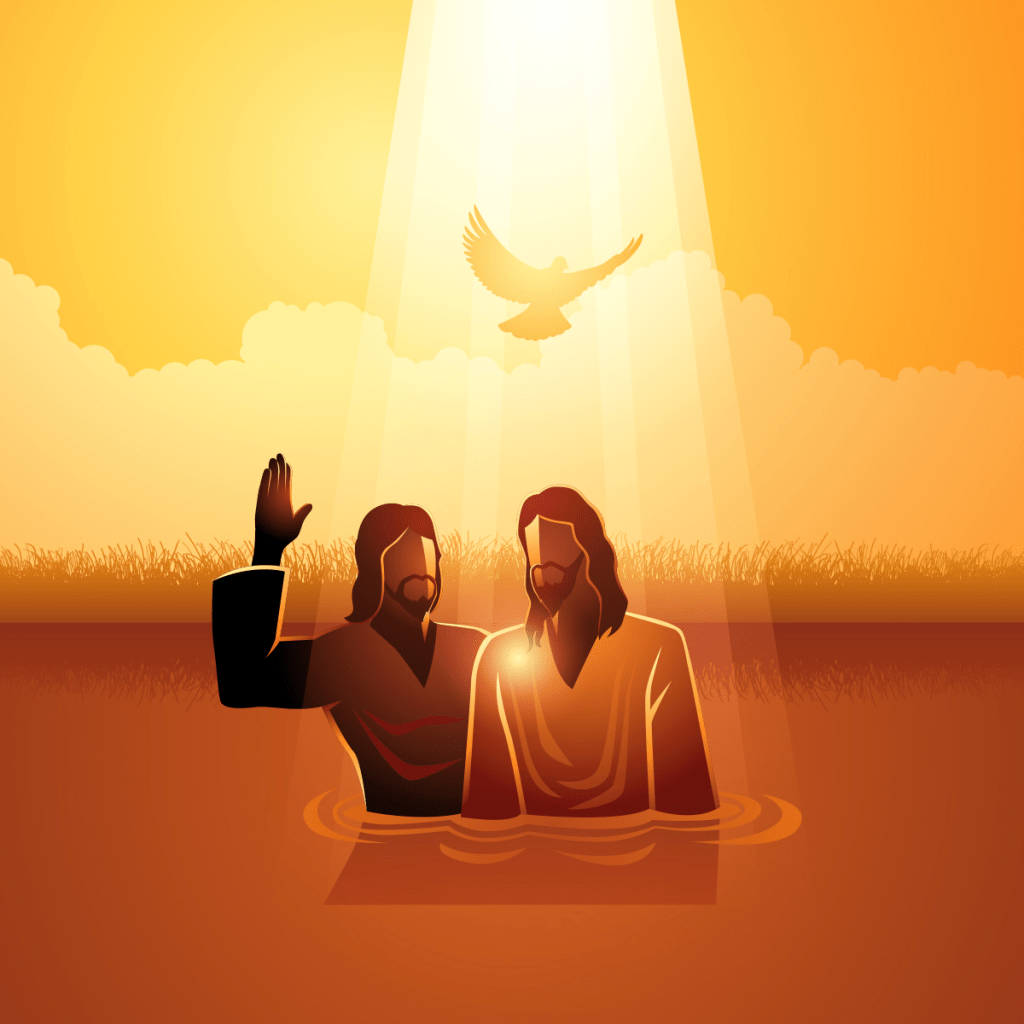
John baptizing Jesus with the Holy Spirit’s affirmation

Then Jesus came from Galilee to the Jordan to be baptized by John. But John tried to deter him, saying, “I need to be baptized by you, and do you come to me?”

Jesus replied, “Let it be so now; it is proper for us to do this to fulfill all righteousness.” Then John consented.

As soon as Jesus was baptized, he went up out of the water. At that moment heaven was opened, and he saw the Spirit of God descending like a dove and alighting on him. And a voice from heaven said, “This is my Son, whom I love; with him I am well pleased.” (New International Version)

Baptism is important. Remembering is important. Put together, remembering our baptism is highly important. Here’s why….

Baptism is important to Jesus

Baptism is the distinguishing mark or symbol of being a Christian. 

The New Testament actually knows nothing of an unbaptized Christian. That’s because the practice is tied to our identity as believers. Our baptisms are based in the baptism of the Lord who, in his Great Commission, told us to baptize in the name of the Father, Son, and Spirit (who were all present at Christ’s baptism). 

The absence of baptism is like a bride without a wedding ring; a football player not wearing a uniform; a motorcycle gang without tattoos; or like an Iowa farmer without a Pioneer seed corn hat!

Baptism is the outward sign that we belong to God. It is the distinguishing symbol that we have been adopted by God and will receive all the promises of salvation in Christ.

Christ’s baptism fulfilled all righteousness through identification with repentant people

John the Baptist was understandably hesitant to baptize Jesus; he knew Jesus had no need of repentance. Although Jesus had no sin to confess, his baptism is a powerful symbol of his humility. It anticipates his ministry to people who recognize their need for God. 

It was necessary for Jesus to be baptized in order to communicate solidarity with people who are coming to God. “Righteousness” means having a right relationship with both God and other people. By being baptized, Jesus is proclaiming that a renewed and right relationship with God will become a reality through himself. Baptism is the sign that we belong to God and that our righteousness is tied to our union with Jesus.

It was important for Jesus to identify with sinners; it is important for us, as well. We remember our baptism – that we belong to God – by identifying with “sinners.” Here are 7 ways of doing it:

  1. Practicing hospitality (love of strangers)
  2. Using our spiritual gifts of speaking and serving on their behalf
  3. Getting to know people very different from ourselves
  4. Meeting people on their turf (not just ours)
  5. Showing respect and upholding dignity
  6. Asking thoughtful and caring questions
  7. Listening with focused attention

It isn’t what we “do” for people that’s as important as affirming our shared humanity with them; thus leading folks to the ultimate person who can address the needs of their heart:  Jesus.

Christ’s baptism fulfilled all righteousness through the affirmation of witnesses

Before Jesus began his ministry, it was necessary to receive validation of what he was about to teach and do. In ancient Judaism, one of the protections guaranteeing that Scripture would be taught according to the way of God, was through an ordination, of sorts. In order for a new rabbi to become a new rabbi, he needed the laying on of hands from two other rabbis who had authority to do so. 

That’s why Christ’s baptism is important. John the Baptist was a powerful teacher and prophet who was recognized by the people as such. John publicly said he wasn’t worthy to carry Jesus’s sandals, that Jesus is the Lamb of God that takes away the sin of the world. So, a baptism by John validated Jesus and inaugurated his ministry. 

Baptism of Christ by Dave Zelenka

A second voice – another witness from heaven – affirmed Jesus: “This is my Son, the one I love. I am very pleased with him.” And then, the Holy Spirit, in the form of a dove, came upon Jesus. This further affirmed that Jesus would save people, not through arm-twisting and great shows of power, but through humility and gentleness.

Baptism was Christ’s first recorded act as an adult. In some ways, it was his first miracle – the miracle of humility in identifying with sinners.

Remember your baptism

Baptism is a sign and seal of God’s grace. Just as Christ’s baptism focused all the promises of God in salvation as being fulfilled in one person, so in our baptism we claim all the promises of God as found in Jesus. Water symbolizes new life, God identifying with us – Immanuel, God with us.

In baptism, God promises and seals to us our union with Jesus so that identity is not found in my past and my profession of faith, but in Christ’s past of bringing redemption to us.  Baptism does not so much express faith as call one to a life of faith and sets us apart as belonging to God.

Baptism is a visible declaration of an invisible reality: union with Christ. Just as circumcision was the outward visible sign of the old covenant, so baptism is the sign of the new covenant in Christ – available to both male and female – thus opening the way for women to participate fully in the ministry of the gospel.

In particular, infant baptism confirms that salvation is not initiated by us, but by God. It affirms that one is betrothed to God. As a child, then an adult, grows into the faith, it is our task to remember our baptism, to be reminded that God’s mark is upon us, that we belong to the Lord. 

God has set us apart to be a holy people, given to Jesus to live as he did. We must never forget that baptism is God’s identifying mark upon us; that our union and solidarity with Jesus is affirmed through this practice.

We are not solitary Christians; we belong Christ and to one another. Baptism is the initiation rite that takes a lifetime to complete. Therefore, we must struggle together in working out our salvation.

Because of our union with Jesus Christ, we must remember:

  • I do not belong to the world. So, I will not live selfishly, only seeking my own comfort agenda. Instead, I will give and serve others from a pure and humble heart.
  • I do not belong to sin. So, I will not give myself over to shameful words or actions, to bullying or manipulating people, to throwing fits and pity parties to get my way, nor using my tongue to speak gossip, slander, or suck-up to others. Instead, I will use my speech wisely, building up others through thoughtful and heartfelt encouragement.
  • I do not belong to the devil. So, I will not seek his agenda of lying, cheating, stealing, and being bitter. 

I belong to Jesus, so therefore:

  • I will uphold biblical justice by championing the cause of the fatherless and the widow, the poor and the needy, the least and the lost among us.
  • I will love others with all the grace God gives me.
  • I will forgive others because Christ has forgiven me.
  • I will consider others better than myself by embracing the humility of Christ.
  • I will hunger and thirst for righteousness.
  • I will seek peace and pursue it.
  • I will, give myself to my Lord and Savior Jesus Christ my Savior and Lord – completely and thoroughly, unabashedly and unreservedly.
  • I will live into my baptism and remember it always because I belong to Jesus!

Ephesians 4:7-16 – Be Mature

Christ has generously divided out his gifts to us. As the Scriptures say,

“When he went up
    to the highest place,
he led away many prisoners
    and gave gifts to people.”

When it says, “he went up,” it means that Christ had been deep in the earth. This also means that the one who went deep into the earth is the same one who went into the highest heaven, so he would fill the whole universe.

Christ chose some of us to be apostles, prophets, missionaries, pastors, and teachers, so his people would learn to serve, and his body would grow strong. This will continue until we are united by our faith and by our understanding of the Son of God. Then we will be mature, just as Christ is, and we will be completely like him.

We must stop acting like children. We must not let deceitful people trick us by their false teachings, which are like winds that toss us around from place to place. Love should always make us tell the truth. Then we will grow in every way and be more like Christ, the head of the body. Christ holds it together and makes all of its parts work perfectly, as it grows and becomes strong because of love. (Contemporary English Version)

The Body of Christ, without love as its skeletal structure, would be as ridiculous and silly as a boneless chicken ranch. 

The Apostle Paul, a concerned spiritual father, was encouraging the Church toward maturity, to act as adults in the faith and not like immature children.

Just as the physical body begins small, then grows and matures over time, so the spiritual body (the church) is to focus on incremental slow growth across the years so that it realizes maturity. And the consummate evidence of that spiritual development is strong bonds of love.

Ten days after the Lord Jesus ascended to heaven, the Day of Pentecost occurred. On that day, the Holy Spirit came upon the small band of believers and the church became a full-fledged phenomenon, growing and expanding. (Acts 2:1-47)

The gracious gifts of the Spirit are given to each and every Christian so that growth and strength will come to the Body of Christ through love. Each spiritual gift might be different from person to person, but every one of them is meant to be used in love for the benefit of the entire church.

Without any bones or skeleton, the church will be weak and ineffective. It might look like a church but will not be able to do anything in the world. 

For spiritual maturity to happen, it is necessary for every single Christian in the church to discover their spiritual gift, and then, use it in love to build up the entire Body. This is the God-ordained means of realizing a healthy functioning church. 

It may appear that you and I, as believers in and followers of Jesus, have the luxury of pursuing other interests rather than providing loving and gifted service to Christ’s Church. After all, church attendance, Christian mission and service are all voluntary, right? A volunteer can choose to sit out, right?

Uh-hem (clearing of throat). Wrong. That sort of thinking is based in the goofy notion that the Church is a voluntary society which we choose to become a part of, or not. It isn’t. The Body of Christ, the Church, the people for whom Christ died, was chosen by God – and not the other way around.

Before we chose God, God chose us. We can no more choose to decline Christian mission and service anymore than a physical heart or bodily organ can decide it needs to go do something else – as if they could simply leave the Body or just stop doing what they’re doing without consequence.

No, my friends, for the Body to function, it must work in concert, paying attention to the unique parts which keep it alive and thriving, while at the same time, maintaining the overall health of all the Bodily systems.

Bottom line: We need one another. Going off and continually doing my own thing or picking up my marbles and going home because I’m mad or frustrated, is what children do. When adults act like children, we rightly discern they are immature and need to grow up.

So, instead of lacking self-awareness or being pouty about my blog post, focus on the following questions:

What is your passion and desire for Christ’s church? 

What issues stir you emotionally? 

What group of people do you feel most attracted to reach? 

What area of Christian mission or church ministry would you most like to influence? 

Are there people whom you notice that others seem to ignore? 

Will you step out in faith and learn how God has wired you for ministry? 

Will you speak and serve in the name of Jesus through the enablement of the Spirit?

Loving God, I ask you to give me a heart of faith to trust the Spirit and the Spirit’s work in my life. I ask for a heart that desires the gifts of the Spirit for the common good of all persons. I ask you to help me be open to the gifts of the Spirit in others. I ask for jealousy of others’ gifts to be quieted in me. I pray that my gifts would build up the church. Most of all, I ask for the gift of love. Use me for the strengthening of Christ’s church, and for a positive influence in the world. Amen.

Jeremiah 3:1-5 – Spiritual Adultery

“If a man divorces a woman
    and she goes and marries someone else,
he will not take her back again,
    for that would surely corrupt the land.
But you have prostituted yourself with many lovers,
    so why are you trying to come back to me?”
    says the Lord.
“Look at the shrines on every hilltop.
    Is there any place you have not been defiled
    by your adultery with other gods?
You sit like a prostitute beside the road waiting for a customer.
    You sit alone like a nomad in the desert.
You have polluted the land with your prostitution
    and your wickedness.
That’s why even the spring rains have failed.
    For you are a brazen prostitute and completely shameless.
Yet you say to me,
    ‘Father, you have been my guide since my youth.
Surely you won’t be angry forever!
    Surely you can forget about it!’
So you talk,
    but you keep on doing all the evil you can.” (New Living Translation)

We all have needs. 

As humans, each one of us has a deep hunger for love, intimacy, attention, affirmation, and encouragement. When these needs are met within gracious and loving relationships, especially in the marital bond, then there is genuine happiness and flourishing. 

But when our deep wants go unmet over a stretch of time, smiles are replaced with furrowed brows and confident strides give way to slumped shoulders.

We feel deeply and are moved at a visceral level because we are made in the image and likeness of G-d – a G-d who feels and has great emotion. 

Perhaps we too often think of G-d as some disembodied ethereal brain without any feelings. I hope today’s Old Testament lesson puts a collar on such notions. G-d entered into a loving covenant relationship with Israel. Yet, over time, the people looked for their relational, emotional, and spiritual needs to be met in other gods rather than the One true G-d. 

And it pained G-d’s heart.

G-d felt deeply about the people turning away to pursue other gods. The Lord responded to the people like a jilted lover, agonized by their acting like a prostitute – looking for their intimate needs to be satisfied elsewhere. 

It seems to me G-d was so profoundly hurt because the Lord knows that our deepest and greatest needs can only really be met through the divine covenant relationship. People need G-d.

To put it in the stark terms of Jeremiah’s prophecy: 

  • Are we playing the part of a harlot, running after all kinds of other relationships and things that we wrongheadedly believe will meet the needs of our lives? 
  • Do we sell ourselves to others in the misguided belief that we will find true happiness? 
  • Have we sought other lovers and forsaken our first love of the Divine? 

Everyone has a legitimate need for attention, love, and relational connection. The problem arises whenever we seek to meet those needs in illegitimate ways. That’s what we call “sin.”

The most important thing in life is not our job position, our social status, or even whether we are married with family. What matters most is the kind of person you are – it’s all about who you become. Because that’s what you will take into eternity. You and I are unceasing spiritual beings with an eternal destiny in G-d’s great universe.

Spiritual prostitution – and faith communities acting like spiritual brothels – are far beneath who we are and how we were designed by our Creator.

The pathos of G-d calls us to better than hanging out in a dark emotional shame lounge of sordid characters drinking cheap dandelion wine and smoking nasty cut-rate cigars in smelly old leisure suits.

We belong to G-d.

Our place is in the wide-open sunlit rooms of G-d’s kingdom. We have been adopted into G-d’s family and there is no longer any need for walking the streets and going into dive bars, looking for a quick fix of some damning elixir which promises life.

It behooves us all to become aware and connect with our longings and needs, and thereby allowing the G-d who delights to meet those needs into the core of our being.

Know who you really are. Because in that knowing, there is eternal life.

Jealous God, you are zealous for your presence to be known in the lives of all your creatures. Help me to be aware of the deepest needs of my life. May I find in you the desire of my heart and let you fill me with your infinite grace, love, mercy, and attention so that I will know true peace and joy. Amen.