Remember Your Baptism (Matthew 3:13-17)

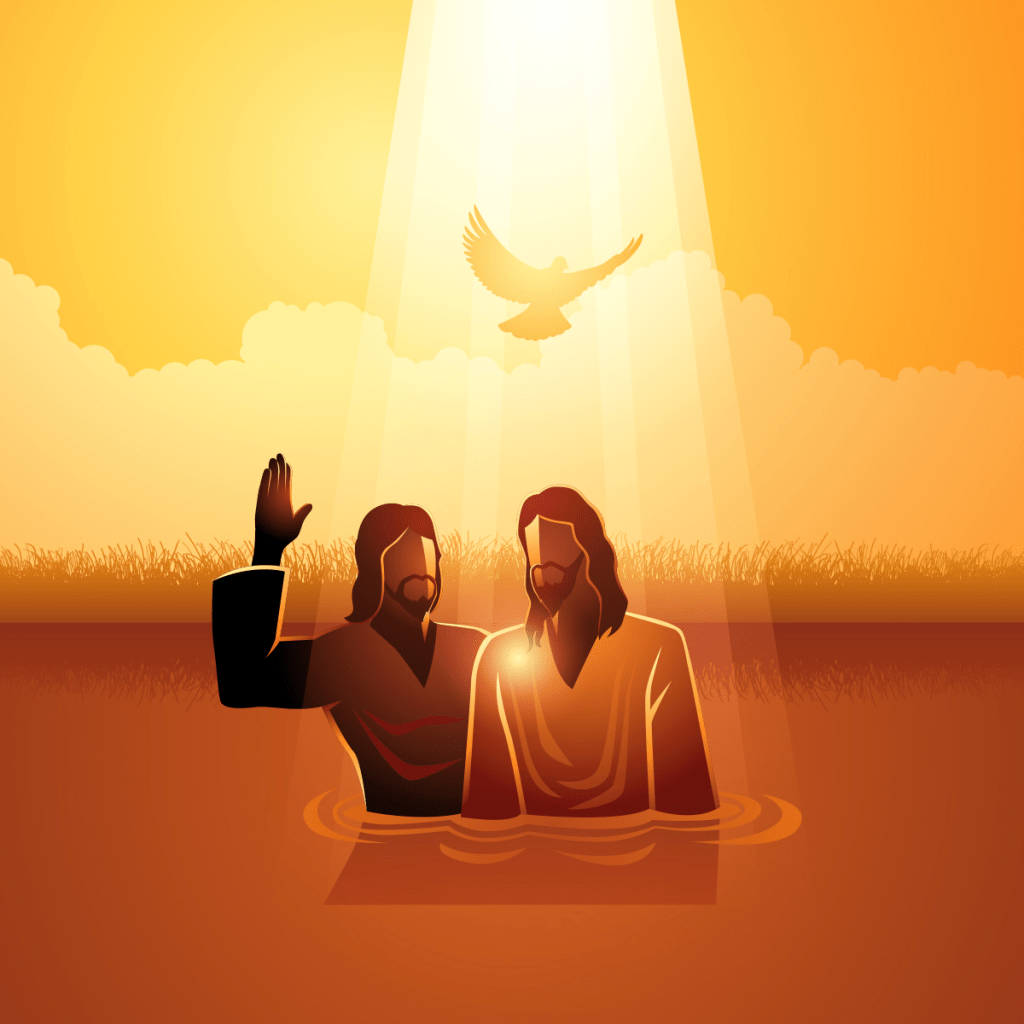
John baptizing Jesus with the Holy Spirit’s affirmation

Then Jesus came from Galilee to the Jordan to be baptized by John. But John tried to deter him, saying, “I need to be baptized by you, and do you come to me?”

Jesus replied, “Let it be so now; it is proper for us to do this to fulfill all righteousness.” Then John consented.

As soon as Jesus was baptized, he went up out of the water. At that moment heaven was opened, and he saw the Spirit of God descending like a dove and alighting on him. And a voice from heaven said, “This is my Son, whom I love; with him I am well pleased.” (New International Version)

Baptism is important. Remembering is important. Put together, remembering our baptism is highly important. Here’s why….

Baptism is important to Jesus

Baptism is the distinguishing mark or symbol of being a Christian. 

The New Testament actually knows nothing of an unbaptized Christian. That’s because the practice is tied to our identity as believers. Our baptisms are based in the baptism of the Lord who, in his Great Commission, told us to baptize in the name of the Father, Son, and Spirit (who were all present at Christ’s baptism). 

The absence of baptism is like a bride without a wedding ring; a football player not wearing a uniform; a motorcycle gang without tattoos; or like an Iowa farmer without a Pioneer seed corn hat!

Baptism is the outward sign that we belong to God. It is the distinguishing symbol that we have been adopted by God and will receive all the promises of salvation in Christ.

Christ’s baptism fulfilled all righteousness through identification with repentant people

John the Baptist was understandably hesitant to baptize Jesus; he knew Jesus had no need of repentance. Although Jesus had no sin to confess, his baptism is a powerful symbol of his humility. It anticipates his ministry to people who recognize their need for God. 

It was necessary for Jesus to be baptized in order to communicate solidarity with people who are coming to God. “Righteousness” means having a right relationship with both God and other people. By being baptized, Jesus is proclaiming that a renewed and right relationship with God will become a reality through himself. Baptism is the sign that we belong to God and that our righteousness is tied to our union with Jesus.

It was important for Jesus to identify with sinners; it is important for us, as well. We remember our baptism – that we belong to God – by identifying with “sinners.” Here are 7 ways of doing it:

  1. Practicing hospitality (love of strangers)
  2. Using our spiritual gifts of speaking and serving on their behalf
  3. Getting to know people very different from ourselves
  4. Meeting people on their turf (not just ours)
  5. Showing respect and upholding dignity
  6. Asking thoughtful and caring questions
  7. Listening with focused attention

It isn’t what we “do” for people that’s as important as affirming our shared humanity with them; thus leading folks to the ultimate person who can address the needs of their heart:  Jesus.

Christ’s baptism fulfilled all righteousness through the affirmation of witnesses

Before Jesus began his ministry, it was necessary to receive validation of what he was about to teach and do. In ancient Judaism, one of the protections guaranteeing that Scripture would be taught according to the way of God, was through an ordination, of sorts. In order for a new rabbi to become a new rabbi, he needed the laying on of hands from two other rabbis who had authority to do so. 

That’s why Christ’s baptism is important. John the Baptist was a powerful teacher and prophet who was recognized by the people as such. John publicly said he wasn’t worthy to carry Jesus’s sandals, that Jesus is the Lamb of God that takes away the sin of the world. So, a baptism by John validated Jesus and inaugurated his ministry. 

Baptism of Christ by Dave Zelenka

A second voice – another witness from heaven – affirmed Jesus: “This is my Son, the one I love. I am very pleased with him.” And then, the Holy Spirit, in the form of a dove, came upon Jesus. This further affirmed that Jesus would save people, not through arm-twisting and great shows of power, but through humility and gentleness.

Baptism was Christ’s first recorded act as an adult. In some ways, it was his first miracle – the miracle of humility in identifying with sinners.

Remember your baptism

Baptism is a sign and seal of God’s grace. Just as Christ’s baptism focused all the promises of God in salvation as being fulfilled in one person, so in our baptism we claim all the promises of God as found in Jesus. Water symbolizes new life, God identifying with us – Immanuel, God with us.

In baptism, God promises and seals to us our union with Jesus so that identity is not found in my past and my profession of faith, but in Christ’s past of bringing redemption to us.  Baptism does not so much express faith as call one to a life of faith and sets us apart as belonging to God.

Baptism is a visible declaration of an invisible reality: union with Christ. Just as circumcision was the outward visible sign of the old covenant, so baptism is the sign of the new covenant in Christ – available to both male and female – thus opening the way for women to participate fully in the ministry of the gospel.

In particular, infant baptism confirms that salvation is not initiated by us, but by God. It affirms that one is betrothed to God. As a child, then an adult, grows into the faith, it is our task to remember our baptism, to be reminded that God’s mark is upon us, that we belong to the Lord. 

God has set us apart to be a holy people, given to Jesus to live as he did. We must never forget that baptism is God’s identifying mark upon us; that our union and solidarity with Jesus is affirmed through this practice.

We are not solitary Christians; we belong Christ and to one another. Baptism is the initiation rite that takes a lifetime to complete. Therefore, we must struggle together in working out our salvation.

Because of our union with Jesus Christ, we must remember:

  • I do not belong to the world. So, I will not live selfishly, only seeking my own comfort agenda. Instead, I will give and serve others from a pure and humble heart.
  • I do not belong to sin. So, I will not give myself over to shameful words or actions, to bullying or manipulating people, to throwing fits and pity parties to get my way, nor using my tongue to speak gossip, slander, or suck-up to others. Instead, I will use my speech wisely, building up others through thoughtful and heartfelt encouragement.
  • I do not belong to the devil. So, I will not seek his agenda of lying, cheating, stealing, and being bitter. 

I belong to Jesus, so therefore:

  • I will uphold biblical justice by championing the cause of the fatherless and the widow, the poor and the needy, the least and the lost among us.
  • I will love others with all the grace God gives me.
  • I will forgive others because Christ has forgiven me.
  • I will consider others better than myself by embracing the humility of Christ.
  • I will hunger and thirst for righteousness.
  • I will seek peace and pursue it.
  • I will, give myself to my Lord and Savior Jesus Christ my Savior and Lord – completely and thoroughly, unabashedly and unreservedly.
  • I will live into my baptism and remember it always because I belong to Jesus!

Water Is Life (Ezekiel 47:1-12)

Now he brought me back to the entrance to the Temple. I saw water pouring out from under the Temple porch to the east (the Temple faced east). The water poured from the south side of the Temple, south of the altar. He then took me out through the north gate and led me around the outside to the gate complex on the east. The water was gushing from under the south front of the Temple.

He walked to the east with a measuring tape and measured off fifteen hundred feet, leading me through water that was ankle-deep. He measured off another fifteen hundred feet, leading me through water that was knee-deep. He measured off another fifteen hundred feet, leading me through water waist deep. He measured off another fifteen hundred feet. By now it was a river over my head, water to swim in, water no one could possibly walk through.

He said, “Son of man, have you had a good look?”

Then he took me back to the riverbank. While sitting on the bank, I noticed a lot of trees on both sides of the river.

He told me, “This water flows east, descends to the Arabah and then into the sea, the sea of stagnant waters. When it empties into those waters, the sea will become fresh. Wherever the river flows, life will flourish—great schools of fish—because the river is turning the salt sea into fresh water. Where the river flows, life abounds. Fishermen will stand shoulder to shoulder along the shore from En Gedi all the way north to En-eglaim, casting their nets. The sea will teem with fish of all kinds, like the fish of the Great Mediterranean.

“The swamps and marshes won’t become fresh. They’ll stay salty.

“But the river itself, on both banks, will grow fruit trees of all kinds. Their leaves won’t wither, the fruit won’t fail. Every month they’ll bear fresh fruit because the river from the Sanctuary flows to them. Their fruit will be for food and their leaves for healing.” (The Message)

Jesus said, “Let the one who believes in me drink. As the Scripture has said, ‘Out of the believer’s heart shall flow rivers of living water.’”

John 7:38, NRSV

The coming of the Lord is what Advent is all about. It means that God is about to show up. And when God shows up, there are rivers of blessing and an abundance of salvation.

We need water

Just as we need water to survive, so we also need the living water which grants us eternal life.

Every living cell of our body contains water. 65% of your body is water. Up to 90% of plant tissue is water. Water defines our environment and shapes our landscape. We need at least two liters of fresh water to drink every day to stay healthy.

Just as each person on earth ought to have clean, safe, fresh water each day, but don’t, so every person also should have the living water of salvation and blessing flowing from God, yet they don’t.

Water constantly moves around the planet – on, above and below the earth’s surface. The cycle from rainfall to evaporation to rainfall is powered by energy from the sun. Water falls as rain, snow, and sleet. It collects in ice, rivers, groundwater, and the oceans. The water cycle naturally cleans the water.

Just as the natural processes of the water cycle give life and health to the planet, so the unseen spiritual processes working above, below, and on the earth exist to provide the life that is truly life.

Water in the Bible

Water is mentioned 722 times in the Bible. Water flows throughout Holy Scripture, reminding us of its importance, both spiritually and physically. Water is such an essential component of life that God created it on the very first day (Genesis 1:2). And water shows up at the very end of the Bible:

The Spirit and the bride say, “Come!” And let the one who hears say, “Come!” Let the one who is thirsty come; and let the one who wishes, take the free gift of the water of life. (Revelation 22:17, NIV)

Naaman the Syrian was cured from his leprosy in the waters of Jordan River (2 Kings 5:1-14). Water is used as a sign and a seal to purify and provide deliverance, as in Christian baptism (Romans 6:3-4; 1 Peter 3:18-22). And the power of water can also be a destructive force (Genesis 6:17; Exodus 14:1-15:21).

Living Water

Jesus, the source of Living Water, extends an invitation to all who thirst.

“But those who drink the water I give will never be thirsty again. It becomes a fresh, bubbling spring within them, giving them eternal life.” (John 4:14, NLT)

Christ uses water for redemptive purposes, to bring comfort and help.

Jesus got up from the meal, took off his outer clothing, and wrapped a towel around his waist. After that, he poured water into a basin and began to wash his disciples’ feet, drying them with the towel that was wrapped around him. (John 13:4-5, NIV)

“O Christ, He is the fountain,

The deep, sweet well of love;

The streams on earth I’ve tasted

More deep I’ll drink above.

There to an ocean fullness

His mercy doth expand,

And glory, glory dwelleth

In Immanuel’s land.”

The Sands of Time Are Sinking by Sam Rutherford and Anne Cousin

From a Christian perspective, the water flowing from the temple finds its fulfillment in the person and work of Jesus Christ. He is the living water that gives eternal life. We would do well to ensure that all people have access to clean physical water, as well as access to purified spiritual water.

Lord Jesus, Son of God, Savior of humanity, there is a river flowing straight from your heart into mine — replenishing, renewing, sustaining. 

May you, as Living Water, be persistent in me, breaking through every barrier in its path.

Send this hydropower through the dark crevices of my heart like a mighty flood overcoming and pushing everything out of the way that blocks its path.

I want my heart to be washed clean of any debris cluttering and blocking your life-giving flow.

May your love overflow onto your people — your grace, your mercy — into the lives of those we encounter, to your glory and honor, in spirit, and in truth. Amen.

Let the Little Children Come (Luke 18:15-17)

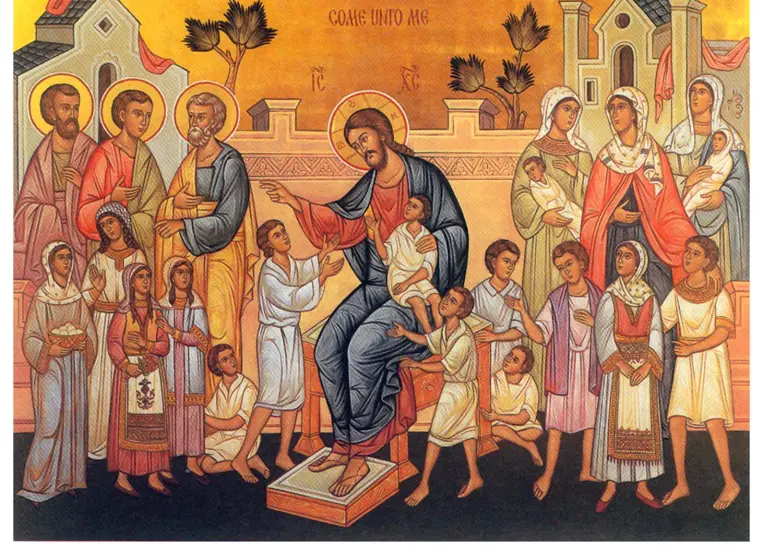
People were also bringing babies to Jesus for him to place his hands on them. When the disciples saw this, they rebuked them. But Jesus called the children to him and said, “Let the little children come to me, and do not hinder them, for the kingdom of God belongs to such as these. Truly I tell you, anyone who will not receive the kingdom of God like a little child will never enter it.” (New International Version)

I happen to believe that kids are closer to the kingdom of God than most adults.

Us big people have developed a lot of baggage over the years. And all that stuff tends to obscure God’s kingdom and the light of Christ within us.

Kids, however, especially small children, still haven’t discerned any veil between the seen and unseen worlds. They freely move between them both without any problem.

So, of course, Jesus wanted to be around children. If he had any homesickness at all, I’m sure the presence of kids made him feel at home more than anywhere else on this earth.

Jesus is our Immanuel, God with us.

The kingdom of God is here within us.

The disciples of Jesus had some difficulty with Christ’s branding of the message because it was not exclusive enough for them. They wanted limits on the us part.

Kids are part of that mass of people that God is with. Children deserve as much or more attention than adults. More than simply saying that we care about kids, we need to be like Jesus. He let the children come to him and was intolerant of anyone preventing kids from doing so.

Since the disciples were, ironically, still living in a small world, they rebuked those who brought little children to Jesus.

We aren’t specifically told why the disciples rebuked the adults bringing children to Jesus. Maybe the children were making a lot of noise and were being a nuisance in the middle of Jesus’ teaching. Perhaps the disciples had Jesus on a tight time schedule and this bringing kids to Christ thing was causing a delay. It could be that the disciples simply saw children as an interruption to the “important” work of ministry. 

I tend to think that the disciples simply failed to appreciate the children. The dominate view of kids in the ancient world was to see them as potential adults. Kids were pretty low on the ladder of society. The disciples likely saw no reason for children to be involved in what was happening.

The babies and toddlers and small children were brought so that Jesus might place his hands on them and pray for them. That still seems to me to be the best reason to bring kids to Jesus. 

“This story teaches us that Christ does not receive only those who voluntarily come to Him of a holy desire and moved by faith, but also those who might not yet be old enough to realize how much they need His grace….  From this we gather that His grace reaches to this age of life also….  It would be cruel to exclude that age from the grace of redemption.”

John Calvin

“Jesus does not only save repentant adults; he also saves dependent children and all those whom we think are incompetent to respond to Jesus.”

Frederick Dale Bruner

Jesus flat out rebuked his disciples for hindering the little children from coming to him. He wanted just the opposite of what was taking place. Why? Because the kingdom of heaven belongs to such little people as these. 

As mentioned, children were at the bottom of the societal pecking order in the ancient world. Their place in that society was to be respectful and quiet, to speak only when spoken to, and to never interrupt an adult.

Yet, Jesus took the time to touch them and pray for them. He invited this interruption to his schedule. Christ bluntly told his disciples that they were the ones being the hindrance, not the kids.

I baptize all sorts of people, including kids and babies. Why? Because in baptism, I recognize that the smallest ones among us can come to this holy sacrament. I understand that in baptism the Holy Spirit begins and initiates the process of salvation that will take that little one from infancy to adulthood and eventual death. I discern that, ideally, the child grows to live into their baptism by recognizing by faith that Jesus died and rose from the dead and grants grace and forgiveness to all who come to him. 

In that process of salvation, of coming to know Jesus, we have the sacrament of the Lord’s Table to strengthen our faith and demonstrate to us that the saving work of Jesus that has been accomplished. It is a Table of grace for all the members of Christ’s Church. 

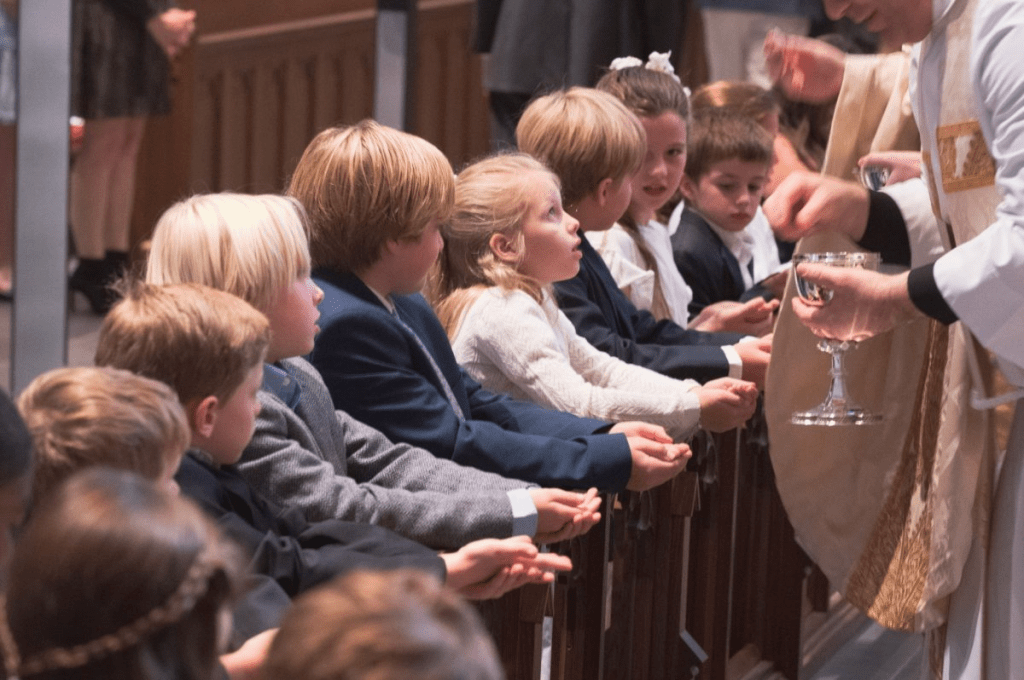
In my Reformed Christian tradition, we believe that Jesus is not physically, but spiritually present at the Table.  Because Jesus is present, we are able to receive the grace available to us as Christ’s members. So why, in light of this reality, and the words and practice of Jesus toward children, would we ever hinder and prevent the smallest members among us from participating at the Table?

Here’s a thought: If Jesus himself were serving communion in a church, and a group of 2-year-old children came toddling up to the Table to see Jesus, would you stop them from doing so? Or much like the disciples, would you rebuke those bringing children to Jesus?

As for me, I’d rather not be rebuked by my Lord.

Jesus gave children the three gifts they most need: time, touch, and prayer. Parenting and teaching are holy vocations, and we have the wonderful privilege of bestowing these same gifts on our children, grandchildren, and students.

Time, touch, and prayer are ways we bless children. And, what’s more, as God’s children, we are all to approach Jesus and spend time with him, allow him to touch us, and interact with him through prayer. 

May we all have the humility to bend down at eye level to the littlest among us so that we and others will know that the kingdom of God is among us.

Galatians 6:1-16 – Fulfill the Law of Christ

Brothers and sisters, if someone is caught in a sin, you who live by the Spirit should restore that person gently. But watch yourselves, or you also may be tempted. Carry each other’s burdens, and in this way you will fulfill the law of Christ. If anyone thinks they are something when they are not, they deceive themselves. Each one should test their own actions. Then they can take pride in themselves alone, without comparing themselves to someone else, for each one should carry their own load. Nevertheless, the one who receives instruction in the word should share all good things with their instructor.

Do not be deceived: God cannot be mocked. A man reaps what he sows. Whoever sows to please their flesh, from the flesh will reap destruction; whoever sows to please the Spirit, from the Spirit will reap eternal life. Let us not become weary in doing good, for at the proper time we will reap a harvest if we do not give up. Therefore, as we have opportunity, let us do good to all people, especially to those who belong to the family of believers.

See what large letters I use as I write to you with my own hand!

Those who want to impress people by means of the flesh are trying to compel you to be circumcised. The only reason they do this is to avoid being persecuted for the cross of Christ. Not even those who are circumcised keep the law, yet they want you to be circumcised that they may boast about your circumcision in the flesh. May I never boast except in the cross of our Lord Jesus Christ, through which the world has been crucified to me, and I to the world. Neither circumcision nor uncircumcision means anything; what counts is the new creation. Peace and mercy to all who follow this rule—to the Israel of God. (New International Version)

It’s all about grace. God’s grace. Not rules. Not a list of principles to live by. Not judgment. Not punishment or penance. Grace – amazing, wonderful, scandalous grace.

The Law of Christ is to help each other in our troubles, no matter what.

Overwhelming physical, mental, emotional, and spiritual burdens can become even more heavy through failing to live up to someone’s or some group’s unwritten list of rules. “Keep a stiff upper lip.” “Everything is possible for those who love God.” “Stay positive.” “Just have faith and trust God.” Or someone’s silence…. These and hundred other phrases communicate to people with crushing spiritual and emotional loads that they will have to carry them alone.

The letter to the Galatian believers spells out what is to truly characterize Christian interactions, and what it means to walk in the Spirit. Believers in Jesus are to emulate the behavior of Christ, the ultimate burden-bearer, who came to restore sinners, not condemn them. We have a responsibility to rescue, renew, and revitalize persons who have lost their way. We are our brother’s and our sister’s keeper.

Someone caught in the crosshairs of a bad decision, or ensnared by making a wrong step, who is now in over their heads, needs help. In such a case, we are to restore, not punish. The person’s wound needs spiritual cauterizing. The broken spirit needs to be set back into place to heal properly.

The tone and the attitude which we do this important work of restoring people is through gentleness (meekness). We are to have a mindset and a heart stance which understands there is no moral superiority with me. I could easily be that person in need of restoration.

With a gentle spirit, we discern no one is above falling into the same trouble. We, too, are ethically and morally vulnerable. So, the church has a corporate responsibility to bear one another’s burdens.

There are other people who, through no fault of their own, find themselves in over their heads, too. Their physical struggles, mental health challenges, the emotional weight of hard circumstances, and their broken spirits require others to help shoulder the load so that the weighted-down person is not crushed.

Burden-bearing is the work of everyone and not a select few. You and I are to take responsibility for our own backpack of stuff – our own actions and attitudes. A mature spiritual community of people are able to distinguish those loads which individuals must bear for themselves, and those burdens where help is sorely needed. We are accountable to carry our own backpack. And we are also accountable before Christ to share our load with others when it becomes too heavy to carry.

If we choose not to allow others to assist us when we need it, then we will reap what we sow – we’ll feel the full weight and consequences of our silence. The planting and harvesting metaphor isn’t just for those who have engaged in wrongdoing. It is also for those who don’t put any seeds in the ground to begin with. They shouldn’t expect a harvest, at all.

Grace lived out in real experiences knows when to get under a load and help carry it. And grace also knows when to be kind to self and share the heavy burden with others who can help shoulder it for a bit. This is a Christianity which relies on the enablement of the Spirit, made possible by Christ, who carried our crushing weight of guilt and shame for us.

“Come to me, all you who are weary and burdened, and I will give you rest. Take my yoke upon you and learn from me, for I am gentle and humble in heart, and you will find rest for your souls. For my yoke is easy and my burden is light.”

Jesus (Matthew 11:28-30, NIV)

Motives matter. The interior life of a person is important. Life is neither a mere getting things done nor doing what is needed on the exterior. A house may be beautiful and orderly on the outside, with careful landscaping, a manicured lawn, and attractive appearance – yet on the inside it might be disorderly, full of relational discord, and completely discombobulated.

The exterior life of a person is also important. But it’s only half the person. And, unlike God who sees the heart, we aren’t always privy to what’s going on inside someone. Folks who are enamored with outward displays of spirituality and righteousness tend to be compulsive about maintaining appearances – for both themselves, and everyone else.

Policing outward forms of righteousness through clear identifiable means is really nothing more than old fashioned judging of one another. It’s antithetical to grace. And it smacks of the snooty superiority of Star-Bellied Sneetches.

Rather than a star on the belly, in the Apostle Paul’s day it was circumcision. Those who had it were “in” and those without it were “out.” Never mind the interior life. A hard outward boundary of righteousness was established by false teachers who made the Christian life easy by simply holding to readily observable forms, like circumcision.

It wasn’t that circumcision was a bad thing. The issue was making it a necessary part of the Christian life. Not circumcised? Not a Christian, insisted the false teachers. In other words, one had to become Jewish before becoming a Christian. I can picture the Apostle Paul doing a  face palm, saying, “Oy vey.”

For the Christian, one must be vigilant not to exaggerate baptism. On the one hand, I would argue far too many believers underestimate the significance and importance of baptism. Flippantly making it a personal choice, as if the individual is in complete control of one’s own salvation, is not only wrongheaded – it’s downright blasphemous.

Yet, on the other hand, a preoccupation with getting a person, especially a child, baptized, as if the world might end if it doesn’t happen, betrays the same problem as Paul faced with circumcision in the first century.

The proper approach, it seems to me, is to embrace the full spectrum of Christianity – both outward and inward – the whole person. And Paul addresses this by anticipating a question of the Galatian congregation: What, then, is of central importance?

The answer is: a new creation. To be transformed by the power of the Spirit is what really counts. The grace of God in Christ, applied to a person, brings a change to inner motives and attitudes, as well as outer behavior through loving actions.

We must always keep in mind that the sign points to the substance. It would be weird if I were traveling to Milwaukee on I-94 and pulled over on the interstate next to the sign marking the city is ahead, crawl all over it, and say, “I’m here!”

The overall thrust of Paul’s letter to the Galatians is that they were debasing the true worship of God into an outward show, honoring Christ with their lips but not holding him in their hearts through carrying one another’s burdens.

Christianity is fundamentally not about what we do for God but what God has done for us in Jesus Christ. It is divine grace which saves people. We belong to God. Just as we neither chose our own parents nor the time when we were born, so also, before we chose God, God chose us. We don’t “born again” ourselves; God does the rebirthing.

Since salvation is solely the work of God in us, there is zero reason to boast about the circumstances of our new birth and becoming a new creation in Christ. We didn’t save ourselves. It would be like getting a COVID-19 vaccine and then bragging about how we personally stopped the pandemic.

Instead, we are to bear the spiritual marks of Christ’s crucifixion on our inner selves. No one is saved because they deserve it but simply because they need saving. That’s what grace truly is – and that’s how we are to live toward one another.

Merciful God, you are our Burden-Bearer. Awaken our hearts to remember your love. Open our eyes to see your grace. Stir up hope in those who are overwhelmed with sorrow and fear. Teach them to place their burdens at your feet as an offering — a sacrifice well-pleasing to you. Teach us all to allow others to help us in our time of need, through Jesus Christ our Lord, who with you and the Holy Spirit are one God, now and forever. Amen.