Third Sunday of Advent – The Ministry of John the Baptist (Luke 3:7-18)

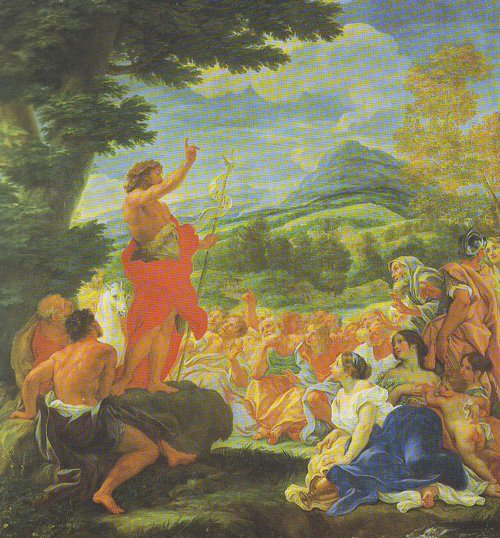
St. John the Baptist Preaching, by Giovanni Battista Gaulli (1639-1709)

John said to the crowds coming out to be baptized by him, “You brood of vipers! Who warned you to flee from the coming wrath? Therefore, bear fruits worthy of repentance, and do not begin to say to yourselves, ‘We have Abraham as our ancestor,’ for I tell you, God is able from these stones to raise up children to Abraham. Even now the ax is lying at the root of the trees; therefore every tree that does not bear good fruit will be cut down and thrown into the fire.”

And the crowds asked him, “What, then, should we do?” In reply he said to them, “Whoever has two coats must share with anyone who has none, and whoever has food must do likewise.” Even tax collectors came to be baptized, and they asked him, “Teacher, what should we do?” He said to them, “Collect no more than the amount prescribed for you.” Soldiers also asked him, “And we, what should we do?” He said to them, “Do not extort money from anyone by threats or false accusation, and be satisfied with your wages.”

As the people were filled with expectation and all were questioning in their hearts concerning John, whether he might be the Messiah, John answered all of them by saying, “I baptize you with water, but one who is more powerful than I is coming; I am not worthy to untie the strap of his sandals. He will baptize you with the Holy Spirit and fire. His winnowing fork is in his hand to clear his threshing floor and to gather the wheat into his granary, but the chaff he will burn with unquenchable fire.”

So with many other exhortations he proclaimed the good news to the people. (New Revised Standard Version)

John’s ministry was meant to be one of preparing people for the Lord’s coming. His understanding of that preparation may seem odd, even harsh, to us.

Yet, John believed that the coming of the Lord meant that Judgment Day was at hand. So, his words are consistent with that sort of theological understanding.

What John did not see at the time – nor anyone else, for that matter – was that the coming of the Lord was happening in two advents, and not just one.

The first advent, or coming, was the incarnation and earthly life of Jesus. This first coming is not yet the time for judgment. The second advent, however, will be all about judgment for both the living and the dead.

That reality, however, doesn’t mean John’s feisty words have no meaning for us. In fact, they have more meaning than ever, because the judgment he foresaw is still yet to come.

We need to hear John’s words, and have the ears to receive those words, because we are in a world that seems ripe for divine judgment.

Repentance – a change of mind and heart that leads to a new life of active justice (not judgment) – is the appropriate preparation for us in this current Advent season.

Amongst the crowds who gathered around John, some recognized how they had fallen short of loving God and neighbor. Some had a profound sense of failing to live faithfully. Others were overwhelmed and came to see and hear the Baptist preach.

Above all, however, John had a warning to the people about relying on their privilege as Jews. It isn’t pedigree that gets anyone anywhere in God’s kingdom.

Instead of putting faith in something like ethnicity or religious beliefs, people ought to be putting their efforts into living a good, right, and just life.

For us today, nobody can rely on special privileges either. It has always been humanity’s responsibility and obligation to love, not hate; serve, not always looking to be served; and showing mercy, not revenge.

The axe comes in many forms, yet it consistently exists to cut off something. Far too many persons, during this time of year, and especially in this season, feel cut off from family or friends. Many sense they are cut off from light, or sanity, as if the world is a surreal place filled with clowns and oligarchs who care nothing for others.

There’s a lot of suffering going on. And any threats of axes and separation are already a reality for too many persons. So, what are we to do with all these icky and unwanted thoughts, feelings, and situations?

John said to the crowd that they were to bear fruit that is worthy of repentance. That is a very biblically language-based way of saying that, for God’s sake, we had better start practicing forgiveness, and see one another from a different angle.

We need a changed viewpoint that leads to a changed heart and life.

There must be a new, or renewed, relationship with God.

If there is doubt about what to do, the answer lies within the problem:

  • For the money-hungry, don’t be greedy, but learn to give away resources
  • For those in authority, don’t abuse power through extortion, but learn to give it away, along with your wages
  • For those who talk a good line, don’t manipulate others, but learn to give your hands and feet to working for a better world, and for your neighbor next door

Learning how to change and be different in this season of Advent is the very best way of preparing to receive the Christ child at Christmas.

One greater than John is coming, with something better than anyone can imagine. It is the gift of a different baptism – fire and spirit – that breathes the power of God into everything it touches.

The axe may be at the root of the tree. There may already be plenty of separation and disconnection. But this year doesn’t have to end in disaster or destruction or disappointment.

You and I, along with everyone who calls on the name of the Lord, can experience deliverance from evil, and freedom to be the people we were always meant to be.

O God of the lost and the displaced, you promise restoration and wholeness through the power of Jesus Christ. Give us faith to live joyfully, sustained by your promises, as we eagerly await the day when they will be fulfilled for all the world to see; through the coming of your Son, Jesus Christ. Amen.

What Should We Do? (Acts 2:37-42)

Apostle Peter Preaching, by Lorenzo Veneziano, c.1370

When the crowd heard this, they were deeply troubled. They said to Peter and the other apostles, “Brothers, what should we do?”

Peter replied, “Change your hearts and lives. Each of you must be baptized in the name of Jesus Christ for the forgiveness of your sins. Then you will receive the gift of the Holy Spirit. This promise is for you, your children, and for all who are far away—as many as the Lord our God invites.” With many other words he testified to them and encouraged them, saying, “Be saved from this perverse generation.” Those who accepted Peter’s message were baptized. God brought about three thousand people into the community on that day.

The believers devoted themselves to the apostles’ teaching, to the community, to their shared meals, and to their prayers. (Common English Bible)

The Apostle Peter, follower of Jesus, had a fire in his belly and fresh wind in his lungs.

Pentecost will do that to a person.

The promised Holy Spirit came – the Spirit of fire and wind – and the result was an impassioned, reasoned, and convicting message from Peter.

The crowd of people listening to Peter understood clearly that he was saying the person and work of Jesus was the activity of God.

And Christ was killed because of his presence and ministry. But three days later, he was raised from death. And then, ascended to heaven, promising the Spirit’s continual involvement.

The people listening to Peter were cut to the heart, convicted in the depths of their soul, and beside themselves as to their culpability in Christ’s situation. They cried out to Peter and asked him what they should do, how they could possibly be a part of what God is doing in the world.

Peter’s response to the crowd was to change – to repent and be baptized, receiving the gift of the Holy Spirit. The Apostle was telling them to turn away from the old way, and turn toward the new coming kingdom of God.

Baptism assures people that God has received their repentance, and has forgiven them. It initiates the believer into the new community of the redeemed, the church.

This was not only for Jewish people, but also for Gentiles; and for everyone, both far and near.

Celebration, by John August Swanson (1938-2021)

The four qualities which characterized the earliest church were these:

  1. The new community followed apostolic teaching (the story of Jesus)
  2. The church continually engaged in fellowship (mutual encouragement and working together in unity)
  3. The believers broke bread together (kept meeting together in shared meals to remember the person and work of Jesus)
  4. They prayed (as the Lord had taught them to pray – for God’s gracious and benevolent kingdom to come, and God’s ethical and moral will to be done, right now on this earth, as it is always done in God’s heaven)

For those who are established in the faith of Christianity, all of this material raises several questions to reflect upon in how our life together as Christians is going:

How do Christians understand the word “repentance?”

Because this determines a great deal of how we live as believers. If we discern repentance as following the rules – both written and unwritten – then we are likely behaving more in the old ways that the earliest believers were to repent of.

But if we see repentance as a way of life, of continually offering prayers of confession to God, and seeking to align our life with the words and ways of Jesus, then we are living more into the spirit of Peter’s original exhortation to the people.

Is the Church living as the baptized community of the redeemed?

Again, how do we understand the word “baptism?” If baptism is nothing more than a personal decision to outwardly show one’s faith, then we have severely truncated Peter’s meaning of the word.

Baptism is the outward sign that we belong to God. And belonging to God is something God does, not us.

One good way of understanding the whole of the Christian life is that we are to ‘live into our baptism,’ that is, we are to daily live our lives cognizant that our life is not our own.

We belong to God. Long before we happened to choose God, God chose us. And we must always remember that.

Are believers in Jesus living in the Spirit?

The Spirit has been given as the continuing presence of Jesus on this earth. The Spirit reminds us of Christ’s words and ways, his person and work. To live in the Spirit is to be continually reminded that what is important to Jesus, needs to be important to us.

“You’re blessed when you’re at the end of your rope. With less of you there is more of God and his rule.

“You’re blessed when you feel you’ve lost what is most dear to you. Only then can you be embraced by the One most dear to you.

“You’re blessed when you’re content with just who you are—no more, no less. That’s the moment you find yourselves proud owners of everything that can’t be bought.

“You’re blessed when you’ve worked up a good appetite for God. He’s food and drink in the best meal you’ll ever eat.

“You’re blessed when you care. At the moment of being ‘care-full,’ you find yourselves cared for.

“You’re blessed when you get your inside world—your mind and heart—put right. Then you can see God in the outside world.

“You’re blessed when you can show people how to cooperate instead of competing or fighting. That’s when you discover who you really are, and your place in God’s family.

“You’re blessed when your commitment to God provokes persecution. The persecution drives you even deeper into God’s kingdom. (Matthew 5:3-10, MSG)

Are individual Christians and the Church communicating the promise to those who are far away? In other words, are we seeking to include others in the community?

Too many churches are closed groups who have a lot of extraneous rules and ancillary beliefs in order to truly be a part of their local church.

This does not mean we are to have no rules or guidelines or any teaching about our particular Christian tradition. However, it does mean that make sure we are proclaiming good news (which is what the word “gospel” means) because the gospel is radically inclusive, not exclusive.

Therefore, to have a community of people who genuinely love one another by spiritually changing and growing, serving and helping, sharing and encouraging, praying and opening up, is to have a group of redeemed persons who give a compelling proclamation of good news through both their gracious words and their loving actions.

If we have little Christ’s walking about this world and living according to his words and ways, and being full of the Spirit, then we give other people a big reason for faith, hope, and love in a world that is too often characterized by being overwhelmed, jaded, and hopeless.

One can never go wrong with living a blessed life as Jesus has defined it; and as the early apostles and believers lived it.

May it be so, to the glory of God, and for the blessing of the church and the world. Amen.

Baptism of the Lord (Mark 1:4-11)

The Baptism of Jesus, by Rosalind Hore

So John the Baptist showed up in the desert and told everyone, “Turn back to God and be baptized! Then your sins will be forgiven.”

From all Judea and Jerusalem crowds of people went to John. They told how sorry they were for their sins, and he baptized them in the Jordan River.

John wore clothes made of camel’s hair. He had a leather strap around his waist and ate grasshoppers and wild honey.

John also told the people, “Someone more powerful is going to come. And I am not good enough even to stoop down and untie his sandals. I baptize you with water, but he will baptize you with the Holy Spirit!”

About that time Jesus came from Nazareth in Galilee, and John baptized him in the Jordan River. As soon as Jesus came out of the water, he saw the sky open and the Holy Spirit coming down to him like a dove. A voice from heaven said, “You are my own dear Son, and I am pleased with you.” (Contemporary English Version)

Why is the baptism of Jesus important?    

The baptism of the Lord is a regular staple each year on the Christian Calendar, because Christ’s baptism is a theologically profound event that announces the fact of his divinity in a dramatic way. The story of his baptism helps us understand Christ’s identity, as well as his mission.

Because God the Father acknowledged Jesus as God the Son, we are encountering God’s will for us through the words and actions of Christ. Jesus is the hinge upon which all history turns. The centrality of Jesus for everything we say and do is confirmed and expected through the event of his baptism.

Baptism is a ritual that signals new life. Jesus came to be baptized by John in the Jordan River – not because he personally needed to repent of sin – but so that he might identify with us as humans and signal for us the true way of life for people.

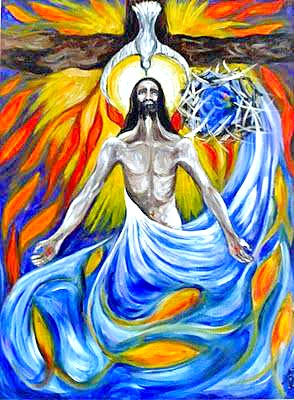
Jesus’ Baptism, by Laura James

With the Father’s affirmation of Christ, the Lord Jesus is our authority. All authority on heaven and earth has been given to him. He is the author and finisher of our faith. So we must pay careful attention to Jesus.

Here we are, two millennia removed from the earthly ministry of Christ. For some, the name of Jesus might be so familiar that they end up ignoring him. Or, others might become so disappointed with Jesus that, over time, they simply slip away from him. That’s why the author of the book of Hebrews exhorted: 

We must give our full attention to what we were told, so we won’t drift away. The message spoken by angels proved to be true, and all who disobeyed or rejected it were punished as they deserved. So if we refuse this great way of being saved, how can we hope to escape? The Lord himself was the first to tell about it, and people who heard the message proved to us that it was true. (Hebrews 2:1-3, CEV)

By remembering our own baptisms, and the authoritative claim Christ has upon us, we are able to keep what is most important in front of us at all times.

Why is the descent of the Holy Spirit significant?

If God the Father established the authority of Jesus over all things, then the Holy Spirit coming upon Jesus empowered him to exercise that authority over everything, especially the demonic realm. Jesus was given the Spirit so that he would confront evil in the world.

Our own baptisms are a participation in the baptism of Christ. We receive the same power. We are called to the same practice of self-denial in order to confront evil in our lives and in the world. The descent of the Spirit in Christ’s baptism opens to us a road of carrying our cross daily, and losing our lives in order to save them.

In Christ, we died to guilt and shame. We were baptized into Christ, and were therefore baptized into his death.  That means Jesus has opened the way for us to live a new life and no longer be slaves to sin. It furthermore means that we have been given the Spirit to deal with the continuing presence of sin in this life. 

Through Jesus Christ the Spirit of life set us free from sin and death. Therefore, we have been given the power to resist the devil and set our minds on what the Spirit desires. 

Baptism of Christ, by He Qi

So, we have an obligation, and it’s not to the sinful nature. Our responsibility is to put to death the misdeeds of the body. We can do this because we have not been given a spirit that makes us slaves to fear, but have received the spirit of sonship. (Romans 8:1-17)

Thus, God is not only Father of Jesus, but our Father, as well. We can cry “Abba and have all the help of heaven behind us in our quest to follow Jesus. This is all possible because of the descent of the Spirit in Christ’s baptism – a baptism that we participate in through our own baptisms.

How does heaven opening help me today?

Heaven was ripped and torn open, letting us know the striking reality that God does not remain far away, but has come near to us in the Son, the Lord Jesus.

Long ago in many ways and at many times God’s prophets spoke his message to our ancestors. But now at last, God sent his Son to bring his message to us. God created the universe by his Son, and everything will someday belong to the Son. God’s Son has all the brightness of God’s own glory and is like him in every way. By his own mighty word, he holds the universe together. After the Son had washed away our sins, he sat down at the right side of the glorious God in heaven. (Hebrews 1:1-3, CEV)

Heaven was again ripped open at the death of Christ. The curtain of the temple that separated the inner sanctuary from everything else was torn in two from top to bottom – signifying that once and for all, God is near, and has become close to us in the person of Jesus Christ.

So whenever we are in need, we should come bravely before the throne of our merciful God. There we will be treated with undeserved grace, and we will find help. (Hebrews 4:16, CEV)

What is our appropriate response to the baptism of the Lord?

Since Jesus is the rightful ruler of the universe; the authority over all things; a faithful high priest always living to intercede for us; the power to transform and give new life; the Deliverer from sin, death, and hell; then our proper response is confession, repentance, and the expectation of change.

The Lord’s baptism exposes all the things we rely upon other than Jesus, such as our own ability to set goals and accomplish them through sheer willpower; ideas and ingenuity; hard work and experience.

Yet we can rely on Jesus, and have the sort of change that he can bring. Rather than expecting everyone else, and every circumstance to change, God calls us to change through the empowering presence of the Holy Spirit – the same Spirit given to Jesus.

We have the opportunity and the invitation to trust Jesus. Just as it took humility for Jesus to be baptized by John in the Jordan River, so it takes humility for us to come to Christ and admit our need for help and inner transformation.

Almighty ever-living God,
who, when Christ had been baptized in the River Jordan,
and as the Holy Spirit descended upon him,
solemnly declared him your beloved Son,
grant that your children by adoption,
reborn of water and the Holy Spirit,
may always be well pleasing to you. Amen.

Remember Your Baptism (Matthew 3:13-17)

John baptizing Jesus with the Holy Spirit’s affirmation

Then Jesus came from Galilee to the Jordan to be baptized by John. But John tried to deter him, saying, “I need to be baptized by you, and do you come to me?”

Jesus replied, “Let it be so now; it is proper for us to do this to fulfill all righteousness.” Then John consented.

As soon as Jesus was baptized, he went up out of the water. At that moment heaven was opened, and he saw the Spirit of God descending like a dove and alighting on him. And a voice from heaven said, “This is my Son, whom I love; with him I am well pleased.” (New International Version)

Baptism is important. Remembering is important. Put together, remembering our baptism is highly important. Here’s why….

Baptism is important to Jesus

Baptism is the distinguishing mark or symbol of being a Christian. 

The New Testament actually knows nothing of an unbaptized Christian. That’s because the practice is tied to our identity as believers. Our baptisms are based in the baptism of the Lord who, in his Great Commission, told us to baptize in the name of the Father, Son, and Spirit (who were all present at Christ’s baptism). 

The absence of baptism is like a bride without a wedding ring; a football player not wearing a uniform; a motorcycle gang without tattoos; or like an Iowa farmer without a Pioneer seed corn hat!

Baptism is the outward sign that we belong to God. It is the distinguishing symbol that we have been adopted by God and will receive all the promises of salvation in Christ.

Christ’s baptism fulfilled all righteousness through identification with repentant people

John the Baptist was understandably hesitant to baptize Jesus; he knew Jesus had no need of repentance. Although Jesus had no sin to confess, his baptism is a powerful symbol of his humility. It anticipates his ministry to people who recognize their need for God. 

It was necessary for Jesus to be baptized in order to communicate solidarity with people who are coming to God. “Righteousness” means having a right relationship with both God and other people. By being baptized, Jesus is proclaiming that a renewed and right relationship with God will become a reality through himself. Baptism is the sign that we belong to God and that our righteousness is tied to our union with Jesus.

It was important for Jesus to identify with sinners; it is important for us, as well. We remember our baptism – that we belong to God – by identifying with “sinners.” Here are 7 ways of doing it:

  1. Practicing hospitality (love of strangers)
  2. Using our spiritual gifts of speaking and serving on their behalf
  3. Getting to know people very different from ourselves
  4. Meeting people on their turf (not just ours)
  5. Showing respect and upholding dignity
  6. Asking thoughtful and caring questions
  7. Listening with focused attention

It isn’t what we “do” for people that’s as important as affirming our shared humanity with them; thus leading folks to the ultimate person who can address the needs of their heart:  Jesus.

Christ’s baptism fulfilled all righteousness through the affirmation of witnesses

Before Jesus began his ministry, it was necessary to receive validation of what he was about to teach and do. In ancient Judaism, one of the protections guaranteeing that Scripture would be taught according to the way of God, was through an ordination, of sorts. In order for a new rabbi to become a new rabbi, he needed the laying on of hands from two other rabbis who had authority to do so. 

That’s why Christ’s baptism is important. John the Baptist was a powerful teacher and prophet who was recognized by the people as such. John publicly said he wasn’t worthy to carry Jesus’s sandals, that Jesus is the Lamb of God that takes away the sin of the world. So, a baptism by John validated Jesus and inaugurated his ministry. 

Baptism of Christ by Dave Zelenka

A second voice – another witness from heaven – affirmed Jesus: “This is my Son, the one I love. I am very pleased with him.” And then, the Holy Spirit, in the form of a dove, came upon Jesus. This further affirmed that Jesus would save people, not through arm-twisting and great shows of power, but through humility and gentleness.

Baptism was Christ’s first recorded act as an adult. In some ways, it was his first miracle – the miracle of humility in identifying with sinners.

Remember your baptism
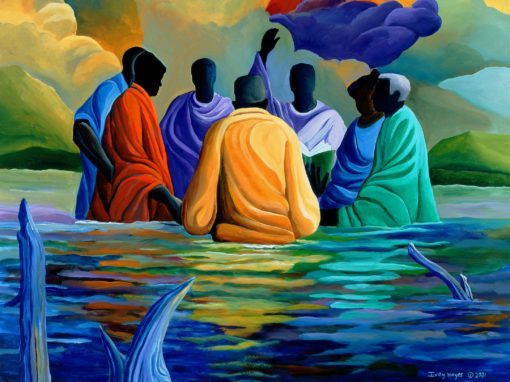
Baptism is a sign and seal of God’s grace. Just as Christ’s baptism focused all the promises of God in salvation as being fulfilled in one person, so in our baptism we claim all the promises of God as found in Jesus. Water symbolizes new life, God identifying with us – Immanuel, God with us.

In baptism, God promises and seals to us our union with Jesus so that identity is not found in my past and my profession of faith, but in Christ’s past of bringing redemption to us.  Baptism does not so much express faith as call one to a life of faith and sets us apart as belonging to God.

Baptism is a visible declaration of an invisible reality: union with Christ. Just as circumcision was the outward visible sign of the old covenant, so baptism is the sign of the new covenant in Christ – available to both male and female – thus opening the way for women to participate fully in the ministry of the gospel.

In particular, infant baptism confirms that salvation is not initiated by us, but by God. It affirms that one is betrothed to God. As a child, then an adult, grows into the faith, it is our task to remember our baptism, to be reminded that God’s mark is upon us, that we belong to the Lord. 

God has set us apart to be a holy people, given to Jesus to live as he did. We must never forget that baptism is God’s identifying mark upon us; that our union and solidarity with Jesus is affirmed through this practice.

We are not solitary Christians; we belong Christ and to one another. Baptism is the initiation rite that takes a lifetime to complete. Therefore, we must struggle together in working out our salvation.

Because of our union with Jesus Christ, we must remember:

  • I do not belong to the world. So, I will not live selfishly, only seeking my own comfort agenda. Instead, I will give and serve others from a pure and humble heart.
  • I do not belong to sin. So, I will not give myself over to shameful words or actions, to bullying or manipulating people, to throwing fits and pity parties to get my way, nor using my tongue to speak gossip, slander, or suck-up to others. Instead, I will use my speech wisely, building up others through thoughtful and heartfelt encouragement.
  • I do not belong to the devil. So, I will not seek his agenda of lying, cheating, stealing, and being bitter. 

I belong to Jesus, so therefore:

  • I will uphold biblical justice by championing the cause of the fatherless and the widow, the poor and the needy, the least and the lost among us.
  • I will love others with all the grace God gives me.
  • I will forgive others because Christ has forgiven me.
  • I will consider others better than myself by embracing the humility of Christ.
  • I will hunger and thirst for righteousness.
  • I will seek peace and pursue it.
  • I will, give myself to my Lord and Savior Jesus Christ my Savior and Lord – completely and thoroughly, unabashedly and unreservedly.
  • I will live into my baptism and remember it always because I belong to Jesus!