
Submission Is an Attitude (1 Peter 2:13-17)

For the sake of the Lord submit yourselves to every human authority: to the Emperor, who is the supreme authority, and to the governors, who have been appointed by him to punish the evildoers and to praise those who do good. For God wants you to silence the ignorant talk of foolish people by the good things you do. Live as free people; do not, however, use your freedom to cover up any evil, but live as God’s slaves. Respect everyone, love other believers, honor God, and respect the Emperor. (Good News Translation)

Submission is a word a lot of people would like to do without. And that’s understandable. We’ve all likely had the experience of being under the authority of someone who either didn’t know what they were doing, or who gaslighted us, took advantage of us, and maybe was even downright mean and nasty toward us. What’s more, it’s hard to obey someone or some institution who we aren’t quite sure has our best interests at mind.

And then there’s an association with the word “submission” as being forced to do something you don’t want to do. That sort of understanding of submission is actually slavery and oppression, not submission.

Simply put, to submit is the informed and willing choice to place oneself under the authority of another. If it isn’t a willing and informed choice, then it’s either manipulation or coercion by another.

The Apostle Peter was referring to submitting to human authority by a volitional choice of our will. And what he was encouraging believers to do was no small thing.

The Roman Empire was an ancient behemoth. At the time of Peter’s writing, the Romans were firmly in charge of Palestine – Gentile rule in a Jewish land – and they did not take kindly to any ideas of rebellion. The Jews wanted their own autonomy and rule. To be subject to the Romans was, for many, humiliating and unacceptable.

So, why in the world should anyone willingly choose to submit to an empire that doesn’t align with their values, aspirations, and goals in life?

Peter made it clear why: Submission helps clear away the obstacles to freedom (both personal and corporate) and doesn’t give the persons in authority a reason to speak or act foolishly.
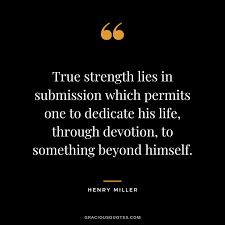
It’s hard to submit; it’s not an easy thing to do. Yet, if we will continually connect submission with why we are doing it, this helps us persevere, especially under leadership which is less than stellar.

The real issue is how we deal with unwanted circumstances in our lives. Although we didn’t ask for many of the unfortunate situations in life, our response to them is critical, and makes all the difference.

“Evil is changed into good when it is received in patience through the love of God; while good is changed into evil when we become attached to it through the love of self. True good lies only in detachment, and abandonment to God. You are now in the trial; put yourself confidently and without reserve into his hand.”

François Fénelon, Let Go: To Get Peace and Real Joy

Admittedly, it is maddening when an injustice is done to us, or we observe someone else experiencing something they don’t deserve. Unjust actions and words perpetrated against us are out of our control. What is, however, within our control is our response. We can choose how to react in each and every situation we face.

“Forces beyond your control can take away everything you possess except one thing, your freedom to choose how you will respond to the situation.”

Viktor Frankl, Man’s Search for Meaning

We, indeed, have a range of responses we may choose from: We can react in passive-aggressive anger, become sullen and morose, stuff all our emotions down and ignore them, lash out and verbally attack; or we can choose to accept the situation for what it is (and not what we want it to be) and submit ourselves to God.

All of you must put on the apron of humility, to serve one another; for the scripture says, “God resists the proud, but shows favor to the humble.” Humble yourselves, then, under God’s mighty hand, so that he will lift you up in his own good time. Leave all your worries with him, because he cares for you. (1 Peter 5:5-7, GNT)

Submission to God often comes in the form of submitting to the human authorities in our lives – even when those persons and institutions over us are imperfect. Systemic evil isn’t changed by our response of perpetrating even more evil back upon them. Rather, unjust structures are transformed through godly persons choosing to work within the system to do good, not harm, and to love, not hate.

Christian freedom is never a matter of simply doing whatever the heck you want to do, regardless of how it impacts anyone else. Our freedom is in the ability to make choices about what sort of attitude we are going to have in all the circumstances of life we encounter.

Don’t do anything from selfish ambition or from a cheap desire to boast, but be humble toward one another, always considering others better than yourselves. And look out for one another’s interests, not just for your own. The attitude you should have is the one that Christ Jesus had:

He always had the nature of God,
    but he did not think that by force he should try to remain equal with God.
Instead of this, of his own free will he gave up all he had,
    and took the nature of a servant.
He became like a human being
    and appeared in human likeness.
He was humble and walked the path of obedience all the way to death—
    his death on the cross. (Philippians 2:3-8, GNT)

Therefore, what we’re left with is the willing choice to alter our own life, instead of continually trying to make everyone else change. It comes down to showing respect for all humanity, honoring God with our attitudes, and loving our sisters and brothers in the faith who face the same sorts of challenges we do.

“When we are no longer able to change a situation, we are challenged to change ourselves.”

Viktor Frankl

Be safe. Be strong. Be spiritual. We are all in this life together.

Don’t Let Suffering Surprise You (1 Peter 4:12-19)

Dear friends, do not be surprised at the fiery ordeal that has come on you to test you, as though something strange were happening to you. But rejoice inasmuch as you participate in the sufferings of Christ, so that you may be overjoyed when his glory is revealed. 

If you are insulted because of the name of Christ, you are blessed, for the Spirit of glory and of God rests on you. If you suffer, it should not be as a murderer or thief or any other kind of criminal, or even as a meddler. 

However, if you suffer as a Christian, do not be ashamed, but praise God that you bear that name. For it is time for judgment to begin with God’s household; and if it begins with us, what will the outcome be for those who do not obey the gospel of God? And,

“If it is hard for the righteous to be saved,
    what will become of the ungodly and the sinner?”

So then, those who suffer according to God’s will, should commit themselves to their faithful Creator and continue to do good. (New International Version)

In a culture of toxic positivity, we can never quite bring ourselves around to the reality of suffering. Being uncomfortable with the unwanted emotions associated with suffering seems to be the modus operandi of the Western world.

Like it, or not, none of us gets off this fallen planet without experiencing a host of circumstances we neither asked for nor wanted. And no amount of plastic smiles, fake-it-till-you-make-it approaches, and spin doctoring of attitudes will ever take the pain completely away – or even fully understand it’s mystery. In the long run, whitewashing pain only exacerbates the suffering.

Yet, despite all hardship and hurt, joy and the ability to rejoice still remains a necessary part of life, even in the worst of situations. The problem is: We tend to believe that we cannot hold seemingly opposing feelings at the same time – even though we actually do it all the time.

When the youngest child leaves home and the parents are empty nesters, they feel the simultaneous emotions of proud joy and deep sadness.

And when an aging parent or grandparent dies, the family experiences the bittersweet feelings of knowing that suffering is ended, yet also this dear loved one is gone from us.

Or when you are treated unfairly and spoken of unkindly, there is a mix of emotions from anger about what is happening to some sense of peace that this person or group of people have shown their real colors to the world.

I am going to make one of the simplest observations about God’s people in the Bible: they suffered; they were seen.

Whether Abel dying by the hand of his own brother, Noah enduring the ridicule of his neighbors, Abraham facing an uncertain future, Jeremiah weeping over Jerusalem’s calloused destruction, or Paul enduring persecution, everyone who wants to live a godly life will face suffering.

Every New Testament Epistle has a message about how to handle the inevitability of human suffering.

Fifth Station of the Cross, by Candido Portinari, 1953

The Apostle Peter, in his epistle, made it clear that every Christian should neither be surprised nor shocked when they suffer. If our Lord suffered (which he did, even to the extreme) then we, too, will also suffer, as those who follow him. 

Yet, Peter balances the harsh reality of suffering with the need for followers of Jesus to properly interpret that suffering. The Apostle learned the hard way that our means of accepting, coping with, and transcending hardship is by interpreting our personal suffering in light of Christ’s own suffering.

He insisted that the Christian’s suffering is a privilege, even a blessing. It is a mark of belonging – a sign that God’s Spirit is within us. 

If we do stupid things, we face the consequences for our foolishness. But when we do the good, right, and altruistic thing – then suffer some adverse effect – it puts us in solidarity with Christ. We can be glad for the chance to suffer as Christ suffered. It prepares the believer for even greater happiness when Jesus returns to judge the living and the dead.

I’m under no illusions or delusions here. Interpreting our suffering through specifically Christian lenses is no easy task. Sometimes it’s rough and downright hard. And it gets complicated when the suffering doesn’t let up and is compounded daily for weeks, months, even years at a time.

So, what shall we do in such times? Peter says that if your suffering originates in obedience to God, then keep the faith, keep on doing the right, the just, and the good thing.

A bad attitude, giving up, and revenge are not options on the table for the Christian. I believe most followers of Jesus understand that. The greater temptation, however, is a more subtle and insidious approach toward suffering: going with “meh.”

“Meh” is a spiritual, emotional, and mental stance of simply going with the flow, getting along on the surface of things, and hoping all the unpleasantness goes away soon. In facing the adversity with all it’s painful suffering, the “meh” person just shrugs their shoulders and says, “Meh, whatever; what’s a guy to do, anyway?”

Thanks for asking. We persevere. Don’t let suffering surprise you when it shows up at your door like an unwanted guest. Here’s some practical ways of getting through it:

  1. Tell your story to others and don’t go it alone and be the martyr. We already have a Martyr, and his name is Jesus.
  2. Do something that isn’t nothing. Avoid piddly busywork. Instead, when renewal and rest are needed, read a good book or have a stimulating conversation.
  3. Have a support system in place before suffering comes upon you. Trials to faith will happen. It will be overly difficult to face them without a community of persons around you.
  4. Ask for help, for God’s sake! People are hard-wired by their Creator for community. Rugged individualism is a myth; it doesn’t exist and isn’t even possible.
  5. Be comfortable with being uncomfortable. Comfort is not the summum bonum of life. Hedonism only masks pain and does not take it away. Expand your ability to handle diverse situations.
  6. Realize that Christianity is a process of becoming more and more like Jesus Christ. Christianity is not a one-and-done uttering a sinner’s prayer and waiting to cash-in a divine life insurance policy in order to stay out of hellfire. If you actually believe this, I suggest reading the Bible.
  7. Keep living your life. The earth is still spinning on its axis. The sun will still come up in the morning. God’s steadfast and faithful love will still be waiting for you when you wake up.

God sees and will vindicate the godly attitude, the ongoing work, and all the blood, sweat, and tears that go with our commitment to Christ and perseverance in the faith.

You’re already signed-up for suffering just by being a person. Welcome to the human condition. What will you do with your pain?

Saving and sustaining God, it is a small thing for me to suffer in light of your great suffering on my behalf through the cross. Empower me, and all your people everywhere, to do right every day so that praise, glory, and honor for Jesus Christ will always be on my lips through the enablement of the Holy Spirit. Amen.

2 Samuel 1:4-27 – Express Your Grief

“What happened?” David asked. “Tell me.”

“The men fled from the battle,” he replied. “Many of them fell and died. And Saul and his son Jonathan are dead.”

Then David said to the young man who brought him the report, “How do you know that Saul and his son Jonathan are dead?”

“I happened to be on Mount Gilboa,” the young man said, “and there was Saul, leaning on his spear, with the chariots and their drivers in hot pursuit. When he turned around and saw me, he called out to me, and I said, ‘What can I do?’

“He asked me, ‘Who are you?’

“‘An Amalekite,’ I answered.

“Then he said to me, ‘Stand here by me and kill me! I’m in the throes of death, but I’m still alive.’

“So, I stood beside him and killed him, because I knew that after he had fallen he could not survive. And I took the crown that was on his head and the band on his arm and have brought them here to my lord.”

Then David and all the men with him took hold of their clothes and tore them. They mourned and wept and fasted till evening for Saul and his son Jonathan, and for the army of the Lord and for the nation of Israel, because they had fallen by the sword.

David said to the young man who brought him the report, “Where are you from?”

“I am the son of a foreigner, an Amalekite,” he answered.

David asked him, “Why weren’t you afraid to lift your hand to destroy the Lord’s anointed?”

Then David called one of his men and said, “Go, strike him down!” So, he struck him down, and he died. For David had said to him, “Your blood be on your own head. Your own mouth testified against you when you said, ‘I killed the Lord’s anointed.’”

David took up this lament concerning Saul and his son Jonathan, and he ordered that the people of Judah be taught this lament of the bow (it is written in the Book of Jashar):

“A gazelle lies slain on your heights, Israel.
    How the mighty have fallen!

“Tell it not in Gath,
    proclaim it not in the streets of Ashkelon,
lest the daughters of the Philistines be glad,
    lest the daughters of the uncircumcised rejoice.

“Mountains of Gilboa,
    may you have neither dew nor rain,
    may no showers fall on your terraced fields.
For there the shield of the mighty was despised,
    the shield of Saul—no longer rubbed with oil.

“From the blood of the slain,
    from the flesh of the mighty,
the bow of Jonathan did not turn back,
    the sword of Saul did not return unsatisfied.
Saul and Jonathan—
    in life they were loved and admired,
    and in death they were not parted.
They were swifter than eagles,
    they were stronger than lions.

“Daughters of Israel,
    weep for Saul,
who clothed you in scarlet and finery,
    who adorned your garments with ornaments of gold.

“How the mighty have fallen in battle!
    Jonathan lies slain on your heights.
I grieve for you, Jonathan my brother;
    you were very dear to me.
Your love for me was wonderful,
    more wonderful than that of women.

“How the mighty have fallen!
    The weapons of war have perished!” (New International Version)

Character is revealed by both attitude and action. It seems likely the Amalekite would have lived if he had any, at all.

But instead, the Amalekite tried to act as if he knew David. It became very apparent, he didn’t really know David, at all.

By claiming responsibility for King Saul’s death, the Amalekite sealed his own. David spent months outrunning and outwitting Saul, trying his best to stay alive, while at the same time, carefully avoiding killing Saul. In assuming Saul’s death would be good news to David, the Amalekite went full braggadocio, looking to impress, as well as get a reward.

He got a reward, alright.

David’s attitude could not be any more different than the Amalekite’s. Whereas the Amalekite had a small and selfish attitude, David had a magnanimous attitude. David had suffered much because of Saul, and yet held firm in his commitment to God and to the king.

Our attitudes and our actions truly reveal what is in our hearts.

Because David had an attitude which reflected that he knew God, he therefore genuinely grieved and lamented the deaths of both King Saul and Saul’s son, Jonathan.

Bereavement, grief, and lament are, unfortunately, scarce words in the English language. But those words were not strange or stingy with David. He shows us the good path to follow in facing significant loss and change.

David’s grief was not only personal but public. He crafted a lament and had everyone learn it and say it. Indeed, grief may be intensely personal, yet it most definitely needs a public outlet.

Tears, questions, sorrow, anger, anxiety, and sadness are all the normal and necessary expressions of working through the death of someone close to us. The only bad grief is unexpressed grief. It sits idle, deep inside one’s personhood. Over time, it becomes gangrene of the soul.

Many deaths are bittersweet. It may be an end of suffering for the deceased, but it is also the beginning of suffering for those left behind. Sometimes Christians forget that death is a result of humanity’s fall. There is nothing to rejoice over with death; it is something to mourn over.

We need to become comfortable with talking about death, bereavement, and all the emotions that come with it. Methinks this is a chief reason for so many improper attitudes, like that of the ancient Amalekite with David.

Unexpressed grief neither disappears nor goes away. It eventually comes out sideways, usually harming both ourselves and others.

To grieve and lament simply means that we tell our story – which requires someone to listen without criticism or invalidating our feelings.

David was able to respond the way he did because of his closeness to God. For even and especially God grieves over significant losses. It is the proper and right attitude.

My God, my God, why have you forsaken me?
    Why are you so far from helping me, from the words of my groaning?
O my God, I cry by day, but you do not answer;
    and by night but find no rest….

He did not despise or abhor
    the affliction of the afflicted;
he did not hide his face from me,
    but heard when I cried to him….

To him, indeed, shall all who sleep in the earth bow down;
    before him shall bow all who go down to the dust,
    and I shall live for him. Amen.
(Psalm 22:1-2, 24, 29, NRSV)

Philippians 2:5-11 – Descending Into Greatness

In your relationships with one another, have the same mindset as Christ Jesus:

Who, being in very nature God,
    did not consider equality with God something to be used to his own advantage;
rather, he made himself nothing
    by taking the very nature of a servant,
    being made in human likeness.
And being found in appearance as a man,
    he humbled himself
    by becoming obedient to death—
        even death on a cross!

Therefore, God exalted him to the highest place
    and gave him the name that is above every name,
that at the name of Jesus every knee should bow,
    in heaven and on earth and under the earth,
and every tongue acknowledge that Jesus Christ is Lord,
    to the glory of God the Father. (New International Version)

So, what kind of people (and what kind of church) would we be if we resembled these verses of Holy Scripture?  

The Apostle Paul said to the church in Philippi that their “attitude” or “mindset” should be the same as Christ Jesus. Their thinking ought to be like the mind of Christ. To think well, live well, and be well, we need the mind of Christ.

To relate to others in a godly way, to navigate this fallen world with integrity and truth, to make an impact on those around us, we must adopt the mindset and attitude of Jesus.  

Everything comes down to God – how we should think and how we ought to live. Within the life of the one true God, exists three persons: Father, Son, and Spirit. Within the Holy Trinity, there exists perfect love, absolute holiness, united harmony, and constant respect. 

Just as God is holy, we are to be holy.

Therefore, once you have your minds ready for action and you are thinking clearly, place your hope completely on the grace that will be brought to you when Jesus Christ is revealed. Don’t be conformed to your former desires, those that shaped you when you were ignorant. But, as obedient children, you must be holy in every aspect of your lives, just as the one who called you is holy. It is written, You will be holy, because I am holy. (1 Peter 1:13-16, CEB)

Just as God is love, so we are to love one another.

Dear friends, we should love each other, because love comes from God…. This is how God showed his love to us: He sent his one and only Son into the world so that we could have life through him. This is what real love is: It is not our love for God; it is God’s love for us. He sent his Son to die in our place to take away our sins. Dear friends, if God loved us that much, we also should love each other. (1 John 4:7-11, NCV)

Just as Jesus is a humble servant, so we are to practice humble service in all relationships.

Everyone must live in harmony, be sympathetic, love each other, have compassion, and be humble. Don’t pay people back with evil for the evil they do to you, or ridicule those who ridicule you. Instead, bless them, because you were called to inherit a blessing. (1 Peter 3:8-9, GW)

Humility is vital to Christian existence, and not optional. There is no place in the believer’s life for pride, posturing, and power-broking. Instead, we are to take the posture of lowliness, using any kind of influence for the benefit and encouragement of others – just like Jesus did while on this earth. 

In a world pre-occupied with power and control, safety and security, influence and throwing its weight around, there is Jesus. Christ did the opposite of engaging in upward mobility; he practiced downward mobility. In doing so Jesus Christ descended into greatness as Lord and Savior.

To have the mind and attitude of Christ happens through emulating our Lord’s example of humility. Jesus is God. Yet, despite that reality, the pre-incarnate Christ did not sit in heaven as the second person of the Trinity and hold onto his lofty position with tight fists. 

Jesus came to this earth with a humble willingness to open his hands and relinquish his rights and privileges as God. Christ divested himself of all his privilege. He became a slave. Jesus gladly emptied himself and held nothing back. Christ completely gave himself up for us.

Jesus became one of us, yet never ceased being the Lord of all. It’s just that he willingly put his kingly robe in the closet and put on Dickies and work boots. Jesus came among us and purposely limited himself to identify with us fully – and secured for us the greatest generosity imaginable: an answer to the problem of guilt and shame through forgiveness of sins.

Jesus became a servant, a bond-slave. Christ completely tied himself to us, not coming to this earth seeking to be served, but serving and giving his life as a ransom for many. 

What’s more, Christ kept going lower and lower to the point of descending to the greatest humiliation and shame of all – death on a cross. The King of the universe was killed by sinful humanity so that he might redeem and save those very same people from their terrible plight of bondage to the power of sin.

Therefore, we are to be humble, embracing the lowly status of being slaves to God and to one another. The Philippian church had a real problem with pride. Hear the exhortations given to the Philippian church so that they would practice humility in all their relationships: 

  • Live your life in a manner worthy of the gospel of Christ, so that, whether I come and see you or am absent and hear about you, I will know you are standing firm in one spirit, striving side by side with one mind for the faith of the gospel (Philippians 1:27, NRSV)
  • Don’t be jealous or proud but be humble and consider others more important than yourselves. (Philippians 2:3, CEV)
  • You must continue to live in a way that gives meaning to your salvation. (Philippians 2:12, ERV)
  • Do all things without murmuring and arguing. (Philippians 2:14, NRSV)
  • Brothers and sisters, imitate me, and pay attention to those who live by the example we have given you. (Philippians 3:17, GW)
  • Do not be anxious [tight-fisted control] about anything, but in every situation, by prayer and petition, with thanksgiving [open-handed humility] present your requests to God. (Philippians 4:6, NIV)

As a result of Christ’s humble obedience to the Father, he was exalted from the lowest place to the highest place. King Jesus is on the throne, above everyone and everything. Because of his descent to this earth, he ascended in glory and honor. We now see God in a new way, through Jesus – and it causes us to bend the knee and confess with the tongue that Jesus Christ is Lord.

In the ancient Roman world, Jesus as Lord was subversive language. Because if Jesus is Lord, Caesar is not, and ultimate allegiance does not belong to the Empire. And it is no different in our day. The issue of who we pledge our fealty to, still pertains to us. If Jesus is Lord, no earthly politician or religious figure is owed lordship status.

To follow Jesus, one must practice downward mobility and embrace humility.

Bowing the knee to Christ becomes second nature whenever we give our unflagging allegiance to him. We accept that we are the creatures and God is the Creator, that God is God, and we are not.

As we enter Holy Week, hear the prophet Isaiah’s words of humiliation and exaltation:

Just watch my servant blossom!
    Exalted, tall, head and shoulders above the crowd!
But he didn’t begin that way.
    At first everyone was appalled.
He didn’t even look human—
    a ruined face, disfigured past recognition.
Nations all over the world will be in awe, taken aback,
    kings shocked into silence when they see him.
For what was unheard of they’ll see with their own eyes,
    what was unthinkable they’ll have right before them.

Who believes what we’ve heard and seen?
    Who would have thought God’s saving power would look like this?

The servant grew up before God—a scrawny seedling,
    a scrubby plant in a parched field.
There was nothing attractive about him,
    nothing to cause us to take a second look.
He was looked down on and passed over,
    a man who suffered, who knew pain firsthand.
One look at him and people turned away.
    We looked down on him, thought he was scum.
But the fact is, it was our pains he carried—
    our disfigurements, all the things wrong with us.
We thought he brought it on himself,
    that God was punishing him for his own failures.

But it was our sins that did that to him,
    that ripped and tore and crushed him—our sins!
He took the punishment, and that made us whole.
    Through his bruises we get healed.
We’re all like sheep who’ve wandered off and gotten lost.
    We’ve all done our own thing, gone our own way.
And God has piled all our sins, everything we’ve done wrong,
    on him, on him.

He was beaten, he was tortured,
    but he didn’t say a word.
Like a lamb taken to be slaughtered
    and like a sheep being sheared,
    he took it all in silence.
Justice miscarried, and he was led off—
    and did anyone really know what was happening?
He died without a thought for his own welfare,
    beaten bloody for the sins of my people.
They buried him with the wicked,
    threw him in a grave with a rich man,
Even though he’d never hurt a soul
    or said one word that wasn’t true.

Still, it’s what God had in mind all along,
    to crush him with pain.
The plan was that he give himself as an offering for sin
    so that he’d see life come from it—life, life, and more life.
    And God’s plan will deeply prosper through him.

Out of that terrible travail of soul,
    he’ll see that it’s worth it and be glad he did it.
Through what he experienced, my righteous one, my servant,
    will make many “righteous ones,”
    as he himself carries the burden of their sins.
Therefore I’ll reward him extravagantly—
    the best of everything, the highest honors—
Because he looked death in the face and didn’t flinch,
    because he embraced the company of the lowest.
He took on his own shoulders the sin of the many,
    he took up the cause of all the black sheep. (Isaiah 52:13-53:12, MSG)

Lord Jesus, Son of God, you walked the earth with humility, despite being Lord of all. Your meekness confused the proud and arrogant. Your nobly attended to the needy and destitute. Teach me to model my life after you, to live with a humble spirit. Help us to never view ourselves as greater or better than others. Let our hearts always imitate your humility. Amen.