Oppressors Are On Notice (Nahum 1:1-13)

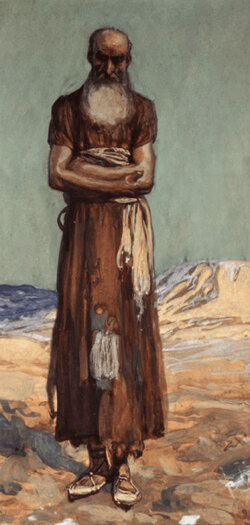
Nahum, by James Tissot, 1888

A prophecy concerning Nineveh. The book of the vision of Nahum the Elkoshite.

The Lord is a jealous and avenging God;
    the Lord takes vengeance and is filled with wrath.
The Lord takes vengeance on his foes
    and vents his wrath against his enemies.
The Lord is slow to anger but great in power;
    the Lord will not leave the guilty unpunished.
His way is in the whirlwind and the storm,
    and clouds are the dust of his feet.
He rebukes the sea and dries it up;
    he makes all the rivers run dry.
Bashan and Carmel wither
    and the blossoms of Lebanon fade.
The mountains quake before him
    and the hills melt away.
The earth trembles at his presence,
    the world and all who live in it.
Who can withstand his indignation?
    Who can endure his fierce anger?
His wrath is poured out like fire;
    the rocks are shattered before him.

The Lord is good,
    a refuge in times of trouble.
He cares for those who trust in him,
    but with an overwhelming flood
he will make an end of Nineveh;
    he will pursue his foes into the realm of darkness.

Whatever they plot against the Lord
    he will bring to an end;
    trouble will not come a second time.
They will be entangled among thorns
    and drunk from their wine;
    they will be consumed like dry stubble.
From you, Nineveh, has one come forth
    who plots evil against the Lord
    and devises wicked plans.

This is what the Lord says:

“Although they have allies and are numerous,
    they will be destroyed and pass away.
Although I have afflicted you, Judah,
    I will afflict you no more.
Now I will break their yoke from your neck
    and tear your shackles away.” (New International Version)

I’m willing to wager you’ve never heard a sermon on the Old Testament book of Nahum. It’s unfortunate that many Bible-readers have never read the prophecy of Nahum, let alone know that this book even exists in Holy Scripture.

Each individual book of the Bible has its own particular message that is wise for us to understand. Although Nahum’s prophecy is against the long-dead empire of Assyria, it still contains a timeless message for us.

Nineveh

The capital city of Assyria, Nineveh, was a large and influential city in the centuries of 600-900 B.C.E. The Assyrians were a cruel people even by ancient standards. Their army was feared, and rightly so. Army officers were experts at torture, having turned it into an art form with all kinds of different ways of killing and maiming captured people from their conquests.

The prophet Nahum focused on the sure destruction of Nineveh, and the overwhelming judgment and justice of God. And at the same time, Nahum was also attuned to the great and many sins of Israel – their predilection for idolatry and immorality, as well as their purposeful ignoring of social responsibilities.

No matter who we are, or where we are from, the Lord God, the Almighty, shows no favoritism in condemning the guilty, and upholding the innocent. Unlike us, who have a nasty tendency toward practicing cronyism, bigotry, and ethnocentrism, Yahweh extends grace, judgment, and fairness in an even-handed way.

We humans also have a bent toward emphasizing one trait of God over another. There are those who talk only of love when it comes to the Lord; and others who always speak of God’s wrath and judgment.

Yet, in truth, God is the sovereign Lord of both wrath and love, judgment and grace. And, if we are able to hear it, God’s wrath is an expression of God’s love – not willing for oppression and violence to run amok among the powerless.

What’s more, God’s love has a penetrating way of arousing the conscience and bringing deep conviction of guilt for things we have done, and have left undone. So, when we talk of God, let us keep in mind that God is the Lord of both wrath and love, judgment and grace.

Nahum described Yahweh as a powerful God who is the avenging Lord against violence, cruelty, and injustice. If this God can make mountains move, oceans froth, and the earth heave, then no one, including the mighty Assyrian warriors, can stand against Yahweh’s indignation.

It is also true that with the Lord God there is abundant goodness which provides protection for those who seek refuge in Yahweh. Throughout Holy Scripture, including the prophecy of Nahum, divine vengeance and wrath is continually set in the context of divine mercy and grace.

Because God is holy and just, sovereign and powerful, God is Judge of the nations. Mercy only really has meaning when wrath is necessary. If everything were always unicorns and bunny rabbits, there would never be a need for mercy. But we live in a terribly broken world in which oppression and cruelty too often make sinister inroads into our lives.

Although the Lord is slow to anger and God’s fuse is long, divine patience has its limits. Yahweh does not let calloused hearts and selfish minds go on with impunity. Eventually, there will be hell to pay.

God saw all the foolish destruction and misery that Assyria brought to others. And so, Nineveh would see their own terrible destruction. This is why we now talk of Assyria as a long-past ancient empire; they no longer exist in any way, shape, or form. The Lord wiped the Assyrians off of the map.

As for Judah, there would be comfort. Even though it was true that God used the Assyrians to extend judgment upon Israel, there was also merciful relief and gracious rest from Assyria for the people.

With God, relief, rest, and recovery are sure and certain. Violence and oppression shall not last. Mercy always ends up winning the day.

This is most assuredly good news for us who seek the just, the right, and the good in this fallen world. The foolish decisions of contemporary politicians shall not win the day. God will have the final word on all things.

In a time when it seems the other shoe keeps dropping, we can be a hopeful people, because there is a transcendent God in heaven who sees it all, and will have mercy upon the innocent, while judging the guilty.

Therefore, those who engage in grift, corruption, violence, and cruelty, with no concern for the weak and needy, will eventually find themselves on the side of God’s vengeful wrath.

Whereas, those who are powerless against an evil misuse of authority, eventually they will know what it is to experience hope and deliverance from that evil. They shall know safety and perfect peace.

The overarching message of Nahum is that God is sovereign over all the world and all of history. The Lord will judge and love according to God’s own sense of divine wrath and divine grace.

Since God is the ultimate champion of the frustrated and the helpless, God will by no means acquit the guilty. The universe is God’s dominion, and in this dominion, violence, corruption, and oppression will face an awesome judgment which eradicates evil.

No nation, no person, and no government can withstand the God who is over all. Every corrupt person, especially politicians who have their eye only on themselves, should be on notice.

O God, by whom the meek are guided in decision-making, and light rises up in darkness for the godly: Grant us, in all our doubts and uncertainties, the grace to ask what you would have us to do, so that the Spirit of wisdom may save us from all false choices, and that in your light we may see light, and in your straight path may not stumble; through Jesus Christ our Lord. Amen.


From Adversaries to Allies (Isaiah 19:18-25)

In that day five cities in Egypt will speak the language of Canaan and swear allegiance to the Lord Almighty. One of them will be called the City of the Sun.

In that day there will be an altar to the Lord in the heart of Egypt, and a monument to the Lord at its border. It will be a sign and witness to the Lord Almighty in the land of Egypt. When they cry out to the Lord because of their oppressors, he will send them a savior and defender, and he will rescue them. 

So the Lord will make himself known to the Egyptians, and in that day they will acknowledge the Lord. They will worship with sacrifices and grain offerings; they will make vows to the Lord and keep them. The Lord will strike Egypt with a plague; he will strike them and heal them. They will turn to the Lord, and he will respond to their pleas and heal them.

In that day there will be a highway from Egypt to Assyria. The Assyrians will go to Egypt and the Egyptians to Assyria. The Egyptians and Assyrians will worship together. In that day Israel will be the third, along with Egypt and Assyria, a blessing on the earth. The Lord Almighty will bless them, saying, “Blessed be Egypt my people, Assyria my handiwork, and Israel my inheritance.” (New International Version)

Yahweh is so much more than an ancient local Israelite deity. This is the Lord God almighty, creator of heaven and earth. God is the Lord of the universe, and Israel is not just a sliver of land in the Middle East.

As such, all peoples belong to God. And God is concerned for all the nations. In the ancient world, the Lord was even concerned for places like Egypt and Assyria – two nations which historically treated Israel with contempt and oppression.

The Lord God, Yahweh, as the prophet Isaiah stated, will be revealed to the Egyptians, so that they, too, will worship the Lord with sacrifices and offerings. They will revere God with a monument to Yahweh’s saving power.

The Egyptians will make religious vows and fulfill them. And there will also be relations with Assyria. Israel will exist alongside – and literally geographically in the middle – the powers of Egypt and Assyria. And Israel will serve as a blessing between them.

In other words, God will choose to bless, bringing both religious and political balance and peace. It is rather extraordinary that the Lord speaks of Egypt as “my people” and Assyria as “my handiwork.” God’s vision is always much larger than our own puny human sight or imagination.

In a biblical book filled with sad visions of judgment and God’s wrath, today’s Old Testament lesson is a beautiful vision of hope and peace. This, my friends, is what can be! It doesn’t have to be a pipe dream that various peoples who are historical enemies of one another can walk together in the peace and wholeness of God’s blessing. This is no impossible, although it appears highly improbable.

It takes little effort to hold onto hate and enmity; but it takes a great deal of energy to work on peacemaking, and loving those who have harmed others so terribly.

The fact of the matter is that Yahweh responds to every people who cry out in their oppression – even those who were once oppressors themselves.

That is called “grace,” and it is why grace is so scandalous, because a lot of folks don’t want to see grace extended to those they dislike, hate, and even want dead.

God will do for other nations what God did for Israel, in delivering them from their harsh slavery. The Lord’s ears hear everyone on the earth, and not just some people.

All of the hard-hearted resistance of the past, personified so stubbornly in the Pharaoh who would not let go of Israel, is remarkably overcome and reversed.

This is how it always seems to operate throughout history, including today. People cry out and are delivered, then worship the God who granted them grace and freedom. We very often come to believe because we were in some sort of awful trouble, which caused us to cry out and acknowledge the God who saves.

God both strikes and heals, attacks and helps. God moves people from rancorous relationships to robust reconciliation.

People, however, are not passive in any of this process. Those who are already blessed and enjoy God must relinquish any sort of exclusive thoughts or practices and be willing to share their identity and privilege with others who were once enemies.

Unity, harmony, wholeness, and a true ecumenical spirit and vision will bring people together. The benefits are wonderful, yet let it also be acknowledged that reconciliation and relationships require giving up any sense of being better than the other, or holding on to primacy of positions and power.

Stated positively, it means that we embrace a diversity of people, including them in every way possible, because we discern them as being equals, and not so different from me.

God has other chosen people besides me and you. Can you accept that?

“Egypt comes home to its true self only as Israel opens its sense of privilege to its adversaries.”

Walter Brueggemann

The Lord opposes the arrogant and proud, but gives grace to the humble. God will gladly deliver and welcome all peoples.

If we have the spiritual eyes to see, we will notice and observe that the world is God’s chosen people.

O God, hear our humble prayer, so that we may serve you in holiness and faith, giving voice to your divine presence among us until the coming of your Son, Jesus Christ, who lives and reigns forever and ever. Amen.          

How To Live When Things Are Bad (Isaiah 33:10-16)

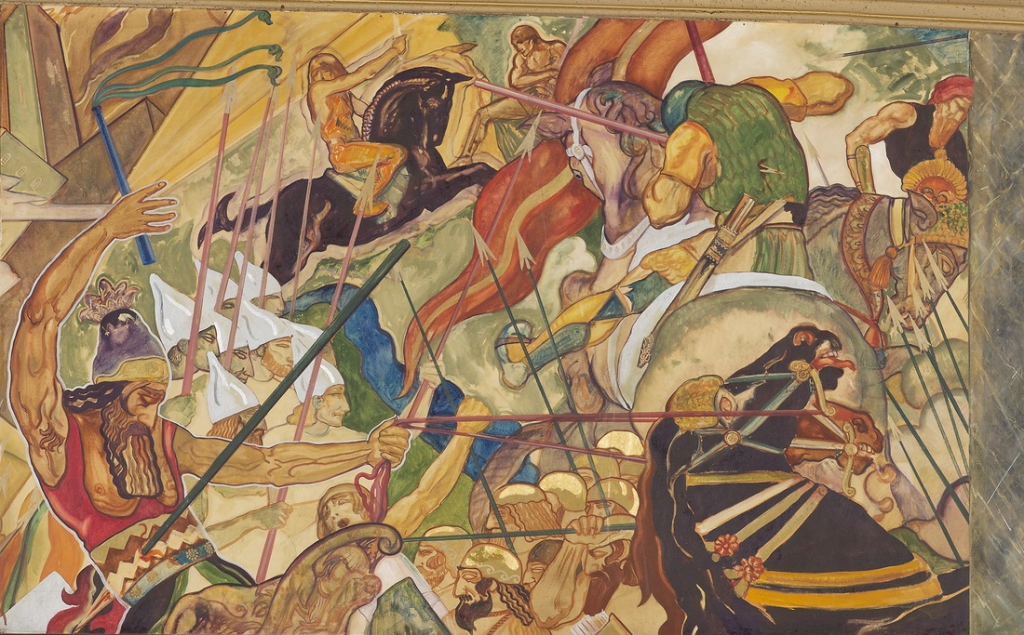
Mural depicting the wars of Israel and Judah with the surrounding nations, Wilshire Boulevard Temple, Los Angles

But the Lord says: “Now I will stand up.
    Now I will show my power and might.
You Assyrians produce nothing but dry grass and stubble.
    Your own breath will turn to fire and consume you.
Your people will be burned up completely,
    like thornbushes cut down and tossed in a fire.
Listen to what I have done, you nations far away!
    And you that are near, acknowledge my might!”

The sinners in Jerusalem shake with fear.
    Terror seizes the godless.
“Who can live with this devouring fire?” they cry.
    “Who can survive this all-consuming fire?”
Those who are honest and fair,
    who refuse to profit by fraud,
    who stay far away from bribes,
who refuse to listen to those who plot murder,
    who shut their eyes to all enticement to do wrong—
these are the ones who will dwell on high.
    The rocks of the mountains will be their fortress.
Food will be supplied to them,
    and they will have water in abundance. (New Living Translation)

The Assyrians were a nasty bunch. So were the people of Jerusalem, at the time of Isaiah’s prophecy. Maybe the folks in Judah played the comparison game and thought they were better than their foe. After all, the Assyrians were experts in war and torture.

Jerusalem was understandably terrified of the Assyrian army. And they trusted God, that is, to a degree. There’s a difference between looking to the Lord because you’re between a rock and a hard place, and placing faith in God because that is the default response of your life.

Easy for me to say. I’ve never stood on a city wall watching a powerful army surrounding me like a bunch of bullies on the playground.

Jerusalem was intimidated to the point of letting the Assyrian ruffians take their gold and silver. Well, actually, it wasn’t their gold; it was God’s. And when the army left, the city was still intact. But for how long?

It was humiliating. Being the victim of a bully always is. And because they’re bullies, it’s never enough. Like feeding the neighbor’s cat, the Assyrians end up going nowhere. They want more. In fact, they never really intended on leaving anyway. It was all a double-cross.

Judah, out of their fear and anxiety, made a bargain with the devil. A bully is a bully because they can be. Give in to them, and it only enables them to keep bullying. The Assyrians were ready for battle. It’s what they always did: fight and conquer.

It was at this point that Jerusalem finally got the clue that they’d been living with God in the background, not the foreground. They did their own thing, much like the hated and dreaded Assyrians.

So, the only recourse the people of Judah had was the mercy of their God. Yet, even though they ought to have petitioned the Lord from the get-go, at least they noticed the Lord is still there.

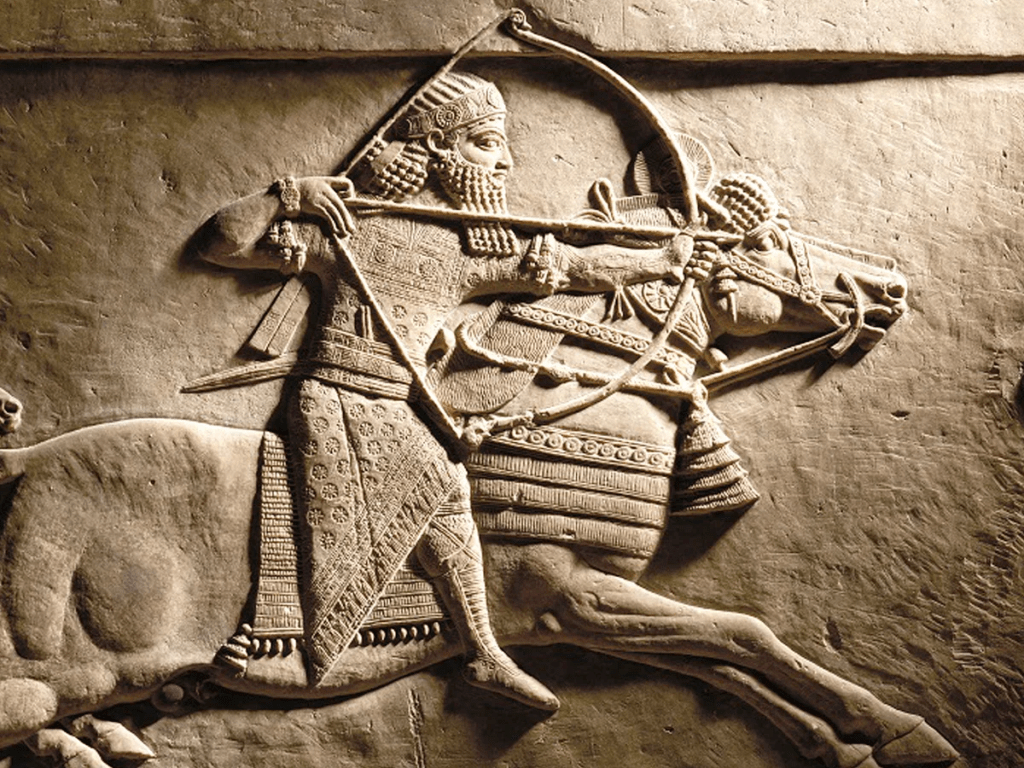
Assyrian king, British Museum

Unfortunately, most of our repentant overtures are way overdue. And yet, because of divine grace, the crazy mess we make of our lives is the very same place where a merciful God meets us.

Any sort of help is surely undeserved. It always is. The Lord, however, avoids making us grovel in our own vomit. God accepts us where we are, and not where we ought to be.

In truth, we all need to make a change, and not just the bullies. The sheer reality of God demands that we pay attention to what is right, just, and good. And the prophet Isaiah informed the people exactly how we must live in a world full of bullies and busted dreams.

We are to have an awareness of ethics and morality, a concern for humanity, and an orientation to help everyone thrive and flourish in this life.

The answer to life’s question of how to exist in this world and do more than just survive comes down to human morality:

  • Live right
  • Speak the truth
  • Despise exploitation
  • Refuse bribes
  • Reject violence
  • Avoid evil pleasures

The safe and stable way to live is to participate in the rhythms of mercy and justice that are woven into the fabric of the universe. The path to a contented and satisfying life is through goodness, not hatred.

Security and satisfaction don’t come through control of all circumstances; it comes by discerning that God has ultimate control, and that this God is good, not evil; just, not unjust; and righteous, not capricious.

According to the prophet, God will determine when the suitable time for assistance will come for us. And the Lord will deal with the ungodly according to the divine timetable, and not when we believe judgments should be rendered.

None of this is in our purview. Sometimes, talking about this sort of theology is a way of taking the focus off of our own need for an ethical and moral life. Sometimes, it is a helpful way of coming to grips with what is happening. Discernment is needed with oneself in these matters.

Trusting God means to exercise patience and perseverance, to focus on faith, to discipline ourselves in prayer, and to express confidence in hope.

We are not necessarily ruined whenever our circumstances are dire. The worse things become, the greater the display of divine power that can come.

By orienting ourselves around God and God’s strength and will, we grow in courage and develop in faith. We learn to trust in the worst of situations. We discover that the Lord knows the score of things, that God understands what’s going on.

And God laughs at the ungodly who believe they can bully the godly around. The most brilliant of military commanders is like a little toddler before the sovereign Lord of the universe. The fiery words they blow will blow back on them and consume their arrogance.

So, let us not harden our own hearts, but exercise a change of heart to let God be God, and to want for nothing but the courts of the Lord.

Let us not be like the bullies of Assyria who lived without a thought to the divine reality in front of them. Let us not become tormented, as if a fire were devouring us with inward anguish of soul, but instead:

  • Walk in right relations with others and with the Lord
  • Maintain truth and integrity in everything
  • Be free from corruption and offending others and God
  • Act with love toward your neighbor and your God
  • Refuse to accept a bribe
  • Restrain evil impulses
  • Open wide the spigot of goodness and justice

God is our refuge and strength, an ever-present help in trouble. Safety and abundance of good things is provided by the Lord. God protects. And God supplies. Rely upon God’s promises, and not the empty bellowing of others.

Be safe. Be strong. Be spiritual. We are all in this life together.

O God, my refuge and strength: In this place of unrelenting light and noise, enfold me in your holy darkness and silence, so that I may rest secure under the shadow of your wings. Amen.