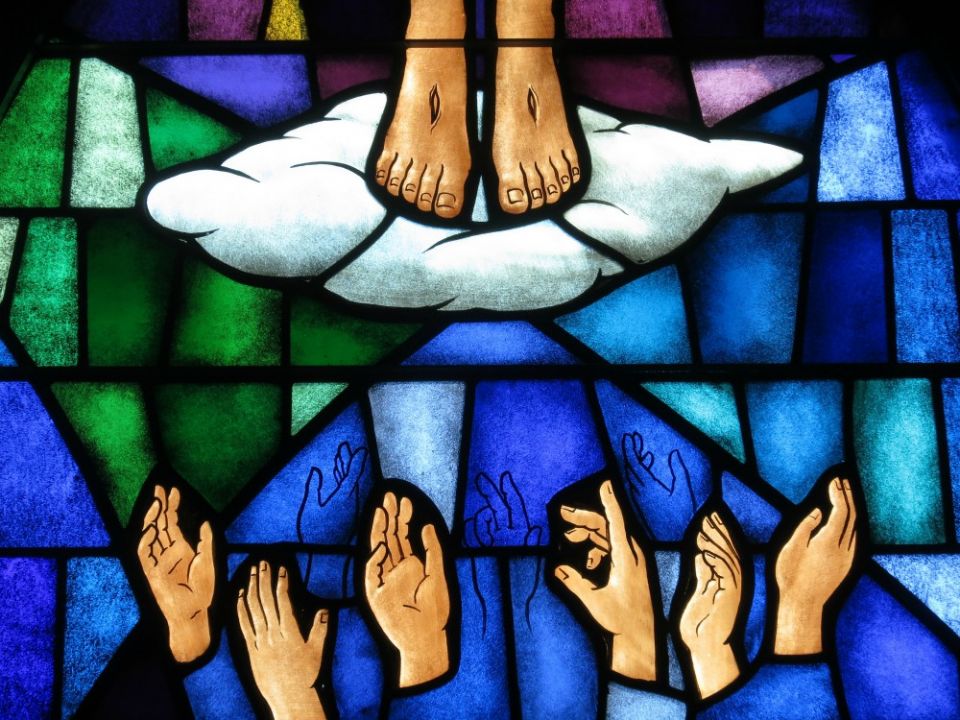
Ascension of the Lord (Acts 1:1-11)

In my former book, Theophilus, I wrote about all that Jesus began to do and to teach until the day he was taken up to heaven, after giving instructions through the Holy Spirit to the apostles he had chosen. After his suffering, he presented himself to them and gave many convincing proofs that he was alive. He appeared to them over a period of forty days and spoke about the kingdom of God. 

On one occasion, while he was eating with them, he gave them this command: “Do not leave Jerusalem, but wait for the gift my Father promised, which you have heard me speak about. For John baptized with water, but in a few days you will be baptized with the Holy Spirit.”

Then they gathered around him and asked him, “Lord, are you at this time going to restore the kingdom to Israel?”

He said to them: “It is not for you to know the times or dates the Father has set by his own authority. But you will receive power when the Holy Spirit comes on you; and you will be my witnesses in Jerusalem, and in all Judea and Samaria, and to the ends of the earth.”

After he said this, he was taken up before their very eyes, and a cloud hid him from their sight.

They were looking intently up into the sky as he was going, when suddenly two men dressed in white stood beside them. “Men of Galilee,” they said, “why do you stand here looking into the sky? This same Jesus, who has been taken from you into heaven, will come back in the same way you have seen him go into heaven.” (New International Version)

Ascension Day often feels like the weird stepchild in the family of church events in the Christian Year. It’s often overlooked without ever really being missed.

O sure, there are a few congregations that worship on this Thursday, coming 40 days after Easter Sunday. And a few more churches will observe Christ’s ascension this coming Sunday. Yet, most Christians will go about their usual business; thus, in my opinion, for what it’s worth, missing a grand opportunity.

It’s hugely important that Christ is now presently sitting at God’s right hand, offering continual prayers on our behalf to the Father. Ascension Day teaches us, and reminds us, that we have an advocate, a champion who has gone before us and secured deliverance from sin, death, and hell.

On top of it all, Christ’s ascension to heaven means that Jesus is the universal ruler; he commands a kingdom which will never end. Ascension Day proclaims from the heights of the clouds that Jesus is Lord – which means nothing and no one else is. It is because of his ascension that Jesus can authoritatively grant us repentance, forgiveness, and new life.

Speaking of clouds, the reference to a cloud in Christ’s ascension is not a heavenly elevator with a special pass to the umpteenth floor to be with God. The cloud is meant to be a sign of God’s presence – much like the pillar of cloud for the Israelites in the exodus from Egypt; or like the cloud that surrounded Jesus and his disciples on the mount of transfiguration.

Jesus ascending into the cloud is the divine welcome into the Father’s presence. This is a whole lot more than returning to the status quo of things before Christ’s incarnation. No, everything has changed.

The life, ministry, crucifixion, death, and resurrection of Christ makes the ascension possible – and now Jesus is enthroned at the right hand of God. Jesus has permanently impacted the world. The dark forces and the demonic powers of this world have been stripped of their control.

Through humiliation, Christ has been exalted. Jesus gladly bore the shame and rejection that was ours. We now have spiritual freedom and are no longer in bondage to sin, death, and hell.

The stage is set for Pentecost and the giving of the Spirit. You will receive power when the Holy Spirit has come upon you. God’s Spirit is moving in the world to bring a new thing: the birth of the Church and the mystical union of Christ and his Church.

Every good spiritual thing comes through patience and faith; we must wait and trust in God’s good promise. The disciples, of course, saw no need for this waiting thing. They were ready for a restoration of everything immediately.

Unfortunately, their idea of restoration was an old-style sort of kingdom, very hierarchical with themselves in control and calling the shots. These apostles needed to discover what the rule and reign of God was actually all about. It’s not a turning back of the clock to the good old days.

Rather, it’s in doing away with the dark shadows of old ruling oppressions and allowing the divine light of Christ to shine into the world so that hearts are transformed and justice for all is the norm. In other words, all things are being redeemed.

By God’s grace, the Church and all believers will be steadfast in proclaiming good news, teaching the words and ways of Jesus, loving one another, and serving with the model given to us by Christ. The ascension and glorification of Jesus makes this possible.

So, this is a day in which Christian churches and believers are to shake off their collective spiritual A.D.D. (Ascension Deficit Disorder) and stop staring up in the sky, slack-jawed and shoulders hunched. Hopefully, no angels will come along and ask us what we’re doing just standing there.

Jesus will come back when he comes back. You and I aren’t going to know when. Now is the time to get busy with what Jesus just told us to do two minutes ago: Tell everyone about me.

Christians since the time of the ascension have been proclaiming Christ crucified, died, risen, ascended, and coming again. This is a day of joy and celebration for us. Jesus is our ascended and glorified king! The fate of the earth is with the benevolent and mighty Ruler of all. Jesus is Lord!

The great Reformed Confession, the Heidelberg Catechism, question and answer 49, states the following question and answer:

How does Christ’s ascension to heaven benefit us?

First, he is our advocate

            in heaven

            in the presence of his Father.

Second, we have our own flesh in heaven

            as a sure pledge that Christ our head

            will also take us, his members,

            up to himself.

Third, he sends his Spirit to us on earth

            as a corresponding pledge.

            By the Spirit’s power

                        we seek not earthly things

                        but the things above, where Christ is,

                                    sitting at God’s right hand.

Amen.

Ascension of the Lord (Acts 1:1-11)

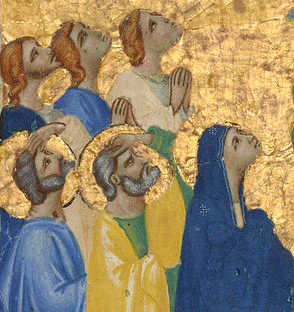
The Ascension of Christ, by Pacino di Bonaguida, c.1340

Theophilus, the first scroll I wrote concerned everything Jesus did and taught from the beginning, right up to the day when he was taken up into heaven. Before he was taken up, working in the power of the Holy Spirit, Jesus instructed the apostles he had chosen. After his suffering, he showed them that he was alive with many convincing proofs. He appeared to them over a period of forty days, speaking to them about God’s kingdom. While they were eating together, he ordered them not to leave Jerusalem but to wait for what the Father had promised. He said, “This is what you heard from me: John baptized with water, but in only a few days you will be baptized with the Holy Spirit.”

As a result, those who had gathered together asked Jesus, “Lord, are you going to restore the kingdom to Israel now?”

Jesus replied, “It isn’t for you to know the times or seasons that the Father has set by his own authority. Rather, you will receive power when the Holy Spirit has come upon you, and you will be my witnesses in Jerusalem, in all Judea and Samaria, and to the end of the earth.”

After Jesus said these things, as they were watching, he was lifted up and a cloud took him out of their sight. While he was going away and as they were staring toward heaven, suddenly two men in white robes stood next to them. They said, “Galileans, why are you standing here, looking toward heaven? This Jesus, who was taken up from you into heaven, will come in the same way that you saw him go into heaven.” (Common English Bible)

It’s been two-millennia since Jesus Christ ascended to heaven. Since then, a lot has changed.

Yet, on the other hand, we’re still in the same situation as the early church: Jesus is still up there; and we are still down here. That means, because we are still awaiting Christ’s return, the original call and practice of the church is still in effect.

As far as experiences go, it’s hard to top being one of the original disciples and seeing Jesus ascend into the clouds to heaven. Now what? How do you go about your life after that?

In the spiritual life, we move back and forth between moments of genuine inspiration and the sheer routine of our daily mundane lives. The uplifting mountain-top experience and the hard slog of walking through the valley are both important. The trick is to channel the energy from one into the other. For that to happen, we need to work out rhythms of grace that connect expectant prayer with the action of being witnesses.

Prayer and witness – both are necessary for the church; and they are closely tied to the risen and ascended Christ. The ascension of the Lord Jesus means Christ is exalted above everything; he’s in charge. By his authority he has made us prayerful witnesses and given us the means of carrying out that job.

Jesus and the disciples, even after forty days together, post-resurrection, were not on the same page. The disciples were anticipating a restoration of David’s kingdom. Their vision for the future was a great apocalypse in which Jesus, as the ultimate mixed martial arts champion, would beat up all their enemies. Then, set up a political kingdom just like King David of old. 

But Jesus had a different agenda. Instead of creating an immediate utopia, where the disciples would be in charge and in control, Jesus bluntly told them that knowing God’s timetable is not in their pay grade. Instead, the disciples were commissioned for a job, which didn’t include gawking at the sky and trying to figure out when the end of the world was happening.

Christ’s Ascension, by Scott Rayl

Although we (understandably and deservedly) want peace and justice now, Jesus avoided handing out prophecy charts detailing when that would happen. He essentially said to quit thinking about that stuff because it’s really none of our business.

Rather, our business is being witnesses of Jesus. The angels came along immediately after Jesus ascended and said to the disciples to stop standing there slack jawed. Jesus is coming back and, meanwhile, there is a job to do – to be witnesses of Christ’s redemptive events. And, the strength of that witness will come from the Holy Spirit. So, hang tight in prayer.

So, what does it mean to be a “witness?” A few years back, I was called to the bedside of an actively dying patient. The patient’s spouse and parents were present. In the space of two hours I watched them in the throes of grief. And I provided all the spiritual support I could. 

The situation had similarities to many emergencies I have attended, with one exception: I noticed that I was different. I did not “do” or “say” a lot. Mostly, I was present. I remember, at times during my encounter, feeling helpless. In some ways I was. I certainly couldn’t fix a thing. Yet, this time, I saw my role in a new way. 

I distinctly remember the sense of bearing witness to this sacred event. There was an entire world outside the patient room that knew nothing of this family’s intense grief. But I knew. I watched the whole thing. I was present for all the struggles of the medical team, the tears of the husband, the grief of a Dad, the angry questions of a mother toward a God that she didn’t know how to approach – who seemed aloof and capricious.  I was there for it all. Even now, I still carry those folks and their story in my heart.

And it was enough. 

Yes, it was enough. This was the first time I ever said that after such a situation. I had a settled sense that the role of witnessing the events in front of me was a blessed and sacred responsibility. Billions of people on planet earth didn’t know the grief of these people. I did. Because I was there. 

There is something both mystical and necessary about this understanding of being a witness with active prayerful observation.

I wonder if that’s how the disciples felt after Christ’s ascension. Perhaps my experience is what Jesus meant when he said, “You shall be my witnesses.” Maybe a witness is one who has the special role of observing the suffering of Christ, his resurrection of the dead, and the ongoing work of the Spirit. 

God is, I believe, the ultimate witness. When no one else sees, God sees. Where there is grief, God is present. Wherever pain, hurt, and brokenness exists, God is there bearing witness to it all. 

And, once in a while, the Lord is gracious to invite me into the scene to witness it along with him. Jesus is our Immanuel – God with us. And that is enough for me. 

In the book of Acts, praying and witnessing was a consistent pattern that the early church practiced. They prayed about whom to choose as leaders and bore witness to the Spirit setting individuals apart for the work of gospel proclamation and service to the church. They prayed for the Holy Spirit to come on people and bore witness to miraculous signs of the Spirit’s work. They prayed for the courage to preach and heal and bore witness to the saving work of God.

As the book of Acts unfolds, we see Peter imprisoned for being a witness. So, the church went to prayer. Peter was released, and when he showed up at the prayer meeting, the believers at first did not believe it was him.  Even with their little faith they were able to witness God answer their prayers. (Acts 12:1-18)

It was at a prayer meeting where Paul and Barnabas were set apart by the Spirit to bear witness in other locations. (Acts 13:1-3)

While traveling from city to city, Paul constantly devoted himself to prayer and listened to the Spirit. (Acts 16:1-35)

People came to Christ because of prayerfully listening to the Spirit and the obedient action that followed by Peter, Paul, and the other believers giving witness to how the risen Christ saved their lives. This was possible because of the risen and ascended Christ.

There is not one square inch of this earth that Jesus is not Lord. This means we can be alive with devotion to prayer and to being witnesses in this world for Jesus. Just as a cup of coffee needs a warm-up, so our prayers need to be refreshed so that God’s purposes will be accomplished. And his purposes are that all of creation comes, in a real and practical way, under Christ’s lordship.

What does the ascension of Jesus Christ mean for us today? That we belong to God and have the wondrous privilege of prayer and witness in a world that so desperately needs to connect with the transcendent and divine.

Acts 1:1-11 – Ascension of the Lord

In my first book I told you, Theophilus, about everything Jesus began to do and teach until the day he was taken up to heaven after giving his chosen apostles further instructions through the Holy Spirit. During the forty days after he suffered and died, he appeared to the apostles from time to time, and he proved to them in many ways that he was actually alive. And he talked to them about the Kingdom of God.

Once when he was eating with them, he commanded them, “Do not leave Jerusalem until the Father sends you the gift he promised, as I told you before. John baptized with water, but in just a few days you will be baptized with the Holy Spirit.”

So, when the apostles were with Jesus, they kept asking him, “Lord, has the time come for you to free Israel and restore our kingdom?”

He replied, “The Father alone has the authority to set those dates and times, and they are not for you to know. But you will receive power when the Holy Spirit comes upon you. And you will be my witnesses, telling people about me everywhere—in Jerusalem, throughout Judea, in Samaria, and to the ends of the earth.”

After saying this, he was taken up into a cloud while they were watching, and they could no longer see him. As they strained to see him rising into heaven, two white-robed men suddenly stood among them. “Men of Galilee,” they said, “why are you standing here staring into heaven? Jesus has been taken from you into heaven, but someday he will return from heaven in the same way you saw him go!” (New Living Translation)

“At his Ascension, our Lord entered Heaven, and he keeps the door open for humanity to enter.”

Oswald Chambers

Jesus was taken up to heaven in what Christians celebrate as the “Ascension of the Lord.” This is a hugely important event for followers of Jesus.

The Ascension means that Christ is now presently sitting at God’s right hand, offering continual prayers on our behalf to the Father. We have an advocate, a champion, who has gone before us and secured deliverance from sin, death, and hell.

On top of it all, Christ’s ascension means that Jesus is the universal ruler; he commands a kingdom that will never end. Yes, the Ascension of the Lord is a big deal.

So, why does a day set aside on the Christian Calendar celebrating the Lord’s mighty and redemptive ascension over all creation garner such scant attention from many churches?

Maybe the church has A.D.D. (Ascension Deficit Disorder).

Our clue to the inability to focus on such a grand redemptive event is the disciples’ response when Jesus ascended.

The picture St. Luke paints for us in the account of our Lord’s ascension, is a group of guys looking up into the sky slack-jawed and shoulders hunched.

It took a couple of angels to come along and ask them what in the world they were doing just standing there. Now is not the time to stand and gawk at the clouds, the angels insisted. Jesus will come back when he comes back. You aren’t going to know when. So, now is the time to get busy with what Jesus just told you to do two minutes ago: Tell everyone about me.

Christ’s ascension to heaven is a deeply theological event. It’s freighted with major implications for our prayer lives. And it means Christ is the King to whom we must obey.

Jesus is coming again. In the meantime, there’s to be no cloud-gawking. Instead, there is to be a well-developed and well-cultivated connection with Jesus which proclaims the good news that Christ died, rose from death, and ascended to heaven for mine and your forgiveness of sins and a new clean slate on life.

Trying to peer into the future about how the end of history will shake-out is, frankly, not the job we are called to do. Believers in Jesus aren’t supposed to stand and gawk at the clouds waiting for the Lord’s return, as if we are in some earthly holding tank until heaven. 

Rather, we are to bear witness about the person and work of Jesus. The Ascension of the Lord means we are God’s people blessed with deliverance from the realm of sin, and the hope of Christ’s coming again. The Church everywhere recognizes together the rule and reign of the Lord Jesus.

The world, as we know it, shall eventually come to an end. Until that time, Christians since the time of the ascension have been proclaiming Christ crucified, died, risen, ascended, and coming again.

This is a day of joy and celebration for us. Jesus is our ascended and glorified king! The fate of the earth is with the benevolent and mighty Ruler of all. Jesus is Lord, and no other human leader is. Thank you, Jesus.

The great Reformed Confession, the Heidelberg Catechism, question and answer 49, states:

Q: How does Christ’s ascension to heaven benefit us?

A: First, he is our advocate

            in heaven

            in the presence of his Father.

Second, we have our own flesh in heaven

            as a sure pledge that Christ our head

            will also take us, his members,

            up to himself.

Third, he sends his Spirit to us on earth

            as a corresponding pledge.

            By the Spirit’s power

                        we seek not earthly things

                        but the things above, where Christ is,

                                    sitting at God’s right hand.

Amen.
Acts 1:1-11 – Ascension of the Lord

Ethiopian Ascension
Ethiopian Orthodox depiction of Christ’s ascension.

In the first book, Theophilus, I wrote about all that Jesus did and taught from the beginninguntil the day when he was taken up to heaven, after giving instructions through the Holy Spirit to the apostles whom he had chosen. After his suffering he presented himself alive to them by many convincing proofs, appearing to them during forty days and speaking about the kingdom of God. While staying with them, he ordered them not to leave Jerusalem, but to wait there for the promise of the Father. “This,” he said, “is what you have heard from me; for John baptized with water, but you will be baptized with the Holy Spirit not many days from now.” 

So, when they had come together, they asked him, “Lord, is this the time when you will restore the kingdom to Israel?” He replied, “It is not for you to know the times or periods that the Father has set by his own authority. But you will receive power when the Holy Spirit has come upon you; and you will be my witnesses in Jerusalem, in all Judea and Samaria, and to the ends of the earth.” When he had said this, as they were watching, he was liftedup, and a cloud took him out of their sight. While he was going and they were gazing up toward heaven, suddenly two men in white robes stood by them. They said, “Men of Galilee, why do you stand looking up toward heaven? This Jesus, who has been taken up from you into heaven, will come in the same way as you saw him go into heaven.” (NRSV) 

Jesus was taken up to heaven in what Christians celebrate as the “Ascension of the Lord.”  It is hugely important for followers of Jesus because it means that Christ is now presently sitting at God’s right hand offering continual prayers on our behalf to the Father. We have an advocate, a champion who has gone before us and secured deliverance from sin, death, and hell. This is no small thing. On top of it all, Christ’s ascension means that Jesus is the universal ruler; he commands a kingdom which will never end. Yes, it is a big deal. 

So, why does a day set aside on the Christian Calendar celebrating the Lord’s mighty and redemptive ascension over all creation garner such little attention from many churches?  Perhaps the clue is the disciples’ response when Jesus ascended. The picture that Luke paints for us in the account of our Lord’s ascension is a group of guys looking up into the sky slack-jawed and shoulders hunched.  It took a couple of angels to come along and ask them what in the world they were doing just standing there. Now is not the time to stand and gawk at the clouds, the angels insisted. Jesus will come back when he comes back. You aren’t going to know when.  So, now is the time to get busy with what Jesus just told you two minutes ago to do:  Tell everyone about me. 

The Ascension of the Lord is a deeply theological event; it is freighted with major implications for our prayer lives; and, it means that Christ is the King to whom we must obey. And he is coming again. In the meantime, there is to be no cloud-gawking. Instead, there is to be a well-developed and well-cultivated connection with Jesus which proclaims good news that Christ died, rose from death, and ascended to heaven for mine and your forgiveness of sins and a new clean slate on life. 

Believers in Jesus are not to be found standing and gawking at the clouds waiting for the Lord’s return, as if we are in some earthly holding tank until heaven.  Rather, we are to bear witness about the person and work of Jesus. The Ascension of the Lord means we are God’s people blessed with deliverance from the realm of sin, and the hope of Christ’s coming again. The Church everywhere recognizes together the rule and reign of the Lord Jesus. 

The world as we know it shall eventually come to an end. Until that time, Christians since the time of the ascension have been proclaiming Christ crucified, died, risen, ascended, and coming again. This is a day of joy and celebration for us. Jesus is our ascended and glorified king! The fate of the earth is with the benevolent and mighty Ruler of all. Jesus is Lord, and no other human leader is. Thank you, Jesus. 

The Reformed Confession, the Heidelberg Catechism, question and answer 49, states: 

Q: How does Christ’s ascension to heaven benefit us? 

A: First, he is our advocate in heaven in the presence of his Father. 

Second, we have our own flesh in heaven as a sure pledge that Christ our head will also take us, his members, up to himself. 

Third, he sends his Spirit to us on earth as a corresponding pledge. By the Spirit’s power we seek not earthly things but the things above, where Christ is, sitting at God’s right hand. Amen.  

Click Ancient of Days sung by Ron Kenoly for an oldie but goody on this Ascension Day.