It’s Time To Wake Up – First Sunday of Advent (Romans 13:11-14)

Besides this, you know what time it is, how it is already the moment for you to wake from sleep. For salvation is nearer to us now than when we became believers; the night is far gone; the day is near. Let us then throw off the works of darkness and put on the armor of light; let us walk decently as in the day, not in reveling and drunkenness, not in illicit sex and licentiousness, not in quarreling and jealousy. Instead, put on the Lord Jesus Christ, and make no provision for the flesh, to gratify its desires. (New Revised Standard Version)

But make sure that you don’t get so absorbed and exhausted in taking care of all your day-by-day obligations that you lose track of the time and doze off, oblivious to God. The night is about over; dawn is about to break. Be up and awake to what God is doing! God is putting the finishing touches on the salvation work he began when we first believed. We can’t afford to waste a minute, must not squander these precious daylight hours in frivolity and indulgence, in sleeping around and dissipation, in bickering and grabbing everything in sight. Get out of bed and get dressed! Don’t loiter and linger, waiting until the very last minute. Dress yourselves in Christ, and be up and about! (The Message)

I like metaphors, that is, word-pictures that help illustrate and visualize a concept or idea. That’s probably why I like the Apostle Paul, because I find in him a guy who appears to have the same affinity for metaphors that I do.

In the New Testament reading on this First Sunday of Advent, Paul gives four metaphors to help us grab ahold of what he wants to get across to us:

We are not in some holding pattern, passively awaiting heaven. This is because our salvation is not yet complete. Completeness won’t happen until Jesus returns, until the second advent of Christ. Therefore, we are to be active now, working on our faith commitment to Jesus and to his church.

In this advent season, as we remember Christ’s first “advent” (or “coming”) to this earth, we are equally anticipating the second coming of Christ – not knowing quite when that will occur. Only until this event happens will our salvation come in all of its fullness.

The church is a unique community of persons who continually have an eye toward the future return of Jesus. And this future orientation is supposed to give shape to how we live in the present time.

The world-wide Christian community presently follows the way of deliverance. This current time and place is not the arrival point. Today doesn’t mark the time in which our salvation is fully realized or acquired.

In other words, we are to avoid acting as if this is our permanent home. Rather, we are pilgrims on this earth, sojourning through it as if we were but camping out. Our true home is someplace else. And we will get there when Christ comes again.

There is a stark contrast between those who put all their eggs into the present earthly basket, and those who maintain a future orientation of working now with an eye out for Jesus to return. This contrast is illustrated by Paul with images of what it’s like to live for and in the Roman society; and what it’s like to live with Jesus as Lord, instead of Ceasar.

Are you asleep or awake, living for the night or in the day?

Therefore, keep awake, for you do not know when the master of the house will come, in the evening or at midnight or at cockcrow or at dawn, or else he may find you asleep when he comes suddenly. (Mark 13:35-36)

Paul, taking his cues from Jesus, exhorted the believers to stay alert and be prepared for the end when it comes. Living for the nighttime is a metaphor for giving-in to one’s personal sinful desires; whereas living in the daylight hours is a picture of following the words and ways of Jesus.

What are you wearing? What are you taking off, and what are you putting on?

Using the metaphor of clothes – undressing and dressing oneself – Paul is talking about exchanging one set of clothing for another. This isn’t merely putting on a different pair of jeans than what you already have on. It’s much more radical than that. It’s doffing the tuxedo and donning the overalls. The picture is one of doing something completely different than what you’ve been doing before.

Paul wanted a complete makeover, a total change of moral and ethical behavior that is consistent with the gospel of Christ, and not with typical Roman society. It involves taking up one’s cross and following Jesus. It’s gritty and dirty and gets down to it; instead of avoiding hard work and seeking to have someone else do what is unpleasant to me.

Our allegiance and commitment to Christ is on full public display – not in placards with Bible verses on them, but with the sweet aroma of living a humble and just life in all of its simplicity and holiness.

Will you do the works of darkness, or take up the armor of light?

The darkness represents the unjust life of lies, selfishness, conflicts of interest, relational discord, and immoral actions. The light is meant to convey a beautiful life of integrity, wholeness, righteousness, and peace through loving actions.

Christians are to progressively take on the character of Christ, and not of whatever political character happens to be in power.

Using the metaphor of armor points us not only toward the struggle we confront in living a moral and righteous life, but also toward Christ who is our Divine Warrior. Jesus is the One who fights the battle and wins the victory.

Our struggle is not against flesh and blood, but “against the rulers, against the authorities, against the cosmic powers of this present darkness, against the spiritual forces of evil in the heavenly places.” (Ephesians 6:12)

Do you know what time it is? Is there any hopeful expectation?

The Christian is one who knows the time is nearer now than when they first believed. We may not know the precise date on the calendar when Jesus will come again, yet we are convinced that he is returning soon.

Therefore, the believer has no business spending time in trying to predict the day of the end. Instead, the believer must remain faithful and persevere to the end with a firm commitment to Christ, and a dedication to doing what is good, right, and just.

So, herein lies the challenge for every believer: Those of us who name Jesus as Lord will continue to live in a world of injustice and unrighteousness. Christians are continually being pulled in differing directions all at once, all the time.

It’s a hard slog. Yet the Christian finds joy and satisfaction in knowing who they are, who they believe in, and who is coming back to make all things new.

Christianity involves a whole lot more than praying a salvation prayer once, then going on one’s merry way, doing whatever the heck one wants to do.

Rather, Christianity is a radical existence of waking from sleep and changing allegiances from immoral leaders to the true sovereign of the universe.

It’s like moving from seeing shadowy forms just before the dawn to seeing clearly in the sun’s full light of day.

It’s as if I’ve been given a completely new set of clothes to put on, giving up the rags of this world for the raiment of being adopted into royalty.

We remain continually vigilant, always watching, always praying, always believing, always loving – knowing that our salvation is at hand, nearly here, and could happen at any moment.

God of justice and peace, from the heavens you rain down mercy and kindness, so that all on earth may stand in awe and wonder before your marvelous deeds. Raise our heads in expectation, that we may yearn for the coming day of the Lord and stand without blame before your Son, Jesus Christ, who lives and reigns forever and ever. Amen.

Are Your Ears Being Tickled? (2 Timothy 3:14-4:5)

But as for you, continue in what you have learned and firmly believed, knowing from whom you learned it and how from childhood you have known sacred writings that are able to instruct you for salvation through faith in Christ Jesus. All scripture is inspired by God and is useful for teaching, for reproof, for correction, and for training in righteousness, so that the person of God may be proficient, equipped for every good work.

In the presence of God and of Christ Jesus, who is to judge the living and the dead, and in view of his appearing and his kingdom, I solemnly urge you: proclaim the message; be persistent whether the time is favorable or unfavorable; convince, rebuke, and encourage with the utmost patience in teaching. For the time is coming when people will not put up with sound teaching, but, having their ears tickled, they will accumulate for themselves teachers to suit their own desires and will turn away from listening to the truth and wander away to myths. As for you, be sober in everything, endure suffering, do the work of an evangelist, carry out your ministry fully. (New Revised Standard Version)

It’s only human in wanting to hear only those things we like to hear. Rarely do any of us purposely seek to listen to another voice which is contrary to our likings. This may be why we exist in such a polarized world; we simply have no intention of listening to any sort of opposing view on anything.

We put our fingers in our ears to stop hearing things we don’t want to hear; and conversely, we surround ourselves only with people who tell us what we want to hear.

The Apostle Paul would say that we like our ears tickled.

One of the hardest things to hear is that sometimes we need to hear hard things.

There is no spiritual growth, and no Christian maturity, apart from the willingness to hear what we need to hear, rather than to always hear what we want to hear. All of us need to keep developing our listening skills.

I would argue that one of the reasons there are umpteen Protestant denominations in this world is that groups of people don’t really want to listen to one another. We’d much rather insulate ourselves; label ourselves as right; and declare that everyone else is worldly and wrong, or an antichrist and a terrorist.

But that sort of thinking will not do for the Apostle Paul. It’s one of the reasons he took the time to write to his young protégé Timothy.

Paul’s letter to Timothy is filled with exhortations and warnings about making sure the church is ethical with their words; avoids useless and profane speech; holds to sound biblical talk; and stays away from speaking erroneously about apostolic teaching.

In other words, church folk must keep their life, their doctrine, and their speech in line with the words and ways of Jesus – even when we encounter hard words from our Lord and his apostles.

Listening to what we need to hear, instead of always what we want to hear, is a significant way of maturing in the Christian life.

We choose to listen to hard things, and things we don’t necessarily want to hear in order to connect with God and others; and to compassionately understand what they’re saying to us.

We need not be at the mercy of our own reactivity. Knee jerk reactions only breed ignorance, not spiritual growth.

Since listening is a skill to develop, that means we need a lot of practice doing it. We can begin by listening to Scripture; embracing the sort of faith which it advocates; and following the examples of godly persons, like the Apostle Paul.

In Timothy’s case, faith was learned and nurtured through the examples of his mother Eunice and grandmother Lois (2 Timothy 1:5). Their compassionate and beloved way of life displayed an embodied source of sound teaching.

There was a whole lot more going on with the godly examples than catechism classes and Sunday School lessons. Their teaching effected a deep and enduring desire to follow the example of godly living.

Every believer needs helpful examples and models, whether they are family or not. The truly Christian person is one who allows the inspiration of Holy Scripture to manifest itself in their life in profoundly powerful ways which brings transformation, not just information.

And whenever these godly persons are together, making up a Christian community, then there is wise discernment in carefully listening to what is right, true, good, and just. Gossip is jettisoned. Lack of evidence is not ever entertained. Rather, encouragement and spiritual nurture take hold.

Christians with the inspired text in the very marrow of their souls faithfully call out deviations and departures from godly scriptural speech. They hold to righteousness and embrace the good. They love mercy and exhibit humility in all things.

Holy Scripture was not a collection of facts for Timothy, but was engrafted into his mind and heart so that what came out of him was faith, hope, and love. Christians like Paul and Timothy had a well-rounded spirituality which was attuned to following Jesus and nurturing the faith of others.

Paul lovingly and confidently exhorted Timothy (and his congregation) to go diligently after Scripture, so that it could do its work within them. They were to speak out the gospel of grace, no matter the situation.

Believers are to liberally use apostolic teaching to convince, rebuke, and encourage each other toward the righteousness of God.

Everyone is to work together in practicing holiness, proclaiming grace, and promoting a way of life rooted in the life of Christ.

Everyone is to avoid flocking to leaders who only tell them what they want to hear. They are to instead flock toward humble and wise leadership who possess time-tested teaching – not pithy slogans and promotions of hate.

Reliable true-blue teaching understands perseverance, long-suffering, honesty, and fidelity to Christ’s words. The truth is stated plainly, and thinks of others. There’s no get-down-and-dirty pride; no posturing nor slick salesmanship.

Timothy cared nothing about getting as many social media followers as he could. And he wasn’t so insecure as to want everyone in his congregation to like him. But neither was he calloused by forcing his way on everyone. Paul taught him better than that.

Paul’s instruction took hold with Timothy by cultivating a genuine spiritual growth that is organic and patient, rooted in love, that can always hearken back to the faithfulness of Christ and the apostles.

It is profoundly sad to me how many persons have left the church. And yet, I understand why. There are too many pastors and elders and deacons who are driven by their own selfish desires for power, control, money, and personal followers. That stuff is a sure prescription for people to get hurt and disillusioned with Christianity, let alone the church.

The Apostle Paul wanted to see leadership which reflects the grace by which he himself had been saved. Furthermore, Paul was devoted to being a mentor in helping others like Timothy and Titus to live in ways which exhibit the grace and mercy of Christ.

A hard teaching is really only hard wherever there exists a hard heart. We all need ever-expanding and softening hearts which are receptive to the voice of Holy Scripture.

What’s more, we need non-itchy ears which listen to the voice of God and the voice of hurting people who need the gospel of grace.

We need godly leadership who knows the difference between truth and being a jerk.

Where are you in your own faith walk?

O God, Spirit of righteousness, you temper judgment with mercy. Help us to live out the covenant which is written on our hearts so that when Christ returns we may be found worthy to receive your gracious presence. Amen.

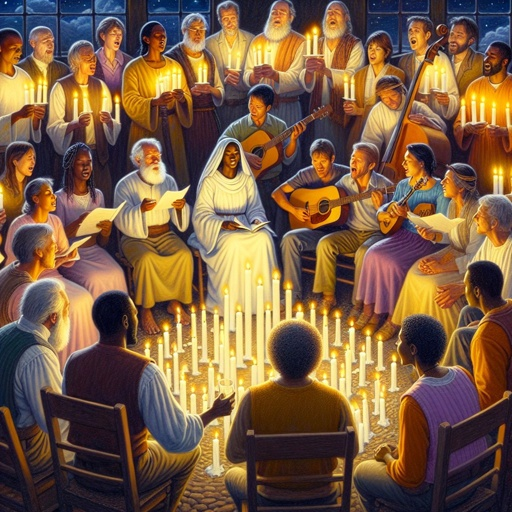
Sing Psalms and Hymns and Spiritual Songs to One Another (Ephesians 5:15-20)

By Bible Art

Be careful, then, how you live, not as unwise people but as wise, making the most of the time, because the days are evil. So do not be foolish, but understand what the will of the Lord is. Do not get drunk with wine, for that is debauchery, but be filled with the Spirit, as you sing psalms and hymns and spiritual songs to one another, singing and making melody to the Lord in your hearts, giving thanks to God the Father at all times and for everything in the name of our Lord Jesus Christ. (New Revised Standard Version)

It’s unlikely I need to tell anyone that the days are evil. The world is upside-down and topsy-turvy with injustice, waywardness, and narrow partisanship. In fact, there is a lot of similarity to the Apostle Paul’s time. Maybe that’s why Paul exhorted the church not to drown their sorrows in a bottle of spirits, but to be filled with the Spirit.

Perhaps, because of the times we live in, you don’t feel much like singing. You might not be finding much in your life right now to sing about. Yet, maybe singing is the very thing we need.

An inebriated person says and does things that they would not typically say or do when they’re sober. The Apostle’s point about being filled with the Spirit is that, instead of doing and saying foolishness, we are to be so filled with God that we do and say wisdom that we wouldn’t typically do and say, if not filled with God. 

Without the fullness of God’s Spirit, we end up mumbling, not singing; worrying, not making music in our hearts; complaining and arguing, not giving thanks. Half-filled Christians can only practice a half-hearted Christianity. And they’re only half-baked in their service and devotion to Christ.

Why sing? 

Because singing is part of being filled with the Spirit of God. Singing happens when we experience God’s overflowing grace in our lives through the blessings of being chosen, adopted, and redeemed into God’s new community. (Ephesians 1:3-11)

Music is powerful. It’s not only a means of expressing praise and commitment to Christ and each other, it is also a powerful means of remembering.

For example, when we first teach kids the alphabet, we teach it in a song. Trying to teach letters in a rote fashion doesn’t work well for pre-school kids. But words set to music is why we can still remember words from old TV shows, because those words were set to a catchy tune (alas, the lyrical theme from Gilligan’s Island will forever be in my head).  Music is why an Alzheimer’s patient doesn’t remember her daughter’s name, yet can flawlessly sing all four verses of Amazing Grace.

Singing is an offering and a sacrifice of praise to God (Hebrews 13:15). And singing is also a vehicle whereby we are taught, encouraged, and built up in the community of believers. We sing to God, one another, and even to ourselves.

Christian music, then, is to be both a means of praising God and a practice of encouraging each other. We accomplish this through singing psalms, hymns, and spiritual songs.

Sing Psalms

The word “psalm” helps us rightly think of the biblical book of Psalms. Singing the psalms is an ancient practice, going all the way back to the Israelites singing psalms in the temple and synagogue. The early church maintained this practice, especially as a means of being faithful to praying without ceasing. 

However, over time, medieval congregations began neglecting the practice. In fact, European congregations eventually gave up most singing altogether. Almost all the singing was done by church choirs and professional musicians employed by the king (there was no separation of church and state) to write, compose, and perform in worship services. 

Five-hundred years ago, during the Reformation, Martin Luther reinstituted congregational singing. He gave music back to the people. One of the results of this change was putting the book of psalms to song – the Psalter.  For many Protestant denominations, the Psalter became the primary means of singing. The Psalter chiefly set prayers to song. It was both a means of expressing prayer to God and learning Scripture.

Singing Hymns

There have always been hymns in the church. Yet, it was not until the Reformation that hymns began to be written and sung by congregations. For the Reformers, hymns were used to teach sound doctrine and theology, as well as a means of confessing the faith together

A mighty fortress is our God,
a bulwark never failing;
our helper he, amid the flood
of mortal ills prevailing.
For still our ancient foe
does seek to work us woe;
his craft and power are great,
and armed with cruel hate,
on earth is not his equal. (Martin Luther, 1529)

Singing Spiritual Songs

Spiritual songs are the present day equivalent of praise and worship choruses, or what some refer to as contemporary songs. These are songs purposefully designed to be emotional expressions of praise to God and to give powerful testimony for what God has done or is doing.

Remember When You Sing…

  • Psalms are used to pray and learn Scripture.
  • Hymns are used to teach us sound doctrine and confess the faith together.  
  • Spiritual songs are an important way of expressing praise to God and being encouraged in the faith. 

Therefore, church music is to serve as both a revelation from God, and as a response from God’s people.

There are two important deductions from the Apostle Paul’s exhortation:

  1. A variety of songs is inferred and expected
  2. Their use is commanded

The reason worship style seems always to be a controversial topic is because everyone has their personal preferences. And yet, if we are to be faithful to today’s New Testament lesson, we will do more than focus on what I want. 

Truth be told, we are selfish people when it comes to music. We want what we want, and we don’t care what somebody else wants. And we’ll persist in that self-absorbed spirit until somebody calls us on it… That somebody is the Apostle Paul. Scripture calls us to encompass psalms, hymns, and spiritual songs – all three of them – in our worship.

I have an old friend who is an accomplished church musician and worship pastor. I once asked him how I can lead a worship service among such a variety of preferences concerning music. He answered my question with a question:

“How highly do people, including and especially your musicians, value the unity of the church? Do they love each other so much that they can allow for a wider range of style, and do so without vocally complaining about it?”

My friend went on to say, “When I arrived at one church as their pastor, some people were in a rather bad habit of saying very openly, ‘Oh I hate that song,’ or, ‘If I hear this song one more time I’m walking out.’ What I tried to do was teach people that this is not the most loving or mature approach; and it does little to build up the rest of the Body of Christ.”

If a group of people are being faithful to Scripture, and doing their best musically, then – if the music seems lifeless, dull, or strange to us – the real issue isn’t style but our hearts.    

A heart filled with the Spirit of God will speak to others using the Psalter, time-honored hymns, and fresh new contemporary songs. The result is believers built up in the faith.

Gracious God, give us grace to take to heart the great dangers we are in by our unhappy divisions about all kinds of things, including music. Take away all hatred and prejudice, and whatever else may hinder us from godly union and harmony, so that as there is but one body and one Spirit, one hope of our calling, one Lord, one faith, one baptism, one God and Father of us all, we may from this time forward be all of one heart and of one soul, united in one holy bond of peace; and may with one mind and one mouth glorify you, through Jesus Christ our Lord. Amen.

The Illness of Our Era: What Is It?

Anxiety, by James Callaghan

Our contemporary society focuses primarily on a functional existence. In our pragmatism, we care a great deal about production, the things we can do and produce; and we are attentive of how we appear to others. Western culture is enamored with all things of the outer person that others can see, touch, hear, smell, and taste with physical senses.

The outer person is important. The way in which we present ourselves to the world does have meaning and significance. Yet, so does the inner person.

The Inner Person

I believe the inner person, the true self, the soul, is just as vital, if not more, than the outward displays we give to others. On the inside is where our motives and intents come from. The core of self is of utmost importance; it is the place where our inherent worth is found.

Being aware of this inner person (which I use interchangeably with “soul” and “true self”) gives us a guide for ordering our outer self – our activities, work, and relationships.

If we are unaware of what’s happening deep within us, or pay little to no attention to the soul, our outer person becomes a false self. A gross disconnect then occurs between how we think and feel within, and what we choose to display for everyone.

In paying attention to the inner person, we will likely find that there is a lot of anxiety within us. Anxiety may even transform itself into a despair of self and/or the world.

The Anxiety Within

This anxiety, however, is not all bad. It certainly can lead us to a struggle with life, an experience of strained relationships, and a crippling fear of what will happen. Yet it can also help us become in touch with the soul, and enable us to gain an awareness of what is happening within and what to do about it.

It is my firm understanding and unshakable conviction that if we are to learn anything at all about healthy functioning in this world, it must begin with learning about one’s self – the true self, the inner person, the soul.

Knowing Ourselves

“Without knowledge of self, there is no knowledge of God.”

John Calvin, Institutes of the Christian Religion, Vol.1

As we commit ourselves to the journey within, we come to discover our place in the cosmos, and the image of God that is inherent in us. We come to know ourselves as integral to creation.

If we never gain this sense of humanity and of the divine, then we lose our special perspective on reality, and of the vital interconnectedness we have with God and others. Separateness then replaces the unity and oneness which exists. As a result, the person lives without a sense of their true place or function in this world.

Feelings of isolation and estrangement take over. This profound experience of disconnection with God, people, and even self creates a powerful sense of anxiety. Fear becomes a dominant theme. Unconscious emotions and desires drive the anxious person. A belief that my conscious self is all there is to me is a path of denial that leads to abject misery.

Knowing ourselves – before we know anything else – must be our pursuit. Failure to do this is perhaps why we live in such an era of worry, pessimism, and fear.

Addressing Our Fears

Have you ever felt that there is no one to whom you could turn to in your time of loneliness and despair?

Is there a time when you felt as if you were in a deep dark hole of quiet anxiety?

Did you ever brood over your situation in life so much that all of your courage melted like ice cream on a 100 degree day?

Was there a season in your life where you felt the world could not understand your grief?

Has God ever felt aloof to you, with your prayers seeming as if they were bouncing off the ceiling?

Depending upon who we are, the self believes that if I am right enough, help enough, achieve enough, unique enough, know enough, plan enough, party enough, lead enough, or withdraw enough, then I will relieve this bothersome anxiety and fear within me and can get on with life.

Others may seek solace in the finite things of this world. But that approach only exacerbates the existing problem. Believing that freedom from an ethereal illness can come by having more of something you can see only increases the despairing feelings.

Any sickness of the soul must be addressed by means of infinite resources.

The Need For Integration

If we lose ourselves, we are fragmented and in need of integration. The work needed is to bring our spiritual internal parts into a unified whole. This then puts us in a position to experience the grace and peace of God. Indeed, the process itself becomes the divine mercy and settled rest.

We tend to hold onto what we are afraid of experiencing. This very problem often becomes the solution. Our anxiety has the potential to lead us toward the grace of God, or away from it by self-conjured solutions and/or coping mechanisms.

Rather than holding our anxieties and fears close so that we can keep an eye on them, we need to let go of them. This is accomplished by actually feeling our feelings. By holding our emotions loosely, they can express themselves and then fly away.

If we never experience anxiety, worry, discouragement, fear, depression, or despair, then we internally see no reason whatsoever to pursue transformation of life – to go after that which is immortal and invisible.

The Apostle Paul’s Struggle

At the end of a frustrating litany of anxiety over his inability to control the trajectory of his inner self, the Apostle Paul concluded:

So I find it to be a law that, when I want to do what is good, evil lies close at hand. For I delight in the law of God in my inmost self, but I see in my members another law at war with the law of my mind, making me captive to the law of sin that dwells in my members. Wretched person that I am! Who will rescue me from this body of death? Thanks be to God through Jesus Christ our Lord! (Romans 7:21-25, NRSV)

Sin presupposes itself through anxiety. And anxiety awakens the awareness of needing freedom and deliverance. Worry is not our master. Anxiety has no authority over us. Fear merely exists for us to pay attention to something.

In Christianity, that something is a someone: Jesus. Christ is the Deliverer from sin, death, and hell. The oblivious and lonely darkness we find ourselves trapped within has a way out, or rather, up. A divine hand reaches from above to snatch us from our inky hole.

If humanity never had a need of God, people would not know themselves. They would fail to realize that there is immortality in their very souls.

Taking the Journey Within

It takes bravery to engage in a journey within, down into the core of one’s being. It’s neither a vacation nor a weekend adventure. The path unfolds slowly over time; it is circuitous, and often frustrating. Yet, when we find the incredibly bright blue diamond at the center, we immediately know every part of the journey was worth it.

The illness of our era is that we are soul-sick with anxiety, even despair, and most of us don’t know it. But why?

Like a cancer lurking unaware within the body, the years of ego construction has smothered the image and likeness of God within.

Anxiety becomes the initial symptom that something is askew with us. We’d better get checked out and find what the root problem is.

Are you up for the discovery of yourself, and thus, of God?